
案例研究case study
- 格式:pptx
- 大小:253.71 KB
- 文档页数:11

1 Case Briefs for Research
1、编号索引(Citation)
2、当事方(Parties)
E.g., in a tort case, parties include:defendant—appellant—tortfeasor;
plaintiff—respondent--victim
3、诉讼历史(Prior Proceedings)
E.g.,Trial court found against the defendant;Defendant appealed;
Court of appeals reversed the trial court’s decision;
To the end, this appeal is before the supreme court.
4、当事人的诉由(Theories of the Parties)
E.g.,false imprisonment; breach of contract; consent; lack of consideration
5、寻求的法律救济(Objectives )
E.g.,getting specific performance; getting damages in the amount of $55,000; or getting
acquitted
6、事实(Facts)
legally significant facts & background facts
7、确定争议焦点(Issue)
E.g.,Did defendant Curties falsely imprison plaintiff Butterworth when he drove around in
the car for seven hours without stopping to let her out?
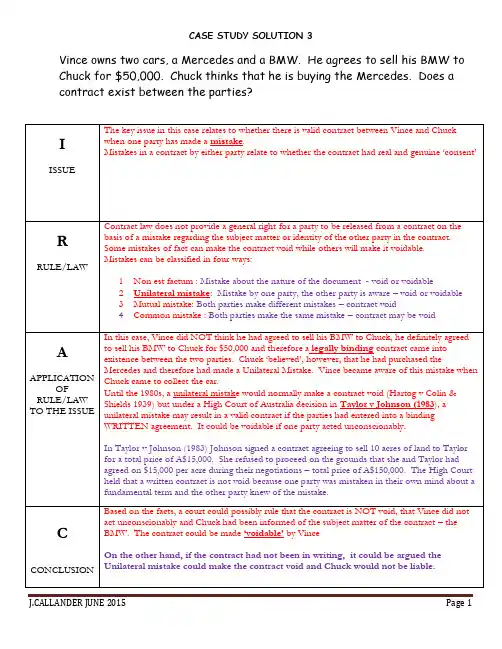
J.CALLANDER JUNE 2015 Page 1 CASE STUDY SOLUTION 3 Vince owns two cars, a Mercedes and a BMW. He agrees to sell his BMW to Chuck for $50,000. Chuck thinks that he is buying the Mercedes. Does a contract exist between the parties? I ISSUE The key issue in this case relates to whether there is valid contract between Vince and Chuck when one party has made a mistake. Mistakes in a contract by either party relate to whether the contract had real and genuine ‘consent’
R RULE/LAW Contract law does not provide a general right for a party to be released from a contract on the basis of a mistake regarding the subject matter or identity of the other party in the contract. Some mistakes of fact can make the contract void while others will make it voidable. Mistakes can be classified in four ways: 1 Non est factum : Mistake about the nature of the document - void or voidable 2 Unilateral mistake: Mistake by one party, the other party is aware – void or voidable 3 Mutual mistake: Both parties make different mistakes – contract void 4 Common mistake : Both parties make the same mistake – contract may be void A APPLICATION OF RULE/LAW TO THE ISSUE In this case, Vince did NOT think he had agreed to sell his BMW to Chuck, he definitely agreed to sell his BMW to Chuck for $50,000 and therefore a legally binding contract came into existence between the two parties. Chuck ‘believed’, however, that he had purchased the Mercedes and therefore had made a Unilateral Mistake. Vince became aware of this mistake when Chuck came to collect the car. Until the 1980s, a unilateral mistake would normally make a contract void (Hartog v Colin & Shields 1939) but under a High Court of Australia decision in Taylor v Johnson (1983), a unilateral mistake may result in a valid contract if the parties had entered into a binding WRITTEN agreement. It could be voidable if one party acted unconscionably. In Taylor v Johnson (1983) Johnson signed a contract agreeing to sell 10 acres of land to Taylor for a total price of A$15,000. She refused to proceed on the grounds that she and Taylor had agreed on $15,000 per acre during their negotiations – total price of A$150,000. The High Court held that a written contract is not void because one party was mistaken in their own mind about a fundamental term and the other party knew of the mistake. C CONCLUSION Based on the facts, a court could possibly rule that the contract is NOT void, that Vince did not act unconscionably and Chuck had been informed of the subject matter of the contract – the BMW. The contract could be made ‘voidable’ by Vince On the other hand, if the contract had not been in writing, it could be argued the Unilateral mistake could make the contract void and Chuck would not be liable. J.CALLANDER JUNE 2015 Page 2
1
‘Gaming DNA’ Trading Card Game Shop
1. History
The “Gaming DNA” trading card game has 22 years of history, in Hamilton this
is the first “MTG” trading card game shop.
Vision
To become the biggest trading card game shop in NZ, opening new branches
in different regions.
Mission and goals
The main mission of Gaming DNA is to spread the sport of MTG trading card
game in Hamilton.
The short term goals for Gaming DNA Trading Card Game Shop include:
1) To recruit a salesperson who can not only sell MTG trading card game
product but also can teaching novice to play this game.
2) Effective advertising for Gaming DNA Trading Card Game Shop
3) Hold some small-scale competition
The long term goals for Gaming DNA Trading Card Game Shop include:
1) Earn enough profit to open outlets in other regions
2) Host some large-scale competition
Created by Tzy-Ling Chen
2022/4/27 个案研究法 1
个案研究法(Case Study)
陈姿伶
中兴大学农业推广教育研究所
早在1870年,美国哈佛大学法学院即创用此一个案研究法来训练学生思考法律的原理原则。依叶重新(2001)的考证,此法最初多用于医学方面,应用于研究病人的案例;尔后,陆续地于心理学、社会学及工商管理学等领域相继被沿用,至今于教育界的运用也相当广泛,大都采此法于教学与相关的学习研究上,或者应用于教育心理与儿童心理等领域,特别对于超常儿童、特殊才能儿童、学习落后或低度缺陷儿童等类型学习者的心理研究。
而在这当中几位举足轻重的关键学者,如实验心理学家菲吉纳于1860年创立新物法,针对个别对象,进行有系统的感官研究,建立著名的Fecher’s Law。之后,弗洛伊德及皮亚杰等,于其所涉及的相关研究中皆不难发现「个案研究法」被运用的例证。以弗洛伊德为例,可被视为是运用个案研究法于精神病学的先驱,就其处理精神神经症的病人方面言之,则是致力于发现所谓的「一致的经验模式」。在其细心的探求下,使得病人能够回忆自己在儿童及年轻时代所发生的,但却已遗忘良久的,有关创伤性的或与性有关的意外事件,根据弗洛伊德的假设:这些意外事件或可用来解释病人的神经性行为,以所曾研究之Sergei Petrov 的—位狼人(the Wolf Man)的生活史来说,其最后并以「来自婴幼期神经症的生活史」(From
the History of an Infantile Neurosis)为标题,将研究结果撰写成书并于1918年出版问世,此书则是弗洛伊德应用个案研究的典型例举之一,且其所归结获致之个案的结果,事实上与其假设一致吻合,这亦使得心理的个案分析因此一时蔚为时尚,且被认定视为一项有效的处理事情的方法。
总言之,个案的运用与分析,在法律和医学知识的传授上,早就成为最基本的教学工具之一。法律的名词称个案为「案例」或「判例」,医学的名词则称其为「病例」。至于个案分析在社会学上的发展沿革,则可依年代顺序归纳如下: