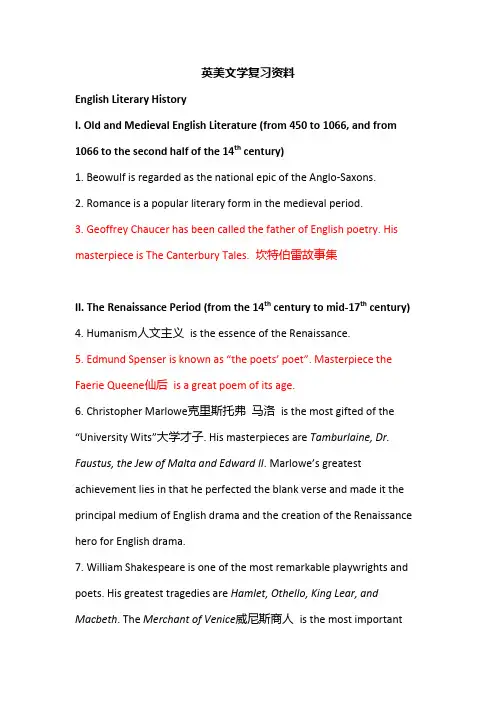
英美文学复习资料
- 格式:docx
- 大小:21.92 KB
- 文档页数:10
英美文学复习资料
英美文学
I. 本期讲过的所有名家名作
II.名词术语:
Ode
——in ancient literature, is an elaborate lyrical poem
composed for a chorus to chant and to dance to; in modern use,
it is a rhymed lyric expressing noble feelings, often addressed to
a person or celebrating an event.
Alliteration
——It is a form of initial rhyme, or head rhyme.
It is the repetition of the same sound or sounds at the
beginning of two or more words that are next to or close to each
other.
e.g. He came on under the clouds, clearly saw at last
Rage-inflamed, wreckage-bent, be ripped open
Kenning
——a figurative language in order to add beauty to ordinary
objects. It is a metaphor usually composed of two words, which
becomes the formula for a special object.
e.g. Helmet bearer—— warrior
Swan road——the sea
The world candle—— the sun
Repetition &Variation
e.g. Grendel / The spoiler / warlike creature /
the foe / horrible monster
A host of young soldiers / a company of
Kinsmen / a whole warrior-band
Caesura ——every line consists of two clearly separated half lines
between which is a pause, called caesura.
e.g. Grendel stalking; God’s brand was on him.
the gold-hall of men, the mead-drinking place
nailed with gold plates. That was not the first visit
Ballad
——is a form of verse, often a narrative set to music. Ballads
were particularly characteristic of the popular poetry and song of
the British Isles from the later medieval period until the 19th
century and used extensively across Europe and later the
Americas, Australia and North Africa. Many ballads were written
and sold as single sheet broadsides. The form was often used by
poets and composers from the 18th century onwards to produce
lyrical ballads. In the later 19th century it took on the meaning of
a slow form of popular love song and the term is now often used
as synonymous with any love song, particularly the pop or rock
power ballad.
Epic
——is a lengthy narrative poem, ordinarily concerning a
serious subject containing details of heroic deeds and events
significant to a culture or nation. The first epics are known as
primary, or original, epics. One such epic is the Old English story
Beowulf. Epics that attempt to imitate these like Milton’s
Paradise Lost are known as literary, or secondary, epics.
The six main characteristics:
1. The hero is outstanding. He might be important, and
historically or legendarily significant.
2. The setting is large. It covers many nations, or the known
world.
3. The action is made of deeds of great valor or requiring superhuman courage.
4. Supernatural forces—gods, angels, demons—insert
themselves in the action.
5. It is written in a very special style.
6. The poet tries to remain objective.
Sonnet (Italian Sonnet, Shakespearean Sonnet, Spenserian
Sonnet, Miltonic Sonnet)
①Italian sonnet
created by Giacomo da Lentini, head of the Sicilian School.
Petrarch (1304-1374) most famous early sonneteer
It falls into two main parts:
an octave rhyming “abbaabba” (set up a problem ) + volta
followed by a sestet rhyming “cdecde” or some variant,
such as “cdccdc” (answer)
②English / Shakespearean sonnet
The greatest practitioner: William Shakespeare
three quatrains followed by a couplet
often presents a repetition-with-variation of a statement in
each of the three quatrains ?The final couplet in the English
sonnet usually imposes an epigrammatic turn at the end.
——a fourteen-line poem of iambic pentameters. This form
is made up of 3 quatrains and a couplet, rhyming:ababcdcdefefgg
③Spenserian sonnet
A variant on the English form is the Spenserian sonnet,
named after Edmund Spenser
three quatrains connected by the interlocking rhyme scheme
and followed by a couplet ?the rhyme scheme is abab, bcbc, cdcd,
ee
——has the rhyme scheme ababbcbccdcdee and no break between the octave (an eight line stanza) and the sestet( a six line
stanza). It is named after the Elizabethan poet Edmund Spenser.
④Miltonic Sonnet
Conceit
——in literature, a conceit is an extended metaphor with a
complex logic that governs a poetic passage or entire poem. By
juxtaposing, usurping and manipulating images and ideas in
surprising ways, a conceit invites the reader into a more
sophisticated understanding of an object of comparison.
Extended conceits in English are part of the poetic idiom of
Mannerism, during the later sixteenth and early seventeenth
century. Simile
—is a figure of speech which makes a comparison between
two unlike elements ha ving at least one quality or characteristic
in common.Simile is almost always introduced by
the following words:like,as,as…as,as it were,as if,as though,be
something of,similar to, etc.