
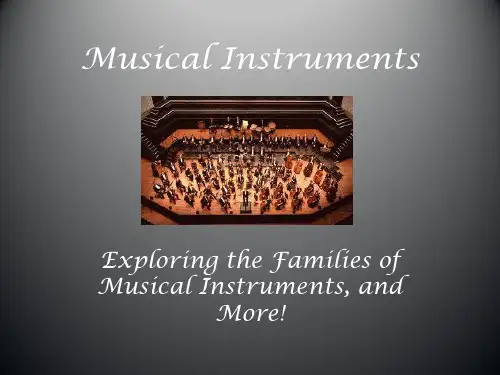
Musical Instruments
- 格式:ppt
- 大小:1.65 MB
- 文档页数:18


中国古代音乐乐器介绍英语作文Title: An Introduction to Ancient Chinese Musical InstrumentsChina, with its rich and diverse cultural heritage, has a long-standing tradition of music and musical instruments. The history of Chinese musical instruments can be traced back to the ancient times, with many instruments evolving and being refined over the centuries. This essay aims to provide an overview of some of the significant ancient Chinese musical instruments.1. Guqin (古琴):The guqin, also known as the Chinese qin, is a plucked string instrument that has been played since the early days of Chinese civilization. It is one of the most revered musical instruments in China and is often associated with scholars and intellectuals. The guqin produces a serene and contemplative sound, making it a popular choice for meditation and artistic expression.2. Pipa (琵琶):The pipa is a four-stringed lute-like instrument that originated in Central Asia and later became popular in China. It has a narrow, wooden body and a distinct, convex soundboard. The pipa is known for its expressive and dynamic playing techniques, which can produce rapid, intricate melodies as well as slow, melancholic tunes.3. Erhu (二胡):The erhu is a two-stringed bowed instrument that is widely used in Chinese traditional music. It is known for its soul-stirring sound and remarkable expressive range. The erhu's body is typically made of wood, and the strings are traditionally made of silk. The instrument is played by holding it vertically and using a bow to create sound by rubbing the strings.4. Dizi (笛子):The dizi is a Chinese transverse flute made of bamboo. It is a popular instrument in both folk and classical music, known for its pure and penetrating tone. The dizi has a range of over two octaves and can produce various articulations and effects, including tremolo and bending notes.5. Xun (埙):The xun is an ancient Chinese wind instrument made of pottery or bone. It belongs to the family of ocarinas and is known for its distinct, mellow sound. The xun has a spherical shape with finger holes on its surface, allowing the player to produce different pitches by covering or uncovering the holes.6. Gongs and Drums (锣鼓):Gongs and drums have played a significant role in Chinese music, particularly in ceremonial and festive contexts. Chinese gongs, known as luó, are struck with a mallet to produce a resonant, metallic sound.Drums, such as the dabo and the pangu, provide rhythmic accompaniment and add a dynamic energy to performances.In conclusion, ancient Chinese musical instruments represent a rich tapestry of cultural heritage and artistic expression. From the serene guqin to the dynamic pipa and the soulful erhu, these instruments have captivated audiences for centuries. They continue to be celebrated for their unique sounds and contributions to the world of music.。

乐器作文英语四级模板Musical Instruments as a Window into Cultural Heritage。
Music has long been an integral part of human culture, transcending geographical boundaries and connectingsocieties through shared experiences. Musical instruments, as the physical conduits through which melodies and rhythms are expressed, play a pivotal role in the preservation and transmission of cultural traditions. Delving into the world of musical instruments offers a profound glimpse into the rich tapestry of human history and diversity.Historical Significance。
Musical instruments have been present in human civilizations for millennia, dating back to the earliest known examples from around 40,000 BCE. Archaeological discoveries have unearthed a remarkable array of ancient instruments, including flutes, drums, and stringed instruments. These artifacts provide invaluable insightsinto the musical practices and cultural development of past societies.The evolution of musical instruments over time reflects both technological advancements and changing cultural values. Ancient instruments were often crafted from natural materials such as wood, bone, and skin, while modern instruments incorporate advanced materials and manufacturing techniques. The introduction of electronic instruments in the 20th century revolutionized the musical landscape, opening up new possibilities for sound manipulation and artistic expression.Cultural Identity。

乐器英语翻译Musical instruments are devices that are used to create music. They come in various shapes, sizes, and types, each with its own unique sound and characteristics. There are several different categories of musical instruments, including string, woodwind, brass, percussion, and keyboard.String instruments produce sound by vibrating strings. Some common examples include the guitar, violin, and cello. These instruments are played by plucking or bowing the strings, which causes them to vibrate and produce sound.Woodwind instruments are made of wood or metal and produce sound when air is blown into them. Examples of woodwind instruments include the flute, clarinet, and saxophone. These instruments are played by using the mouth to blow air into the instrument and using the fingers to cover or press down on the keys to change the pitch.Brass instruments are made of brass or other metals and produce sound when air is blown into them. Some common examples include the trumpet, trombone, and French horn. These instruments are played by using the mouth to blow air into the instrument and manipulating the valves or slide to change the pitch.Percussion instruments produce sound when they are struck, shaken, or scraped. Examples of percussion instruments include drums, tambourines, and xylophones. These instruments are played by using the hands or mallets to strike or hit the instrument, or by shaking or scraping it to create sound.Keyboard instruments, as the name suggests, have keys that are pressed to produce sound. Examples of keyboard instruments include the piano, organ, and synthesizer. These instruments are played by using the fingers to press down on the keys, which causes hammers or other mechanisms to strike the strings or produce electronic sounds.In addition to these traditional categories, there are also electronic instruments, such as synthesizers and drum machines, which create sound using electronic circuits and digital technology. These instruments allow musicians to create unique and futuristic sounds that are not possible with traditional acoustic instruments. Musical instruments have been around for thousands of years and have played a significant role in human culture and expression. They have been used in various musical genres and styles, ranging from classical orchestral music to jazz, rock, and pop. Whether they are used for solo performances, ensemble playing, or recording in a studio, musical instruments are an essential part of the music-making process.。