
初中英语语法:代词
- 格式:ppt
- 大小:3.81 MB
- 文档页数:64

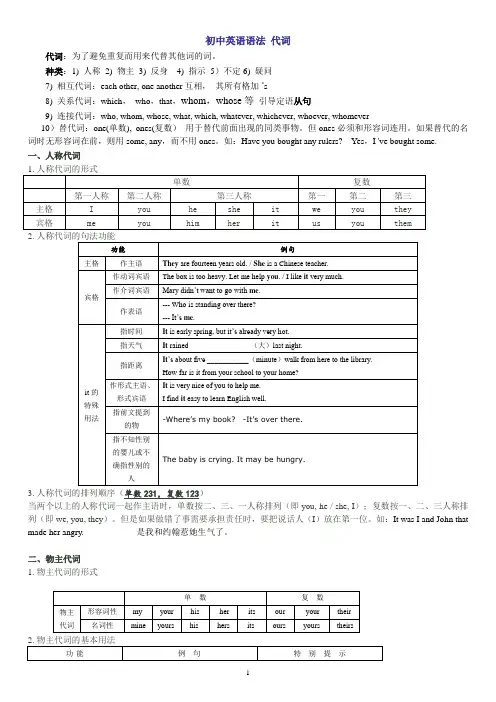
1 初中英语语法 代词
代词:为了避免重复而用来代替其他词的词。
种类:1) 人称 2) 物主 3) 反身 4) 指示 5)不定6) 疑问
7) 相互代词:each other, one another互相, 其所有格加-’s
8) 关系代词:which, who,that,whom,whose等 引导定语从句
9) 连接代词:who, whom, whose, what, which, whatever, whichever, whoever, whomever
10)替代词:one(单数), ones(复数) 用于替代前面出现的同类事物。但ones必须和形容词连用。如果替代的名词时无形容词在前,则用some, any,而不用ones。如:Have you bought any rulers? Yes,I 've bought some.
一、人称代词
1. 人称代词的形式
单数 复数
第一人称 第二人称 第三人称 第一 第二 第三
主格 I you he she it we you they
宾格 me you him her it us you them
2.
人称代词的句法功能
功能 例句
主格 作主语 They are fourteen years old. / She is a Chinese teacher.
宾格 作动词宾语 The box is too heavy. Let me help you. / I like it very much.
作介词宾语 Mary didn’t want to go with me.
作表语 --- Who is standing over there?
--- It’s me.
it的特殊用法 指时间 It is early spring, but it’s already very hot.
指天气 It rained ________________(大)last night.

1. 人称代词
人称代词是表示“我”、“你”、“他”、“我们”、“你们”、“他们”等的词,有人称、数和格的变化。 单数 复数
主格 宾格 主格 宾格
第一人称 I me we us
第二人称 you you you you
第三人称 he, she,
it him,
her, it they them
人称代词的用法:
(1)作主语(用主格)
We all like maths very much. 我们都很喜欢数学。
(2)作宾语(用宾格)
Would you mind giving her a hand? 你能帮帮她吗?
I’m very pleased with it. 我对它很满意。
(3)作表语(非常正式用主格,常用宾格)
Open the door, please. It’s me. 请打开门,是我。
注意:
两个或者两个以上的人称代词并列的时候,单数形式排列一般是:第二人称在前面,第三人称在中间,第一人称在后面。例如:You, he and I are
all your father’s students. 复数形式的排列一般是:第一人称在前面,第二人称在中间,第三人称在后面。例如:We, you and they all go swimming
after school. 如果表示承担错误和责任,一般把I最前面。
2. 物主代词
物主代词表示所有关系,它可以分为形容词性物主代词和名词性物主代词两种形式。
名词性物主代词可以在句子中作主语、表语和宾语,相当于形容词性物主代词+名词。例如:
This isn’t my coat. Mine (=my coat) has been
put in the classroom.
这不是我的大衣,我的(大衣)已经放在教室里了。
A student of his (= his students) has gone

1 代词(一)
一、 人称代词
人称代词是表示"我"、"你"、"他"、"她"、"它"、"我们"、"你们"、"他们"的词。是表示自身或人称的代词。
1、人称代词有人称、数和格的变化,见下表:
单数 复数
主格 I you he she it we you they
宾格 me you him her it us you them
中文 我 你 他 她 它 我们 你们 他/她/它们
2、人称代词的用法
(1) 人称代词在句中可以用作主语(用主格)和宾语(用宾格):
He loves her, but she hates him.
(2) 人称代词用于as, than之后时,可用宾格:
“Who is it?” “It’s me.”
He gets up earlier than me.
He speaks English as well as her.
但是,若than, as后的人称代词后跟由动词,则必须用主格:He gets up earlier than I do.
(3)单独使用的人称代词通常用宾格:Me too.
3 人称代词的排列顺序
人称代词的排列顺序为:
(1) 单数人称代词通常按“二三一”排列,即you, he and I:
You, he and I are all middle school students.
(2) 复数人称代词通常按“一二三”排列,即we, you and they:
We, you and they will all go there.
(3) 但若用于承担责任或错误等场合,则可把第一人称I置于其他人称代词之前:
I and Tom are to blame.
二、 物主代词
表示所有关系的代词叫做物主代词。
1 、物主代词可分为形容词性物主代词和名词性物主代词两种。列表如下:
单数 复数

1 代词(一)
Part 1 人称代词
人称代词是表示"我"、"你"、"他"、"她"、"它"、"我们"、"你们"、"他们"的词。是表示自身或人称的代词。
1 人称代词有人称、数和格的变化,见下表:
单数 复数
主格 I you he she it we you they
宾格 me you him her it us you them
中文 我 你 他 她 它 我们 你们 他/她/它们
2人称代词的用法
(1) 人称代词在句中可以用作主语(用主格)和宾语(用宾格):
He loves her, but she hates him.
(2) 人称代词用于as, than之后时,可用宾格:
“Who is it?” “It’s me.”
He gets up earlier than me.
He speaks English as well as her.
但是,若than, as后的人称代词后跟由动词,则必须用主格:He gets up earlier than I do.
(3)单独使用的人称代词通常用宾格:me too.
3 人称代词的排列顺序
人称代词的排列顺序为:
(1) 单数人称代词通常按“二三一”排列,即you, he and I:
You, he and I are all middle school students.
(2) 复数人称代词通常按“一二三”排列,即we, you and they:
We, you and they will all go there.
(3) 但若用于承担责任或错误等场合,则可把第一人称I置于其他人称代词之前:
I and Tom are to blame.
Part 2 物主代词
表示所有关系的代词叫做物主代词。
1 物主代词可分为形容词性物主代词和名词性物主代词两种。列表如下: