
牛津译林版高中英语必修五Unit 2《The environment》(Period 2)教学课件
- 格式:ppt
- 大小:2.31 MB
- 文档页数:93

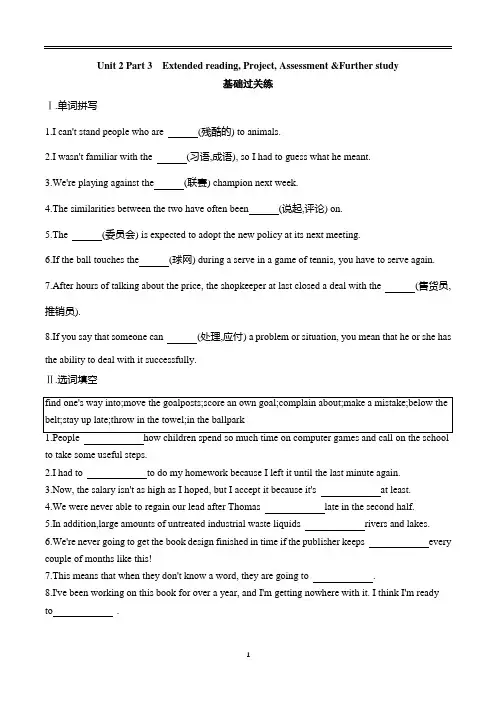
1 Unit 2 Part 3 Extended reading, Project, Assessment &Further study
基础过关练
Ⅰ.单词拼写
1.I can't stand people who are (残酷的) to animals.
2.I wasn't familiar with the (习语,成语), so I had to guess what he meant.
3.We're playing against the (联赛) champion next week.
4.The similarities between the two have often been (说起,评论) on.
5.The (委员会) is expected to adopt the new policy at its next meeting.
6.If the ball touches the (球网) during a serve in a game of tennis, you have to serve again.
7.After hours of talking about the price, the shopkeeper at last closed a deal with the (售货员,推销员).
8.If you say that someone can (处理,应付) a problem or situation, you mean that he or she has
the ability to deal with it successfully.
Ⅱ.选词填空
find one's way into;move the goalposts;score an own goal;complain about;make a mistake;below the
高中英语学案大全,高考学案大全
Unit 2 The environment
Word power: Discussing the environment
Learning aims:
1. To make the students understand and master words related to the environment.
2. Better understand environmental problems.
Step 1 Lead-in
1. Show some pictures to the students and introduce the topic.
Do you know when the following festivals are?•National Tree-Planting Day _____
•World Water Day ______________
•World Environment Day _______________
•World Oceans Day ____________
•International Biodiversity Day _____________
2. Environmental problems are discussed quite frequently in the news. A whole vocabulary has
developed to help us talk about the environment and problems related to it.
Step 2 Part A
1. Do you love travelling? Where did you usually live?
Have you ever heard of Ecoville?
2. Task A
Read the following leaflet about a new hotel which is friendly to the environment. Ecotourists are people who visit an area and don not harm or damage the ecosystem. They are interested in environmental protection. If you are this kind of tourist, you will love Ecoville. We use natural, safe energy from the sun, solar energy, instead of digging up Earth to find fuels, such as coal and oil. Nothing in our hotel causes pollution. We even use eco-friendly washing powder to wash your

高中英语必修五六单元的单词谐音
Unit 5.
1. characteristic.
- 谐音:开瑞可特儿瑞斯特克。
- 音标:英 [ˌkærəktəˈrɪstɪk] 美 [ˌkærəktəˈrɪstɪk]。
- 词性:名词、形容词。
- 解释:
- 作名词时意为“特征,特点,特性”;
- 作形容词时意为“典型的,特有的”。
- 出处:常用于描述人或事物的独特之处。
- 造句:The ability to think independently is one of the
characteristics of a great scientist.(独立思考的能力是伟大科学家的特征之一。)!
- 近义词:feature, trait。
- 反义词:commonness(普通,平凡)。
2. radium.
- 谐音:瑞迪əm。
- 音标:英 [ˈreɪdiəm] 美 [ˈreɪdiəm]。
- 词性:名词。
- 解释:镭(一种放射性化学元素)。 - 出处:化学领域,因居里夫人对镭的研究而广为人知。
- 造句:Marie Curie discovered radium.(玛丽·居里发现了镭。)。
- 近义词:无。
- 反义词:无。
3. painter.
- 谐音:喷特儿。
- 音标:英 [ˈpeɪntə(r)] 美 [ˈpeɪntər]。
- 词性:名词。
- 解释:画家;(尤指)油画家;油漆匠。
- 出处:艺术领域用于称呼从事绘画创作的人。
- 造句:Picasso is a famous painter.(毕加索是一位著名的画家。)。
- 近义词:artist。
- 反义词:无。
4. put forward.
- 谐音:铺特 佛沃德。
- 音标:英 [pʊt ˈfɔːwəd] 美 [pʊt ˈfɔːrwərd]。
- 词性:动词短语。
- 解释:提出;推荐;将(钟表等)拨快。
- 出处:常用于正式或学术语境中表达观点或建议的提出。 - 造句:He put forward a new theory at the meeting.(他在会议上提出了一个新理论。)。

英语知识点⽜津译林版⾼中英语必修五
Unit2《Theenvironment》语法-总结
现在分词
动词的-ing形式:
动词的ing形式是⾮谓语动词中的⼀种,它由动词原形加-ing 形成。有的动词-ing形式在句中起名词作⽤,有的则起形容词或副词作⽤。所以在句中,动词的-ing形式可以担当除了谓语以外的任何成分,即:主语、表语、宾语(介词宾语和动词宾语)、定语、状语和宾语补⾜语(宾补)。动词-ing形式仍具有动词的若⼲特点,所以它⼜可以有⾃⼰的宾语和状语等。
⼀般式:动词原形+-ing 所表⽰的动作与谓语动词所表⽰的动作同时发⽣e.g. I found him lying on the ground.
完成式:having+动词的过去分词所表⽰的动作发⽣在谓语动词所表⽰的动作之前e.g. Do you remember having promised me that?
被动式:being+动词的过去分词或having been +动词的过去分词,表⽰该词的逻辑主语是动作的承受者e.g. I can’t stand being treated like that.
否定式:在动词的-ing形式前加not 或 nevere.g. I apologize for not having kept my promise.
1.作表语,相当于形容词。
1)The film is moving and interesting.
这部电影感⼈⼜有趣。2)The news sounds encouraging.
这个消息听起来激动⼈⼼。
(起形容词作⽤的动词的ing 形式含有“令⼈……”的意思。如:amusing, astonishing, boring, exciting, inspiring, missing,promising, puzzling, surprising, tiring, embarrassing, disappointing, worrying, frightening, moving)