
小学阶段英语句型转换
- 格式:ppt
- 大小:1.32 MB
- 文档页数:43

第十六讲: 句型转换
姓名: 班级:
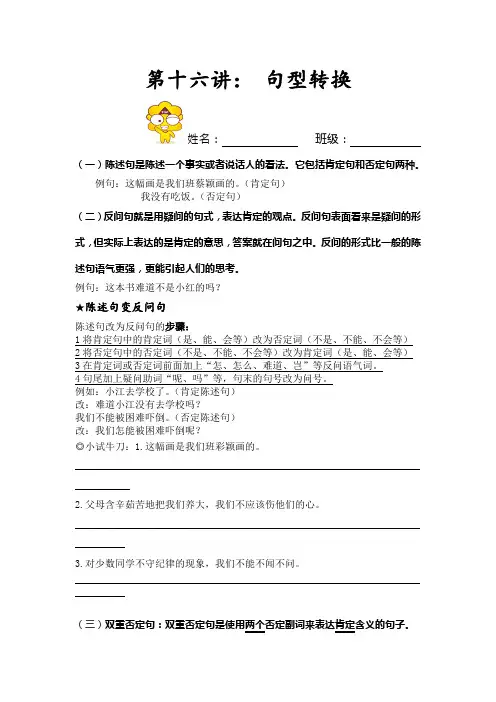
(一)陈述句是陈述一个事实或者说话人的看法。它包括肯定句和否定句两种。
例句:这幅画是我们班蔡颖画的。(肯定句)
我没有吃饭。(否定句)
(二)反问句就是用疑问的句式,表达肯定的观点。反问句表面看来是疑问的形式,但实际上表达的是肯定的意思,答案就在问句之中。反问的形式比一般的陈述句语气更强,更能引起人们的思考。
例句:这本书难道不是小红的吗?
★陈述句变反问句
陈述句改为反问句的步骤:
1将肯定句中的肯定词(是、能、会等)改为否定词(不是、不能、不会等)
2将否定句中的否定词(不是、不能、不会等)改为肯定词(是、能、会等)
3在肯定词或否定词前面加上“怎、怎么、难道、岂”等反问语气词。
4句尾加上疑问助词“呢、吗”等,句末的句号改为问号。
例如:小江去学校了。(肯定陈述句)
改:难道小江没有去学校吗?
我们不能被困难吓倒。(否定陈述句)
改:我们怎能被困难吓倒呢?
◎小试牛刀:1.这幅画是我们班彩颖画的。
________________________________________________________________________________
2.父母含辛茹苦地把我们养大,我们不应该伤他们的心。
_______________________________________________________________________________
3.对少数同学不守纪律的现象,我们不能不闻不问。
_______________________________________________________________________________
(三)双重否定句:双重否定句是使用两个否定副词来表达肯定含义的句子。 “两个否定副词”例如"不……不"、"没有……不"、"非……不"等。
句型转换
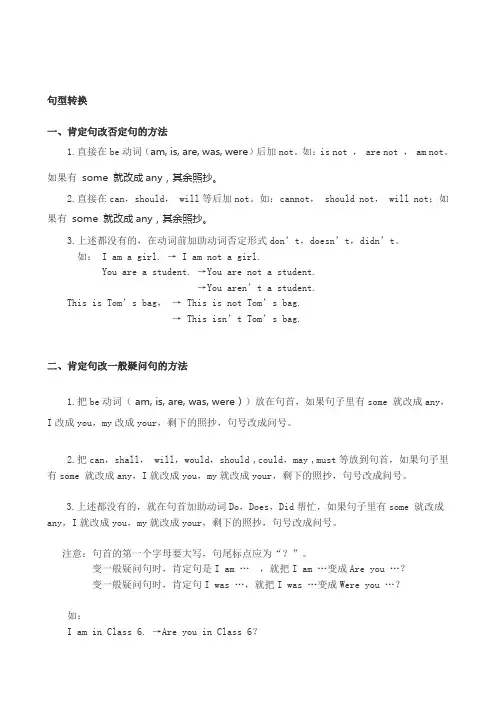
一、肯定句改否定句的方法
1.直接在be动词(am, is, are, was, were)后加not。如:is not , are not , am not。如果有 some 就改成any,其余照抄。
2.直接在can,should, will等后加not。如:cannot, should not, will not;如果有 some 就改成any,其余照抄。
3.上述都没有的,在动词前加助动词否定形式don’t,doesn’t,didn’t。
如: I am a girl. → I am not a girl.
You are a student. →You are not a student.
→You aren’t a student.
This is Tom’s bag, → This is not Tom’s bag.
→ This isn’t Tom’s bag.
二、肯定句改一般疑问句的方法
1.把be动词( am, is, are, was, were))放在句首,如果句子里有some 就改成any,I改成you,my改成your,剩下的照抄,句号改成问号。
2.把can,shall, will,would,should ,could,may ,must等放到句首,如果句子里有some 就改成any,I就改成you,my就改成your,剩下的照抄,句号改成问号。
3.上述都没有的,就在句首加助动词Do,Does,Did帮忙,如果句子里有some 就改成any,I就改成you,my就改成your,剩下的照抄,句号改成问号。
注意:句首的第一个字母要大写,句尾标点应为“?”。
变一般疑问句时,肯定句是I am … ,就把I am …变成Are you …?

小学生英语句型转换练习题
### 小学英语句型转换练习题
题目一:一般疑问句转换
1. 原句:I am a student.
- 转换:Are you a student?
2. 原句:She has a cat.
- 转换:Does she have a cat?
3. 原句:They play soccer on weekends.
- 转换:Do they play soccer on weekends?
题目二:特殊疑问句转换
1. 原句:My father works in a bank.
- 转换:Where does your father work?
2. 原句:We usually have lunch at twelve.
- 转换:What time do you usually have lunch?
3. 原句:The new movie is very interesting.
- 转换:How is the new movie?
题目三:否定句转换
1. 原句:I like apples. - 转换:I don't like apples.
2. 原句:She can swim.
- 转换:She can't swim.
3. 原句:They are at home.
- 转换:They are not at home.
题目四:陈述句转换为一般疑问句
1. 原句:The cat is under the table.
- 转换:Is the cat under the table?
2. 原句:He is doing his homework.
- 转换:Is he doing his homework?
3. 原句:We are going to the park tomorrow.
- 转换:Are you going to the park tomorrow?

1 小学英语所有句型转换的方法
基本助动词只有三个:be, do, have, 他们没有词汇意义,只有语法作用,如协助构成进行体,完成体,被动态,否定句,疑问句等。
一、 肯定句改否定句的方法——一步法
1、 在be动词后加not。如:is not , are not , am not, was not, were not;
2、 在can,should, will等后加not。如:cannot, should not, will not;
3、 上述都没有的,在动词前加助动词否定形式don’t/doesn’t/didn’t。
4、 some 改成any。
二、 肯定句改一般疑问句的方法——三步法
1、 把be动词放在句首,剩下的照抄,(some 改成any,my改成your等)句点改成问号。
2、 把can,shall, will等放到句首,剩下的照抄,(some 改成any,my改成your等)句点改成问号。
例如:陈述句: They are in the park. He can play the guitar..
一般疑问句: Are they in the park? Can he play the guitar?
把下列句子变成一般疑问句
1. I am listening to music.
_______________________________________
2. Mike is a student.
_______________________________________
3. Sarah can clean the classroom.
________________________________________
4. They are in the zoo.