小学英语所有句型转换方法
- 格式:doc
- 大小:126.50 KB
- 文档页数:8
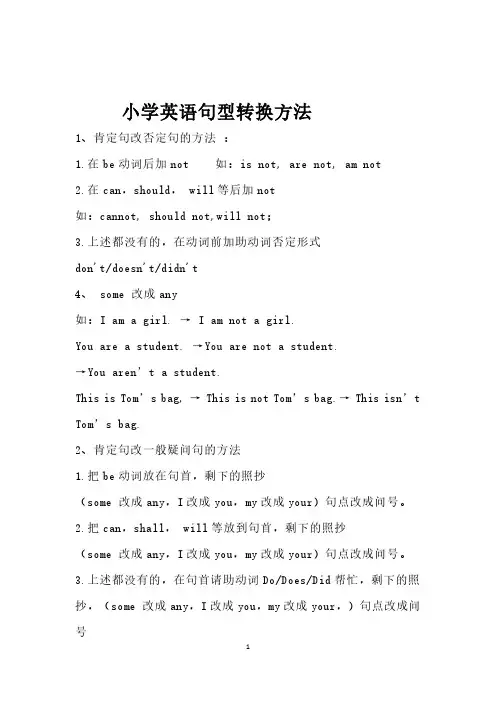
小学英语所有句型转换方法
1、将is,are,am移位到句首.如有I、you将其该成you、I。(疑问句)
2、划线部分提问:句中不能出现划线部分,但将划线部分转成疑问词.
划线部分提问:句中不能出现划线部分,但将划线部分转成疑问词.
将陈述句变成否定句 将陈述句变成疑问句 一般疑问句, 就是将一般疑问词提到句首。
没有一般疑问词(am is are)就加上助动词放在句首。 然后句子中间注意要改变的地方.
比如说,如果是一句以第三人称来写的陈述句。 那一些动词后面会加上es。
如果要改成一般疑问句,
句子里面又必须将助动词does(第三人称单数)放在句首作一般疑问句的话,那改变的时候,动词后面就必须去es。
然后就是some和any的事情, 陈述句用some, 一般疑问句用any.
但是一小部分一般疑问句里面, 看到some, 一般疑问句也是要改some的.
在这句句子是…… 比如说想要什么东西, 一般疑问句里面就要用some.
还有一种是特殊疑问句, 题目一般是划线提问。 根据划线的词语选用特殊疑问词,
放在句首, 进行提问. 特殊疑问词一般是w或wh开头的。 如:
what \how\ who\ how many \how much \what colour\ how old\which\why…… 等等……
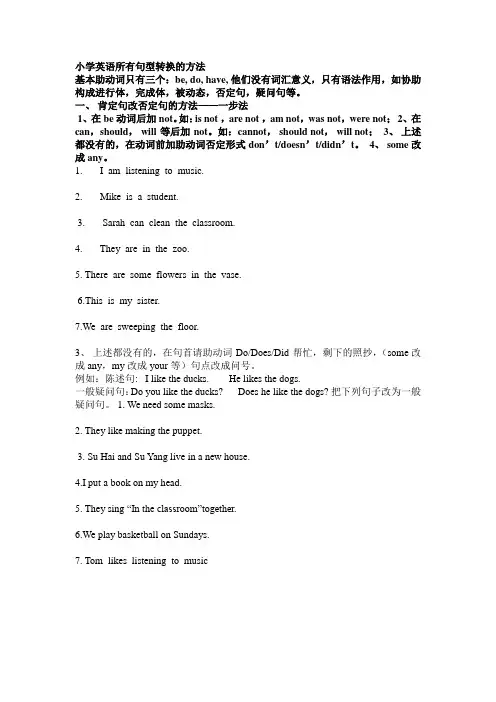
一、 肯定句改否定句的方法——一步法
1、 在be动词后加not。如:is not , are not , am not, was not, were not;
2、 在can,should, will等后加not。如:cannot, should not, will not;
3、 上述都没有的,在动词前加助动词否定形式don't/doesn't/didn’t.
4、 some 改成any。
二、 肯定句改一般疑问句的方法-—三步法
1、 把be动词放在句首,剩下的照抄,(some 改成any,my改成your等)句点改成问号。
2、 把can,shall, will等放到句首,剩下的照抄,(some 改成any,my改成your等)句点改成问号。
3、 上述都没有的,在句首请助动词Do/Does/Did帮忙,剩下的照抄,(some 改成any,my改成your等)句点改成问号.
三、 肯定句改特殊疑问句的方法—-四步法
1、在一般疑问句的基础上,句首添加一个疑问词即可,可根据划线部分确定是什么疑问词.
2、接着找be动词或can,shall, will等放在疑问词后面,若没有则请助动词do/does/did帮忙,写在疑问词后面,how many除外,必须先写物品,再写be动词等。
3、划线部分去掉后剩下的内容照抄,(some 改成any,my改成your等)
4、句点改成问号。
对划线部分提问.
1。 问人。Who 例如:I'm going to New York soon。 →Who’s going to New York soon。
2. 问干什么.What … do。例如: My father is going to watch a race with me this
afternoon. →What is your father going to do with you this afternoon。
3。 问什么时候。When.例如:She’s going to go to bed at nine。 →When is she going
to bed?
4。补充________________________________________________________________________
六、同义句:be going to = will
I am going to go swimming tomorrow(明天). = I will go swimming tomorrow
改句子.
5. Nancy is going to go camping.(改否定) Nancy ________ going to go camping.
6。 I’ll go and join them。(改否定)
I _______ go ______ join them。
7。 I’m going to get up at 6:30 tomorrow.(改一般疑问句)
________ _______ ________ to get up at 6:30 tomorrow?
8。 We will meet at the bus stop at 10:30.(改一般疑问句)
_______ ________ meet at the bus stop at 10:30.
9。 She is going to listen to music after school。(对划线部分提问)
________ _______ she ________ ________ _________ after school?
10。 My father and mother are going to see a play the day after tomorrow.(同上)
_________ _________ going to see a play the day after tomorrow。
把下列句子变成一般疑问句
1。 I am listening to music.
_______________________________________
2。 Mike is a student.
_______________________________________
3。 Sarah can clean the classroom.
________________________________________
4。 They are in the zoo。
________________________________________
5. There are some flowers in the vase。
________________________________________
6.This is my sister.
_________________________________________
7.We are sweeping the floor。
__________________________________________
二、借助助动词do/does,第三人称单数用does,其余人称用do,放到句首,其他照写。特别记住:前面用does,后面的动词一定还原成原形。遇I/we-you, my—your, some—any. 句号变成问号(?)
例如:陈述句: I like the ducks. He likes the dogs.
一般疑问句:Do you like the ducks? Does he like the dogs?
把下列句子改为一般疑问句。
1。 We need some masks。
_________________________________
2。 They like making the puppet。
_________________________________
3. Su Hai and Su Yang live in a new house.
_________________________________________________
4.I put a book on my head。
_________________________________________________
5. They sing “In the classroom”together。
_________________________________________________
6.We play basketball on Sundays。 _________________________________________________
7. Tom likes listening to music
按照要求改写句子
1。 Daniel watches TV every evening。(改为否定句)
___________________________________________________
2. I do my homework every day.(改为一般疑问句,作否定回答)
________________________________________________________
3. She likes milk.(改为一般疑问句,作肯定回答)
___________________________
4。 Amy likes playing computer games。(改为一般疑问句,作否定回答)
___________________________________________________
5. We go to school every morning。(改为否定句)
_______________________________________________________
6。 He speaks English very well。(改为否定句)
___________________________________________________
7. I like taking photos in the park.(对划线部分提问)
________________________________________________________
8. John comes from Canada。(对划线部分提问)
___________________________________________________
9. She is always a good student.(改为一般疑问句,作否定回答)
________________________________________________________
10。 Simon and Daniel like going skating。(改为否定句)
___________________________________________________
句型转换:
1. They are doing housework 。(分别改成一般疑问句和否定句)
_____________________________________________________________
_____________________________________________________________