
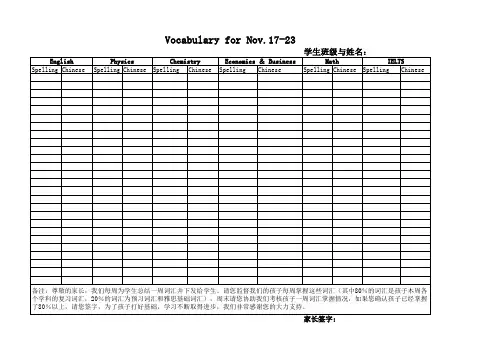
spelling list
- 格式:xlsx
- 大小:11.41 KB
- 文档页数:2
英语拼写比赛作文模板英文回答:Introduction:A spelling bee is an educational competition in which contestants are asked to spell words orally. The goal of the spelling bee is to determine the contestant who can spell the most words correctly. Spelling bees are typically held in schools and libraries, and they can be a lot of fun for participants and spectators alike.How to Prepare for a Spelling Bee:There are a few things you can do to prepare for a spelling bee. First, you should start by practicingspelling the words that are on the official spelling bee word list. You can find the word list on the website of the Scripps National Spelling Bee. Once you have practiced the words on the list, you can start practicing spelling otherwords that you may encounter in the competition.In addition to practicing spelling, you should also try to improve your vocabulary. The more words you know, the easier it will be to spell them correctly. You can improve your vocabulary by reading books, magazines, and newspapers. You can also learn new words by playing word games.Tips for Spelling Success:Here are a few tips to help you spell successfully in a spelling bee:Pay attention to the pronunciation of the word. Theway a word is pronounced can give you clues about how it is spelled.Break the word down into smaller chunks. This can make it easier to remember the spelling of the word.Use your fingers to spell the word. This can help youto visualize the spelling of the word.Take your time. Don't rush through the spelling of the word. Make sure you are spelling it correctly before you say it out loud.Benefits of Participating in a Spelling Bee:There are many benefits to participating in a spelling bee. Spelling bees can help you to:Improve your spelling skills.Increase your vocabulary.Build your confidence.Learn how to compete.Have fun!Conclusion:Spelling bees are a great way to learn and have fun. If you are interested in participating in a spelling bee, be sure to start preparing early. With a little practice, you can increase your chances of success.中文回答:什么是拼字比赛?拼字比赛是一种教育竞赛,参赛者需要口述拼写单词。

spell的用法总结大全spell作为名词符咒,咒语,魅力,一段时间,轮班的意思,今天我给大家带来了spell的用法,希望能够帮助到大家,下面我就和大家分享,来欣赏一下吧。
spell的用法总结大全spell的意思vt. 拼写,导致,意味着,组成(一个词)的字母是…vi. 轮替n. 符咒,咒语,魅力,一段时间,轮班变形:过去式: spelt spelled; 现在分词:spelling; 过去分词:spelt spelled;spell用法spell spell可以用作动词spell作“拼写,拼读”解时,一般指拼写单词,即把单词的字母逐个地读或写出来,用作不及物动词,也可用作及物动词。
用作及物动词时接名词或代词作宾语。
spell也可作“招致,带来”解,多指招致不好的结果,用作及物动词,接名词或代词作宾语。
spell作名词的意思是“着魔,中邪”,指被一种魔力所迷惑,引申可作“着迷”解,常用作单数名词,与不定冠词a连用。
spell用作动词的用法例句I don t know how to spell your name.我不会拼写你的名字。
Can you spell the word metropolis ?你会拼写“metropolis”这个词吗?Her writing is neat, but she can t spell.她的书写很工整,但是她不会拼写。
spell可以用作名词spell作名词的意思是“着魔,中邪”,指被一种魔力所迷惑,引申可作“着迷”解,常用作单数名词,与不定冠词a连用。
spell还可作“连续不断的一段时间”解,可用于表示天气、疾病等持续的“一段时间”。
可用作不可数名词,也可用作可数名词。
spell用作名词的用法例句The witch put the princess under a spell, and she fell asleep for ten years.这女巫使公主中了巫术,沉睡了十年。
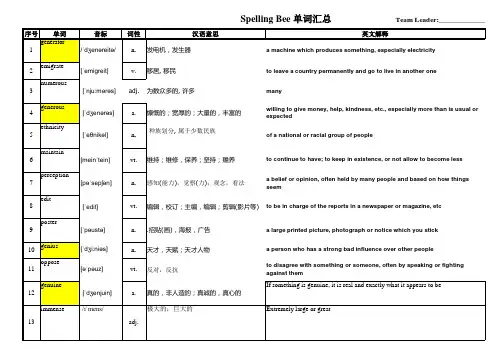
Spelling Bee 单词汇总 Team Leader:_________________进行说明:如果单词有多个发音、常见词性和意思,请将这些词性和意思都列出来。
请参看上面例子。
标注黄色的部分为四级单词表中的单词,没有标记的部分是教材中的单词。
总 Team Leader:__________________ Week NO. _____2_____转。
None of us had ever set eyes on a generator before我们过去谁也Certain formalities have to be gone through before one canemigrate必须办妥某些手续方可移居他国。
The Earth is only one of the numerous planets in the universe.地球只是宇宙中众多星球中的一个。
She was always very generous in her charity.她行善时总是很慷慨。
It's her nature to be generous.慷慨大方是她的天性。
The whole idea of ethnicity is a spurious hangoverfrom the past anyway.无论怎么说,整个种族划分思想都是过去的荒谬残留。
The government has taken a measure to maintain the stabilityof prices政府已经采取了措施以确保物价稳定。
His analysis of the problem showed great perception他对该问题的分析显示出敏锐的洞察力。
He edit a daily paper before he come to teach at our college.他来我们学院任教之前充任过一份日报的主编。

三年级上册英语书第五单元单词表正确书写全文共3篇示例,供读者参考篇1Dear Mrs. Smith,You asked us to write an essay about the vocabulary words from Unit 5 and how to spell them correctly. I will do my best to write what I know, even though spelling is still pretty hard for me sometimes.The first word is "adventure". This word means an exciting experience or undertaking. To spell it, it starts with"a-d-v-e-n-t-u-r-e". I remember this one because we just went on a class adventure to the science museum and it was really fun and exciting! We got to see dinosaur fossils and explore the planetarium. That was definitely an adventure.Next is the word "courage". Courage means bravery and being able to do something scared. The spelling is"c-o-u-r-a-g-e". I had to have a lot of courage last year when I broke my arm and had to get a cast. I was really scared of the doctor at first, but I tried to be brave. My little sister looks up to me for having courage.Another vocabulary word is "smooth". This word describes the texture of something that has no bumps or ridges. It's spelled "s-m-o-o-t-h". My favorite food is mashed potatoes because they are smooth and creamy. The surface of a brand new baseball is also very smooth before it gets scuffed up.The next word is "rough". This is kind of the opposite of smooth - it means uneven or not smooth. Rough is spelled"r-o-u-g-h". My dad has really rough hands from working construction. The bark on a tree trunk is another example of something rough and bumpy. Sandpaper is intentionally made to be rough so it can smooth other surfaces.We also learned the word "crunch". Crunch refers to the noise something makes when you bite or step on it with force. It's spelled "c-r-u-n-c-h". I love the crunch of fresh vegetable sticks like carrots and celery. When you walk on fresh snow, it also makes a awesome crunching sound under your feet.Another vocab word is "applause". Applause means clapping to show approval, usually for a performance. It's spelled"a-p-p-l-a-u-s-e". My little brother just started taking guitar lessons, and every time he plays a song for us we give him big applause to make him feel proud. People applaud at concerts, movies, and plays too.The word "concert" reminds me of applause. A concert is a performance of music in front of an audience. It's spelled"c-o-n-c-e-r-t". My favorite kind of concerts are rock concerts because the music is so energetic and fun. But I've also been to orchestra concerts at the symphony hall, which are more quiet and serious. I want to learn an instrument someday so I can maybe be in a concert!One tricky word is "prairie". It refers to a wide open area or flat grassland. The spelling is "p-r-a-i-r-i-e". We learned about how pioneers used to travel across the prairies in covered wagons a long time ago. I imagine prairies as seeming to go on forever with no trees or buildings. We don't have many prairies around here.The last word I'll talk about is "canyon". A canyon is a deep gorge or ravine between cliffs, kind of like a valley. Its spelling is "c-a-n-y-o-n". The most famous canyon is probably the Grand Canyon out west. It looks so massive and amazing in pictures.I've never been but I hope to go see it someday on a family trip. Canyons are created by millions of years of erosion from wind and water.Those are the main vocabulary words I can remember from our Unit 5 list. Spelling is definitely a challenge for me still. I haveto sound words out carefully and try making associations to things I know. Mrs. Smith always says that reading and writing a lot is the best way to get better at spelling over time. I'll just have to keep practicing every day.Thanks for letting me share what I've learned so far! Let me know if you need any clarification or have additional questions.Sincerely,Your Student篇2The Struggle is Real: Mastering the Vocabulary Minefield of Unit 5Hey there, fellow word warriors! It's me, your friendly neighborhood student, here to share the battles I've been fighting in the treacherous realm of Unit 5 vocabulary. Let me tell you, it's been a wild ride, full of unexpected twists, turns, and more silent letters than you can shake a pencil at!Now, I know what you're thinking, "But it's just a bunch of words, right? How hard could it be?" Oh, my sweet summer child. Little did I know that beneath the seemingly innocent veneer ofthese vocabulary gems lay a labyrinth of linguistic landmines, just waiting to trip me up at every turn.Take, for instance, the word "friends." Seems simple enough, right? Wrong! This unassuming little word is a wolf in sheep's clothing, hellbent on ruining my spelling test scores with its deceptive "ie" combination. I mean, who decided that was a good idea? Wouldn't "frends" make so much more sense? But no, the English language just had to go and throw a curveball my way.And let's not even get started on "school." This one had me stumped for weeks. Is it "s-c-h-o-o-l" or "s-k-o-o-l"? The internal debate raged on, until I finally had to resort to pneumonic devices involving owls and pools just to keep it straight. Honestly, at this point, I'm half-convinced the whole English language is just a massive practical joke played on unsuspecting students like myself.But wait, there's more! "Classroom" – now there's a word that's just begging for trouble. Is it "c-l-a-s-s-r-o-o-m" or"c-l-a-s-s-r-o-m"? Who knows?! Certainly not me, at least not until I've triple-checked with my trusty dictionary (and maybe consulted a few oracles for good measure).And don't even get me started on "independent." I mean, seriously, why does such a simple concept need so many letters? And let's not forget the dreaded double consonants that lurk within, just waiting to trip up the unwary speller. It's enough to make me want to throw in the towel and embrace a life of blissful illiteracy.But alas, I soldier on, for the sake of my education and my future prospects (or so my parents keep telling me). Each day, I charge headlong into the fray, armed with my pencil and a seemingly endless supply of erasers, determined to conquer these linguistic beasts one letter at a time.And you know what? Sometimes, just sometimes, I emerge victorious. There's no feeling quite like nailing the spelling of "different" or "practice" on the first try. It's a rush of pure, unadulterated joy that makes all the struggle worth it (at least until the next vocabulary list comes along).So, to all my fellow students out there, battling the good fight against these unruly words, I salute you. Keep your heads held high, your pencils sharpened, and your dictionaries close at hand. Together, we shall conquer this vocabulary minefield, one perfectly spelled word at a time.And who knows? Maybe, just maybe, by the time we reach Unit 6, the English language will have taken pity on us and thrown us a bone with some nice, simple, three-letter words. A kid can dream, right?Until then, happy spelling, my friends! May the odds be ever in your favor (and may your erasers never run dry).篇3Spelling Words from Unit 5Hey there! It's me again, your friendly neighborhood third grader. Today I want to talk to you about the spelling words we learned in Unit 5 of our English textbook. As you know, spelling is super important if you want to be a great writer and communicator. That's why I've been working extra hard to master the spelling of all these new words.Let me start by listing out the words, just so we're all on the same page:CaughtTaughtDaughterNaughtyThoughtBroughtFoughtBoughtSoughtOughtPhew, that's quite a list! Can you see the pattern there? They all have that funky "augh" sound that can be really tricky to spell. But don't worry, I've got some tips and tricks up my sleeve to help you remember how to spell each one correctly.Let's start with "caught." This one always makes me think of catching a baseball or a butterfly. When I picture myself catching something, it helps me remember that "caught" has an "augh" in the middle. Isn't it cool how our brains can make connections like that?Next up is "taught." Now, this one relates to teaching, like when our teacher is up at the front of the class teaching us new things. I imagine her standing there saying "Today I taught you about spelling!" and that helps cement the spelling in my mind."Daughter" is another family word, just like "father" and "mother." I think of my own daughter (even though I don't actually have one yet) and how she would be the daughter of me and my future spouse. See, using your imagination really works for remembering spellings!Oh "naughty," you little rascal of a word! This one makes me think of someone being bad or naughty, like pulling pranks or tracking mud into the house. When I picture a mischievous kid being naughty, it's easier to recall that "naughty" has an "augh" sound.Half way there! Let's keep powering through. How about "thought?" I'm sure you've had lots of deep thoughts before, right? Maybe thoughts about what you want to be when you grow up, or thoughts about your favorite book or movie. Whatever it is, having a thought triggers my memory of how to spell this word correctly."Brought" is definitely one of the harder ones. But I like to connect it to "brought over" as in "I brought over my favorite game to play." If I imagine lugging my prized possession to a friend's house, it gets the spelling stuck in my head.Oh "fought," how could I forget this one? It makes me think of two people fighting or arguing over something. Maybe therewas a big fight on the playground over who got to be the ball monitor that day. In any case, picturing a fight helps me fight against misspelling it.Now "bought" is an easy one for me because it relates to buying things, like buying new clothes or buying ice cream from the truck. I just think of my mom buying my school supplies and BAM, the spelling comes right to me."Sought" is another toughy. But I try to connect it to the phrase "sought out," as in sought out a good book to read or sought out the bathroom after having too much juice. Whenever I need to seek something out, I remember "sought."Finally, we have "ought." To be honest, this one doesn't really spark any vivid pictures for me. But I just try to repeat it over and over: "I ought to study harder. I ought to be nice to my sister. I ought to eat my veggies." Drilling it like that makes it stick.Wow, we made it through all 10 spellings! Who knew learning new vocabulary could be so fun and imaginative? The key really is to make associations between the words and concrete images or experiences from your life. That's what works best for memorizing those tricky spellings.I hope sharing my thought process has helped you as much as it has helped me. We may be just third graders, but we're spelling champs now! Thanks for reading, and keep working on those spelling skills. A great writer is just an "augh" away!。