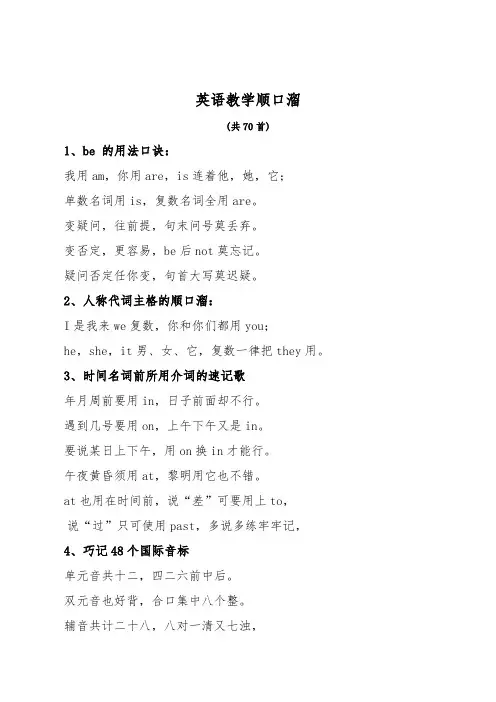
英语顺口溜
- 格式:doc
- 大小:45.50 KB
- 文档页数:3
冠词、定冠词和不定冠词口诀一、定冠词的用法口诀特指双熟悉,上文已提及;世上独无二,序数最高级;某些专有名,习语及乐器。
二、不用冠词用法口诀下列情况应免冠,代词限定名词前;专有名词不可数,学科球类三餐饭;复数名词表泛指,两节星期月份前;颜色语种和国名,称呼习语及头衔。
一、定冠词和不定冠词的用法详解],强调时读作。
ιT],在以元音音素开头的词前读作[ET1.定冠词the,在以辅音音素开头的词前读作[例:the table]那张桌子the animal那只动物2.定冠词the,基本含义是“这个,那个”,表示特指。
例: the flower 那朵花the E-mail 那个电子邮件3.不定冠词a和an,基本含义是“一、一个”,表示泛指。
例:a flower 一朵花an E-mail 一个电子邮件二、a和an的区别a用在辅音音素前,包括以前元音[j]、[w]开首的词前,注意,这里讲的辅音音素指的是发音,不是指辅音字母。
an用在元音音素前(不是元音字母),例:a hotel [一家旅馆a knife 一把小刀a useful tool 一件有用的工具a university 一所大学a European country一个欧洲国家a one-eyed man一个一目失明的人an hour ] 一小时an ant 一只蚂蚁an honour 一种荣誉an honest boy 一个诚实的男孩an umbrella 一把伞an onion一个洋葱an eye 一只眼睛an ear [一只耳朵an English book [ 一本英语书an egg 一只鸡蛋an ap 一个苹果an island 一座岛an uncle一位叔叔an old man 一位老人三、不定冠词1 表示“一,一个”,用在单数可数名词前例:There is a picture on the wall. 墙上有一幅图画。
He has an apple in his hand. 他手里拿着一个苹果。
提示:a. a (an) 虽表示“一个”,但不强调数量,而是强调类别;one则强调数量。
例:I bought a computer. 我买了一台电脑。
(不是收音机和电视机)I bought one computer. 我买了一台电脑。
(不是两台)Would you like an ice cream? 来一客冰淇淋好吗?(不是别的食物)She gave one ice cream to themeach. 她给他们每人一客冰淇淋。
(不是两客)b. 表示数量对比时,要用one, 不用a(an)。
比:我有一支红铅笔,但是他有三支。
I have a red pencil, but she hasthree. (误)I have one red pencil, but she hasthree. (正)我只需要一美元,但他给了我两美元。
I only want a dollar, but he hasgiven me two. (误)I only want one dollar, but he hasgiven me two. (正)2 表示一类人或物,指同类中的任何一个,a或an不必翻译例Even a child can answer this question. 就是小孩子也能回答这个问题。
An elephant is stronger than a horse. 大象比马力气大。
A teacher must be strict with his students. 教师必须对学生严格要求。
3 第一次提到某人或某物第一次提到某人或某物时,用不定冠词a 或an,起介绍作用。
例: A girl wants to see you. 一位姑娘要见你。
On a cold evening a stranger came to my house. 在一个寒冷的晚上,一个陌生人来到我的住处。
4 表示身份、职业不定冠词用于单数名词前表示身份、职业,尤其用在作表语或补足语的名词前。
例:She is a high school teacher. Her name is Li Fang. 她是一位中学教师,名叫李芳。
The Whites wanted their daughter to be a musician. 怀特夫妇想要他们的女儿成为音乐家。
提示:表示某个职位在某一时期内只有一人担任,或表示某人的头衔,则不用冠词。
例:He is captain of the team. 他是球队队长。
Zhang Fei, monitor of their class, isgood at English. 张飞是他们的班长,英语很棒。
5 用于专有名词前,表示不认识某人例:A Zhang called you just now. 一位姓张的刚才给你打电话。
A Mr. Smith wanted to see you. 有位史密斯先生想要见你。
6 不定冠词用在表示数量、长度、时间等的计数单位的名词前,表示“每一”例:We have three meals a day. 我们每天吃三顿饭。
They met each other once a month.他们每月会面一次。
The car moved 100 miles an hour.这辆小汽车以每小时100英里的速度行驶。
The envelopes are one yuan adozen. 信封一打是一元钱。
Amily goes to see her grandmothertwice a week. 爱米莉每周去看奶奶两次。
英语语法顺口溜:宾语从句口诀巧记宾语从句顺口溜附宾语从句详解:[宾语从句歌诀]宾语从句三姊妹,that,if/whether,wh-/how展风采。
展风采有三关,引导词、语序、时态在把关。
主从时态要一致,陈述语序永不变。
陈述请你选that,疑问需用if/whether连。
特殊问句作宾从,原来问词不用换。
三关过后莫得意,人称、标点需注意。
留意变脸的if/when,从句的简化记心间。
[歌诀解码]一、三姊妹宾语从句根据引导词的不同可分为三种类型:1. 由that引导的宾语从句。
如:We knew (that)we should learnfrom each other.2. 由if/whether引导的宾语从句。
如:Please tell me if/whether you havebeen to America.3. 由who,where,how等连接代词或连接副词引导的宾语从句。
如:Can you tell me how I can get to thenearest post office?二、三关1. 引导词关如果从句是陈述句,引导词用that(that在口语或非正式文体中常省略);如果从句是一般疑问句,引导词用if/whether;如果从句是特殊疑问句,引导词用由疑问词转换而来的疑问代词/副词。
2. 语序关①陈述句变为宾语从句,语序不变,即仍用陈述语序。
如:He is an honest boy. The teacher said. →The teacher said(that)he was an honest boy.②一般疑问句和特殊疑问句变为宾语从句,语序变为陈述语序。
如:Does he work hard?I wonder.→I wonder if/whether he works hard.When did he leave?I don’t know. →I don’t know when he left.3. 时态关①如果主句是现在的时态,从句的时态可根据实际情况而定。
如:I have heard(that)he will come back next week.②如果主句是过去的某种时态,那么从句的时态一定要用过去的某种时态。
如:He said(that)there were no classes yesterday.注意:如果宾语从句表述的是客观真理、自然现象等时,不管主句是什么时态,从句都要用一般现在时。
如:He said that light travels much faster than sound.三、人称的变化和标点的使用1. 从句的主语如果是第一人称,变为宾语从句则与主句的主语一致;如果是第二人称,则与主句的宾语一致;如果是第三人称,不用变化。
如:“May I use your knife?”He askedme. →He asked me if he might usemy knife.“Do you know her telephonenumber?”He asked me. →Heasked me if I know her telephonenumber.2. 宾语从句的标点均由主句决定。
主句是陈述句,用句号;主句是疑问句,用问号。
如:Who will give us a talk?I don’tknow. →I don’t know who will giveus a talk.Do you know?Where does he live?→Do you know where he lives?四、两副面孔if和when既能引导时间状语从句,又能引导宾语从句。
因此,遇到它们就要认真分析一下,它们究竟属于“两副面孔”的哪一副。
如:If it rains tomorrow,I won’t come.(时间状语从句)I don’t know if it will rain tomorrow.(宾语从句)五、从句的简化1. 当主句谓语动词是find,see,watch,hear等感官动词时,从句常简化为“宾语+宾补”结构,宾补为不带to的不定式或V-ing形式。
如:She found that the wallet lay/waslying on the ground. →She foundthe wallet lie/lying on the ground.2. 当主句谓语动词是hope,wish,decide,forget,plan,agree等,且主句主语与从句主语相同时,从句可简化为不定式结构。
如:She agreed that she could help mewith my maths. →She agreed tohelp me with my maths.3. 在连接代词/副词引导的宾语从句中,当从句主语与主句主语或间接宾语一致时,宾语从句可简化为“连接代词/副词+不定式”结构。
如:Can you tell me how I can get to thestation?→Can you tell me how toget to the station?。