ABSTRACT Weak Signal Detection Performance of Selective Rake Receivers in Fading Channels
- 格式:pdf
- 大小:79.65 KB
- 文档页数:2
i.song@
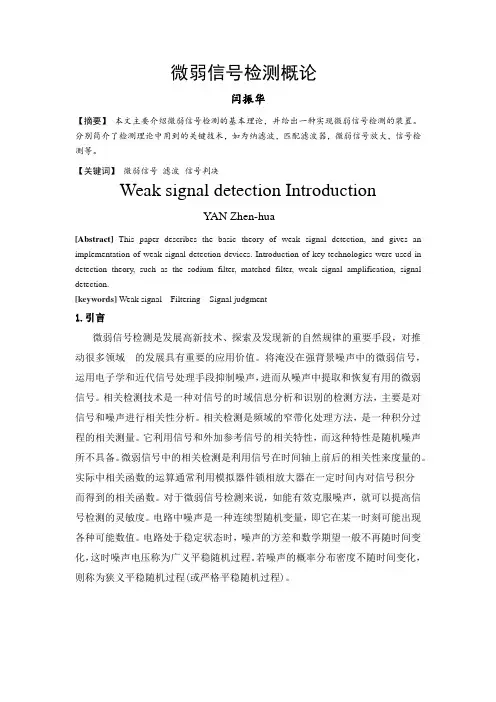
sian environment, which will be called the Gaussian optimized (GO) SRR, could experience severe performance degradation in the UWB-MA systems in impulsive channels. In this paper, we obtain and evaluate the performance of the optimum and reduced-complexity suboptimum [2] SRRs under impulsive interference.
(j +1)Tf
−3 10
α=1.0
Njl =
jTf
(w(t) + n(t))q (t −
(1) cj Tc
− tjl )dt
(5)
−4 10 0
is the noise component of the correlator output.
0.1
0.2
0.3
0.4
0.5
0.6
0.7
0.8
Square root of G−SNR
(k ) (k ) Ns −1 j =0
q (t − jTf − cj Tc ),
(k )
i = 0, 1.
(1)
1. INTRODUCTION
Recent studies [1] in the area of wireless systems indicate that the ultra wideband multiple access (UWB-MA) system is a viable technology for short-range multiple access communications. The fine time resolution of multipaths induced by the channel is exploited by the use of a rake receiver to capture significant amount of energy found in the multipath components and to benefit from multipath diversity gain. Most of the rake rake receivers in detection problems have been studied and implemented under the Gaussian noise assumption. In the UWB-MA systems, however, the sum of the multiple access interference (MAI) and channel noise can be more adequately modelled as impulsive interference. Thus, the selective rake receiver (SRR) optimized for Gaus-
2.
UWB-MA SYSTEM
Assume that the users employ binary phase shift keyed (BPSK) modulation where the transmitted signals consist of a low duty-cycle sequence of a large number of UWB pulses. The signal of the k-th user for 0 ≤ t ≤ Ns Tf is one (k ) (k ) of the two equi-probable signals s0 (t) and s1 (t), where si (t) = θbi
In (1), Ns is the number of the UWB pulses modulated by a given symbol, Ts = Ns Tf is the symbol duration, θ is the (k ) signal strength, bi is the binary data bit of equiprobable (k ) s −1 is the +1 and −1 transmitted by the k-th user, {cj }N j =0 time-hopping sequence of the k-th user with period Nc . We employ the channel model in [3] accepted by the IEEE 802.15 Study Group 3a based on indoor channel measurements in the 2-8 GHz frequency band. The impulse response of the channel is given by
jTf
0 10
GO CO CS α=0.5
−1 10
r(t)q (t − cj Tc − tjl )dt (4)
(1)
Bit error rate
(j +1)Tf
α=1.0 10
−2
=
Байду номын сангаас
(1) ujl θbi
+ Njl ,
α=1.5 α=0.5 α=2.0
where tjl is the estimated value of {Tm + Tm,n }, ujl is the estimated value of Ujl , and
M −1 N −1
h(t)
=
m=0 n=0
Um,n δ (t − Tm − Tm,n ),
(2)
Permission to make digital or hard copies of all or part of this work for personal or classroom use is granted without fee provided that copies are not made or distributed for profit or commercial advantage and that copies bear this notice and the full citation on the first page. To copy otherwise, to republish, to post on servers or to redistribute to lists, requires prior specific permission and/or a fee. PE-WASUN’05, October 10–13, 2005, Montreal, Quebec, Canada. Copyright 2005 ACM 1-59593-182-1/05/0010 ...$5.00.
Weak Signal Detection Performance of Selective Rake Receivers in Fading Channels
Jinsoo Bae
Dept. Inform., Comm. Engr. Sejong University Seoul, Korea
Sang Won Choi
Dept. Electr. Engr. KAIST Daejeon, Korea
So Ryoung Park
School ICEE Catholic University of Korea Bucheon, Korea
j.bae@
swchoi@Sejong.kaist.ac.kr srpark@catholic.ac.kr Iickho Song Jongho Oh
3. RAKE RECEIVERS
−1 We model {Njl }L l=0 with the independent and identically distributed (i.i.d.) symmetric alpha stable (SαS) distribution [4]. The zero mean SαS pdf is given by (−1)k−1 ∞ 1 Γ(αk + 1) k=1 k! πγ 1/α kαπ · sin 2 −αk−1 x| · γ| , for 0 < α ≤ 1, 1/α (6) fNjl (x) = k (−1) ∞ 1 2k+1 k=0 (2k)! Γ α παγ 1/α 2 k · γ 1x , for 1 ≤ α ≤ 2, /α
(1)
(3)
where ∗ is the convolution operation, w(t) represents the MAI caused by the other users, n(t) denotes the channel noise. Assuming that the multipath channel coefficients {Um,n } and the arrival times {Tm } and {Tm,n } are estimated perfectly, the output of the matched filter corresponding to the l-th finger of the SRR at the j -th frame is Rjl =
where M is the number of clusters, N is the number of multipath components (rays) in a cluster, Um,n is the multipath channel coefficient of the n-th ray of the m-th cluster, Tm is the arrival time of the m-th cluster, Tm,n is the arrival time of the n-th ray measured from the beginning of the m-th cluster, and δ (·) is the impulse function. Assume that the desired user is the first user, that is, k = 1. The received signal r(t) can then be written as r(t) = si (t) ∗ h(t) + w(t) + n(t),