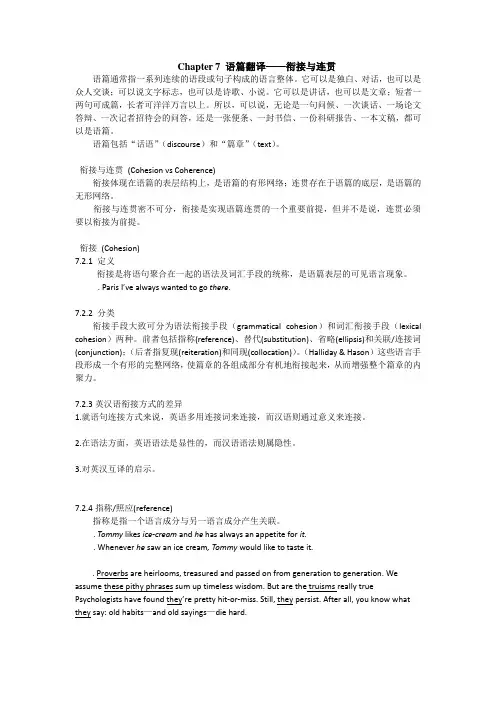
Lexical Cohesion in the Translation between English and Chinese 英汉翻译中的词汇衔接
- 格式:doc
- 大小:97.50 KB
- 文档页数:24
英汉翻译中的词汇衔接摘要: 近年来,语篇语言学有很大发展。
借鉴其研究成果和理论,人们普遍认为应把语篇作为翻译单位,即在翻译研究中,应强调原文的整体意义在译文中的再现。
作为语篇构成要素之一的衔接是把在结构上互不相关的成分联系起来的手段。
在语篇翻译中,译者必须正确运用衔接来理解原文,兼顾原语和目的语在衔接方面的差异,运用恰当的翻译策略来传达原文的整体意义,创造出一个符合目的语使用规则的译文。
根据韩礼德、哈桑的理论,衔接方式或通过语法或通过词汇来体现。
本文主要从词汇的角度来讨论英汉翻译中的衔接,旨在探寻词汇衔接手段在英汉翻译中的作用及其重要性。
全文可分为三章:第一章从对语篇的学习入手,继而引入衔接概念以及它在英汉翻译中的作用;第二章主要介绍什么是词汇衔接;第三章则通过具体翻译实例,分析词汇衔接在英汉翻译中的作用。
关键词:衔接词汇衔接语篇翻译Lexical Cohesion in the Translation between English andChineseAbstract: In recent years, text linguistics has got great improvement. Inspired by text linguistics, people believe that translation studies should be carried out with the text as the unit, which implies that in translating, what is transferred should be the meaning of the whole text. As one of the important ties in composing a text, cohesion is relations, in which two or several elements, which are structurally irrelevant to each other, are joined together semantically. Hence, cohesion is an indispensable element for translator to handle in the process of translation. Taking into consideration the cohesive differences, he should make appropriate adjustments according to the normof the target language and produce a text that is cohesive and coherent.According to Halliday and Hasan, cohesion is expressed partly through grammar and partly through vocabulary. This thesis discusses cohesion in English-Chinese translation mainly in lexical perspective, in order to find out the importance and function of lexical cohesion in English-Chinese translation. The thesis is composed of three chapters: Chapter One begins with the study of text, and then the notion of cohesion and its respective functions in translation are brought in. The second chapter mainly talks about what lexical cohesion is. In Chapter Three, the functions of lexical cohesion in translation between English and Chinese are introduced, by showing some specific examples.Key Words: cohesion lexical cohesion text translationLiterature ReviewRecently, text linguistics has got great improvement. With the development of the translation studies, text is regarded by more and more people, as the starting point of translation and it inevitably becomes an integral concept for the interdiscipline of translation. Cohesion, an element of textuality, plays an important role in keeping a text and its function in a text consistent. The study of textual cohesion is a complicated program, for it includes phonology, vocabulary, phrase, sentence, text and so on.The concept of cohesion was first presented by M.A.K; Halliday in 1962, and afterwards it has been fully formulated by Halliday and Hasan in their book Cohesion in English. According to Halliday and Hasan, the concept of cohesion is a semantic one; it refers to relations of meaning that exist within the text, and that define it as a text.Cohesion occurs where the interpretation of some element in the discourse is dependent on that of another. The one presupposes the other, in the sense that it cannot be effectively decoded except by recourse in it. When this happens, a relation of cohesion is set up, and the two elements, the presupposing and the presupposed, are thereby at least potentially integrated into a text.Professor Zhu Yongsheng, with Zheng Lixin and Miao Xingwei, discussed textual cohesion in their book A Contrastive Study of Cohesion in English and Chinese, by collecting and analyzing a lot of specific text samples. The differences of cohesion between English and Chinese can be seen clearly.To write this thesis, I collected a lot of materials about lexical cohesion, and some linguistic books in particular. Based on Halliday’s theory of cohesion, my thesis mainly discusses cohesion in English-Chinese translation mainly in lexical perspective, in order to find out the importance and function of lexical coIntroductionIt is known to all that English and Chinese belong to different language systems and great differences exist in their way of expression, which can, in one way, be presented by different use of cohesive devices. So, in the process of translating, it’s essential for a translator to have a good knowledge of the similarities between the two languages, but more importantly, he should bear in mind their differences, including that in the appropriate adjustments in accordance with the presupposed purpose.Cohesion, as one element of textuality, plays an important role in keeping a text and its function in a text consistent. Many people have carried out studies on this topic and in this thesis, the famous linguist M.A.K; Halliday’s theory of cohesion will be adopted as the foundation of the discussion.In a text, lexical cohesion is the result of chains of related words that contribute to the continuity of lexical meanings. These lexical chains are a direct result of units of text being “about the same thing”, and finding text structure involves finding units of text that are about the same thing. Hence, computing the chains is useful, since they will have a correspondence to the structure of the text. Determining the structure of text is an essential step in determining the deep meaning of the text.While translating, significant attention should be paid to the lexical cohesion ofthe original text, so that the target text can better reflect the original text and be more readable.1.Cohesion and Translation1.1 Text and Translation1.1.1 Text and TextureUnder the influence of the traditional linguistics, it was universally regarded that the sentence is among the highest rank of grammatical unit and translating is to achieve equivalence at the level of sentence or clause. But as a way to realize communication, language is influenced by many factors, such as culture, history and thinking method. Therefore, it’s not enough to study only the formal structures of language in translation studies. Beaugrande points out, “The analysis of formal structures might well fail to uncover the nature and function of an entity in its wider context.”More and more scholars regard text as the primary object of study in translation.A text “can be anything from a single proverb to a whole play, from a momentary cry for help to an all-day discussion on a committee.” (Halliday&Hasan, 1976:1) In linguistics, text refers to “any passage, spoken or written, of whatever length that does form a united whole” (Halliday&Hasan, 1976:1) “It is an instance of language in use rather than languages as an abstract system of meanings and relations.”(Baker, 2000:111) A text, Halliday and Hasan believe, is not a grammatical unit larger than sentence, but a semantic one. It’s “a unit not of form but of meaning” (1976:2). But this does not imply that the meaning of a text is simply the combination of the meanings of the individual sentences, which compose this text. As Guy Cook said in his Discourse, “not all sentences are interesting, relevant, or suitable. One cannot just put any sentence after another, and hope that it will mean something.” (1989:3). What distinguishes a text from a shapeless string of words or structures is actually the features it displays. If a passage containing more than one sentence is perceived as a text, “there will be certain linguistic features present in that passage, which can beidentified as contributing to its total unity and giving it texture.” (Halliday&Hasan, 1976:2). Here the property, which makes a text recognized as a text is named as texture. For example, in the following two sentences: ①Wash and core six cooking apples.②Put them into a fire proof dish. (Halliday&Hasan, 1976:2) it’s very clear that in the second sentence, “them”refers back to the “six cooking apples”in the previous sentences, uniting them as a whole. Thus, the cohesive relation that exists between “them” and “six cooking apples” provides the texture of this text. Such kind of cohesive relation, in Halliday’s words, is a tie. A tie “makes it possible to analyze a text in terms of its cohesive properties, and gives a systematic account of its patterns of texture” (Halliday&Hasan, 1976:4).Halliday, in the book Cohesion in English, motioned that a text is a unit of meaning, distinguished from a non-text by its texture.1.1.2 Text and TranslationAccording to modern trends in linguistics, as a “communicative occurrence”(Beaugrande, 1981:3), a text rather than a sentence should be the unit of communication. What is transferred during the human communication is not only the information presented by the abstract linguistic system in the text, but also the communicative values contained. As for the unit of translation, Bassett (1981: 8) thinks that in literary translation, “the text is the prime unit”, because “every text is made up of a series of interlocking systems, each of which has a determinable function in relation to the whole”. Thus, when translating works, no matter whether it is a novel, a short poem or even a slogan for an advertisement, it should base on the text instead of on its linguistic features. (Zhang Meifang, 2001:1). Halliday states, without a theory of wordings, there is no way of making explicit interpretation of the meaning of a text. The understanding of a text is based on the understanding of the meaning of individual words and sentences that compose the text. To put it into a nutshell, these scholars try to emphasize the two sides of the same coin concerning the text.A French translator once pointed out that translation is to understand and let andmake it understood. So, translating process may be put into two steps: understanding and conveying. Neither of these two steps can be fulfilled without taking into consideration the whole text.Usually, the source text employs a different rhetorical pattern as the target text, so, a good rendering on doubt starts with a correct understanding of the source text. But this kind of understanding should not be limited to the analysis at the word level or clause level because “a formalism is only a representation, not an explanation, and a means, not an end”. (Beaugrande, 1981:miv) Besides the grammatical structure, such items as the intention of the source text, the notions it embodies, or even its textual function may not be out of place. In this sense, “the translator’s first task is to understand the text, often to analyze, or at least make some generalizations about his text before he selects an appropriate translation method” (Newmark, 2001:2) As for the second step of translation, the translator is confronted with the task not only of transferring the meaning of individual words, but also of trying to “keep the communication channels open” by creating a text with the use of the cohesive devices to establish cohesion. (Baker, 2000:9)1.2Cohesion and Translation1.2.1 The Notion of Cohesion and Its Function in a TextThe concept of cohesion was first presented by M.A.K; Halliday in 1962, and afterwards it has been fully formulated by Halliday and Hasan in their book Cohesion in English.According to Halliday and Hasan, the concept of cohesion is a semantic one; it refers to relations of meaning that exist within the text, and that define it as a text. Cohesion occurs where the interpretation of some element in the discourse is dependent on that of another. The one presupposes the other, in the sense that it cannot be effectively decoded except by recourse in it. When this happens, a relation of cohesion is set up, and the two elements, the presupposing and the presupposed, are thereby at least potentially integrated into a text. (Halliday&Hasan, 1976:4) This statement shows clearly that cohesion is not only a constituting component ina text, more importantly, it is a catalyst in the sense that, “without cohesion, the remainder of the semantic system cannot be effectively activated at all.” (Halliday&Hasan, 1976:28) So, its catalytic function is emphasized as a necessary element in the interpretation of a text.1.2.2 Cohesion in TranslationSince cohesion is an indispensable element in composing a text, its importance lies not only in helping us understand a text, but also in helping us construct a new one. The knowledge of cohesive patterns is especially useful for a translator in the process of translation when the scope of the study is extended from a monolingual text to a contrastive study concerning bilingual texts. In fact, the topic of cohesion, as pronounced by Newmark (1987:295), has always been “the most useful constituent of text linguistics applicable to translation”.During the process of translation, a translator is required to get a more accurate understanding of applying appropriate target language, the source text by tracing the cohesion embedded in the text, and techniques based on his understanding of the cohesive pattern of them to produce a text, cohesive and coherent, acceptable to the target readers (Li Yunxing, 2000:132-133). Take the personal pronoun as an example: in an English text, personal pronoun is often used when an item appears for the second time, as in(a)The patient shook her head and stretched out her hands towards the baby. Thedoctor put it in her arms. She kissed it on the forehead. (Li Yunxing, 2000:148) In a Chinese text, lexical repetition is most commonly used in this case. Thus, some adjustments need to be made to ensure a cohesive target text, which conforms to the tradition of Chinese language, as exemplified by the following translated text:(b)病人摇了摇头,把手伸向孩子。