译林5A-Unit2(单元测试)
- 格式:doc
- 大小:72.00 KB
- 文档页数:9
〔二〕How many + 可数名词复数 + 〔are there〕? 有多少……?答复为具体的数字。例如:
How many students are there in our class? 我们班有多少个学生?
There are 42. 有42人。
How many dogs can you see? 你能看到多少条狗?
I can see three. 我看见3条狗。
二、基数词和序数词
Our classroom is on the second floor. 我们的教室在一楼。
They are on the third floor. 他们在三楼。
It’s on the first floor. 它在一楼。
本单元出现了三个基数词one, two, three的序数词分别为first, second, third,这三个基数词是比拟特殊的。教师可可以根据学生的学习情况,适当的拓展序数词4th至10th,教师可以补充这些序数词的简写形式,并鼓励学生归纳出4至10序数词后缀。例如:
one — first, two — second, three — third,
four — fourth, five — fifth, eight — eighth, nine — ninth…
口诀 解说 举例
基变序,有规律,后面th加上去。 在数词后面加th。 four → fourth
一二三,特殊记,后面字母t, d, d。 one, two, three特殊变。 first,second,third
八去t,九去e。整数中的y要变成ie eight去掉t,nine去掉e。twenty去掉y变成twentieth eight → eighth, nine → ninth
f 来把ve替。 five和twelve的ve要变成f 。 five→ fifth, twelve→ twelfth
假设是遇到几十几,只变个位就可以。 两位数或两位以上数字只变个位。 thirty-three → thirty-third
序数词前要加the 我们一定要牢记
注:序数词在使用时,通常前面要加 定冠词the;但是如果序数词前出现 不定冠词a或an时,那么表示“再......〞,“又......〞。例如:
We live on the fourth floor. 我们住在四楼。
Today is the first day of school. 今天是开学第一天。
We’ll read it a second time. 我们再念第二遍。
We’ve tried it three times.Must we try it a fourth time?
我们已经试过三遍了,还必须再试一次〔第四次〕吗?
【知识点分析】
1. This is Nancy Black. 这位是南希.布莱克。
解析: (1)句式This is…可用来介绍他人,意为“这位是…〞。
例句: This is my brother Tom. 这位是我弟弟汤姆。
〔2〕句中的Nancy Black是一个外国人名,按发音译为“南希。布莱克〞。其中,Nancy是名,Black是姓。我国的人名是姓在前,名在后。
例句:Hello, I’m John Brown. 你好,我叫约翰.布朗。
2. Can you show her around? 你能带着她参观吗? 解析:句中的短语show……around意为“带着……参观〞,其中show后面一般跟人〔人称代词要用宾格〕,around后面跟地点。
例句:〔1〕Let me show them around our factory.
让我带你参观一下我们的工厂。
(2) Will you show Mr Green around the hospital?
请你带着格林先生参观一下医院,好吗?
的表达
现在,城市里楼房处处可见,那么我们该怎样描述某物所在第几层楼呢?其句型为:
地点/It is on the + 序数词 + floor.
如:Our house is on the first floor. 我们的房子在一楼。
英美两国在表达楼层时有所不同: the first floor, 二楼称为the second floor;而英国人那么把一楼称为the ground floor,二楼才称为the first floor。
英国
三楼 the third floor the second floor
二楼 the second floor the first floor
一楼 the first floor the ground floor
4. Push me, Bobby! 推我,波比!
解析:push为动词,后接人称代词的宾格形式,me是人称代词I 的宾格形式。这是一个祈使句。英语中的祈使句经常以动词原形开头,其否认句那么在动词前加Don’t.
例句:Open the blue box. 把这个蓝色盒子翻开。
5. high和tall的区别
It’s too high!意为“太高了〞句中的high意为“高的〞,它表示一个不与地面接触的人或物高。tall也意为“高的〞,但它表示人、物或树木等有生命的东西高。
如:The kites are high in the sky. 风筝在空中很高。
The man is very tall. 这个人长得很高。
6. You are so heavy, Sam! 你是如此的重,萨姆!
解析:此句中的heavy意思是“沉的;重的。〞它既可以形容人,也可以形容物品。前面的so是一个程度副词,是“如此;这样〞的意思。
例句:This bag is so heavy. I can’t move it. 这个袋子真重,我搬不动它。
7. It’s great fun! 真有趣!
解析:当你认为某件事情很有趣时,可以用这个交际用语。短语great fun意为“有趣的人或事〞,fun是名词。此句相当于〞It’s very interesting.〞
例句:——let’s play this computer game. 咱们玩这个电脑游戏吧。
——OK. It’s great fun. 好。它很有趣。
8. It’s time for dinner. 该吃晚饭了。
解析:〞It’s time for…〞是提醒某人该做某事时的常用语,意为“是该...的时候了。〞,其同意句为〞It’s time to do …〞。
例句:It’s time for PE。=It’s time to have a PE lesson.. 该上体育课了。
9. Let’s go and have a look. 我们去看一看吧。
Let’s go and play. 我们去玩玩吧。
Let’s play again. 我们再玩一次吧。
Let’s go home now. 我们回家吧。 Let’s + 动词原形 这一句型构成祈使句,意为“我们……吧。〞’s go to the zoo. 我们去动物园吧。
Let’s watch TV. 我们看电视吧。
【语音】
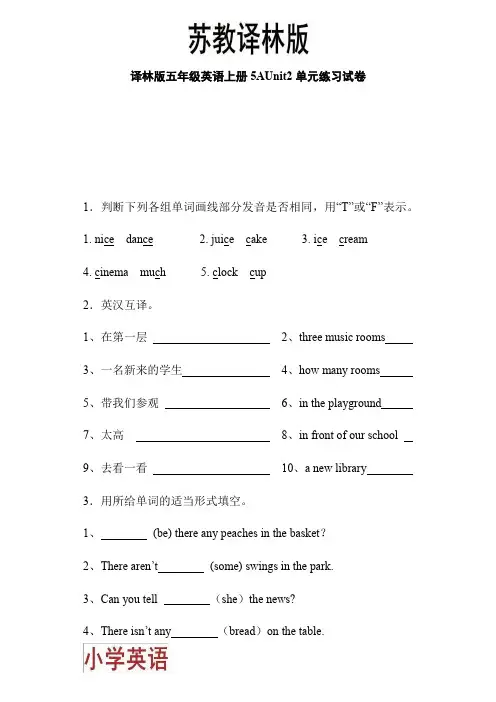
c [s] 字母c在元音字母e, i, y前发[s]音。[s]为辅音,发音时舌端接近齿槽,气流从舌端和齿槽间形成的缝隙中通过,发生摩擦,形成摩擦音[s]。
cinema, dance, ice cream, juice, nice, city, juice, pencil, Nancy, Lucy, rice
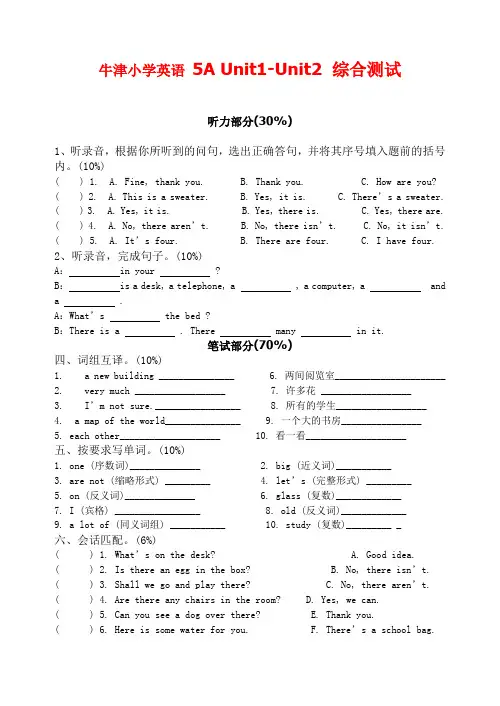
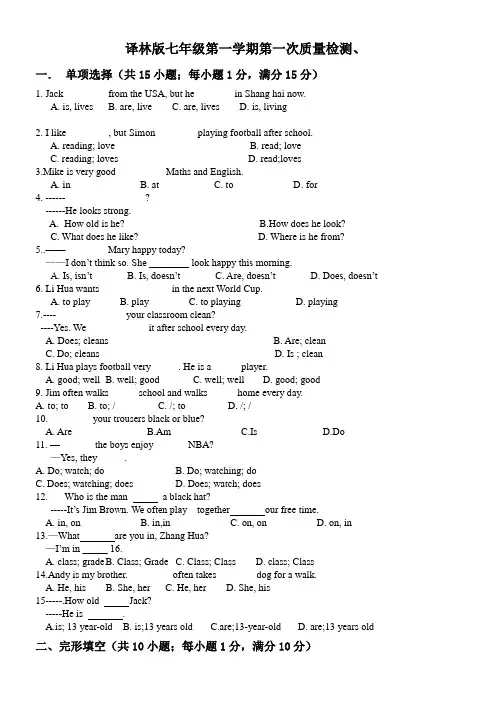
Unit Two单元练习卷
班级___________ 姓名_______________ 得分_____________
听力局部〔30分〕
一、听录音选出你所听到的内容。〔每题1分;每题1分,共10分。每题读两遍〕
( ) 1. A. behind B. beside C. between
( ) 2. A. high B. heavy C. fun
( ) 3. A. who B. whose C. how
( ) 4. A. art room B. classroom C. living room
( ) 5. A. glass B. class C. gloves
( ) 6. A. here B. near C. there
( ) 7. A. second B. third C. first
( ) 8. A. fridge B. umbrella C. picture
( ) 9. A. computer B. school C. computer room
( )10. A. cake B. soup C. bed
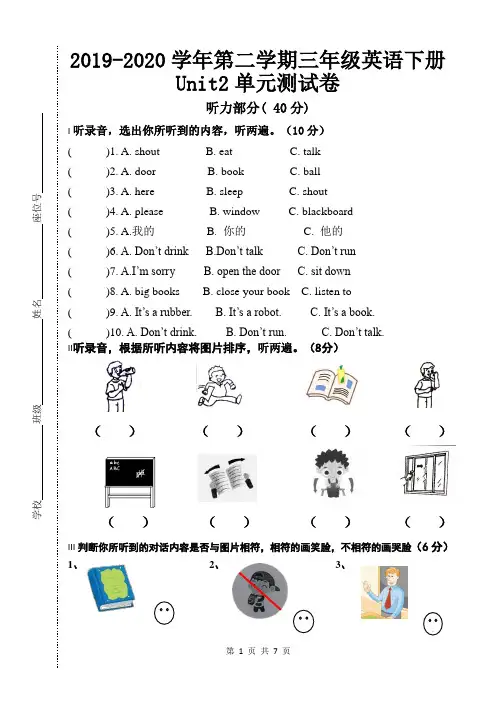
二、听录音,判断所听内容是否正确,正确的写T,错误的写F。 (每题1分;每题1分,总分值5分。每题读两遍)
1. 2. 3.
( ) ( ) ( )
4. 5.
( ) ( )
三、听录音,选出相应的应答句。(共5小题;每题1分,总分值10分。每题读两遍)
( )1. A. Yes, they are. B. Yes, there are. C. They’re on the table.
( )2. A. There’s one. B. It’s Mr Zhang’s computer.
C. It’s near the window.
( )3. A. It’s a big box. B. There are some cakes. C. It’s under the table.
( )4. A. Yes, it is. B. No, it isn’t. C. No, there isn’t.
( )5. A. It’s on the sofa. B. They’re on the bed.
C. There’s a jacket on the chair.
四、听录音,根据所听内容完成下面短文。(共10个空格:每空1分,总分值10分。对话读三遍)