Research Findings Methods
- 格式:docx
- 大小:8.83 KB
- 文档页数:2
Research Findings Methods
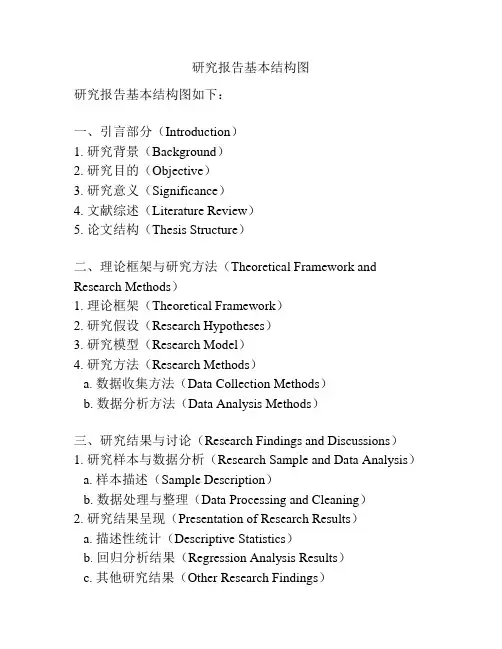
Research findings methods are crucial for the advancement of knowledge in various
fields. These methods provide a systematic approach to gathering, analyzing, and
interpreting data in order to answer research questions and test hypotheses. There are
several research findings methods that researchers can employ, each with its own strengths
and limitations. In this response, we will explore some of the most common research
findings methods, including experimental research, survey research, qualitative research,
and mixed methods research.
Experimental research is a method in which the researcher manipulates one or more
variables and measures the effect of the manipulation on other variables. This method
allows researchers to establish cause-and-effect relationships between variables, making it a
powerful tool for testing hypotheses. However, experimental research is often conducted in
artificial laboratory settings, which may limit the generalizability of the findings to real-world situations. Additionally, ethical considerations may restrict the types of experiments
that can be conducted on human subjects.
Survey research involves the collection of data from a sample of individuals through
the use of questionnaires or interviews. This method is commonly used to gather
information about people's attitudes, beliefs, and behaviors. Survey research is relatively
quick and cost-effective, making it a popular choice for researchers studying large
populations. However, survey research is susceptible to response bias, as participants may
provide inaccurate or socially desirable responses. Additionally, the quality of the data
collected is highly dependent on the wording and structure of the survey questions.
Qualitative research is a method that focuses on understanding the meaning and
experiences of individuals within their social context. This method often involves the
collection and analysis of textual data, such as interviews, observations, and documents.
Qualitative research allows researchers to explore complex phenomena in depth and from
multiple perspectives. However, qualitative research is often criticized for its subjectivity
and lack of generalizability. Additionally, the process of analyzing qualitative data can be
time-consuming and challenging.
Mixed methods research is an approach that combines qualitative and quantitative
research methods in a single study. This method allows researchers to gain a more
comprehensive understanding of a research problem by triangulating different sources of
data. Mixed methods research is particularly useful for addressing complex research
questions that cannot be adequately answered by either qualitative or quantitative
methods alone. However, conducting mixed methods research requires expertise in both
qualitative and quantitative data collection and analysis, which can be challenging for
researchers with limited experience in one or both methods.
In conclusion, research findings methods play a critical role in generating new
knowledge and advancing our understanding of the world. Each research findings method
has its own strengths and limitations, and researchers must carefully consider which
method is most appropriate for their research questions and objectives. By employing a
variety of research findings methods, researchers can triangulate their findings and
strengthen the validity and reliability of their conclusions. Ultimately, the choice of research
findings method should be guided by the specific research question and the nature of the
phenomenon being studied.