
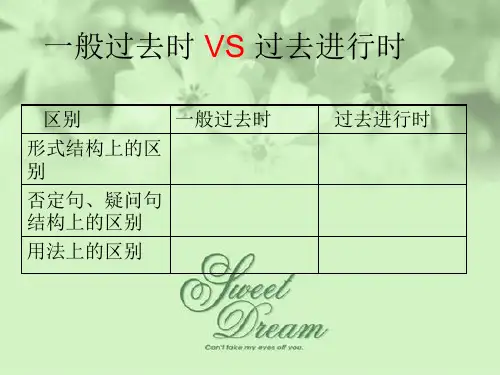
一般过去时与过去进行时区别
- 格式:ppt
- 大小:870.00 KB
- 文档页数:12
学习好资料欢迎下载
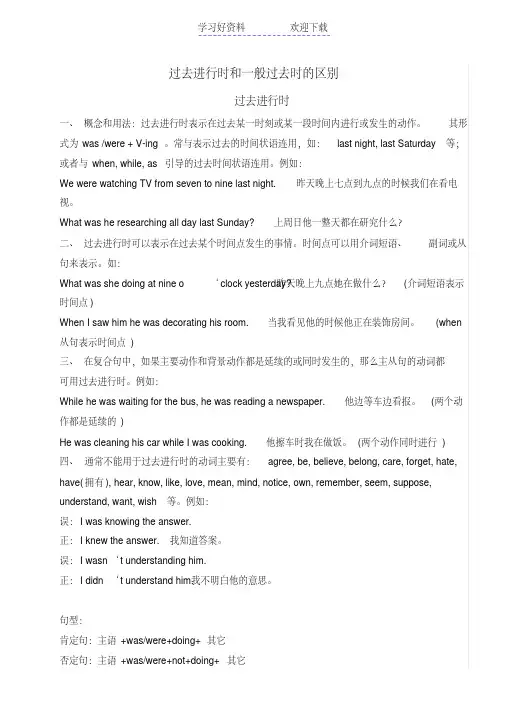
过去进行时和一般过去时的区别
过去进行时
一、概念和用法:过去进行时表示在过去某一时刻或某一段时间内进行或发生的动作。其形式为was /were + V-ing。常与表示过去的时间状语连用,如:last night, last Saturday等;
或者与when, while, as引导的过去时间状语连用。例如:
We were watching TV from seven to nine last night. 昨天晚上七点到九点的时候我们在看电视。
What was he researching all day last Sunday? 上周日他一整天都在研究什么?
二、过去进行时可以表示在过去某个时间点发生的事情。时间点可以用介词短语、副词或从
句来表示。如:
What was she doing at nine o‘clock yesterday? 昨天晚上九点她在做什么?(介词短语表示时间点)
When I saw him he was decorating his room. 当我看见他的时候他正在装饰房间。(when从句表示时间点) 三、在复合句中,如果主要动作和背景动作都是延续的或同时发生的,那么主从句的动词都
可用过去进行时。例如:
While he was waiting for the bus, he was reading a newspaper.他边等车边看报。(两个动
作都是延续的)
He was cleaning his car while I was cooking. 他擦车时我在做饭。(两个动作同时进行) 四、通常不能用于过去进行时的动词主要有:agree, be, believe, belong, care, forget, hate,
have(拥有), hear, know, like, love, mean, mind, notice, own, remember, seem, suppose, understand, want, wish等。例如:误:I was knowing the answer. 正:I knew the answer. 我知道答案。
Verb Tenses动词时态
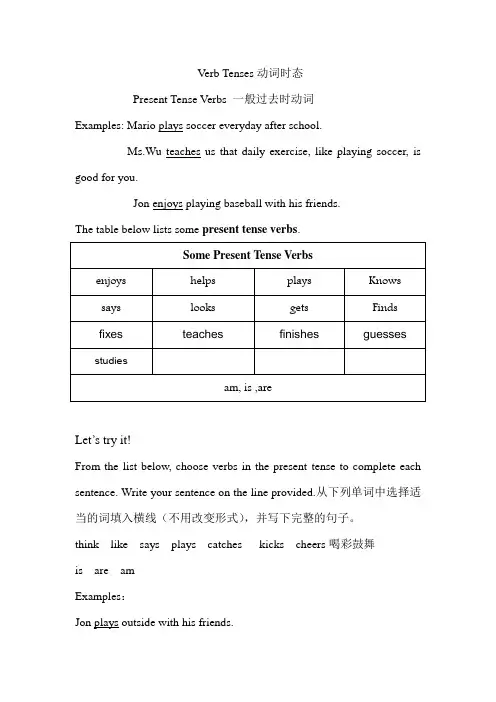
Present Tense Verbs 一般过去时动词
Examples: Mario plays soccer everyday after school.
Ms.Wu teaches us that daily exercise, like playing soccer, is
good for you.
Jon enjoys playing baseball with his friends.
The table below lists some present tense verbs.
Some Present Tense Verbs
enjoys helps plays Knows
says looks gets
Finds
fixes teaches finishes guesses
studies
am, is ,are
Let’s try it!
From the list below, choose verbs in the present tense to complete each
sentence. Write your sentence on the line provided.从下列单词中选择适当的词填入横线(不用改变形式),并写下完整的句子。
think like says plays catches kicks cheers喝彩鼓舞
is are am
Examples:
Jon plays outside with his friends. 1.Maria _____ the soccer ball with his friends.
2.Maria ______ the ball.
3.“I ______ to play soccer,” says Maria.
-----WORD格式--可编辑--专业资料-----
--完整版学习资料分享----
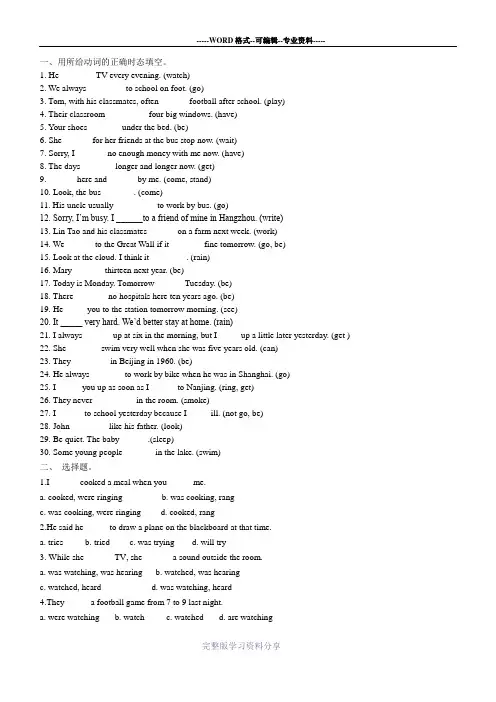
一、用所给动词的正确时态填空。
1. He________ TV every evening. (watch)
2. We always ________ to school on foot. (go)
3. Tom, with his classmates, often ______ football after school. (play)
4. Their classroom _________ four big windows. (have)
5. Your shoes _______ under the bed. (be)
6. She ______ for her friends at the bus stop now. (wait)
7. Sorry, I_______ no enough money with me now. (have)
8. The days _______ longer and longer now. (get)
9. ______ here and ______ by me. (come, stand)
10. Look, the bus _______. (come)
11. His uncle usually _________ to work by bus. (go)
12. Sorry, I’m busy. I ______to a friend of mine in Hangzhou. (write)
13. Lin Tao and his classmates ______ on a farm next week. (work)
14. We ______ to the Great Wall if it _______ fine tomorrow. (go, be)
一般过去时和过去完成时的区别
一般过去时表示(1)过去某个特定时间发生,并且一下子就完成了的动作(即:非持续性动作),也可以表示(2)过去习惯性的动作。一般过去时不强调动作对现在的影响,只说明过去
。 一般过去时的基本用法
1 带有确定的过去时间状语时,要用过去时
注意
在谈到已死去的人的情况时,多用过去时。
2 表示过去连续发生的动作时,要用过去时
这种情况下,往往没有表示过去的时间状语,而通过上下文来表示
3 表示过去一段时间内经常或反复的动作
常与always,never等连用。
4 如果强调已经终止的习惯时要用used to do
5 有些句子,虽然没有表示过去确定时间的状语,但实际上是指过去发生的动作或存在的状态的话,也要用过去时,这一点,我们中国学生往往出错,要特别注意! 动词过去时规则变化
1 直接加ed
2 以不发音的e结尾的,+d
3 以辅音字母+y结尾的,变y为i加ed
4 以重读闭音节结尾的,双写最后的辅音字母+ed
过去完成时表示在过去某一时间或动作之前已经发生或完成了的动作。
它表示句子中描述的动作发生在“过去的过去”。
过去完成时的基本用法
1)表示在过去某一时刻或动作以前完成了的动作,即“过去的过去”。可以用by,
before等介词短语或一个时间状语从句来表示,也可以用一个表示过去的动作来表示,还可能通过上下文来表示
。(2)表示由过去的某一时刻开始,一直延续到过去另一时间的动作或状态,常和for, since构成的时间状语连用。
(3)叙述过去发生的事情,在已叙述了过去发生的事情后,反过来追述或补述以前发生的动作时,常使用过去完成时。
(4)在含有定语从句的主从复合句中,如果叙述的是过去的事,先发生的动作常用(5)过去完成时常常用在宾语从句(或间接引语)中,这时从句中的动作发生在主句表示的过去的动作之前。
在包含有when,