风险英语名词解释汇总
- 格式:docx
- 大小:13.46 KB
- 文档页数:3
风险英语名词解释汇总
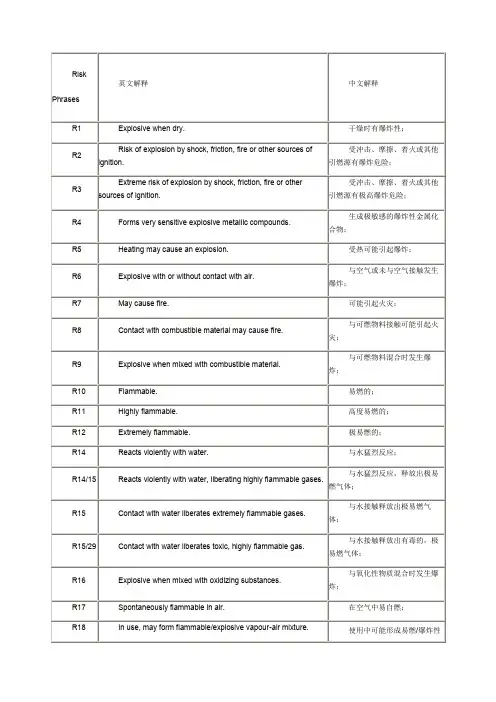
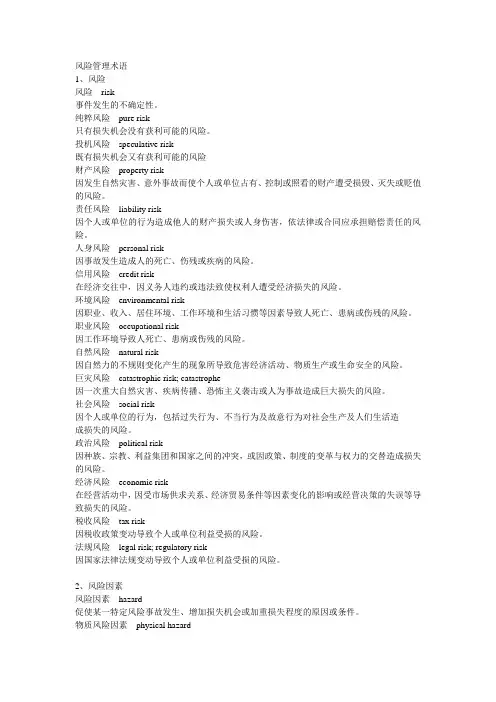
Risk: Risk refers to the possibility of loss or harm due to uncertain events
or circumstances. It is an inherent part of any activity or decision-making
process and can be quantified based on the probability of occurrence and the
potential impact.
Hazard: A hazard is a potential source of harm or danger that has the
potential to cause injury, illness, or damage to property or the environment.
Hazards can be classified into different categories such as physical, chemical,
biological, ergonomic, and psychosocial.
Uncertainty: Uncertainty refers to the lack of knowledge or predictability
about future events or outcomes. It is an important aspect of risk assessment
as it affects the estimation of probabilities and potential impacts of
different scenarios.
Probability: Probability is a measure of the likelihood that a particular
event or outcome will occur. It is usually expressed as a fraction or
percentage ranging from 0 to 1. High probability events are more likely to
occur, while low probability events have a smaller chance of happening.
Impact: Impact refers to the consequences or effects that result from a
particular event or situation. In the context of risk, it represents the
magnitude of the potential loss or harm that may occur if a certain risk
materializes.
Mitigation: Mitigation refers to the actions taken to reduce or minimize the
potential risks or hazards. It involves implementing preventive measures,
control measures, or safety procedures to mitigate the likelihood and severity
of negative outcomes.
Residual risk: Residual risk refers to the level of risk that remains after
mitigation measures have been implemented. It represents the risk that cannot
be completely eliminated and requires ongoing monitoring and management.
Risk assessment: Risk assessment is the process of identifying, analyzing, and
evaluating risks associated with a particular activity, decision, or situation.
It involves identifying hazards, estimating probabilities and potential
impacts, and determining the level of risk involved.
Risk management: Risk management is the process of identifying, assessing, and
controlling risks to minimize the potential for loss or harm. It involves
implementing strategies and measures to mitigate risks, as well as monitoring
and reviewing risk control measures.
Control measure: Control measures are actions or precautions taken to prevent
or reduce the likelihood and severity of a risk. They can include engineering
controls, administrative controls, and personal protective equipment, among
others.
Vulnerability: Vulnerability refers to the degree of susceptibility or
exposure to risks. It is influenced by various factors such as the nature of
the hazard, the level of protection in place, and the capacity to respond
effectively to potential risks.
Contingency plan: A contingency plan is a predefined set of actions or
procedures designed to be implemented in the event of a specific risk or
emergency situation. It outlines the steps to be taken to minimize the impact
and ensure business continuity.
Insurance: Insurance is a financial arrangement in which an individual or
organization transfers the risk of potential losses to an insurance company in
exchange for regular premium payments. It provides financial protection
against unexpected events or accidents.
Risk appetite: Risk appetite refers to an organization's willingness and
ability to tolerate and accept risks in pursuit of its objectives. It reflects
the organization's risk culture and influences its risk management strategies
and decision-making processes.
Stakeholder: Stakeholders are individuals or groups who have an interest or
concern in a particular activity, decision, or organization. They may be
affected by the risks involved and play a role in risk assessment and
management processes.
Compliance: Compliance refers to the adherence to laws, regulations, standards,
and policies. It ensures that organizations operate within legal and ethical
boundaries and reduces the risk of penalties, fines, or reputational damage.
Crisis management: Crisis management is the process of preparing for,
responding to, and recovering from a crisis or emergency situation. It involves establishing emergency response plans, training personnel, and
coordinating resources to minimize the impact and restore normalcy.
Business continuity: Business continuity refers to the ability of an
organization to continue operating and providing essential services or
products during and after a disruption or crisis. It involves implementing
continuity plans, backup systems, and recovery strategies.