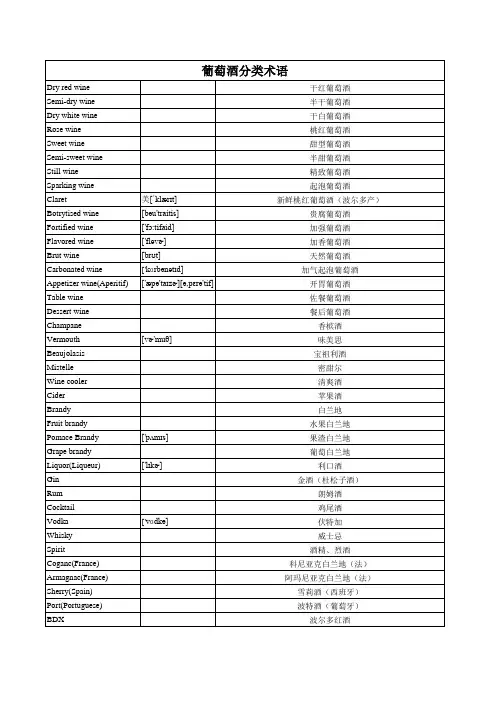
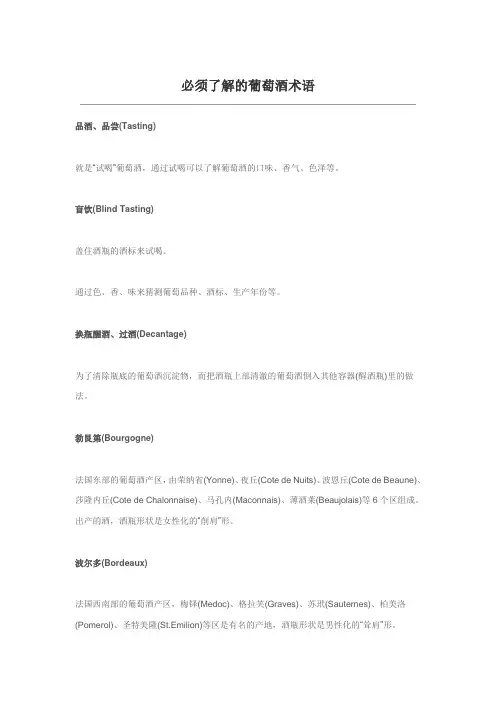
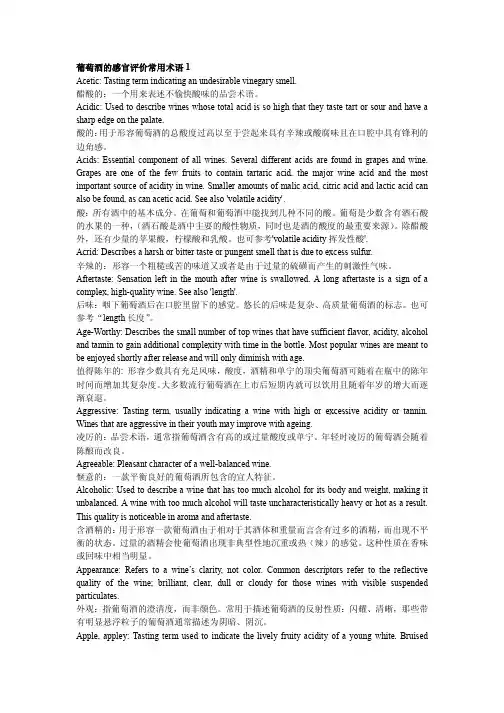
葡萄酒品评术语2 Wine Tasting Terms
- 格式:doc
- 大小:284.50 KB
- 文档页数:28
Wine TerminologyIf you feel intimated or embarrassed by not knowing "winetalk" the charts below will help you . You don't have to be aprofessional or even an amateur wine taster to enjoydrinking wines. Nor is it necessary to know "everything"about wines to select and enjoy them. However, knowing alittle and gradually expanding your knowledge can add immeasurably to yourenjoyment of wine.We have two lists to help you familiarize yourself with wine terms. Each is almost a dictionary. Wine terminology can be confusing and learning it can be a daunting task.Hopefully this will make the task easier.The first is a glossary of Wine Tasting Terminology. The second, below, is a general Wine Glossary. Learning this vocabulary can make your wine tasting experiencemore enjoyable.Glossary Wine TastingAcidicDescribe wines whose total acid is so high that they taste tart or sour and a sharp edge or harshfeeling on the palate.Acrid Describes a harsh or bitter taste or pungent smell that is due to excess sulfur.Aftertaste The taste or flavors that linger in the mouth after the wine is tasted, spit or swallowed. The aftertaste or "finish" is the most important factor in judging a wine's character and quality. Surprisingly, this may differ significantly from the taste while the wine is in your mouth. A lingering aftertaste is a virtue, as long as the taste is enjoyable. Great wines have rich, long, complexaftertastes.Aggressive Slightly harsh in taste or texture, usually due to a high level of tannin or acid.Alcoholic Used to describe a wine that has too much alcohol for its body and weight, making it unbalanced. A wine with too much alcohol will taste uncharacteristically heavy or hot as a result. This quality is noticeable in aroma and aftertaste.Appearance Refers to a wine's clarity, not color.AppleA pleasant apple-fruit aroma, particularly characteristic of Chardonnays made withoutexcessive oak.AromaTraditionally defined as the smell that wine acquires from the grapes and from fermentation. Now it more commonly means the wine's total smell, including changes that resulted from oak aging or that occurred in the bottle--good or bad."Bouquet" has a similar meaning.AstringentDescribes a rough, harsh, puckery feel in the mouth, usually from tannin or high acidity that red wines (and a few whites) have. When the harshness stands out, the wine is astringent.Austere Used to describe relatively hard, high-acid wines that lack depth and roundness. Usually said of young wines that need time to soften, or wines that lack richness and body.Awkward Describes a wine that has poor structure, is clumsy or is out of balance.Backbone Used to denote those wines that are full-bodied, well-structured and balanced by a desirable levelof acidity.BackwardUsed to describe a young wine that is less developed than others of its type and class fromthe same vintage.BalanceA wine has balance when its elements are harmonious and no single element dominates. Alcohol and tannins may also be elements ofstructure or backbone.Bite A marked degree of acidity or tannin. An acid grip in the finish should be more like a zestful tang and is tolerable only in a rich, full-bodied wine.BitterNot common in wines but found occasionally (particularly in the aftertaste, and usually in subtle, refreshing form) in some Italian wines and Alsatian whites. It describes one of the four basic tastes (along with sour, salty and sweet). Some grapes--notably Gewurztraminer and Muscat--often have a noticeable bitter edge to their flavors. Another source of bitterness is tannin or stems. If the bitter quality dominates the wine's flavor or aftertaste, it is considered a fault. In sweet wines a trace of bitterness may complement the flavors. In young red wines it can be a warning signal, as bitterness doesn't always dissipate with age. Normally, a fine, mature wine should not be bitter on the palate.BluntStrong in flavor and often alcoholic (see "Alcoholic"), but lacking in aromatic interest and development on the palate.Body The overall texture or weight of wine in the mouth usually the result of a combination of glycerin, alcohol and sugar. Commonly expressed as full-bodied, medium-bodied or medium-weight,or light-bodied.Bouquet This is a technical term that describes the smell that a wine develops after it has been bottled and aged. Most appropriate for mature wines that have developed complex flavors beyond basic young fruit and oak aromas.Brawny Used to describe wines that are hard, intense, tannic and that have raw, woody flavors. Theopposite of elegant.Briary Describes young wines with an earthy or stemmywild berry character.Bright Used for fresh, ripe, zesty, lively young wineswith vivid, focused flavors.Brilliant Exceptionally clear and transparent. Describes the appearance of very clear wines with absolutely no visible suspended or particulate matter. Not always a plus, as it can indicate ahighly filtered wine.Browning Describes a wine's color, and is a sign that a wine is mature and may be faded. A bad sign in young red (or white) wines, but less significant in older wines. Wines 20 to 30 years old may have a brownish edge yet still be enjoyable.Burnt Describes wines that have an overdone, smoky, toasty or singed edge. Also used to describeoverripe grapes.Buttery Indicates the smell of melted butter or toasty oak. Also a reference to texture, as in "a rich,buttery Chardonnay."Cedary Denotes the smell of cedar wood associated with mature Cabernet Sauvignon and Cabernet blends aged in French or American oak.CheezyOrganic, ripe natural cheese aromas, almost always a flaw, typically indicating filthy wine making and an unwanted secondary fermentationin the bottle.Chewy Describes rich, heavy, tannic wines that arefull-bodied.Cigar Box Another descriptor for a cedary aroma.Clean Fresh on the palate and free of any off-taste. Does not necessarily imply good quality.Closed Describes wines that are concentrated and have character, yet show little aroma or flavor. This may be a temporary condition (akin to "dumb," below) in an age worthy wine that is past itsyouth but not yet mature.Cloudiness Lack of clarity to the eye. Fine for old wines with sediment, but it can be a warning signal of protein instability, yeast spoilage or re-fermentation in the bottle in younger wines.Cloying Too sweet and lacking the balance provided by acid, alcohol, bitterness or intense flavor.CoarseUsually refers to texture, and in particular, excessive tannin or oak. Also used to describe harsh bubbles in sparkling wines.Complexity An element in all great wines and many very good ones; a combination of richness, depth, flavor intensity, focus, balance, harmony and finesse.They offer multiple dimensions in both their aromatic and flavor profiles, and have more going for them than simply ripe fruit and a satisfying, pleasurable, yet one-dimensional quality.Corked Always a flaw, this describes a wine having the off-putting, musty, moldy-newspaper flavor and aroma and dry aftertaste caused by a taintedcork.DelicateComplex with many flavors working together. Used to describe light- to medium-weight wines with good flavors. A desirable quality in wines such as Pinot Noir or Riesling.Dense Describes a wine that has concentrated aromas on the nose and palate. A good sign in youngwines.Depth Describes the complexity and concentration of flavors in a wine, as in a wine with excellent or uncommon depth. Opposite of shallow. Often refers to a more mature wine.Dilute A description of a wine whose aromas and flavorsare thin and watery.Dirty As the name implies, this covers any and all foul, rank, off-putting smells that can occur in a wine,including those caused by bad barrels or corks. A sign of poor wine making.DryThis doesn't mean the opposite of wet, It is the opposite of sweet. Having no perceptible taste of sugar. Most wine tasters begin to perceive sugar at levels of 0.5 percent to 0.7 percent. It can describe wines with a rough feel on the tongue.EarthyImparts a characteristic earthy aroma. Used to describe both positive and negative attributes in wine. At its best, a pleasant, clean quality that adds complexity to aroma and flavors. The flip side is a funky, crude smell that borders on orcrosses into dirtiness.Elegant Used to describe wines of grace, balance andbeauty, not intense.Elusive A secret wine-taster's term meaning "I can'tfigure out what this wine smells like."Empty Similar to hollow; devoid of flavor and interest.Fading Describes a wine that is losing color, fruit or flavor, usually as a result of age.Fat Full-bodied, high-alcohol wines low in acidity give a "fat" impression on the palate. Can be a plus with bold, ripe, rich flavors; can also suggest the wine's structure is suspect.Finish The key to judging a wine's quality is finish, also called aftertaste. A measure of the taste or flavors that linger in the mouth after the wine is tasted. Great wines have rich, long, complexfinishes.Flabby A critical term that is for a wine that is soft,feeble, lacking acidity on the palate.Flat Having low acidity; the next stage after flabby. This can also refer to a sparkling wine that haslost its bubbles.Fleshy Soft and smooth in texture, with very littletannin.Flinty A descriptor for extremely dry white wines suchas Sauvignon Blanc, whose bouquet is reminiscent of flint struck against steel; typical of French Chablis and Loire Valley Sauvignon Blancs(Sancerre).Floral (also Flowery) Literally, having the characteristic aromas of flowers. Mostly associated with white wines.Foxy A term used to describe the unique musky andgrapey character of many native American labrusca varieties, like Concord. Foxy wines are not generally well thought of by serious wine lovers, but a well-made Concord wine (or Scuppernong or Muscadine in the AmericanSouth) can be a pleasant change of pace.Fresh Having a lively, clean and fruity character. An essential for young wines.FruityHaving the aroma and taste of fruit or fruits. Graceful. Describes a wine that is harmonious and pleasing in a subtle way.Full A description of wines that give the impression ofbeing large or heavy in your mouth.FunkyThis is modern slang for an "earthy" wine with strongly organic qualities, may be complimentary, neutral or negative depending on its intensity and the taster's personal preference.Generous A wine whose characteristics are expressive andeasy to perceive.Graceful Describes a wine that is harmonious and pleasingin a subtle way.GrapeyCharacterized by simple flavors and aromas associated with fresh table grapes; distinct from the more complex fruit flavors (currant, blackcherry, fig or apricot) found in fine wines. This is not necessarily a positive term. It implies a strong-flavored, one-dimensional wine without the subtlety or character that shows as complexaroma and flavor.Grassy A signature descriptor for Sauvignon Blanc and a pleasant one unless overbearing and pungent, smelling just like your lawn after cutting thegrass.Green Tasting of unripe fruit. Wines made from unripe grapes will often possess this quality. Pleasant in Riesling and Gewurztraminer.GripA welcome firmness of texture, usually from tannin, which helps give definition to wines suchas Cabernet and Port.HardFirm; a quality that usually results from high acidity or tannins. Often a descriptor for youngred wines.Harmonious Well balanced, with no component obtrusive orlacking.Harsh Used to describe astringent wines that are tannicor high in alcohol.Hazy A visual description, used to describe a wine that has small amounts of matter. A good quality if a wine is unfined and unfiltered.Heady Used to describe high-alcohol wines with afragrant aroma.Hearty Used to describe the full, warm, sometimes rustic qualities found in red wines with high alcohol.Herbaceous Denotes the taste and smell of herbs in a wine. A plus in many wines such as Sauvignon Blanc, and to a lesser extent Merlot and Cabernet. Asynonym of herbal.Hectare A metric unit of area equal to100 ares or 10,000sq m (2.471 acres)Hollow Lacking in flavor. Describes a wine that has a first taste and a short finish, and lacks depth atmid-palate.Hot High alcohol, unbalanced wines that tend to burn the tongue and palate with "heat" on the finish are called hot. This is generally a sign of excessive or unbalanced alcohol. Acceptable inPort-style wines.Intense Wines that express themselves strongly. How strong the aroma or flavor is in relation to thetotal expression.Juicy Tasty and pleasing, not necessarily found in acomplex wine.Leafy Describes the slightly herbaceous, vegetal quality reminiscent of leaves. Can be a positive or a negative, depending on whether it adds to or detracts from a wine's flavor.LeanAnother synonym of acidic. Not necessarily a critical term used to describe wines made in an austere style. When used as a term of criticism, it indicates a wine is lacking in fruit.Legs The viscous droplets that form and ease down the sides of the glass when the wine is swirled.Length The amount of time the sensations of taste and aroma persist after swallowing. The longer thebetter.LingeringUsed to describe the flavor and persistence of flavor in a wine after tasting. When the aftertaste remains on the palate for several seconds, it issaid to be lingering.Lively Describes wines that are fresh and fruity, brightand vivacious.LushWines that are high in residual sugar and taste soft or viscous are called lush. Maceration During fermentation, the steeping of the grape skins and solids in the wine, where alcohol acts as a solvent to extract color, tannin and aroma from the skins.Maderized Describes the brownish color and slightly sweet, somewhat caramelized and often nutty character found in mature dessert-style wines.MalicDescribes the green apple-like flavor found in young grapes which diminishes as they ripen andmature.MeatyDescribes red wines that show plenty of concentration and a chewy quality. They may even have an aroma of cooked meat.MercaptansAn unpleasant, rubbery smell of old sulfur; encountered mainly in very old white wines.Murky More than deeply colored; lacking brightness, turbid and sometimes a bit swampy. Mainly afault of red wines.Musty Having an off-putting moldy or mildew smell. The result of a wine being made from moldy grapes, stored in improperly cleaned tanks and barrels, or contaminated by a poor cork. Corked wines neverimprove with breathing.Nose A term for aroma and bouquet. The character of awine as determined by the olfactory sense.Nutty Used to describe oxidized wines. Wine that is over the hill. Often a flaw, but when it's close to an oaky flavor it can be a plus.Oaky Describes the aroma or taste quality imparted to a wine by the oak barrels or casks in which it was aged. Can be either positive or negative. The terms toasty, vanilla, dill, cedary and smoky indicate the desirable qualities of oak; charred, burnt, green cedar, lumber and plywood describeits unpleasant side. See also American oak, French oak. Oaky white wines often show such flavors as pineapple and tropical fruit. Oaky reds may show strong vanilla aromas, herbal dill, orspices.Over the Hill A wine that's been kept too long (or poorly) and isno longer enjoyable.Oxidized Describes wine that has been exposed too long to air and taken on a brownish color, losing its freshness and perhaps beginning to smell and taste like Sherry or old apples. Oxidized wines are also called maderized or sherrified.PerfumedDescribes the strong, usually sweet and floral aromas of some white wines. This usually reflects a heavy floral quality that may be out of balance.Piercing Implies a high level of tart sourness that may be out of balance, although extreme acidity may be an advantage in some wine-food matches.Potent Intense and powerful.Pruny Having the flavor of overripe, dried-out grapes.Can add complexity in the right dose.Puckery Describes highly tannic and very dry wines.Pungent Having a powerful, assertive smell linked to a high level of volatile acidity. Rarely used in acomplimentary way.RaisinyHaving the taste of raisins from ultra-ripe or overripe grapes. Can be pleasant in small dosesin some wines.RawYoung and undeveloped. A good descriptor of barrel samples of red wine. Raw wines are often tannic and high in alcohol or acidity.RichWines with generous, full, pleasant flavors, usually sweet and round in nature, are describedas rich. In dry wines, richness may be supplied byhigh alcohol and glycerin, by complex flavors andby an oaky vanilla character. Decidedly sweetwines are also described as rich when thesweetness is backed up by fruity, ripe flavors. Robust "Big", meaning full-bodied, intense and vigorous.Round Describes a texture that is smooth, not coarse ortannic.Rustic Describes wines made by old-fashioned methods or tasting like wines made in an earlier era. Can be a positive quality in distinctive wines that require aging. Can also be a negative quality when used to describe a young, earthy wine that should be fresh and fruity.Smoky Usually an oak barrel byproduct, a smoky quality can add flavor and aromatic complexity to wines.Soft Describes wines low in acid or tannin (sometimes both), not tart nor sour, making for easy drinking.Opposite of hard.SpicyA descriptor for many wines, indicating the presence of spice flavors such as anise, cinnamon, cloves, nutmeg, mint and pepper which are often present in complex wines.Stale Wines that have lost their fresh, youthful qualities are called stale. Opposite of fresh.Stalky Smells and tastes of grape stems or has leaf- orhay-like aromas.Stemmy Wines fermented too long with the grape stems.The taste will be bitter.Subtle Complex and balanced. Describes delicate wines with finesse, or flavors that are understated rather than full-blown and overt. A positivecharacteristic.Supple Describes texture, mostly with reds, as it relates to tannin, body and oak. A positive characteristic.Tanky Describes dull, dank qualities that show up in wines aged too long in tanks.Tart Sharp-tasting because of acidity. A broadsynonym for acidic.Thin Lacking body and depth. More critical than light bodied. Implies a bland and uninteresting wine.Tight Describes a wine's structure, concentration and body, as in a "tightly wound" wine. Closed or compact are similar terms.Tinny Metallic tasting. Tired Limp, feeble, lackluster.Toasty Describes a flavor derived from the oak barrels in which wines are aged. Also, a character that sometimes develops in sparkling wines.Vegetal Some wines contain elements in their smell and taste which are reminiscent of plants andvegetables. In Cabernet Sauvignon a small amount of this vegetal quality is said to be part of varietal character. But when the vegetal element takes over, or when it shows up in wines in which it does not belong, those wines are considered flawed. Wine scientists have been able to identify the chemical constituent that makes wines smell like asparagus and bell peppers.Velvety Delicious smoothness. Having rich flavor and a silky, sumptuous texture.Vinous Literally means "winelike" and is usually applied to dull wines lacking in distinct varietal character.Volatile(or Volatile Acidity) Describes an excessive and undesirable amount of acidity, which gives a wine a slightly sour, vinegary edge. At very low levels(0.1 percent), it is largely undetectable; at higherlevels it is considered a major defect.Glossary of Wine TermsAcetic Acid All wines contain acetic acid, or vinegar, but usually the amount is quitesmall--from 0.03 percent to 0.06 percent--and not perceptible to smell or taste. Once table wines reach 0.07 percent or above, a sweet-sour vinegary smell and taste becomes evident. At low levels, acetic acid can enhance the character of a wine, but at higher levels (over 0.1 percent), it can become the dominant flavor and is considered a major flaw. A related substance, ethyl acetate, contributes a nail polish likesmell.Acid The tart (or in excess, sour) quality that is wine's natural acidity. A compound present in all grapes and an essential component of wine that preserves it, enlivens and shapes its flavors and helps prolong its aftertaste. There are four major kinds of acids--tartaric, malic, lactic and citric--found in wine. Acid is identifiable by the crisp, sharp character it imparts to a wine. It is required for proper balance; too much or too littleconstitutes a flaw.Acidity The acidity of a balanced dry table wine is in the range of 0.6 percent to 0.75 percent of the wine's volume. It is legal in some areas--such as Bordeaux and Burgundy, Australia and in California--to correct deficient acidity by adding acid.When overdone, it leads to unusually sharp, acidic wines. However, it is illegal in Bordeaux and Burgundy to both chaptalize and acidify a wine. See alsochaptalization.Aeration The process of letting a wine "breathe" in the open air, or swirling wine in a glass. It's debatable whether aerating bottled wines (mostly reds) improves theirquality. Aeration can soften young, tannic wines; it can also fatigue olderones.AlcoholProduced by the yeast fermentation of the sugar content of grapes. Contributes to the wine's body and texture, which is one reason why non-alcoholic wines don't taste natural. Wine with a low alcohol level might be too sweet because not enough of the grape's sugar was converted. This results in residual sugar, an undesirable trait in some wines.Wines with excessive alcohol are characterized by a burning sensation in the mouth and are, in fact, referred to ashot.Alcohol By Volume As required by law, wineries must state the alcohol level of a wine on its label. This is usually expressed as a numerical percentage of the volume. For tablewines the law allows a 1.5 percent variation above or below the stated percentage as long as the alcohol does not exceed 14 percent. Thus, wineries may legally avoid revealing the actual alcohol content of their wines by labeling them as "table wine."American Oak Increasingly popular as an alternative to French oak for making barrels in which to age wine as quality improves andvintners learn how to treat the wood to meet their needs. Marked by strong vanilla, dill and cedar notes, it is used primarily for aging Cabernet, Merlot and Zinfandel, for which it is the preferred oak. It's less desirable, although used occasionally, for Chardonnay or PinotNoir. Many California and Australia wineries use American oak, yet claim to use French oak because of its more prestigious image. American oak barrels sell in the $250 range, compared to more than $500 for the French ones. Seealso French oak.American Viticultural Area (AVA) A delimited, geographical grape-growingarea that has officially been givenappellation status by the Bureau of Alcohol, Tobacco and Firearms. Two examples are Napa Valley and Sonoma Valley. See also viticultural area.Ampelography The study of the classification of grapevarieties.Aperitif A wine-based product to be drunk before a meal to whet one's appetite, such asVermouth, Lillet and Dubonnet.Appellation Defines the area where a wine's grapes were grown, such as Bordeaux, Gevrey-Chambertin, Alexander Valley or Russian River Valley. Regulations vary widely from country to country. In order to use an appellation on a California wine label, for example, 85 percent of the grapes used to make the wine must be grown in the specified district. See also appellation d'origine controlée.Appellation D'origine Controlee (AOC)The French system of appellations, begun in the 1930s and considered the wine world's prototype. To carry anappellation in this system, a wine must follow rules describing the area the grapes are grown in, the varieties used, the ripeness, the alcoholic strength, the vineyard yields and the methods used in growing the grapes and making thewine.Barrel Fermented Signifies wine that has been fermented in small casks (usually 55-gallon oak barrels) instead of larger tanks.Advocates believe that barrelfermentation contributes greater harmony between the oak and the wine, increases body and adds complexity, texture and flavor to certain wine types.Its liabilities are that more labor is required and greater risks are involved.It is mainly used for whites.Bin Number See also cask number.Blanc De Blancs "White of whites," meaning a white wine made of white grapes, such asChampagne made of Chardonnay.Blanc De Noirs White of blacks, white wine made of red or black grapes, where the juice issqueezed from the grapes and fermented without skin contact. The wines can have a pale pink hue. E.G., e.g., Champagne that is made fromPinot Noir or Pinot Meunier.Botrytis Cinerea Called the "Noble Rot." A beneficial mold or fungus that attacks grapes under certain climatic conditions and causes them to shrivel, deeply concentrating the flavors, sugar and acid. Some of the most famous examples come fromSauternes (Chateau d'Yquem),Germany and Tokay.Brix A measurement of the sugar content ofgrapes, must and wine, indicating the degree of the grapes' ripeness (meaning sugar level) at harvest. Most table-wine grapes are harvested at between 21 and 25. To get an alcohol conversion level,multiply the stated Brix by .55.BrutA general term used to designate a relatively dry-finished Champagne or sparkling wine, often the driest wine made by the producer.Carbonic MacerationFermentation of whole, uncrushed grapes in a carbon dioxide atmosphere. In practice, the weight of the upper layers of grapes in a vat will break the skins of the lowest layer; the resultant wine is partly a product of carbonic maceration and partly of traditionalfermentation of juice.Cask NumberA term sometimes used for special wines, as in Stag's Leap Wine Cellars Cask 23, often applied to ordinary wines.Cellared By Means the wine was not produced at the winery where it was bottled. It usually indicates that the wine was purchasedfrom another source.Chaptalization The procedure of adding sugar to grape juice or MUST (see "Must") prior to or during FERMENTATION; also calledsugaring. Common in northern European countries, where the cold climates may keep grapes from ripening, but illegal in southern Europe (including southern France and all of Italy) andCalifornia. It is legal, with certain restrictions, in Germany and northernFrance.CharmatMass production method for sparkling wine. Indicates the wines are fermentedin large stainless steel tanks and later drawn off into the bottle under pressure. Also known as the "bulk process." See also méthode champenoise.CloneA group of vines originating from asingle, individual plant propagated asexually from a single source. Clones are selected for the unique qualities of the grapes and wines they yield, such as flavor, productivity and adaptability togrowing conditions.Cold StabilizationA clarification technique in which a wine's temperature is lowered to 32° F, causing the tartrates and other insoluble solids to precipitate.Crush Harvest season when the grapes are picked and crushed.Cult Wine Rare wine produced by a vinyard in small quantity which is well known tocollectors and sold for a high price.Cuvee Typically means a blend or special lot ofwine.Decanting A process for separating the sedimentfrom a wine before drinking. Accomplished by slowly and carefully pouring the wine from its bottle into another container called a decanter.Demi-sec In the language of Champagne, a term relating to sweetness. It can be misleading; although demi-sec means half-dry, demi-sec sparkling wines are usually slightly sweet to medium sweet.Destemming The process of removing grape stems prior to fermentation, to avoid adding tannins from the stems to the wine.。