新概念课堂笔记第一册Lesson55-56
- 格式:docx
- 大小:29.75 KB
- 文档页数:3
新观点英语讲堂笔录 第一册 Lesson 55-56
Word Study
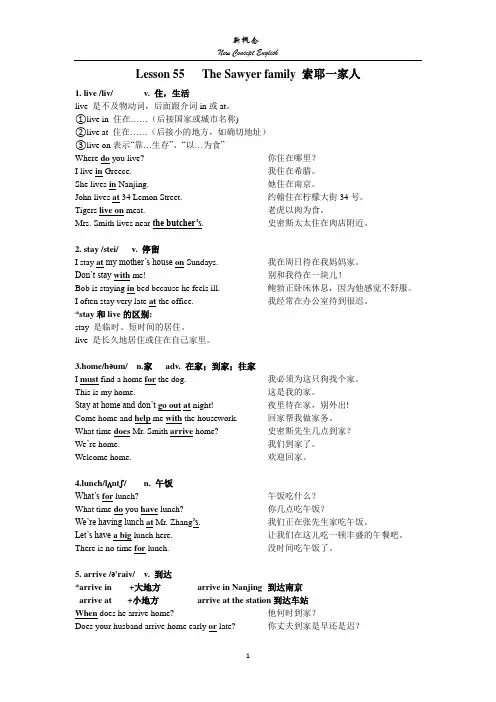
live
【用法】 v. 居住;生活;活,生计;靠 ⋯⋯ 生活
【 】 live on 靠⋯⋯ 生;以 ⋯⋯ 食 live by 靠⋯⋯
生;住在 ⋯⋯ 邻近
live in Beijing 住在北京
live at a small hotel 住在一个小旅
live on the second floor 住在二楼 live
on a farm 住在一个 【例句】 Frank lives in Paris. 弗 克居住在巴黎。
Fish can’t live without water. 没有水 活
不了。
He lives on/by teaching. 他靠教课 生。 Deer live on plants. 鹿靠吃植物 生。
Mr. Green lives by a small river. 格林先生住在一条小河邻近。
stay
【用法】 v. 呆在,逗留;持 ,保存
【 】 stay at home 呆在家
stay behind 跟在后边,留下来
stay up 熬夜
【例句】 Mrs. White stays at home every day. 特太太每天都呆在家中。
We were staying at the same hotel. 我 住在同一家 店。
The house has to stay exactly as it was. 所房屋必 完整保持本来的 子。
home
【用法】 n. 家( );本国
adv. 在家,到家
【短 】 at home 在家
get home 到家
go home 回家
【 展】 homework n. 家庭作
housework n. 家
homeland n. 祖国
hometown n. 家
homeless adj. 无家可 的
arrive
【用法】 vi. 抵达(不及物 )
【 】 arrive in + 大地址 抵达
arrive at + 小地址 抵达
【 展】 get to + 地址 抵达
reach + 地址 抵达
【例句】 He arrived in Beijing in 2019. 他是 2019 年
来的北京。
We arrived at the train station at 5p.m. 我
是下午 5 点到火 站的。
表示一天的时间的词 (n.)
dawn 清晨 at dawn 拂
morning 清晨,上午 in the morning 在上午
noon 正午 at noon 正午
midday 正午 at midday 正午
afternoon 下午 in the afternoon 在下午
dusk 傍晚 at dusk 傍晚 刻
evening 夜晚 in the evening 在夜晚
night 夜晚 at night 在夜晚
midnight 子夜 at midnight 子夜 分
表示三餐的词 (n.)
breakfast 早饭 brunch 早午饭
lunch 午饭 supper 晚饭
dinner 正餐 meal 一
此 前都可加 have,表示“吃 ⋯⋯ ”“喝 ⋯⋯ ”;
比方 have lunch 吃午 have a drink 喝 料
Text Explanation
The Sawyer family / ?s?:j ? /
【 文】索耶一家人
【用法】英 中表示“姓 ⋯⋯ 的一家人”的方法有以下两种: (以 Lee 姓 例)
○1 the Lee family 姓李的一家人。 ( the + 姓 + family )
○2 the Lees 姓李的一家人。 ( the + 姓的复数)
以上两个 作主 ,都被看做是复数。比方:
The Lee family are playing cards in the park. 姓李的一家人正在公园里打牌。
The Lees are both teachers. 李姓夫 都是教
In the morning, Mr. Sawyer goes to work and the children go to school.
【 文】清晨,索耶先生去上班,孩子 去上学。
【用法】 go to work 去上班 / go to school 去上学 由 go 引出的短 有: go to bed 上床睡
注意: 名 work, school, bed 前不加任何冠 。
Their father takes them to school every day.
【 文】父 每天送孩子 去上学。
【用法】○1 take sb. to some place 某人去某地。比方:
My parents often take me to the park. 我父亲母亲 常 我去公园。
○2 school 前没有冠 ,泛指“上学” 。假如加上 the, 特指去某一学校。
○3 every day “每天”,在句中做状 ( 状 ) 。
Mrs. Sawyer stays at home every day. She does the housework.
【 文】索耶夫人每天呆在家里。她料理家 。
【用法】○1 stay at home “呆在家里” ,是固定搭配; home 是名 ,作介 at 的 成分。
stay home 也是“呆在家里” , home 是副 ,作状 。
英 中有些 被称 “地址副 ” ,此 以前是不可以加介 的,比方: home, here, there,
abroad(在外国)等。 go home, come here, arrive there(到那边) , go abroad(出国)。 ○ do the housework “料理家 ” , housework 是不行数名 , 似 有 do the homework 。
2
She usually sees her friends. They often drink tea together.
【 文】她往常去探望他的朋友。
【用法】○1 see sb. 探望某人,拜 某人 = visit sb.
see sb. off 某人送别 / meet sb. + 地址 去 ⋯⋯ 接某人
2
○ drink tea = have tea 品茶
have“吃,喝” 既能够取代 drink 也能够取代 eat
In the evening, the children come home from school. They arrive home early.
【 文】夜晚,孩子 下学回家。他 到家很早。
【用法】 come home from school “下学回家” ,介 from 表示“从 ⋯⋯ ”;come home 表“回家来” ;
arrive home “到家”;
两句的 home 都是地址副 ,前方不用任何介 ,因此我 不 come to home 和 arrive at
home。下文中的 come home from work “下班回家” ,和 arrives home“到家”也是此种用法。
Mr. Sawyer usually reads his newspaper, but sometimes he and his wife watch television.
【 文】索耶先生 是 ,但有 和他老婆一同看 。
【用法】 ○1 read newspaper“ ”,此 用 read,不可以用 look at 。 似 有: read a book ,
read a map 看地
第2页/共3页
○2 he and his wife 作主语,是两个人复数形式,所此后边的 watch 不用 watches。
Grammar Analysis
一般此刻时(二)
【用法】一般此刻是用于表示一个习惯动作、有规律的行为以及永久的现象。一般与时间频度副词和时间短语连用。
时间短语: every day / week / month / year 每天 / 周 / 月 / 年
in the morning / afternoon / evening 在上午 / 下午 / 夜晚
at noon / night 在正午 / 夜里
频次副词: always, usually, often, sometimes, seldom, once( 一次 ), never, hardly( 几乎不 )
频次副词在句中的地点为: be 动词、助动词和神态动词以后,行为动词(实义动词)以前,
有时也可放在句首或句尾。 比方:
It is sometimes rainy. 天气有时多雨。
It rains sometimes. 有时下雨。
在否认句中,频次副词放在 not 的前或后含义不一样。比方:
The weather is not always pleasant. 天气其实不老是很宜人。
The weather always isn’tpleasant. 天气老是不好。
动词的第三人称单数变化形式
【用法】在一般此刻时中,当主语是第三人称单数的时候,后来的谓语动词往常要随之发生变化,其
规律为:
○1 直接加 -s,如:
come — comes arrive — arrives
○2 以 -s, -x, -sh, -ch, -o 结尾的动词加 -es,如:
guess — guesses fix----fixes wash — washes watch — watches go — goes
○3 以辅音加 -y 结尾的动词,把 -y 变为 -i ,再加 -es;而元音加 -y 结尾的动词,只加 -s 即可,
如:
hurry — hurries carry — carries play — plays stay — stays
第3页/共3页