
武汉大学分子生物学-2003真题
- 格式:pdf
- 大小:70.55 KB
- 文档页数:1
武汉大学2001年细胞生物学一、名词解释(10*2.5)1、apoptosis body2、receptor mediated endocytosis3、lamina4、nuclease hypersensitive site5、gap junction6、hayflick limitation7、kinetochore8、molecular chaperones9、leader peptide10、dedifferentiation二、简答题 (8*5)1. 冰冻断裂术将溶酶体膜撕裂出PS,ES,PF,EF四个面,请绘一简图标明。
2. 医生对心脏已经停止跳动的病人采取电击抢救,请说明其心肌细胞是如何同步启搏的。
3. 为什么凋亡细胞的核DNA电泳图谱呈梯状分布带。
而病理坏死细胞却呈弥散状连续分布?4. 将某动物细胞的体细胞核移植到另一去核的体细胞之中,然后其余实验步骤完全按照动物克隆的方式,问能否培育出一头克隆动物来?为什么?5. 切取病毒感染马铃薯植株的顶芽进行组织培养,这是大量繁育无毒苗的成功技术。
试述其去除病毒的原因。
6. 有人认为既然已经有放大几十万倍的电镜,可以不用光镜了,请反驳这种观点的错误。
7. 出生6个月之内的婴儿可由母乳获得抗病的抗体,试述这些抗体是如何由母亲血液转移到婴儿血液中的。
8. 1999年报道,我国科学家成功实现将离体的B型血液改造成O型,请解释其原理。
三、问答题(前两题10分,最后一题15分)1. 概述Cyclin与CDK在细胞周期调控的工作机制及其在各期引起的下游事件。
2. 试述在细胞质中合成的线粒体内膜蛋白及叶绿体类囊体膜蛋白是如何运送到位与装配的。
3. 综述细胞外被中糖蛋白在细胞内合成,组装和运输的全过程及其对于细胞的主要生理功能。
武汉大学2002年细胞生物学一、名词解释(10*2.5)1.nucleosome2.contact inhibition3.Telomerase4.exocytosis5.gap junction6.kinetochore7.heterochromatin8.channel protein9.dynein arm10.molecular switches二、简答题 (8*5)1. 分别以一句话简述1999年和2001年诺贝尔奖获奖项目中有关细胞生物学的内容。
分子生物学习题库与参考答案一、单选题(共49题,每题1分,共49分)1.可以实现体细胞克隆的技术是:A、基因编辑B、聚合酶链式反应C、诱导多能干细胞D、体细胞核移植正确答案:D2.在PCR反应中,引物与模板的结合温度约为:A、37°CB、55°CC、72°CD、95°C正确答案:B3.大肠杆菌对于基因克隆的主要作用是:A、提供连接酶B、合成引物C、表达目的蛋白D、作为宿主正确答案:D4.将单链DNA合成双链的酶是:A、连接酶B、DNA聚合酶C、裂解酶D、RNA聚合酶正确答案:B5.可以增加靶标DNA拷贝数的技术是:A、PCRB、电泳C、测序D、印迹杂交正确答案:A6.在Southern杂交中起探针作用的是:A、DNAB、RNAC、载体D、引物正确答案:A7.编码氨基酸顺序信息的DNA序列称为:A、启动子B、基因C、外显子D、启动密码子正确答案:B8.可以自我复制的核酸是:A、mRNAB、rRNAC、tRNAD、miRNA正确答案:B9.DNA聚合酶在PCR反应过程中不需要的元素是:A、铜离子B、镁离子C、锰离子D、钾离子正确答案:A10.启动子序列通常位于:A、转录起始点上游B、编码区C、基因内含子D、终止子上游正确答案:A11.可以直接导入植物细胞的方法是:A、阳离子脂质体法B、农杆菌法C、微粒射击法D、电穿孔法正确答案:B12.DNA的组成单位是:A、氨基酸B、核苷酸C、核糖D、脱氧核糖正确答案:B13.农杆菌可以将T-DNA转入植物细胞的原因是:A、具有连接酶B、具有限制性内切酶C、具有转座子D、可以与植物细胞膜融合正确答案:C14.DNA测序中的Sanger方法利用了:A、引物延伸终止B、核酸杂交C、蛋白质切割D、荧光标记正确答案:B15.可以用于克隆目的基因的载体是:A、慢病毒B、质粒C、线性DNA分子D、mRNA正确答案:B16.属于真核生物的模型生物是:A、小鼠B、酵母C、果蝇D、以上所有正确答案:D17.可以将质粒DNA转入宿主细胞的是:A、限制性内切酶B、DNA连接酶C、显微注射器D、电穿孔仪正确答案:C18.可以直接将外源基因导入植物细胞的是:A、电穿孔法B、微注射法C、生物炮法D、农杆菌法正确答案:D19.检测蛋白质的方法不是:A、Western印迹B、质谱C、Northern印迹D、免疫印迹正确答案:C20.对DNA进行切割的酶类包括:A、分裂酶B、连接酶C、制限酶D、聚合酶正确答案:C21.可以直接检测蛋白质的方法是:A、PCRB、Northern blotC、Western blotD、Southern blot正确答案:C22.提供能量驱动翻译反应的化学键是:A、糖苷键B、磷酸酯键C、硫磷键D、氢键正确答案:B23.编码线粒体蛋白质的基因主要位于:A、细胞质DNAB、线粒体DNAC、细胞核DNAD、质粒DNA正确答案:B24.下列DNA酶类能切断磷酸二酯键的是:A、连接酶B、DNA聚合酶C、替代酶D、制限酶正确答案:D25.在制备重组DNA时,使用琼脂糖的目的是:A、提供营养B、连接DNA段C、物理分离片段D、催化连接反应正确答案:C26.是mRNA而不是tRNA或rRNA的特征是:A、可翻译成蛋白质B、可与核糖体结合C、含有多肽链D、富含无义密码子正确答案:A27.对蛋白表达的后翻译调控方式是:A、剪接体B、RNA编辑C、蛋白质水解D、磷酸化正确答案:C28.编码tRNA的基因位于:A、线粒体B、核糖体C、细胞核D、细胞质正确答案:C29.单克隆抗体技术利用的真核细胞是:A、诱导的多能干细胞B、杆状病毒感染的淋巴细胞C、转化的肿瘤细胞D、融合瘤细胞正确答案:D30.原核生物基因组中不含有的序列是:A、终止子B、编码区C、启动子D、外显子正确答案:D31.制备cDNA文库常用的反转录酶来源于:A、大肠杆菌B、反刍动物C、艾滋病毒D、枯草杆菌正确答案:C32.编码氨基酸的三联密码所在的核酸是:A、mRNAB、rRNAC、tRNAD、盖帽RNA正确答案:C33.参与DNA复制的关键酶是:A、RNA聚合酶B、连接酶C、DNA聚合酶D、选择酶正确答案:C34.编码rRNA的基因通常组织成:A、基因簇B、可变剪接体C、假基因D、反义基因正确答案:A35.编码 rRNA 的基因位于:A、线粒体DNAB、质粒DNAC、细胞核DNAD、细胞质DNA正确答案:C36.将DNA上的遗传信息转录为RNA的过程称为:A、翻译B、转录C、复制D、修复正确答案:B37.PCR技术依赖的关键酶是:A、连接酶B、聚合酶C、裂解酶D、制限酶正确答案:B38.编码氨酰tRNA合成酶的RNA是:A、mRNAB、rRNAC、tRNAD、siRNA正确答案:B39.可以实现定点诱变的技术是:A、CRISPR/Cas9B、ZFNsC、TALENsD、以上均可正确答案:D40.利用生物信息学分析推测基因功能的方法是:A、突变分析B、蛋白质互作C、序列比对D、同源建模正确答案:C41.可以改变染色体DNA序列的技术是:A、基因敲除B、基因转染C、基因沉默D、基因编辑正确答案:D42.下列不属于PCR反应体系的组成部分是:A、DNA模板B、聚合酶C、dNTPD、琼脂糖正确答案:D43.检测目的蛋白表达的方法不是:A、Southern blottingB、Western blottingC、Eastern blottingD、Northern blotting正确答案:A44.从cDNA库中可以获得的是:A、所有DNA片段B、编码区序列C、非编码区序列D、全部基因组序列正确答案:B45.可以直接克隆cDNA的是:A、质粒B、YACC、λ噬菌体D、人工染色体正确答案:A46.病毒载体导入宿主细胞的方法是:A、共转化B、显微注射C、电穿孔D、吸附感染正确答案:D47.可以识别启动子序列的转录因子是:A、β因子B、α 因子C、σ 因子D、Rho因子正确答案:C48.可以直接提取基因组DNA的方法是:A、PCRB、Northern blotC、Southern blotD、盐析法正确答案:D49.基因敲除实验中所用对照组应为:A、目的基因缺失组B、野生型组C、质粒载体组D、siRNA处理组正确答案:B二、多选题(共35题,每题1分,共35分)1.PCR反应的原料不包括:A、引物B、载体酶C、聚合酶D、dNTPE、模板DNAF、琼脂糖G、无橡皮管封闭正确答案:BFG2.对DNA序列进行PCR扩增需要以下原料:A、模板DNAB、载体酶C、引物D、连接酶E、脱氧核苷三磷酸F、DNA聚合酶G、以上ACF正确答案:G3.质粒载体应具有下列哪些特征:A、大片段插入区B、可自主复制C、含有筛选位点D、与宿主互作E、含有克隆位点F、编码病毒蛋白G、低拷贝数正确答案:BCE4.在制备cDNA文库时需要用到的关键酶包括:A、连接酶B、PCR酶C、限制性内切酶D、RNA聚合酶E、反转录酶F、RNase HG、链化酶正确答案:EF5.编码氨基酸序列的核酸为:A、rRNAB、mRNAC、tRNAD、mRNA前体E、单链RNAF、双链RNAG、环状RNA正确答案:B6.制备重组质粒的主要步骤是:A、载体线性化B、消化插入片段C、连接反应D、感受态细胞制备E、转化宿主细胞F、克隆鉴定G、所有以上步骤正确答案:G7.对肿瘤基因组的检测可以应用:A、Southern印迹B、Northern印迹C、Western印迹D、Eastern印迹E、基因检测F、测序G、基因芯片正确答案:AEFG8.基因表达调控的机制包括:A、转录水平调控B、RNA水平调控C、翻译水平调控D、蛋白活性调控E、基因增幅F、肽链释放G、以上AD均可正确答案:G9.参与翻译过程的RNA包括:A、mRNAB、rRNAC、tRNAD、siRNAE、snRNAF、反义RNAG、以上ABC均参与正确答案:G10.编码氨基酸序列的核酸为:A、rRNAB、mRNAC、tRNAD、cDNAE、基因F、反义链G、互补链正确答案:B11.PCR反应的原料组成包含:A、模板 DNAB、上游引物C、下游引物D、DNA聚合酶E、脱氧核苷三磷酸F、缓冲液G、以上ABDEF正确答案:G12.基因敲入的方法可以包括:A、siRNAB、基因敲除C、ZFNsD、TALENsE、CRISPR/Cas9F、Cre-Lox重组系统G、反义RNA抑制正确答案:CDEF13.编码脱氧核糖的DNA单链为:A、编码链B、反义链C、互补链D、下游链E、正义链F、上游链G、载体链正确答案:B14.基因编辑技术包括:A、ZFNs技术B、TALENs技术C、CRISPR/Cas技术D、基因敲除E、RNAi技术F、慢病毒介导G、以上所有正确答案:ABC15.制备重组DNA的步骤包括:A、载体选择B、插入DNA获得C、双酶切D、连接反应E、转化F、筛选G、以上全部正确答案:G16.参与制备cDNA文库的关键酶类有:A、连接酶B、限制性内切酶C、聚合酶D、反转录酶E、核酸酶F、RNase HG、以上DE正确答案:G17.制备重组质粒的关键步骤不包括:A、载体的选择B、消化载体及插入片段C、连接反应D、PCR扩增插入片段E、转化感受态细胞F、筛选重组克隆G、测序验证正确答案:D18.启动子序列的特征包括:A、定位于基因转录起始点上游B、通常为AT富集区C、具有内含子D、与编码区互补E、与编码区反向验配F、与编码区部分重叠G、保守性非常低正确答案:AB19.直接参与蛋白质翻译的分子包括:A、DNAB、mRNAC、rRNAD、tRNAE、RNA聚合酶F、释放因子G、所有以上分子正确答案:BCDF20.制备重组质粒需要下列步骤:A、载体选择B、消化载体和插入DNAC、连接反应D、感受态细胞制备E、转化宿主细胞F、克隆筛选G、以上全部正确答案:G21.检测mRNA的方法包括:A、Northern杂交B、Western印迹C、Southern印迹D、荧光in situ杂交E、实时定量PCRF、RNA序列表达谱分析G、以上ABDF正确答案:G22.启动子通常位于:A、翻译起始点上游B、转录终止点下游C、翻译终止点下游D、基因内含子E、编码区F、转录起始点上游G、终止子下游正确答案:F23.编码氨基酸序列信息的核酸为:A、DNAB、RNAC、mRNAD、tRNAE、rRNAF、cDNAG、质粒正确答案:C24.基因敲入的技术可以包括:A、siRNAB、基因敲除C、ZFNsD、TALENsE、CRISPR/Cas9系统F、Cre-Lox重组系统G、反义DNA正确答案:CDEF25.制备重组 DNA 需要以下技术:A、载体准备B、PCR 扩增插入片段C、引物设计D、双酶切连接E、宿主细胞转化F、筛选重组克隆G、以上全部正确答案:G26.编码氨基酸序列的核酸为:A、DNAB、mRNAC、rRNAD、tRNAE、miRNAF、cDNAG、基因正确答案:B27.编码mRNA的DNA单链被称为:A、编码链B、上游链C、下游链D、正义链E、反义链F、互补链G、载体链正确答案:E28.Polymerase Chain Reaction (PCR) 的关键步骤不包括:A、模板变性B、引物与模板杂交C、新链延伸合成D、反向转录E、新链变性F、产物检测G、增幅后转化正确答案:D29.Polymerase Chain Reaction (PCR) 的关键步骤包括:A、模板预变性B、引物与模板退火C、新链延伸合成D、产物检测E、反义链合成F、连接酶反应G、以上全部正确答案:ABCD30.编码氨基酸的三联密码存在于:A、DNA双链上B、mRNA分子上C、tRNA分子上D、rRNA上E、盖帽RNA上F、启动子区域G、终止子区域正确答案:C31.抑制基因在体细胞中的表达方法有:A、siRNAB、基因敲除C、反义RNAD、CRISPR/Cas9E、基因激活F、启动子激活G、剪切反应激活正确答案:ABD32.检测mRNA表达水平的技术是:A、北方印迹B、西方印迹C、南方印迹D、东方印迹E、In situ杂交F、免疫组化G、芯片杂交正确答案:AEG33.编码氨基酸的三联密码存在于:A、DNA双链上B、mRNA分子上C、tRNA分子上D、rRNA 上E、盖帽RNA上F、启动子区域G、终止子区域正确答案:C34.可以提高基因在异源表达载体中的表达水平的方法不包括:A、扩增子克隆B、终止子序列调控C、引入变位信号D、改良启动子序列E、引入选择标记F、优化文库构建方法G、优化编码序列正确答案:F35.可以提取基因组DNA的方法有:A、PCR扩增B、Northern印迹C、Southern印迹D、过滤法E、质谱法F、限制性酶切G、盐析法正确答案:CG三、判断题(共38题,每题1分,共38分)1.基因敲入可以使用双链DNA分子实现。
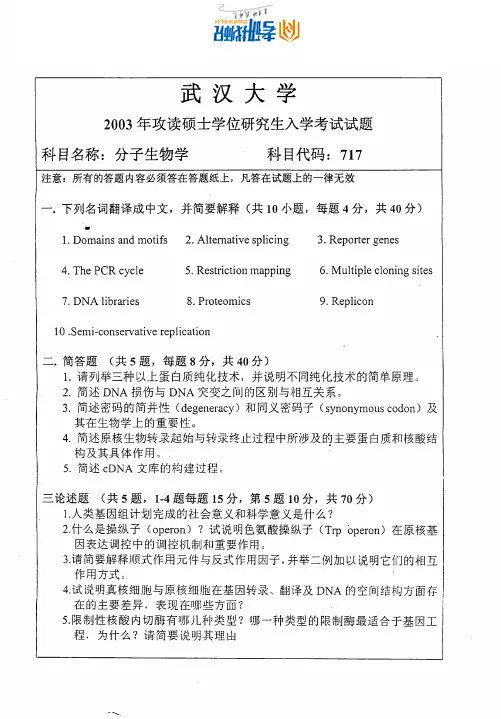
武汉大学2003年分子生物学一、下列名词翻译成中文,并简要解释(共10小题,每题4分,共40分)1、Domains and motifs2、Alternative splicing3、Reporter genes4、The PCR cycle5、Restriction mapping6、Multiple cloning sites7、DNA libraries8、Proteomics9、Replicon10、Semi-conservative replication二、简答题 (共5题,每题8分,共40分)1、请列举三种以上蛋白质纯化技术,并说明不同纯化技术的简单原理。
2、简述DNA损伤与DNA突变之间的区别与相互关系。
3、简述密码的简并性(degeneracy)和同义密码子(synonymous codon)及其在生物学上的重要性。
4、简述原核生物转录起始与转录终止过程中所涉及的主要蛋白质和核酸结构及其具体作用。
5、简述cDNA文库的构建过程。
三、论述题 (共5题,1-4题每题15分,第5题10分,共70分)1、人类基因组计划完成的社会意义和科学意义是什么?2、什么是操纵子(operon)?试说明色氨酸操纵子(Trp operon)在原核基因表达调控中的调控机制和重要作用。
3、请简要解释顺式作用元件与反式作用因子,并举二例加以说明它们的相互作用方式。
4、试说明真核细胞与原核细胞在基因转录、翻译及DNA的空间结构方面存在的主要差异,表现在哪些方面?5、限制性核酸内切酶有哪几种类型?哪一种类型的限制酶最适合于基因工程,为什么?请简要说明其理由。
武汉大学2004年分子生物学一、名词翻译与解释1、synonymous codons2、RNA editing3、Spliceosome4、Microarray5、Plaque hybridization6、Open reading frame7、Ribozyme8、RFLP9、Site specific recombination10、RNA interference二、简答题(共5小题,每小题10分,共50分)1、简述真核生物 rRNA基因,tRNA 基因和mRNA基因的转录机制。
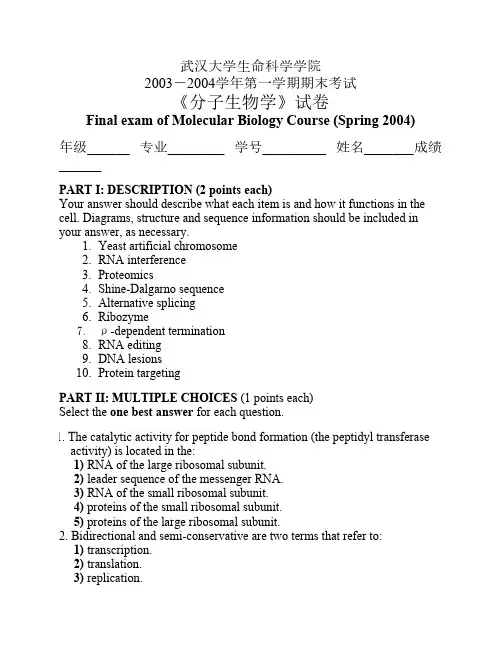
武汉大学生命科学学院2003-2004学年第一学期期末考试《分子生物学》试卷Final exam of Molecular Biology Course (Spring 2004)年级______ 专业________ 学号_________ 姓名_______成绩______PART I: DESCRIPTION (2 points each)Your answer should describe what each item is and how it functions in the cell. Diagrams, structure and sequence information should be included in your answer, as necessary.1. Yeast artificial chromosome2. RNA interference3. Proteomics4. Shine-Dalgarno sequence5. Alternative splicing6. Ribozyme7. ρ-dependent termination8. RNA editing9. DNA lesions10. Protein targetingPART II: MULTIPLE CHOICES (1 points each)Select the one best answer for each question.1. The catalytic activity for peptide bond formation (the peptidyl transferaseactivity) is located in the:1) RNA of the large ribosomal subunit.2) leader sequence of the messenger RNA.3) RNA of the small ribosomal subunit.4) proteins of the small ribosomal subunit.5) proteins of the large ribosomal subunit.2. Bidirectional and semi-conservative are two terms that refer to:1) transcription.2) translation.3) replication.4) all of the above.5) none of the above.3. The fact that most amino acids are specified by multiple codons is known as:1) the “wobble” phenomenon.2) the universality of the genetic code.3) codon bias.4) the anticodon hypothesis.5) the redundancy of the genetic code.4. RNA polymerase I is the eukaryotic enzyme responsible for:1) transcription of ribosomal RNA.2) transcription of transfer RNA and other small RNA species.3) transcription of messenger RNA.4) initiation of Okazaki fragment synthesis in DNA replication.5. Restriction enzymes can cleave DNA that is either single-stranded ordouble-stranded, as long as it contains the appropriate recognition site.1) True 2) False6. Information about the sequence of the coding region of a gene is bestobtained from:1) a YAC clone.2) a genomic clone.3) a cDNA clone.4) the protein.7. A chromatography method that can be used specifically to purify proteinsbased on their charge is:1) gel filtration chromatography.2) ion-exchange chromatography.3) DNA affinity chromatography.4) antibody affinity chromatography.8. A nonsense mutation is a change in the DNA sequence that results in:1) a small deletion or insertion.2) an amino acid change in the protein encoded by the gene.3) a premature stop codon.4) all of the above.5) none of the above.9. A protein complex involved in degradation of proteins within the cell isknown as the:1) ubiquitin/proteasome system.2) molecular chaperone.3) chaperonin.4) ribosome.5) Krebs/TCA cycle.10. ___binds to the repressor and turn on the transcription of the structuralgenes in the Lac operon.1) cAMP2) lactose3) allolactose4) CRP11. Which of the following RNA species is involved in degradation of themRNA containing complementary sequence1) miRNA2) siRNA3) tRNA4) 5S RNA5) U3 snRNA12. The genome sequencing projects are confirming the theory that genome sizeis directly proportional to the number of genes contained within that genome.In other words, a genome that is 10 times as big will contains approximately10 times as many protein coding genes.1) True 2) False13. HeLa cells, derived from a human cervical carcinoma, are able topropagate indefinitely in culture and are therefore known as a(n):1) tissue culture.2) tumor.3) transgenic cell line.4) immortalized cell line.14. E. coli cells are smaller than yeast cells.1) True 2) False15. Which of the following domains is not a DNA binding domain1) Proline-rich domains2) Helix-turn helix domains3) Zinc finger domains4) Basic domains16. The aminoacyl-tRNA synthetases distinguish between about 40 differentshaped tRNA molecules in the cells.1) True 2) FalsePART III: SHORT QUESTIONS (8 points each)1. How do bacterial replication start and accomplished. Remember toinclude the proteins/enzymes and important DNA sequence involvedin this process.2. Design experiments to clone a yeast gene and express this gene inyeast.3. Below is the multiple cloning site (MCS) of the plasmid vectorpUC18 and the N-terminal and C-terminal sequence of protein X.Note that the MCS constitutes a part of the LacZ open reading frame.Suppose that you are going to clone the protein X gene into pUC18,so that your target gene is transcribed under the control of LacZpromoter, and translated with the LacZ gene to produce a fusionprotein. You are requested to use Bam HI and Pst I to the clone Xgene, please add these restriction sites on the correspondingposition of the X gene. Remember to maintain the reading frame ofthe X gene with the LacZ gene4.(1) MCS of pUC18Eco RI Sac I Kpn I Sma I Bam HI Xba I Sal I Pst IACG AAT TCG AGC TCG GTA CCC GGG GAT CCT CTA GAG TCG ACC TGC AGG CAT GCAThr Asn Ser Ser Ser Val Pro Gly Asp Pro Leu Glu Ser Thr Cys Arg His AlaLac Z(2) N-terminal sequence of X gene. ATG ACC CCU CAU AAC GGC GAC…Met Thr Pro His Asn Gly Asp…(3) C-terminal sequence of X gene. …GAU AGU ACA GCU GCC AAG TAA… Asp Ser Thr Ala Ala LysPART IV: MAJOR QUESTIONS (20 points each)1: Please describe how an mRNA gene is transcribed, processed and translated in human cells. What are the possible mechanisms in regulating the expression of this gene?2 (20 points): A bacterium is found to metabolize a rare sugar produced by a plant that the bacteria grow on. However, the bacteria prefer glucose as the energy source. The problem is, if you want to finish this course with a satisfied score, you must figure out the regulatory mechanism that the bacteria used to determine the sugar choice.The gene involving in the rare sugar metabolism has been identified as fun3. You can use northern blot to analyze the expression of fun3 and use DNA footprinting to analyze the binding of proteins to the control elements of fun3 gene. The following table shows the experimental resultsGlucose presence RaresugarpresenceLevels offun3 RNABinding of proteins---Protein A binds to the promoterregionProtein C binds upstream of thepromoter+--Protein A binds to the promoterregion-++++Protein B binds to the promoterregionProtein C binds upstream of thepromoter+++Protein B binds to the promoterregionQuestions:1. Please propose a mechanism to explain the above results. You shouldfocus on the question “How does the expression of fun3 gene istightly regulated so that it is only highly expressed when the raresugar is the only carbon source”. You must answer what proteins A,B andC are. (8 points)2. How is protein A regulated? (2 points)(1) glucose turns the repressor on(2) glucose turns the repressor off(3) the rare sugar turns the repressor on(4) the rare sugar turns the repressor off3. How is protein C regulated? (2 points)(1) glucose turns the activator on(2) glucose turns the activator off(3) the rare sugar turns the activator on(4) the rare sugar turns the activator off4. How could you make the bacteria always use the rare sugar as theenergy source even in the presence of glucose? (8 points)。