人教版七年级上册unit4讲义
- 格式:docx
- 大小:29.47 KB
- 文档页数:20
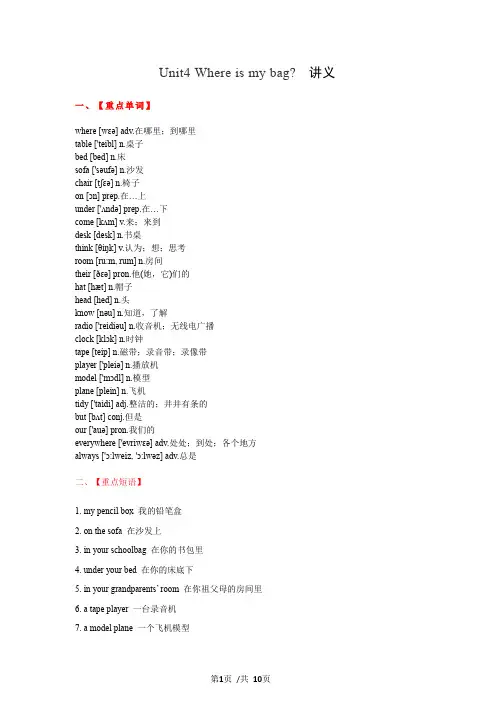
一单词where [wɛə] adv.在哪里;到哪里table ['teibl] n.桌子bed [bed] n.床bookcase ['bukkeis] n.书架;书柜sofa ['səufə] n.沙发chair [tʃɛə] n.椅子on [ɔn] prep.在…上under ['ʌndə] prep.在…下come [kʌm] v.来;来到come on 快点儿desk [desk] n.书桌think [θiŋk] v.认为;想;思考room [ru:m, rum] n.房间their [ðɛə] pron.他(她,它)们的hat [hæt] n.帽子head [hed] n.头yeah [jʒə] interj.是的;对know [nəu] n.知道,了解radio ['reidiəu] n.收音机;无线电广播clock [klɔk] n.时钟tape [teip] n.磁带;录音带;录像带player ['pleiə] n.播放机tape player 录音机model ['mɔdl] n.模型plane [plein] n.飞机model plane 飞机模型tidy ['taidi] adj.整洁的;井井有条的but [bʌt] conj.但是our ['auə] pron.我们的everywhere ['evriwɛə] adv.处处;到处;各个地方always ['ɔ:lweiz, 'ɔ:lwəz] adv.总是重点单词:1.desk 和tabletable 可数名词,意为“桌子”There is a table in my room . 在我房间里有一张桌子。
【拓展】at table 在进餐,在吃饭at the table 在桌子旁边辨析:table与desktable 指“圆桌;饭桌”是用餐、会谈或消遣时所用的桌子,可以是方形的、原形的一般不带抽屉A table for two, please . 请安排两人一桌的位子。
desk指“书桌;课桌”是读书、办公时所用的桌子一般带有抽屉There are many desks in our classroom .在我们的教室里有许多书桌。
2.bed n. 床。
常见搭配:go to bed睡觉;make the/one’s bed整理床铺/整理某人的床铺;be ill in bed生病卧床(e.g. He was ill in bed yesterday.);be in bed 卧床,在床上(e.g. John: Where are you? Sarah: I am in bed.)get/jump out of bed下床;put sb. to bed安顿某人睡觉。
(e.g. I always put my grandpa to bed, then I do my homework.)3.know 知道;了解(1)vi. I don’t know.我不知道。
(2)vt. 知道/了解某人/某事4. bring与takebring v. 带,带来。
常见用法:1)bring sth. to sb. 把某物带来给某人。
e.g. Please bring the ring to my mother.请把戒子带来给我妈妈。
2)bring sb. sth. 给某人带来某物。
e.g. Your father asks you to bring him his book.你爸爸叫你把他的书带回来给他。
3)bring sb. to sp. 带某人来某地。
e.g. Mom brought me to the park. I can play all day.我妈妈带我来公园的,我可以玩一整天呢。
4)特殊用法:bring sb. home/here 带某人回家/到这.说明:sp.表示某地。
当表示地点的词为home/here/there等的时候,不能加介词to.因为是副词直接做状语。
e.g. Mom: Who brought you home?Son: The police officer brought me home.e.g. My father brought me here and then he left me.我爸爸把我带到这了,之后便离开了。
take v.带,带走,带去。
常见用法:1)take sth. to sb. 把某物带去给某人。
e.g. Please take this book to Mr. Ding.请把这本书带给丁先生。
2)take sb. to sp. 带某人去某地。
e.g. My mom took me to the park yesterday.3)特殊用法:take sb. home/there 带某人回家/去那说明:sp.表示某地。
当表示地点的词为home/here/there等的时候,不能加介词to.因为是副词直接做状语。
e.g. John: Police officer, please take me home. I am lost.警察先生,请带我回家。
我迷路了。
Police officer: OK!e.g. The bus stop is very far. Take me there, please. 巴士车站很远,请带我去。
5. but conj. 但是but连接两个并列成分或句子表示转折关系,前后意思相反或相对,意为“但是;然而”.I’m tidy, but Gina is not.and连接两个并列成分或句子表示并列关系,表示意思的顺延或增补,意为“和;并且;而(且);同时”。
My pencil box is in my schoolbag and my schoolbag is under the desk.英语中由but和and连接而成的句子称为“并列句”。
and连接的并列成分作主语,谓语动词用复数。
【拓展】并列连词还有:(1)or表示选择关系,意为“或者”Is your book or his?(2)so常连接两个简单句,意思上有因果关系,意为“因此,所以”Gina is not tidy, so she always asks “where is my schoolbag?”6.always adv 总是,经常它常和一般现在时连用,表示现在经常或反复发生的动作。
有时候也可表示过去经常性、习惯性发生的动作。
一般放在系动词be、助动词、情态动词之后,实义动词之前。
e.g. Bill always asks me “why”.比尔总是问我“为什么”。
7.radio 收音机radio 可数名词,意为“收音机”复数形式为radios。
My grandfather has two radios . 我爷爷有两台收音机。
【拓展】以o结尾的名词变复数时,可以在词尾直接加-s的单词有:zoo 动物园,kangaroo 袋鼠,bamboo竹子,photo照片,radio收音机,piano钢琴等。
助记:袋鼠在动物园里一边观看竹子的照片,一边聆听收音机里的钢琴声。
8.clock时钟clock可数名词, 意为“时钟”There is a clock on the wall . 墙上有一个时钟。
注意:clock与o’clock在形式上只有很小的差别,但意义不同:clock的意思是“钟表”而o’clock 的意思是“点钟”表示整点。
如:five o’clock “5点钟”辨析:clock与watchclock指挂钟、闹钟或建在钟楼、钟塔上的钟表等。
watch 指手表、怀表或秒表等。
9.everywhere adv.复合型副词。
由every 和where组成。
表示“处处,到处,各个地方”。
一般用来形容物品的位置。
练习根据提示回答下面的问题What is this in English? It is a ____.(书桌)Is this your ____?(课本)I am ____.(整洁的)The keys are on the s ____.二重点短语under the table在桌子下面on the sofa在沙发上computer game电脑游戏under the bed 在床下on the table在餐桌上come on快点儿on your desk在你的书桌上under the chair在椅子下面on their bed在他们的床上on your head在你头上tape player 录音机model plane飞机模型under the radio在收音机下面in the bookcase 在书柜里on the desk在书桌上pencil box铅笔盒under the desk在书桌下三句型1.Where’s my schoolbag? It is under the table.where疑问副词,一般引导特殊疑问句,询问别人地点、位置、场所的时候使用。
句型结构为Where + Be + 主语?回答It is 或者是They are + 表示方位的介词短语。
* 特殊疑问句是以特殊疑问词开头,对句中某一成分提问的句子叫特殊疑问句。
2.Are the keys on the sofa?Yes, they are.No, they aren’t.*这是由be动词引导的一般疑问句。
be的数是由主语的数决定的。
they 指上文出现的keys,这是用they代替以免重复。
⑴. they 是人称代词主格,意为“他们;她们;它们,是人称代词he, she, it 的复数形式。
常用来指代复数的人或物。
These are my brothers. They are students .这些是我的兄弟,他们是学生。
(they指代my brothers)I have two books. They are interesting .我有两本书,它们很有趣。
(they指代two books )e on, Jack!快点儿,杰克!说明:这个句子是一个祈使句。
come on 意思是“快点”,用来催促别人快走或快做。
英语中还可以用Hurry (up)!表示催促。
e.g. Come on,it’s g etting dark.快点儿,天要黑了。
补充:祈使句的否定在句首加don’t.e.g. Don’t come to my house.别来我家。
e.g. Don’t talk in the library.别再图书馆说话。
【拓展】come on的其他含义:①. 用来表示请求、鼓励、劝说等,意为“来吧;行啦”。