(完整版)初中定语从句讲解练习及答案
- 格式:docx
- 大小:23.91 KB
- 文档页数:12
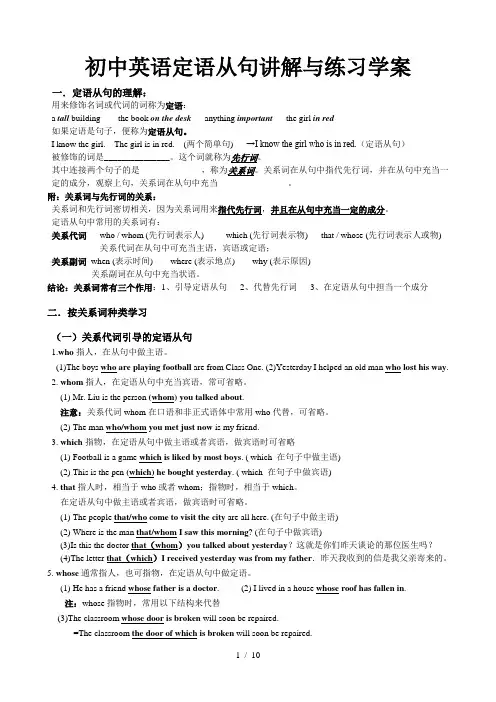
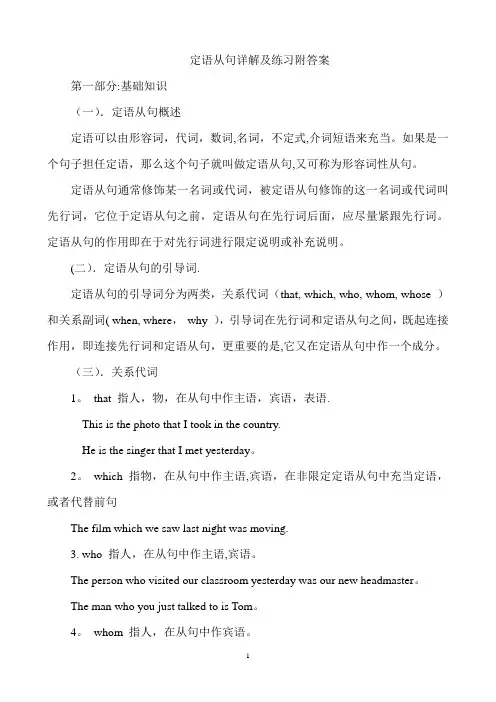
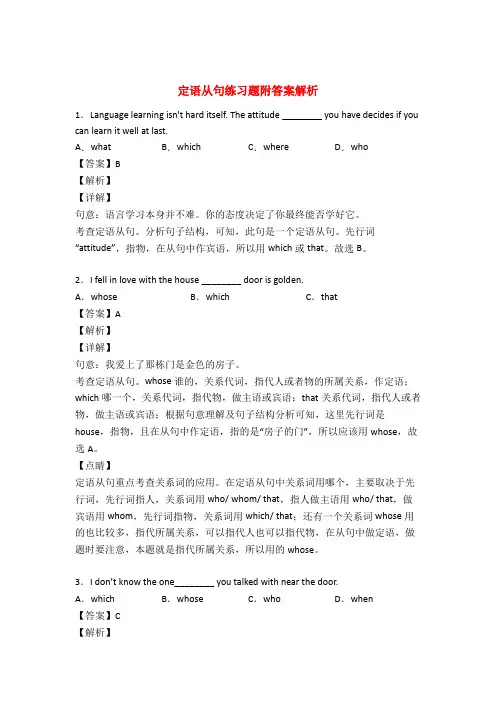
一、定义:在复合句中,修饰某一名词或代词的从句叫做定语从句。
定语定语用来限定、修饰名词或代词的,是对名词或代词起修饰、限定作用的词、短语(动词不定式短语、动名词短语和分词短语)或句子,汉语中常用’••…的’表示。
主要由形容词担任,此外,名词,代词,数词,分词,副词,不定式以及介词短语也可以来担任,也可以由一个句子来担任。
单词作定语时通常放在它所修饰的词之前,作前置定语。
短语和从句作定语时则放在所修饰的词之后,作后置定语。
定语从句是指在一个句子中作定语的句子,定语从句要放在所修饰的词后。
如:1) The man who lives next to us is a policeman.2) You must do everything that I do .上面两句中的man和everything是定语从句所修饰的词,叫先行词,定语从句放在先行词的后面。
引导定语从句的词有关系代词that, which, who(宾格who,所有格whose)和关系副词where, when why关系词常有三个作用:1、引导定语从句2、代替先行词3、在定语从句中担当一个成分二、关系代词引导的定语从句1. who指人,在从句中做主语(1) The boys who are playing football are from Class One.(2) Yesterday I helped an old manwho lost his way .2. whom指人,在定语从句中充当宾语,常可省略。
(1) Mr. Liu is the person (whom) you talked about .注意:关系代词whom在口语和非正式语体中常用who代替,可省略。
(3) The man who/whom you met just now is my friend.3. which指物,在定语从句中做主语或者宾语,做宾语时可省略(1) Football is a gamewhich is liked by most boys . ( which 在句子中做主语)(2) This is the pen(which) he bought yesterday . ( which 在句子中做宾语) 4. that指人时,相当丁who或者whom;指物时,相当丁which。
在宾语从句中做主语或者宾语,做宾语时可省略。
(5) The people that/who come to visit the city are all here.忠句子中做主语)(6) Where is the manthat/whom I saw this morning ?(在句子中做宾语)5. whose通常指人,也可指物,在定语从句中做定语(1) He has a friendwhose father is a doctor.(2) I lived in a house whose roof has fallen in .whose指物时,常用以下结构来代替(3) The classroomwhose door is broken will soon be repaired.=The classroomthe door of which is broken will soon be repaired.(5)Do you like the book whose color is yellow ?=Do you like the book the color of which is yellow ?注:that用法(1)不用that的情况(a) 在引导非限定性定语从句时。
(错)The tree, that is four hundred years old, Is very famous here.(b) 介词后不能用。
We depend on the land from which we get our food.We depend on the land that/which we get our food from.⑵ 只能用that作为定语从句的关系代词的情况(a) 在there be句型中,只用that,不用which。
(b) 在不定代词,如: anything, nothing, the one, all 等作先行词时,只用that,不用which。
(c) 先行词有the only, the very,the same,the last,just 修饰时,只用that。
(d) 先行词为序数词、数词、形容词最高级时,只用that,不能用which。
.(e) 先行词既有人,乂有物时。
(f) 先行词指物,在主句中作表语时.(g) 为了避免重复.(h) 先行词是the way或the reason时,that可作关系副词,也可省略(i) 主句的主语是疑问词who /which时举例:Is this the book that you borrowed in the library?这是你在图书馆借的那本书吗?Who that break the window should be punished .谁打碎了窗户都要受到惩罚.All that is needed is a supply of oil.所需的只是供油问题。
Finally, the thief handed everything that he had stolen to the police.那贼最终把偷的全部东西交给了警察。
三、关系副词引导定语从句关系副词关系副词:在句中作状语关系副词=介词+关系代词why=for whichwhere=in/ at/ on/ ... which (介词同先行词搭配)when=during/ on/ in/ ... which (介词同先行词搭再己)1. where指地点,在定语从句中做地点状语用来表示地点的定语从句。
(1) Shanghai is the city where I was born.(2) The house where I lived ten y ears ago has been pulled down.2. when引导定语从句表示时间。
在定语从句中做时间状语也可做连接词用(1) I still remember the day when I first came to the school.(2) The time when we got together finally came.[注]表示时间“time^词的定语从句只用when引导,有时不用任何关系代词,当然也不用that引导。
By the time you arrived in London, we had stayed there for two weeks.到你到达伦敦的时候,我们在那里已经待了两个星期。
I still remember the first time I met her.我仍然记得我第一次见到她。
Each time he goes to business trip, he brings a lot of living necessities, such as towels, soap, toothbrush。
etc 每一次他去出差,他带来了生活必需品,如毛巾,肥皂,牙刷等,很多。
3. why指原因在定语从句中做原因状语(1) Please tell me the reason why you missed the plane.(2) I don ' t know the reason why he looks unhappy today.注意:关系副词引导的从句可以由介词+关系代词”引导的从句替换(1) The reason why/ for which he refused the invitation is not clear,(2) From the year when/in which he was going to school he began to know what he wanted when he grew up.注:1)介词后面的关系代词不能省略。
2) that前不能有介词。
3) 某些在从句中充当时间,地点或原因状语的"介词+关系词”结构可以同关系副词when ,where和why互换This is the house in which I lived two years ago.This is the house where I lived two years ago.Do you remember the day on which you joined our club?Do you remember the day when you joined our club?This is the reason why he came late.This is the reason for which he came late.练习(一)请分析一下定语从句:(请划出定语从句,并标出先行词)1. Check the ways you study for an English test.2. Another thing that I found very difficult was English grammar.3. You couldn ' t understand peopleo talked fast.4. I have some ideas that may help.5. They said something you didn ' t like.6. Can you think of any problems you have had recently?8. He would always take pride in everything good I do.9. My friends and I talked about the rules that we have in school.10. What are some of the rules that a teenager should obey?12. If you know anyone else who collects them, please tell me.13. Standing very close to the person you are talking with is quite common in some countries.14. If you know someone you know doing this, you can ask them.15. All I ever wanted to do was traveling.二、用关系代词填空:that、which、who、whom、whose1. This is the man wants to see you.2. The student answered the question is Zhang Hua.3. The man you went to see has come.4. The man __________ I met yesterday lent me some money.5. The woman you saw is our geography teacher.6. The runner you are asking about is over there.7. The person you should write to is Mr. Ball.8. The man _________ was passing by saw what happened.9. Here is the pen you lost the day before yesterday.10. These books you lent me were very useful.11. The storybook I have just read cannot be easily forgotten.12. A clock is a machine tells people the time.13. This is shirt I bought yesterday.14. A dictionary is a book gives the meaning to the word.15. The book is on the table is mine.16. The film they are talking about is very interesting.17. I will never forget the people and the places I have ever visited.18. Is there anyone family is in Beijing?19. Show me the boy mother is a well-known singer.20. The boy father is a teacher is good at English.三、单项选择( )1. Your teacher of Chinese is a young lady comes from Beijing. A. who B. which C. whom D. whose( )2. What ' s the name of the program.A. which are listeningB. you are listening toC. to that you are listeningD. that you are listening ( )3. The students were all interested you told them yesterday.A. in whichB. in that thisC. all thatD. in everything( )4. He was the only person in his office was invited. A. whom B. whose C. that D. which( )5. This is the museum we visited last year. A. where B. in which C. which D. in that()6. Charlie told his mother all had happened. A. that B. what C. which D. who5. The wolves hid themselves in the places couldfb be found. A. that B. where C. in which D. in that6. The freezing point is the temperature water changes into ice. A. at which B. on that C. in which D. of what7. This book will show you can be used in other contexts..A. how you have observedB. what you have observedC. that you have observedD. how that you have observed 8. The reason is he is unable to operate the machine. A. because B. why C. that D. whether 9. I ll tell you he told me last week. A. all which B. that C. all that D. which10. That tree,branches are almost bare, is very old.A. whose B. of which C. in which D. on which 11. I have bought the same dress she is wearingA. as B. that C. which D. what12. He failed in the examination,made his father very angry. A. which B. it C. that D. what 13. We ' re talking about the piano and the pianist were in the concert we attended last night.( )7. Do you know the student?A. whom I often talkB. with who I often talkC. I often talk withD. that I often talk( )8. I like the house windows face south. A. whoseB. who' sC. it'sD. its( )9. Would you tell me where to get the dictionary? A. what I need B.I need C. which I need it D. that I need it ()10. The young woman I spoke just now is a young doctor. A. whoB. to whomC. whomD. that定语从句专项练习题 (二)1. Don ' t taObout such things of you are not sure. A. which2. Is this the factory you visited the other day?A. that3. Is this factory some foreign friends visited last Friday? A. that B. what C. as D. thoseB. whereC. I n whichD. the one B. where C. which D. the one4. Is this the factoryhe worked ten years ago?A. thatB. whereC. whichD. the oneA. whichB. whomC. whoD. that14. The girl an English song in the next room is Toms sister. A. whO is singing 15. Those not only from books but also through practice will succeed.A. learn 16. Anyone this opinion may speak out. A. that against B. that against 17. Didn ' t you see the man?A. I nodded just nowB. whom I nodded just nowC. I nodded to him just now 18. Can you lend me the novel the other day?A. that you talkedB. you talked about itC. which you talked withD. you talked about 19. Is there anything to you? A. that is belonged B. that belongs C. that belong D. which belongs 20. ---- “ How do you like the book? "----“It ' s quite different from I read last month. A. thatB/' whichC. the oneD. the one what21. Mr. Zhang gave the textbook to all the pupils except who had already taken them.A. the onesB. onesC. someD. the others22. The train she was travelling was late. A. which B. where C. on which D. in that23. He has lost the key to the drawer the papers are kept. A. where B. in which C. under which D. which24. Antarctic we know very little is covered with thick ice all the year round. A. which B. where C. that D. about which 25. It ' s the third timelate this month.B. when you arrivedC. that you ' ve arrivedD. when you ' ve arrived26. It was in 1969 the American astronaut succeeded in landing on the moon. A. that B. which C. when D. in whichB. is singingC. sangD. was singingB. whoC. that learnsD. who learn C. who is against D. who are againstD. I nodded to just nowA. that you arrived27. May the fourth is the day we Chinese people will never forget. A. which B. when C. on which D. about which 28. We are going to spend the Spring Festival in Guangzhou,live my grandparents and some relatives. A. which B. that C. who D. whereduring our holidays stands by the seaside.39. - Do you know the town at all?29. The hotel A. we stayed at B. where we stayed at C. we stayed D. in that we stayed30. Is it in that factory ca'rReiob 甲agduced? A. in which B. where C. which D. that31. It is the Suez Canalseparates AsiaAfrica.A. which, toB. where, fromC. that, fromD. that, with 32. Under the bridge, however, almost directly below, was a small canoe, with a boy in it.. A. there B. whereC. itD. which33. He is nota foolA. such, as he is lookedB. such, as he looksC. as, as he is lookedD. so, as he looks34. Is that the reason you are in favour of the proposal? A. whichB. whatC. whyD. for that 35. He must be from Africa,can be seen from his skin. A. that B. as C. who D. what36. He has two sons, work as chemists.A. two of whomB. both of whomC. both of whichD. all of whom 37. I,your good friend, will try my best to help you out.A. who isB. who amC. that isD. what is 38. He is a man of great experience,much can be learned. A. who B. that C. from which D. from whom ---No, this is the first time Ihere. A. was B. have been C.came D. am coming40. I don ' t likeyou speak to her.A. the wayB. the way in thatC. the way whichD. the way of which41. The two things they felt very proud are Jim s gold watcls hadr .DellaA. about whichB. of whichC. in whichD. for which42. The dinner was the most expensive meal we .A. would have B. have had C. had never had D. had ever had43. Do you know which hotel? A. she is staying B. she is staying in C. is she staying D. is she staying in44. There is only one thing I can do. A. what B. that C . all D. which45. Who can think of a situation this idiom can be used? A. which B. that C. where D. in that46. I have many books, some of are on chemistry. A. them B. that C. which D. those47. They were interested you told them.A. in whichB. in thatC. all thatD. in everything48. The astronaut did many experiments in the spaceship,much help for knowing space.A. which we think it isB. which we think are ofC. of which we think isD. I think which is of49. The great day we looked forward to at last A. come B. came C. coming D. comes50. I like the second football match was held last week. A. which B. who C. that D. /1 — 5 AADBA 6 —10 ABCCA 11 —15 AADAD16— 20 CDDBC 21 — 25 ACBDC 26 — 30 AADAD31—35 CABCB 36 —40 BBDBA 41 — 45 BDBBC46—50 CDBBC。