2014人教新目标英语八年级下册unit1《What’s the matter》section b课件
- 格式:ppt
- 大小:4.79 MB
- 文档页数:20
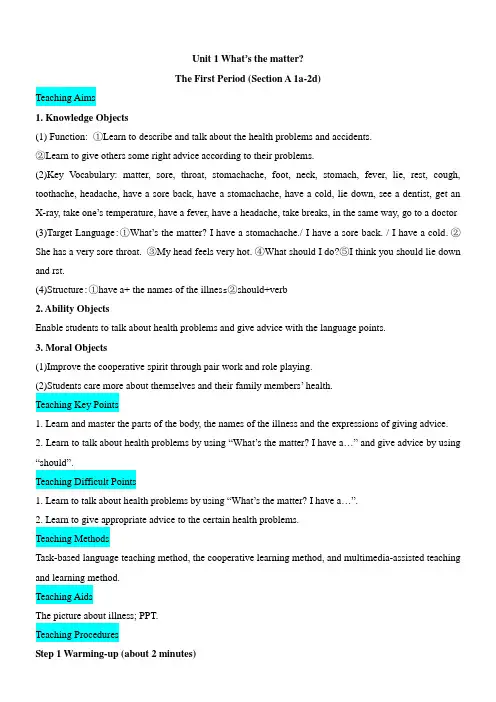
Unit 1 What’s the matter?The First Period (Section A 1a-2d)Teaching Aims1. Knowledge Objects(1) Function:①Learn to describe and talk about the health problems and accidents.②Learn to give others some right advice according to their problems.(2)Key Vocabulary: matter, sore, throat, stomachache, foot, neck, stomach, fever, lie, rest, cough, toothache, headache, have a sore back, have a stomachache, have a cold, lie down, see a dentist, get an X-ray, take on e’s temperature, have a fever, have a headache, take breaks, in the same way, go to a doctor (3)Target Language:①What’s the matter? I have a stomachache./ I have a sore back. / I have a cold.②She has a very sore throat.③My head feels very hot.④What should I do?⑤I think you should lie down and rst.(4)Structure:①have a+ the names of the illnes s②should+verb2. Ability ObjectsEnable students to talk about health problems and give advice with the language points.3. Moral Objects(1)Improve the cooperative spirit through pair work and role playing.(2)Students care more about themselves and their family members’ health.Teaching Key Points1. Learn and master the parts of the body, the names of the illness and the expressions of giving advice.2. Learn to talk about health problems by using “What’s the matter? I have a…” and give advice by using “should”.Teaching Difficult Points1. Learn to talk about health problems by using “What’s the matter? I have a…”.2. Learn to give appropriate advice to the certain health problems.Teaching MethodsTask-based language teaching method, the cooperative learning method, and multimedia-assisted teaching and learning method.Teaching AidsThe picture about illness; PPT.Teaching ProceduresStep 1 Warming-up (about 2 minutes)Sing the English song If you’re happy.Step 2 Presentation (about 6 minutes)T: This is really a beautiful song. What can you do if you are happy?Ss: Clap our hands and stamp our feet.T: Yes. Hands and feet are parts of our body; do you know other parts of our body in English?Ss: Eye, head…T: You’re great. Today, let’s learn the names of thee body parts.The teacher touches the parts of the body one by one and says them. While teaching each one, let students touch or show it.Present a picture of Pan Changjiang on the screen. Let students say each part of the body.Work on Section A 1a.Play the game: Touch the parts of your body. Let the whole class touch the parts of their body when teacher say: Touch your…Ask eight students to come to the front and do as the teacher tells them: Touch your…If one does wrong, let him or her go back, the last one who’s in the front is the winner.Step 3 Presentation and Practice (about 8 minutes)The teacher mimes having a stomachache with an action of touching his stomach, and asks, “What’s the matter?”(Write it on the blackboard), then says, “I’m not feeling well, I have a stomachache.”(Students repeat with teacher.)Then show some pictures on the screen and ask students to practice.Have students look at the picture and ask: What can we say to him?Ss: What’s the matter?T: Yes. And what should the boy say?Ss: I have a stomachache.Let students repeat with other pictures about other illness.Ask some students to use gestures to show the illness, and have others to guess.Make a model dialogue. (S1 does an action to express an illness.)T: What’s the matter?Ss: He/ She has a headache.Let students practice other illness.A: What’s the matter?B: He/ She has a headache/ toothache/ a sore back/ a sore throat/ a cold and a cough.Show other pictures, and ask students to talk about health problems of the persons in the pictures inpairs.Step 4 Listen and Say (about 8 minutes)Work on Section A 1b, listen and number the names [1-5].Have students look at the picture and read 1c, and tell students that the girl talked too much yesterday and she has a very sore throat now. Then ask them look at the picture, practice saying other problems. For example: The boy eats too much ice cream and has a stomachache.Have students work in pairs according to 1c and ask some pairs to act out their conversations.Step 5 Presentation (about 5 minutes)Teacher pretends to cough and asks:T: What’s the matter with me?Ss: Do you have a cough/ a sore throat?T: Yes, I have a sore throat. Can you give me some advice? What should I do?Ss: You should drink hot tea with honey/ shouldn’t talk too much/ go to a doctor…(Students can give different advice as they like)Show different pictures to students, have them practice in pairs.S1: What’s the matter with him/ her?S2: Yes, he/ she has a/ an toothache/ fever/ headache…(Teach the new words)What should he/ she do? S2: He/ She should go to see a dentist/ lie down and rest/ drink a lot of water./ see a doctor… He/ She shouldn’t drink cold water/ play basketball…Work in groups, and have students role-play between a doctor and a patient. Ask them to talk about the health problems and give advice in groups.Step 6 Practice (about 7 minutes)Do 2a. Have students listen and number the picture [1-5]in the order they hear. Then check the answer. Play the tape again for the students and let them do 2b by themselves.Have students listen again and match the problems with the advice. Then play it again and check the answers.Do 2c. Pair work. Let students read the conversations in 2c first. Then work in pairs, make a new conversation according to 2a and 2b. For example:A: What’s the matter?B: My back feels terrible.A: Maybe you have headache. You should see a doctor and get an X-ray.B: That’s a good idea.Show more pictures and let students make more conversations.Step 7 Expansion and Extension (about 5 minutes)Role-play the conversation.First, have students to role-play the conversation in 2d in groups and choose the best.In groups, students discuss the language points and solve the problems. The teacher walks around and gives them some help if they need.Work in groups. Have students do a survey in groups about their health problems, then discuss in groups and give some right advice and make a new conversation.Ask each group to report their conversations.Step 8 Summary (about 3 minutes)Ask students to sum up the parts of a body and the names of illness.Help students to sum up how to give advice by using “should” and “shouldn’t”, then ask them to give the right advice about different problems.Step 9 Homework (about 1 minute)Give advice to the following problems as much as possible: sore throat, toothache, headache, cold. Then choose one to make a dialogue with your partner.Search on the internet about more advice of different health problems and accidents.Blackboard DesignUnit 1 What’s the matter?The First Period (Section A 1a-2d)What’s the matter? I have a stomachache/ sore throat/ a cold.She/ He has a very sore throat.My head feels very hot.What should I/he/she do? You should/ shouldn’t…第一课时作业设计一、根据句意、汉语意思和首字母提示完成句子。

Unit1 What’s the matter?复习课教学设计一、设计背景初中英语升学考试所涉及的知识面广,因而复习时需要扎扎实实打好基础,对课本的复习可以说是以“地毯式”搜捕的方式进行的。
教师要在有限的时间内完成如此大容量的复习任务,就必须要想方设法提高复习效率,让学生的复习取得事半功倍的效果。
我在复习中采用“知识递进式”复习法,用话题带动词句的使用,注重知识的综合运用。
二、设计理念本课是以“problems and advice”为话题的复习课,课堂上把主动权交给学生,以听说训练为主线,通过看、听、说、写等一系列教学活动,让学生运用所学知识来完成单词拼写、即时翻译短语、小组合作翻译句子,定时背诵语篇。
使学生获得最基本的英语听、说、读、写能力,并在教学中充分激发学生强烈的学习愿望。
在注重学生知识能力发展的同时,注重提高学生的人格修养,学会关心别人,帮助别人,达到培养学生互助的德育教育的目的。
三、教学目标设计用具体、明确、可操作的行为语言,描述本课的知识、技能、能力、方法、情感、态度、价值观等方面的教学目标。
Objectives: By the end of the session, most students will be better able to acquire the required information. This will be achieved by: 1.Knowledge Objectives:1)Be able to master the pronunciation, meaning and spellingof the names of diseases: fever, sore throat, sore back; stomachache, headache, toothache, cold, cough; 2) Be able tolearn the e某pressions of giving advice: lie down and rest, drink hot tea with honey, see a dentist, take this medicine;3) Be able to talk about health problems by using “What’s the matter? I have a?” and give advice by using “Youshould?You shouldn’t?” 2. Ability Objectives:1) Be able to talk about one’s health problems and give advice fluently; 2) Be able to role play doctor and patient; 3. Moral Objectives:1) Improve the cooperative spirit through pair work and role playing 2) Care more about yourself and your family members’ health. 四、教学重点难点设计由于本节课的话题是谈论健康,根据教学大纲的要求,学生需掌握有关疾病的单词,并能针对疾病提出合理的建议。