
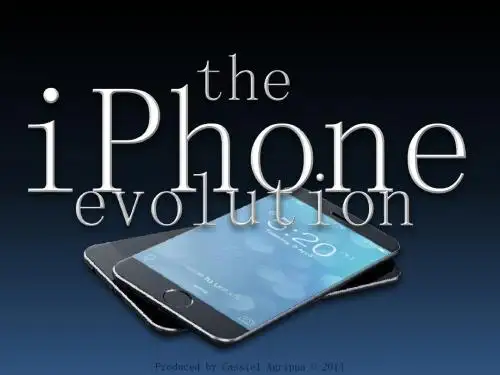
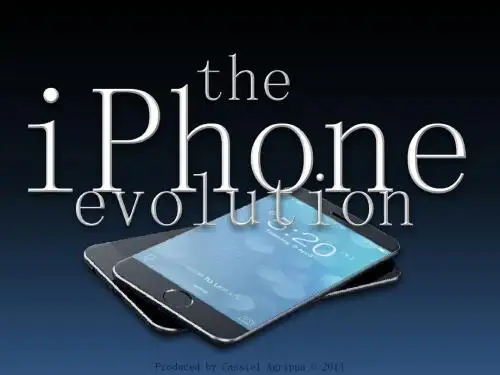
iphone-evolution
- 格式:pptx
- 大小:994.81 KB
- 文档页数:28

手机的发展历史简介英语作文The Evolution of Mobile Phones.The journey of mobile phones, also known as cell phones or handsets, is a fascinating tale that spans over several decades,见证着 remarkable technological advancements and profound societal changes. From their humble beginnings as bulky devices with limited functionality to their current incarnation as sleek, powerful tools that are essential to modern life, mobile phones have transformed the way we communicate, work, and娱乐.The Early Years: Analog Phones and the Mobile Revolution.The first mobile phone systems emerged in the 1970s, utilizing analog technology. These early devices were bulky and heavy, often weighing several pounds. They offered basic communication capabilities, allowing users to make and receive calls while within the coverage area of asingle cellular tower. Despite their size and limitations, these phones marked a significant milestone in the history of mobile technology, as they provided mobility and convenience that had never been seen before.The 1980s: Digital Transformation and Wider Availability.The 1980s marked a significant turning point in mobile phone technology with the transition to digital signals. This shift resulted in clearer calls, better coverage, and the ability to transmit data in addition to voice. Digital technology also paved the way for the development of smaller, lighter phones that were more portable and user-friendly. By the end of the decade, mobile phones became more widely available and accessible, particularly with the introduction of prepaid and contract-based service plans.The 1990s: The Rise of the Smartphone.The 1990s saw the emergence of the first smartphones, which combined the functionality of a mobile phone withadvanced computing capabilities. These early smartphones featured touchscreens, web browsing capabilities, and a range of applications that allowed users to perform tasks beyond basic telephony. The introduction of the iPhone in 2007 marked a watershed moment in smartphone technology, as it revolutionized the design, functionality, and user experience of mobile devices.The 2000s and Beyond: The Era of Rapid Innovation and Ubiquitous Connectivity.The 2000s and beyond have been marked by rapid innovation and the widespread adoption of smartphones. The proliferation of high-speed internet access, particularly through 4G and 5G networks, has transformed mobile phones into powerful tools for accessing information, entertainment, and social media. Smartphones now feature advanced cameras, powerful processors, and vast storage capabilities, allowing users to perform a wide range of tasks from shopping and banking to streaming media and gaming.The impact of mobile phones on society has been profound. They have revolutionized the way we communicate, stay connected, and access information. Mobile phones have also transformed various industries, including entertainment, media, and finance, by enabling new business models and services. Furthermore, they have played acrucial role in bridging the digital divide, providing access to technology and information to those who may have been previously excluded.In conclusion, the evolution of mobile phones is a remarkable testament to the power of technology and innovation. From their humble beginnings as bulky analog devices to their current incarnation as powerful,intelligent tools, mobile phones have transformed the way we live, work, and娱乐. As we look to the future, it is exciting to imagine the new possibilities and advancements that lie ahead in the world of mobile technology.。
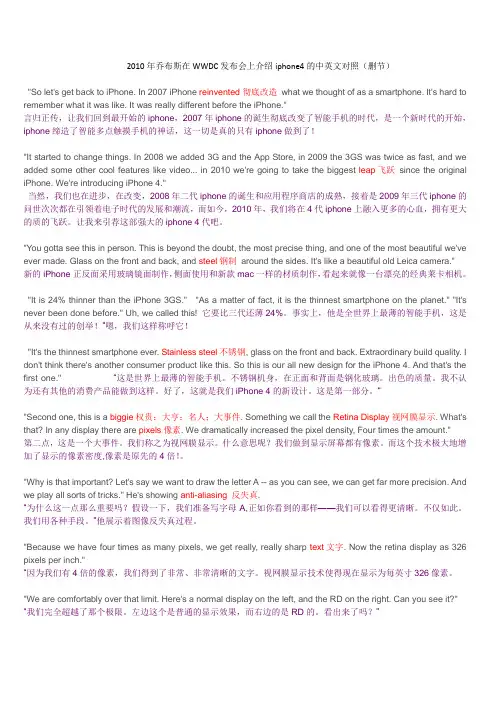
2010年乔布斯在WWDC发布会上介绍iphone4的中英文对照(删节)"So let's get back to iPhone. In 2007 iPhone reinvented彻底改造what we thought of as a smartphone. It's hard to remember what it was like. It was really different before the iPhone."言归正传,让我们回到最开始的iphone,2007年iphone的诞生彻底改变了智能手机的时代,是一个新时代的开始,iphone缔造了智能多点触摸手机的神话,这一切是真的只有iphone做到了!"It started to change things. In 2008 we added 3G and the App Store, in 2009 the 3GS was twice as fast, and we added some other cool features like video... in 2010 we're going to take the biggest leap飞跃since the original iPhone. We're introducing iPhone 4."当然,我们也在进步,在改变,2008年二代iphone的诞生和应用程序商店的成熟,接着是2009年三代iphone的问世次次都在引领着电子时代的发展和潮流,而如今,2010年,我们将在4代iphone上融入更多的心血,拥有更大的质的飞跃。
让我来引荐这部强大的iphone 4代吧。
"You gotta see this in person. This is beyond the doubt, the most precise thing, and one of the most beautiful we've ever made. Glass on the front and back, and steel钢制around the sides. It's like a beautiful old Leica camera."新的iPhone正反面采用玻璃镜面制作,侧面使用和新款mac一样的材质制作,看起来就像一台漂亮的经典莱卡相机。

关于手机的历史和现在手机的发展英语作文全文共6篇示例,供读者参考篇1The Amazing History of Mobile PhonesDo you know what a mobile phone is? Of course you do! Almost everyone has one these days, even some kids! But mobile phones haven't always been around. In fact, they have a really interesting history that goes back many years.A long, long time ago, before mobile phones were invented, people could only make calls from special phones that were connected to the wall with a cord. These phones couldn't be carried around, so you could only call someone when you were at home or at work. Can you imagine having to wait until you got home to call your friends and family? That must have been really inconvenient!The very first mobile phone call was made on April 3, 1973, by a researcher named Martin Cooper. He was working for a company called Motorola at the time. The phone he used was huge and bulky – it weighed over 1 kilogram! That's about as heavy as a big book. It could only be used for 30 minutes beforethe battery ran out. Still, this first call marked the beginning of a new era in communication.Over the next few years, mobile phones became smaller and more advanced. In 1983, the Motorola DynaTAC 8000x was launched. It was the first truly portable mobile phone that anyone could buy. However, it was still pretty big and heavy, weighing almost 800 grams. And it was really expensive too – it cost almost 4,000! That's more than some laptops or TVs cost today.As time went on, mobile phones kept getting smaller, lighter, and more affordable. In 1992, the first smartphone was created. It was called the IBM Simon and it could not only make calls, but also send emails and faxes. It even had a touchscreen, just like the phones we use today!The 1990s and early 2000s saw the rise of many popular mobile phone brands like Nokia, Ericsson, and Motorola. Remember those classic Nokia phones with the changeable covers? Those were so much fun! During this time, mobile phones also started adding fun features like games, cameras, and music players.Then, in 2007, something truly revolutionary happened –Apple released the first iPhone. The iPhone introduced a largetouchscreen display, apps, and a sleek, modern design. It completely changed the way we think about and use mobile phones.Since then, smartphones have become incredibly advanced and powerful. Today's phones are like tiny computers that can do almost anything! We can use them to take amazing photos and videos, play games, watch movies, read books, get directions, and so much more. And with the internet in our pockets, we can access information on just about any topic whenever we want.Mobile phones have also become fashion accessories, with people expressing their personal style through different phone cases and colors. Some people even use multiple phones – one for work, one for personal use, and so on.But mobile phones aren't just for fun and personal use anymore. They have become incredibly important tools for businesses, emergency services, and many other industries. Imagine if doctors couldn't use their phones to look up medical information or firefighters couldn't use their phones to navigate to emergencies! Mobile phones help make our lives safer, more efficient, and more connected.Still, there's no denying that mobile phones have changed the world in incredible ways. From that first clunky call in 1973 tothe sleek, powerful smartphones of today, mobile phones have come a long, long way. And who knows what the future will bring? Maybe one day we'll have phones that can bend, fold, or even become invisible!For now, let's just appreciate how amazing it is that we can carry these tiny computers in our pockets and use them to connect with anyone, anywhere in the world. Mobile phones have revolutionized how we communicate, work, play, and live our lives. They truly are one of the most incredible inventions of our time.篇2The Fascinating Journey of Mobile PhonesDo you know what a mobile phone is? It's a small device that can make calls, send messages, take pictures, play games, and do so much more! Mobile phones have become an essential part of our lives, and they have come a long way from their early beginnings.A Long Time AgoMobile phones have been around for quite some time, but they didn't always look like the sleek and smart devices we havetoday. The very first mobile phone was invented in the 1970s, and it was a bulky, heavy device that could only make calls. Imagine carrying a brick-sized object just to make a phone call!These early mobile phones were called "cell phones" because they worked by communicating with cell towers. These towers divided cities into small areas called "cells," and as people moved from one cell to another, their calls would be transferred to the next tower. It was a revolutionary idea at the time!The First Mobile Phone CallOn April 3, 1973, a researcher named Martin Cooper made the first-ever mobile phone call. He was working for a company called Motorola, and he called his rival at another company while walking on the street in New York City. Can you imagine the looks he must have gotten from people passing by?The First Mobile Phone for EveryoneWhile those early mobile phones were exciting, they were also very expensive and not available to the general public. It wasn't until 1983 that the first truly portable and affordable mobile phone was introduced. It was called the Motorola DynaTAC 8000x, and it weighed almost a kilogram! That's like carrying a big book just to make a call.Despite its weight and bulky size, the DynaTAC 8000x was a hit. People loved the idea of being able to make calls from anywhere, and it quickly became a status symbol. As technology improved, mobile phones became smaller, lighter, and more affordable.The Rise of SmartphonesIn the early 2000s, a new type of mobile phone emerged: the smartphone. These devices were more than just phones; they were like tiny computers that could access the internet, send emails, and run all kinds of apps (short for applications).The first smartphone was the IBM Simon, released in 1994. It had a touchscreen, a stylus pen, and even a built-in calendar and address book. However, it was quite expensive and didn't catch on right away.It wasn't until 2007 that smartphones really took off when Apple released the iPhone. The iPhone had a sleek design, a large touchscreen, and an easy-to-use interface. It revolutionized the way we used mobile phones and paved the way for the smartphones we have today.Smartphones TodayToday, smartphones are more powerful and advanced than ever before. They have high-resolution cameras, fast processors, and tons of apps for everything from gaming to productivity. Some smartphones even have multiple cameras, fingerprint scanners, and face recognition technology.But smartphones aren't just for fun and games; they have become essential tools for communication, learning, and even work. Many people use their smartphones to check emails, attend online classes, and video chat with friends and family.The Future of Mobile PhonesAs technology continues to evolve, mobile phones will likely become even more advanced and integrated into our daily lives. Some experts predict that future mobile phones will have flexible displays that can be rolled up or folded, and even holographic projectors for 3D imaging.Additionally, the development of 5G networks will enable faster data speeds and more reliable connections, allowing for new applications and services we can't even imagine yet.Mobile phones have come a long way from those bulky, brick-like devices of the past. They have transformed the way we communicate, access information, and even entertain ourselves.It's exciting to think about what the future holds for these incredible devices and how they will continue to shape our lives.篇3The Fascinating Journey of Mobile PhonesHave you ever wondered how those little devices we carry around with us every day came to be? Mobile phones have come a long way from their bulky and basic beginnings to the sleek and powerful gadgets we know today. Let me take you on a fun journey through the history and evolution of mobile phones!A Long Time AgoBelieve it or not, the idea of mobile phones dates back to the early 1900s! Inventors and scientists were already dreaming about the possibility of wireless communication devices. However, it wasn't until 1973 that the first true mobile phone call was made by Martin Cooper, a researcher at Motorola.The First Mobile PhonesThose early mobile phones were nothing like the ones we have now. They were huge, heavy, and looked more like bricks than phones! The first commercially available mobile phone was the Motorola DynaTAC 8000x, released in 1983. It weighedalmost a kilogram and could only hold a charge for about 30 minutes of talk time! Can you imagine carrying around such a heavy phone and having to constantly recharge it?The Evolution BeginsAs technology advanced, mobile phones became smaller, lighter, and more powerful. In the 1990s, phones started to have new features like games, calendars, and even primitive internet access. The Nokia 3310, released in 2000, became a iconic phone loved by millions for its durability and long battery life.The Smartphone RevolutionEverything changed in 2007 when Apple released the first iPhone. This was the first truly smart mobile phone, with a large touchscreen, internet access, and the ability to run apps. Other companies quickly followed suit, and smartphones became the new norm. Suddenly, our phones could do so much more than just make calls and send texts!Smartphones TodayToday's smartphones are like mini-computers in our pockets. They have powerful processors, high-resolution cameras, and can run millions of apps for everything from gaming to banking. We use them for communication, entertainment, work, and somuch more. It's hard to imagine life without our trusty smartphones!The Future of Mobile PhonesSo, what's next for mobile phones? Well, experts believe that phones will become even more advanced and integrated into our daily lives. Some ideas for the future include:Foldable phones with flexible screensPhones with advanced augmented reality (AR) and virtual reality (VR) capabilitiesPhones that can project holograms or act as personal assistantsPhones with longer battery life and even faster processing powerIt's an exciting time for mobile technology, and who knows what innovative devices we'll be carrying around in the years to come!Mobile phones have come a long way from those heavy bricks of the past. They've revolutionized how we communicate, work, and even entertain ourselves. It's amazing to think about how much these little devices have changed our lives. Whoknows what the future holds for mobile phones? One thing is for sure – their journey is far from over!篇4The Amazing Evolution of Mobile PhonesHello friends! Today I want to talk to you about something that I'm sure you're all very familiar with - mobile phones! These little gadgets have become such a huge part of our lives, haven't they? But have you ever wondered where they came from and how they got to be so advanced and awesome? Let me take you on a journey through the history and evolution of mobile phones!A Long Time Ago...Way back in the 1940s, scientists and engineers started dreaming about the idea of portable communication devices. They imagined phones that people could carry around with them and use anywhere! At that time, phones had to be plugged into walls and couldn't be moved. The first big step happened in 1947 when researchers built really big "mobile" phone systems into vehicles like trucks and cars. These early mobile phones were super heavy and expensive though, so only rich people and businesses could use them.The Brick AgeIt took a while, but in 1973 the first truly portable mobile phone was created - the Motorola DynaTAC 8000x. It was huge! This "brick phone" weighed almost 2 pounds and measured 9 inches long. It could only hold a charge for 30 minutes of talk time too. But it was revolutionary because for the first time, people could walk around on phone calls. The DynaTAC didn't go on sale until 1983 though, and it cost a whopping 3,995! That's like 10,000 today. Yikes!In 1979, the first commercial cellular networks were introduced, which allowed mobile phones to have better range and coverage. More companies started making brick phones through the 80s, but they were still crazy expensive. It wasn't until the 90s that mobile phones started becoming more affordable for normal people.Smaller and SmarterAs technology improved, mobile phones got much smaller in size. The big bulky bricks were replaced by sleeker "candy bar" shaped phones that could fit in pockets. Flip phones and sliders that could fold up were also very popular. Battery life got way better too, lasting days instead of just minutes.But probably the biggest change came in 1992 when the first smartphone was created - the IBM Simon. It had a touchscreen and could send emails and faxes, take notes, and even load basic software. Of course, it doesn't sound that impressive now, but the Simon paved the way for modern smartphones we all use today.In the 2000s, mobile phones got smarter and more advanced every year. Phones got color screens, built-in cameras, music players, and internet access. Game-changing phones like the Nokia 3310, BlackBerry, Motorola RAZR, and Palm Treo became hugely popular. But then in 2007, Apple released the first iPhone, and the mobile phone world changed forever.The Smartphone RevolutionThe original iPhone didn't have a physical keyboard or stylus - it was all controlled through a huge touchscreen and gestures. It also introduced the concept of mobile apps, which let people customize their phones with tons of different tools and games. Over the next few years, Apple and other companies like Samsung, Google, LG, and others released new and improved smartphone models almost every year.Nowadays, smartphones are like tiny powerful computers that fit in your pocket. They have high-resolution screens,lightning-fast processors, tons of storage, and incredible cameras that can shoot photos and videos as good as professional equipment. We use them for pretty much everything - making calls, texting, checking email, browsing the web, playing games, watching videos, getting directions with GPS, listening to music, and SO much more.Some smartphones even have special accessories that turn them into virtual reality headsets or allow you to create 3D scans of objects and rooms. There are also folding phones with screens that bend! Smartphone cameras now have multiple lenses, depth sensors, night modes, and can even record video at resolutions higher than many TVs. It's simply mind-blowing how far mobile technology has come in just a few decades.The Future of PhonesSo what's next for mobile phones? Well, there's still a lot of innovation happening. Companies are working on giving smartphones even better cameras, longer battery life, faster charging, unbreakable displays, and 5G connectivity for blazing download speeds. Some are also experimenting with making phones flexible, transparent, and holographic displays!But besides just the phone hardware, the real future could be in how we interact with our mobiles. Imagine having asmartphone that doesn't need a screen at all - it could project hologram displays into the air using just your hands. Or phones that can translate languages in real-time as people speak, or scan and identify objects and data just by looking at them through the camera. Maybe one day our phones will even be integrated right into smart clothing we wear!There's no doubt mobile phones have already changed the world in so many ways by connecting people globally. But I'm sure the future will bring innovations just as revolutionary that we can't even imagine yet. Today's mind-blowing mobile tech will probably seem just as quaint as those old brick phones from the 1980s. One thing's for sure though - our lives will only become more intertwined with these incredible pocket-sized computers. I can't wait to see what awesome mobile advancements are still to come!篇5The Fascinating History of Mobile PhonesHave you ever wondered how we ended up with the amazing smartphones we have today? Mobile phones have come a long way from their bulky beginnings. Let me take you on a journey through the history of these incredible devices!A Very Big BeginningThe first mobile phone call was made on April 3, 1973, by a Motorola researcher named Martin Cooper. But the phone he used was massive – it weighed over 2 pounds (that's like carrying a big book)! It was called the Motorola DynaTAC 8000x, and it could only make calls for about 30 minutes before the battery ran out. Imagine having to carry that heavy thing around all day!The Brick AgeFor many years after that first call, mobile phones were still really big and bulky. They were nicknamed "brick phones" because they were so heavy and block-shaped. The Motorola DynaTAC 8000x finally went on sale in 1984 for a whopping3,995 – that's like paying for a fancy car today! Only wealthy people could afford these brick phones at first.The 1990s: When Mobiles Went MainstreamIt wasn't until the 1990s that mobile phones started becoming more affordable and popular with regular people. Companies like Nokia and Ericsson made smaller, lighter phones that could fit in your pocket or purse. Still, these early models could only make calls and maybe send simple text messages. No games, no cameras, no internet!The Dawn of the SmartphoneEverything changed in 2007 when Apple released the first iPhone. This sleek touchscreen device could browse the internet, play music and videos, and run simple apps. It kicked off the "smartphone" era where phones became mini-computers we could carry everywhere. Other companies like Samsung, Google, and Microsoft quickly followed with their own smartphones.Smartphones Get SmarterOver the years, smartphones just kept getting more and more advanced. They got bigger screens, faster processors, better cameras, and thousands of apps for every need. Today's top phones can do things our parents couldn't have dreamed of back in the 90s!We can:Take incredibly clear photos and videosPlay amazing 3D gamesWatch movies and showsVideo chat with anyone around the worldGet directions and information instantlyAnd so much more!Mobile phones have truly become miniature computers and cameras that can also make calls. And developers are still coming up with new mind-blowing features and technologies like augmented reality, facial recognition, and even phones that can fold up!The Future of PhonesSo what does the future hold for mobile devices? Many experts think phones will eventually become our "digital keys" that can control everything around us – our homes, cars, appliances, and more. Some futuristic concepts even imagine flexible phone screens that can roll up, or holographic displays!As computers get smaller and more powerful, phones could one day become virtual reality visors or just tiny earpieces we wear. Or maybe they'll be implanted right into our bodies! One thing's for sure – the phones of tomorrow will make today's look as outdated as the 1970s brick phone. I can't wait to see what crazy new mobile devices get invented!Mobile phones have transformed so much in just a few decades. From those heavy bricks to today's sleek supercomputers, they've revolutionized how we communicate,learn, work, and play. Who knows what amazing phones lie ahead? The future is calling!篇6The Amazing Journey of Mobile PhonesDo you ever wonder how we ended up with these incredible devices called smartphones that can do almost anything? Well, let me take you on a fascinating journey through the history of mobile phones and show you how they've evolved into the powerful little gadgets we carry around today.A Long Time AgoBelieve it or not, the idea of mobile phones has been around for a very long time. Way back in the early 1900s, some really smart people started dreaming about wireless communication. They imagined being able to talk to someone far away without being tied down by wires or cables. Sounds crazy, right?The First StepsThe first mobile phone call was made in 1973 by a researcher named Martin Cooper. He worked for a company called Motorola, and he used a huge, heavy phone that looked like a brick! Can you imagine carrying that around all day? It was calledthe Motorola DynaTAC 8000x, and it could only make calls for about 20 minutes before the battery ran out.The Brick AgeFor many years after that first call, mobile phones were massive and clunky. They were so big and heavy that people called them "bricks." They were also very expensive, so only a few people could afford them. But slowly, technology started improving, and the phones became smaller and more affordable.The Rise of the Flip PhonesIn the 1990s, a new type of mobile phone became popular –the flip phone! These phones had a cool design that allowed them to fold in half, making them more compact and easier to carry around. Flip phones were a big hit, and everyone wanted one.The Smartphone RevolutionThen, in 2007, something incredible happened. A company called Apple released a phone unlike anything the world had seen before. It was called the iPhone, and it was a true smartphone. Instead of just making calls and sending texts, the iPhone could browse the internet, play games, take photos, andrun all sorts of apps (short for applications). It had a big, beautiful touchscreen and was incredibly user-friendly.The iPhone kicked off a smartphone revolution, and soon other companies like Samsung, Google, and Microsoft started making their own smartphones. Suddenly, these powerful little computers that could fit in your pocket became a part of everyday life.The Future is NowFast forward to today, and smartphones have become even more advanced and capable. They can do things that would have seemed like magic just a few years ago. With just a few taps on your screen, you can:Video chat with friends and family on the other side of the worldPlay incredible games with stunning graphicsTake professional-quality photos and videosGet directions and find your way around using GPSLearn about anything by accessing a world of information on the internetAnd so much more!Smartphones have also become essential tools for work, education, and staying connected. Can you imagine going back to a time without them?But This is Just the BeginningAs amazing as smartphones are today, the best is yet to come. Scientists and engineers are working on even more incredible features and capabilities for the phones of the future. Some ideas include:Flexible, bendable screens that won't crack or breakHolographic displays that project 3D imagesCameras that can see microscopic details invisible to the human eyeBatteries that can last for days or even weeks on a single chargeAnd who knows what other mind-blowing innovations are in store?The Future is YoursSo, there you have it – the incredible journey of mobile phones from those early brick-like devices to the powerful pocket computers we have today. Who knows what the futureholds for these amazing gadgets? Maybe someday, you'll be the one inventing the next big thing in mobile technology!For now, let's appreciate how far we've come and how much these little devices have changed the way we live, work, and play. The world of mobile phones is a constantly evolving adventure, and it's exciting to think about where it will take us next.。