
practice of international Business Four
- 格式:ppt
- 大小:558.00 KB
- 文档页数:20

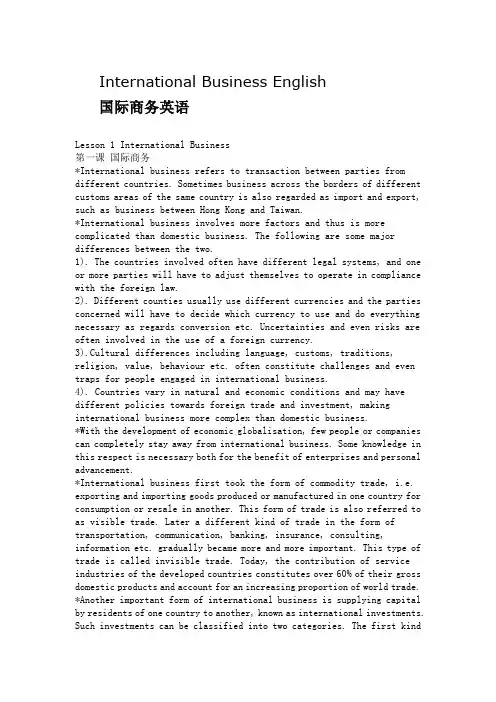
International Business English国际商务英语Lesson 1 International Business第一课国际商务*International business refers to transaction between parties from different countries. Sometimes business across the borders of different customs areas of the same country is also regarded as import and export, such as business between Hong Kong and Taiwan.*International business involves more factors and thus is more complicated than domestic business. The following are some major differences between the two.1). The countries involved often have different legal systems, and one or more parties will have to adjust themselves to operate in compliance with the foreign law.2). Different counties usually use different currencies and the parties concerned will have to decide which currency to use and do everything necessary as regards conversion etc. Uncertainties and even risks are often involved in the use of a foreign currency.3).Cultural differences including language, customs, traditions, religion, value, behaviour etc. often constitute challenges and even traps for people engaged in international business.4). Countries vary in natural and economic conditions and may have different policies towards foreign trade and investment, making international business more complex than domestic business.*With the development of economic globalisation, few people or companies can completely stay away from international business. Some knowledge in this respect is necessary both for the benefit of enterprises and personal advancement.*International business first took the form of commodity trade, i.e. exporting and importing goods produced or manufactured in one country for consumption or resale in another. This form of trade is also referred to as visible trade. Later a different kind of trade in the form of transportation, communication, banking, insurance, consulting, information etc. gradually became more and more important. This type of trade is called invisible trade. Today, the contribution of service industries of the developed countries constitutes over 60% of their gross domestic products and account for an increasing proportion of world trade. *Another important form of international business is supplying capital by residents of one country to another, known as international investments. Such investments can be classified into two categories. The first kindof investments, foreign direct investments or FDI for short is made for returns through controlling the enterprises or assets invested in in a host country.*The host country is a foreign country where the investor operates, while the country where the headquarters of the investor is located is called the home country. The second kind of investment, portfolio investment, refers to purchases of foreign financial assets for a purpose other than controlling. Such financial assets may be stocks, bonds or certificates of deposit.Stocks are also called capital stocks or bonds. Bonds are papers issued by a government or a firm with promise to pay back the money lent or invested together with interest. The maturity period of a bond is at least one year, often longer, for example five, or even ten years. Certificates of deposit generally involve large amounts, say 25 thousand US dollars *Besides trade and investment, international licensing and franchising are sometimes taken as a means of entering a foreign market. In licensing, a firm leases the right to use its intellectual property to a firm in another country. Such intellectual property may be trademarks, brand names, patents, copyrights or technology. Firms choose licensing because they do not have to make cash payments to start business, and can simply receive income in the form of royaltyBesides, they can benefit from locational advantages of foreign operation without any obligations in ownership or management. The use of licensing is particularly encouraged by high customs duty and non-tariff barriers on the part of the host country. However it is not advisable to use licensing in countries with weak intellectual property protection since the licensor may have difficulty in enforcing licensing agreement.*Franchising can be regarded as a special form of licensing. Under franchising, a firm, called the franchisee, is allowed to operate in the name of another, called the franchiser who provides the former with trademarks, brand names, logos, and operating techniques for royalty. In comparison with the relation between the licenser and the licensee, the franchiser has more control over and provides more support for the franchisee.*The franchiser can develop internationally and gain access to useful information about the local market with little risk and cost, and the franchisee can easily get into a business with established products or services. Franchising is fairly popular especially in hotel and restaurant business.*Other forms for participating in international business are management contract, contract manufacturing, and turnkey project.*Under a management contract, one company offers managerial or other specialized services to another within a particular period for a flat payment or a percentage of the relevant business volume. Sometimes bonusesbased on profitability or sales growth are also specified in management contracts.Government policies often have a lot to do with management contracts. When a government forbids foreign ownership in certain industries it considers to be of strategic importance but lacks the expertise for operation, management contracts may be a practical choice enabling a foreign company to operate in the industry without owning the assets*By contract manufacturing, a firm can concentrate on their strongest part in the value chain, e.g. marketing, while contracting with foreign companies for the manufacture of their products. Such firms can reduce the amount of their resources devoted to manufacture and benefit from location advantages from production in host countries. However, loss of control over the production process may give rise to problems in respect of quality and time of delivery.*For an international turnkey project, a firm signs a contract with a foreign purchaser and undertakes all the designing, contracting and facility equipping before handing it over to the latter upon completion. Such projects are often large and complex and take a long period to complete. Payment for a turnkey project may be made at fixed total price or on a cost plus basis. The latter way of payment shifts the burden of possible additional cost over the original budget onto the purchaser *BOT is a popular variant of the turnkey project where B stands for Build, O for operate and T for transfer. For a BOT project, a firm operate a facility for a period of time after building it up before finally transferring it to a foreign company. Making profit from operating the project for a period is the major difference between BOT and the common turnkey project. Needless to say, the contractor has to bear the financial and other risks that may occur in the period of operation.*Some Words and Expressionscustoms area 关税区in compliance with 遵从,遵照conversion n.货币兑换visible trade 有形贸易resale n.转售invisible trade 无形贸易gross domestic product 国内生产总值for short 缩写为account for 占……比例headquarters n.总部trap n.陷阱,圈套portfolio investment 证券投资stocks n.股票bonds n.债券maturity n.(票据等)到期,到期日certificate of deposit 大额存单other than 而不是licensing n.许可经营franchising n.特许经营n.商标advisable adj.可行的,适当的patent n.专利royalty n.专利使用费,许可使用费,版税copyright n.版权licensor n.给予许可的人licensee n.接受许可的人franchiser n.给予特许的人franchisee n.接受特许的人logo n.标识,标记management contract 管理合同expertise n.专门知识bonus n.红利,奖金,津贴flat adj.一律的,无变动的contract manufacturing 承包生产value chain 价值链turnkey project 交钥匙工程BOT(Build, Operate, Transfer)建设,经营,移交Stand for 表示,代表variant n.变形,变体Lesson twoIncome Level and the World Market第二课收入水平和世界市场This lesson discusses the relation between the income level and the market potential, and the features of high income, middle income and low income markets.Special analyses are made on Triad, i.e. the markets of North America,European Union and Japan, as well as other markets that are closely related with China.The first two paragraphs mainly deal with GNP and GDP, two important concepts usedto indicate the total size of an economy. GDP, Gross Domestic Product, stresses the place of production while GNP, Gross National Product, on the ownership of production factors.GDP is used by most countries now where as GNP was more popular before the 1990s. The actual figures of a country’s GNP and GDP are, however, quite similar in most cases and we can use whichever figure that is available.TEXT:In assessing the potential of a market, people often look at its income level since it provides clues about the purchasing power of its residents. The concepts national income and national product have roughly the same value and can be used interchangeably if our interest is in their sum total which is measured as the market value of the total output of goods and services of an economy in a given period, usually a year. The differenceis only in their emphasis. The former stresses the income generated by turning out the products while the latter, the value of the product s themselves. Gross National Product, GNP, and Gross Domestic Product, GDP, are two important concepts used to indicate a country’s total income. GNP refers to the market value of goods and services produced by the property and labor owned by the residents of an economy. This term was used by most governments before the 1990s国民生产总值(GNP)是最重要的宏观经济指标,它是指一个国家地区的国民经济在一定时期(一般1年)内以货币表现的全部最终产品(含货物和服务)价值的总和。

国际商法英文案例International Business Law English Case Study。
In the field of international business law, there are numerous case studies that serve as valuable learning tools for students and professionals alike. One such case study involves a dispute between two multinational corporations over a breach of contract in a joint venture agreement.This case provides a comprehensive understanding of thelegal principles and practical implications ofinternational business law.The case study revolves around a joint venture agreement between Company A, a technology company based in the United States, and Company B, a manufacturing company based in China. The agreement outlined the terms and conditions for the development and production of a new line of consumer electronics. However, due to unforeseen market changes and disagreements over intellectual property rights, the joint venture faced significant challenges, ultimatelyleading to a breach of contract.The legal issues in this case study encompass a wide range of international business law principles, including contract law, intellectual property rights, and dispute resolution mechanisms. The breach of contract raised questions about the applicability of the United Nations Convention on Contracts for the International Sale of Goods (CISG) and the jurisdiction for resolving the dispute. Additionally, the case highlighted the importance of understanding cultural differences and business practicesin international joint ventures.In analyzing this case study, it is crucial to consider the legal implications of the breach of contract and the potential remedies available to the parties involved. The application of CISG in cross-border transactions, as well as the enforcement of arbitration clauses in international contracts, are key aspects of this analysis. Furthermore, the case study underscores the significance of duediligence and risk management in international business transactions to mitigate potential legal disputes.From a practical perspective, this case study offers valuable insights into the challenges and complexities of conducting business across borders. It emphasizes the need for clear and comprehensive contractual agreements, as well as proactive measures to address potential conflicts and disagreements. Moreover, the case study serves as a reminder of the importance of seeking legal counsel and engaging in alternative dispute resolution methods, such as mediation and arbitration, in the international business context.In conclusion, the international business law case study presented here sheds light on the intricacies of cross-border business transactions and the legal considerations that accompany them. It serves as a compelling example of the complexities and challenges that multinational corporations face in the global marketplace. By examining the legal principles and practicalimplications of this case study, individuals can gain a deeper understanding of international business law and its impact on international business operations.。

英文国际商法练习题答案International Business Law Practice Questions and AnswersInternational business law is an important aspect of global commerce, and understanding its principles and practices is essential for businesses operating across borders. In this article, we will explore some practice questions and provide answers to help you deepen your understanding of international business law.1. What is the difference between a treaty and a custom in international law? Answer: A treaty is a formal agreement between two or more sovereign states, while a custom is a general practice that has been accepted as law. Treaties are binding on the parties that have signed them, while customs are binding on all states as a matter of general international law.2. What is the principle of comity in international business law?Answer: The principle of comity is a legal doctrine that encourages courts to defer to the laws and decisions of other countries out of respect for their sovereignty. This principle is important in international business law as it helps to promote cooperation and mutual respect among different legal systems.3. What are the main sources of international business law?Answer: The main sources of international business law include treaties, customs, general principles of law, and decisions of international courts and tribunals. These sources help to create a framework for regulating international business transactions and resolving disputes between parties from different countries.4. How does the principle of forum non conveniens apply in international business law?Answer: The principle of forum non conveniens allows a court to decline jurisdiction over a case if it determines that another forum would be more appropriate for resolving the dispute. This principle is often invoked in international business law cases where the parties are from different countries and there are competing interests in different legal systems.5. What is the role of the International Chamber of Commerce (ICC) in international business law?Answer: The ICC is a global business organization that provides a forum for businesses and governments to discuss and develop international business law and practices. It also administers the ICC International Court of Arbitration, which is a leading institution for the resolution of international commercial disputes.In conclusion, international business law is a complex and dynamic field that requires a deep understanding of its principles and practices. By exploring practice questions and answers like the ones provided in this article, businesses can gain valuable insights into the legal framework that governs their international transactions and relationships.。

我选择的国际商务专业英语作文As an international business major, I believe that proficiency in English is crucial for success in the global business world. English is the most widely used language in international business, and being able to communicate effectively in English can open up countless opportunities for business and career advancement.First and foremost, English is the language of global business. It is used as a common language for communication and negotiation among business professionals from different countries. Whether it's conducting international trade, collaborating with multinational companies, orparticipating in global conferences and events, the ability to speak and write in English is a valuable asset.Moreover, English is the language of the internet and technology. In today's digital age, much of the world's information and resources are available in English. From market research and industry reports to online business platforms and e-commerce websites, having a strong command of English is essential for accessing and utilizing these valuable resources.Furthermore, English is the language of international finance and investment. Many of the world's major financial institutions and stock exchanges operate in English, and proficiency in English is often a requirement for careers in finance, investment banking, and international trade.In addition, English is the language of international travel and tourism. For businesses involved in the hospitality industry, such as hotels, restaurants, and travel agencies, the ability to communicate with English-speaking customers is essential for providing quality service and building strong customer relationships.In conclusion, as an international business major, I recognize the importance of mastering English for success in the global business arena. From communication and negotiation to accessing information and resources, proficiency in English is a valuable skill that can open doors to a world of opportunities.作为国际商务专业的学生,我相信精通英语对于在全球商业世界取得成功至关重要。