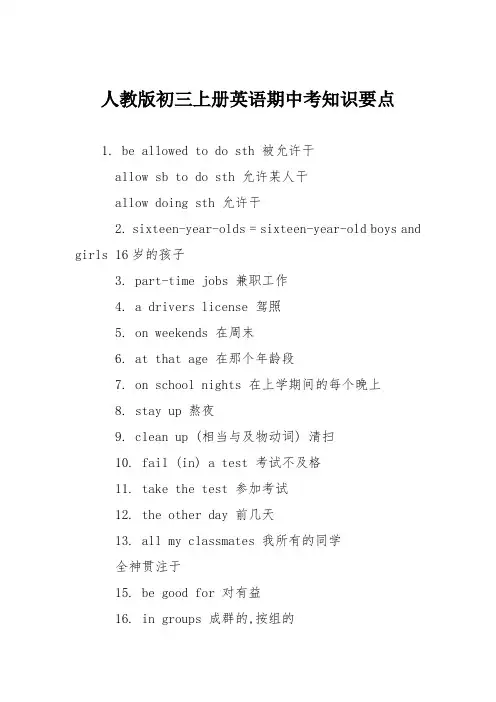
九年级上册人教版英语其中复习
- 格式:doc
- 大小:41.50 KB
- 文档页数:8
九年级上册人教版英语第一单元重点语法1. 动词+ by doing”结构的用法;例:I learn English by listening to tapes.2. 现在完成时的用法。
例:I have learned a lot that way. 用那种方法,我已经学到了很多东西。
3. how引导的特殊疑问句及其回答。
例:How do you study for a test? 你怎样为考试做准备?其他重点单词和短语的用法也很重要,你自己在书中归纳出来吧,那也是一个学习的过程人教版九年级英语上册第二单元学习目标1.掌握描写人物的技巧和词汇。
2.掌握下列知识点:■重点词汇:sure,used,airplane,terrify on■重点短语:①used to②wait a minute③play the piano④be interested in⑤on the swim team另外:①be terrified of②go to sleep③be alone④be afraid of■重点句型:①Mario,you used to be short,didn’t you?②Don't you remember me?③I go to sleep with my bedroom1ight on.■语法:used to句式的用法预习导学Ⅰ.英汉短语互译。
1.过去经常2.on the swim team3.弹钢琴4.wait a minute5.对……感兴趣一、重点单词与短语1.sure adv.的确【拓展】(1)be sure一定要;务必(2)make sure弄清楚;确保【跟踪训练】(1)人的确在变化。
People change.2.play the piano弹钢琴【精解】play与乐器类名词连用时,名词前要加定冠词the,而与球类名词连用时,名词前不要加定冠词the。
例如:play the violin拉小提琴;play soccer踢足球【跟踪训练】(2)她在四岁时学习弹钢琴。
She learned to at the age of four.3.be interested in对……感兴趣,后跟名词、代词、动名词或从句。
【拓展】其同义短语为take an interest in【跟踪训练】(3)我对他说的话感兴趣。
I what he said. 4.terrify.使害怕;使恐惧例如:Don't terrify the lame boy with ghost stories.不要用鬼故事吓唬这个小孩。
【拓展】be terrified of意为“非常害怕的;极度恐惧的”,后跟名词、代词或动名词。
其同义短语为be afraid of。
【跟踪训练】(1)She used to be afraid of snakes(同义句转换)She used to snakes.(2)5.alone adj&adv.独自;单独例如:The o1d man lives alone.那位老人单独居住。
【拓展】短语1eave/1et sb.alone意为“别打扰某人”。
【拓展】辨析:alone/1onelyalone意为“独自;单独”,不含有感情色彩;10nely指人孤独、寂寞,有浓厚的感情色彩。
(2)【跟踪训练】(2)尽管我独自居住,但我并不感到孤二、重点句型与语法独。
Although I1ive,I dont feel.■句型1.Mario,you used to be short,didn't you?玛利奥,你过去个子矮,是不是?【精解】used to意为“过去经常;以前常常”,后跟动词原形,“used to do sth.”这一结构表示“过去常常做某事”,暗指现在不再做了。
【跟踪训练】(1)他以前放学后常常踢足球。
He play soccer after schoo1.【辨析】used to do/be(get)used to doing/be used to do/be used for/be used by ①be(get)used to doing意为“习惯于……”,短语中的to为介词,后跟动名词。
②be used to do意为“被用来做某事”;be used for意为“被用于做某事”,后跟动名词;be used by意为“被……使用”,后跟动作的执行者。
三个短语都是use的被动语态。
【跟踪训练】我爸爸以前常常会习惯于饭后看电视,现在他却习惯与饭后散步。
My father watch TV after supper.Now hetaking a walk.(3)刀被用来切东西。
Knives cutting things。
2.I go to sleep with my bedroom light on.我开着卧室的灯睡觉。
【精解】①go to sleep意为“入睡;睡着”,指渐渐睡着的过程。
【辨析】go to bed/go to sleep/sleep/asleep go to bed指“上床睡觉;就寝”,强调动作;go to sleep指“入睡”,强调过程;sleep v.意为“睡觉”,be sleeping 正在睡觉;asleep adj.意为“睡着的”,强调“睡着的”状态,短语:fall asleep入睡;be asleep睡着。
【跟踪训练】(1)Don't turn on the TV.Grandma now.A.is sleepingB.will sleepC.sleptD.sleeps【精解】②with my bedroom light on意为“开着卧室的灯”’on为形容词,意为“开着的;接通的;工作着的”。
【拓展】turn on打开(电器、电源等);on TV通过电视;on the swim team在游泳队;on Monday morning在星期一早上【跟踪训练】(2)房间的灯亮着,我想他可能在家。
The light is in the room.I think he might be at home.【拓展】“with+名词+介词/形容词”结构,在句中作状语,表示伴随状况。
【跟踪训练】(3)夏天我喜欢开着窗子睡觉。
I like to sleep the window in summer.(4)老师手里拿着一本书走进了教室。
My teacher went into the classroom a book his hand.■语法used to结构①used to的用法used to表示“过去经常;以前常常”,指过去的习惯性动作或状态,现在已不再存在,其中to是动词不定式符号,后接动词原形。
例如:Mother used to get up early.我妈妈过去经常起得很早。
②一般疑问句:Used sb to...或Did sb use to...否定句:used to的否定形式为didn't use to或usedn't to,口语中常用usedn't to。
【跟踪训练】(1)He used to be outgoing;(变为否定句) He be outgoing.③反意疑问句:含有used to的句子,其反问部分用didn't或usedn't。
【跟踪训练】(2)他过去吸烟,是吗?He used to smoke, ? ④there used to be意为“过去曾经有”。
【跟踪训练】(3)这座房子前面曾经有一棵大树。
a tall tree in front of the house.第三单元1.语态:①英语有两种语态:主动语态和被动语态主动语态表示是动作的执行者被动语态表示主语是动作的承受者Tom bought a bike yesterday. (主动语态)昨天,汤姆买了一辆自行车。
A bike was biught by Tom. (被动语态)一辆自行车昨天被汤姆买了。
②被动语态的构成由“助动词be +及物动词的过去分词”构成助动词be 有人称、数和时态的变化,其变化规则与be 作为连系动词时完全一样。
时态被动语态结构例句一般am现在时 am are +过去分词English is spoken in many countries.一般过去时was +过去分词This bridge was built in 1989.were情态动词can/should may be/ must...+过去分词The work must be done right now.8. 倒装句:由so+助动词(be/do/will/have)/情态动词+主语意为:…也是一样 She is a student. So am I. 她是一个学生,我也是。
She went to school just now. So did I . 她刚才去学校了,我也是 She has finished the work. So have I . 她已经完成了工作,我也完成了。
She will go to school. So will he. 她将去学校,他也是。
9. yet 仍然,还常用在否定句或疑问句当中10. stay up 熬夜如:I often stay up until 12:00pm.我经常熬夜到12点。
11. clean up 打扫整理如:I have cleaned up the bedroom. 我已经打扫完了卧室。
12. 程度副词:always总是 usually经常 sometimes有时 never从不如:I am always/usually/sometimes/never late for school. 我总是/经常/有时/从不上学迟到。
13. 曾经做某事:Do you ever get to school late? Yes, I do. No, I don’t. Have you ever got to school late? Yes, I have. No, I haven’t.14. be strict with sb. 对某人严厉如:Mother is strict with her son. 妈妈对她的儿子很严厉。
15 take the test 参加考试 pass the test 通过考试 fail a test 考试失败16. the other day 前几天17. both…and… +动词复数形式如: Both Jim and Li Ming play bastketball.18. have an opportunity to do sth. 有机会做某事 have a chance of doing sth. 有机会做某事如:I have an opportunity to go to Beijing. I have a chance of going to Beijing.19. at present 目前20. at least 最少 at most 最多21. 花费 take ,cost, spend , paysth. take (sb.) time to do sth. It took (me) 10days to read the book.sth. cost (sb.) …… The book cost (me) 100yuan.sb. spend … on sth. She spent 10days on this book.sb. spend …doing sth.She spent 10days reading this book.sb. pay … for sth. She paid 10yuan for this book.22. have +时间段+off 放假,休息如:have 2 days off23. reply to 答复某人如:She replayed to MrGreen.24. get in the way of 碍事,妨碍如:Her social life got in the way of her studies. 她的社会生活妨碍了她的学习。