财务会计题库 The Financial Statements
- 格式:doc
- 大小:177.00 KB
- 文档页数:34
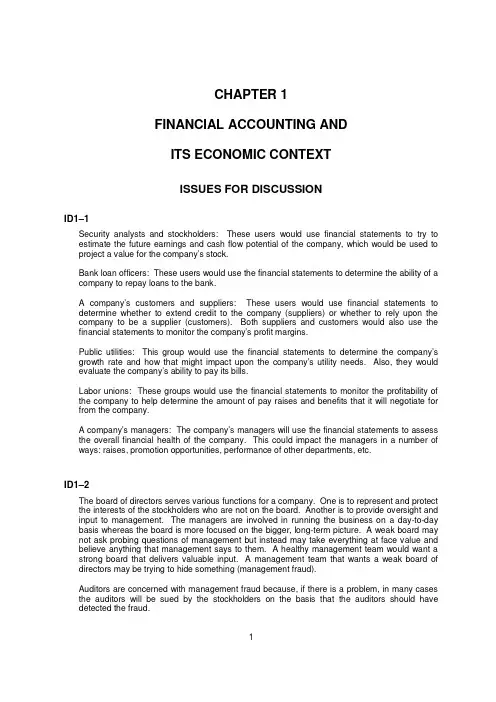
Financial Accounting, 7eHarrison/HorngrenTest Item FileChapter 1: The Financial Statements1.1-1 Bookkeeping is a type of accounting used primarily by proprietorships.Answer: False LO: 1-1 Diff: 2 EOC: QC 11.1-2 The three forms of business organizations are proprietorships, partnerships, and for-profit organizations.Answer: False LO: 1-1 Diff: 1 EOC: E1-131.1-3 To convince an investor to invest money in a particular company, relevant and reliable accountinginformation is required.Answer: True LO: 1-1 Diff: 1 EOC: E1-141.1-4 Limited Liability Companies (LLCs) have members instead of stockholders.Answer: True LO: 1-1 Diff: 1 EOC: E1-131.1-5 All business owners are personally liable for the debts of their businesses.Answer: False LO: 1-1 Diff: 1 EOC: E1-131.1-6 A proprietorship is a distinct and separate entity from the proprietor, from both an accounting and a legalviewpoint.Answer: False LO: 1-1 Diff: 2 EOC: E1-131.1-7 The two types of accounting are:A. profit and nonprofit.B. financial and managerial.C. internal and external.D. bookkeeping and decision-oriented.Answer: B LO: 1-1 Diff: 2 EOC: E1-131.1-8 According to the author, potential investors need information that is:A. relevant and reliable.B. fair and future-oriented.C. accurate and truthful.D. audited and complete.Answer: A LO: 1-1 Diff: 2 EOC: E1-141.1-9 Who ultimately controls a corporation?A. Board of DirectorsB. The Chief Executive Officer (CEO)C. The stockholdersD. The PresidentAnswer: C LO: 1-1 Diff: 2 EOC: E1-131.1-10 Financial statements are:A. standard documents issued by outside consultants who are hired to analyze key operations of thebusiness in financial terms.B. standard documents that tell us how well a business is performing and where it stands in financialterms.C. reports created by management that states it is responsible for the acts of the corporation.D. reports issued by outside consultants who are hired to analyze key operations of the business.Answer: B LO: 1-1 Diff: 1 EOC: E1-261.1-11 For which form of business ownership are the owners of a business legally distinct from the business?A. CorporationB. PartnershipC. ProprietorshipD. All of the aboveAnswer: A LO: 1-1 Diff: 1 EOC: E1-131.1-12 All of the following are forms of business organizations EXCEPT:A. proprietorship.B. limited partnership.C. limited proprietorship.D. limited liability company.Answer: C LO: 1-1 Diff: 1 EOC: E1-131.1-13 The largest organization of professional accountants in the United States is the:A. Financial Accounting Standards Board.B. Securities and Exchange Commission.C. American Institute of Certified Public Accountants.D. Auditing Standards Board.Answer: C LO: 1-1 Diff: 2 EOC: P1-53B1.2-1 Generally accepted accounting principles, or GAAP, are the rules and procedures established by theFinancial Accounting Standards Board, or the FASB.Answer: True LO: 1-2 Diff: 1 EOC: QC 11.2-2The entity concept is the most basic accounting concept.Answer: True LO: 1-2 Diff: 1 EOC: S1-31.2-3The stable monetary unit concept means that the type of currency used for the financial statements isNOT expected to change.Answer: False LO: 1-2 Diff: 2 EOC: E1-141.2-4Since cost is a reliable measure to use in financial accounting, the objectivity principle states that assetsand services should be recorded at their actual cost.Answer: False LO: 1-2 Diff: 2 EOC: E1-141.2-5 The Financial Accounting Standards Board is responsible for establishing:A. the code of professional conduct for accountants.B. the Securities and Exchange Commission.C. generally accepted accounting principles.D. the American Institute of Certified Public Accountants.Answer: C LO: 1-2 Diff: 2 EOC: QC 11.2-6 The acronym GAAP stands for:A. generally acceptable authorized pronouncements.B. government authorized accountant principles.C. generally accepted accounting principles.D. government audited accounting pronouncements.Answer: C LO: 1-2 Diff: 2 EOC: E1-271.2-7 All of the following are characteristics of useful accounting information EXCEPT:A. informative.B. relevant.C. consistent.D. reliable.Answer: A LO: 1-2 Diff: 2 EOC: E1-141.2-8 The objectivity principle of accounting:A. holds that the entity will remain in operation for the foreseeable future.B. enables accountants to ignore the effect of inflation in the accounting records.C. maintains that each organization or section of an organization stands apart from other organizationsand individuals.D. ensures that accounting records and statements are based on the most reliable data available.Answer: D LO: 1-2 Diff: 2 EOC: E1-141.2-9 The stable-monetary-unit concept of accounting:A. ensures that accounting records and statements are based on the most reliable data available.B. holds that the entity will remain in operation for the foreseeable future.c.maintains that each organization or section of an organization stands apart from other organizationsand individuals.d.enables accountants to ignore the effect of inflation in the accounting records.Answer: D LO: 1-2 Diff: 2 EOC: E1-141.2-10 The going-concern concept of accounting:A. enables accountants to ignore the effect of inflation in the accounting records.B. holds that the entity will remain in operation for the foreseeable future.c.maintains that each organization or section of an organization stands apart from other organizationsand individuals.d.ensures that accounting records and statements are based on the most reliable data available.Answer: B LO: 1-2 Diff: 2 EOC: P1-43A1.2-11 The principle which states that assets acquired by the business should be recorded at their actual price isthe:A. cost principle.B. objectivity principle.C. reliability principle.D. stable dollar principle.Answer: A LO: 1-2 Diff: 1 EOC: Q1-301.2-12 The reliability principle is also called the:A. relevance concept.B. truthfulness concept.C. objectivity principle.D. full and fair principle.Answer: C LO: 1-2 Diff: 2 EOC: E1-141.2-13 Which of the following statements is FALSE?A. Reliable data may be supported by objective evidence.B. The informed opinion of owners is an important source of objective evidence.C. An independent appraisal, conducted by a licensed professional, is usually considered reliable.D. Reliable data are verifiable.Answer: B LO: 1-2 Diff: 2 EOC: E1-141.2-14 The relevant measure of the value of the assets of a company that is going out of business is the:A. book value.B. current market value.C. historical cost.D. recorded value.Answer: B LO: 1-2 Diff: 2 EOC: P1-43A1.2-15 The CEO of a business owns a residence in Flagstaff. The company the CEO works for owns a residencein Chandler used for strategic planning meetings by its executives. Which of these properties is considered an asset(s) of the business?A. The Flagstaff residence onlyB. The Chandler residence onlyC. Both the Flagstaff and Chandler residencesD. Neither the Flagstaff nor Chandler residencesAnswer: B LO: 1-2 Diff: 2 EOC: S1-31.2-16 An Oklahoma City business paid $15,000 cash for equipment used in the business. At the time ofpurchase, the equipment had a list price of $20,000. When the balance sheet was prepared, the value of the equipment later rose to $22,000. What is the relevant measure of the value of the equipment?A. Historical cost, $15,000B. Fair market cost, $20,000C. Current market cost, $22,000D. $15,000 on the day of purchase, $22,000 on balance sheet dateAnswer: A LO: 1-2 Diff: 2 EOC: Q1-301.3-1 The accounting equation expresses the idea that Resources - Insider claims = Outsider claims.Answer: True LO: 1-3 Diff: 3 EOC: S1-51.3-2 The accounting equation must always be in balance.Answer: True LO: 1-3 Diff: 1 EOC: S1-11.3-3 Liabilities are divided into "outsider claims" and "insider claims."Answer: False LO: 1-3 Diff: 2 EOC: S1-51.3-4 "Net assets", as stockholders’ equity is often referred to, represents the residual amount of business assetswhich can be claimed by the owners.Answer: True LO: 1-3 Diff: 2 EOC: QC 121.3-5 Common stock and retained earnings are the main components of paid-in capital.Answer: False LO: 1-3 Diff: 2 EOC: S1-101.3-6 Retained earnings do not represent cash that is available to a company for future operations andexpansion.Answer: True LO: 1-3 Diff: 3 EOC: E1-271.3-7 Net income appears on both the income statement and the statement of retained earnings.Answer: True LO: 1-3 Diff: 2 EOC: Q1-391.3-8 The statement of cash flows is organized in terms o f the organization’s operating, investing, and financingactivities.Answer: True LO: 1-3 Diff: 2 EOC: E1-251.3-9 Expenses are increases in retained earnings that result from operations.Answer: False LO: 1-3 Diff: 2 EOC: S1-71.3-10 Dividend payments are NOT classified as expenses.Answer: True LO: 1-3 Diff: 2 EOC: S1-91.3-11 The calculation of ending retained earnings considers current net income or net loss and dividends.Answer: True LO: 1-3 Diff: 2 EOC: S1-91.3-12 The owners’ equity of proprietorships and partnerships is the same.Answer: False LO: 1-3 Diff: 2 EOC: S1-91.3-13 The accounting equation can be stated as:A. Assets + Stockholders’ Equity = LiabilitiesB. Assets - Liabilities = Stockholders’ EquityC. Assets = Liabilities - Stockholders’ EquityD. Assets - Stockholders’ Equity + Liabilities = ZeroAnswer: B LO: 1-3 Diff: 1 EOC: QC 31.3-14 Which of the following best describes a liability? Liabilities are:A. a form of paid-in capital.B. future economic benefits to which a company is entitled.C. payables of the corporation.D. economic obligations to owners to be paid at some future date by the corporation.Answer: C LO: 1-3 Diff: 1 EOC: S1-51.3-15 The owners’ interest in the assets of a corporation is known as:A. common stock.B. stockholders’ equity.C. long-term assets.D. operating expenses.Answer: B LO: 1-3 Diff: 2 EOC: S1-51.3-16 Claims held by the stockholders of a corporation are also known as:A. retained earnings.B. paid-in capital.C. paid-in capital plus retained earnings.D. net income.Answer: C LO: 1-3 Diff: 3 EOC: S1-51.3-17 Payables are classified as:A. increases in earnings.B. decreases in earnings.C. liabilities.D. assets.Answer: C LO: 1-3 Diff: 1 EOC: S1-61.3-18 Receivables are classified as:A. increases in earnings.B. decreases in earnings.C. liabilities.D. assets.Answer: D LO: 1-3 Diff: 1 EOC: S1-61.3-19 The sum of "outsider claims" plus "insider claims" equals:A. net income.B. total liabilities.C. total assets.D. total stockholders’ equity.Answer: C LO: 1-3 Diff: 3 EOC: S1-51.3-20 Revenues are:A. decreases in assets resulting from delivering goods or services to customers.B. increases in liabilities resulting from delivering goods or services to customers.C. increases in retained earnings resulting from delivering goods or services to customers.D. decreases in retained earnings resulting from delivering goods or services to customers.Answer: C LO: 1-3 Diff: 2 EOC: S1-41.3-21 How do revenues for a period relate to the beginning and ending balances in retained earnings?A. Revenues will increase the beginning balance of retained earnings for the period.B. Revenues will increase the ending balance of retained earnings for the period.C. Revenues less expenses will either increase or decrease the beginning balance of retained earnings forthe period.D. None of these answers are correct.Answer: C LO: 1-3 Diff: 2 EOC: S1-91.3-22 Expenses are:A. increases in liabilities resulting from purchasing assets.B. increases in assets resulting from operations.C. increases in retained earnings resulting from operations.D. decreases in retained earnings resulting from operations.Answer: D LO: 1-3 Diff: 2 EOC: S1-41.3-23 Dividends:A. are expenses.B. always affect net income.C. are distributions to stockholders of assets (usually cash) generated by net income.D. are distributions to stockholders of assets (usually cash) generated by a favorable balance in retainedearnings.Answer: C LO: 1-3 Diff: 2 EOC: E1-161.3-24 A corporation’s paid-in capital consists ofA. revenues and expenses.B. assets and liabilities.C. common stock.D. net income.Answer: C LO: 1-3 Diff: 2 EOC: S1-101.3-25 Net income is computed as:A. revenues – expenses – dividends.B. revenues + expenses.C. revenues – expenses.D. revenues – expenses + dividends.Answer: C LO: 1-3 Diff: 2 EOC: QC 81.3-26 Which of the following must be added to beginning Retained Earnings to compute ending RetainedEarnings?A. Net incomeB. ExpensesC. DividendsD. All of these answers are correct.Answer: A LO: 1-3 Diff: 2 EOC: P1-44A1.3-27 At the end of the current accounting period, account balances were as follows: Cash, $180,000; AccountsReceivable, $75,000; Common Stock, $20,000; Retained Earnings, $65,000. Liabilities for the period were:A. $ 70,000.B. $170,000.C. $190,000.D. $210,000.Answer: B LO: 1-3 Diff: 2 EOC: S1-11.3-28 On January 1, 2009, total assets for Liftoff Technologies were $125,000; on December 31, 2009, totalassets were $145,000. On January 1, 2009, total liabilities were $110,000; on December 31, 2009, total liabilities were $115,000. What is the amount of the change and the direction of the change in Liftoff Technologi es' stockholders’ equity for 2009?A. Decrease of $15,000B. Increase of $15,000C. Increase of $30,000D. Decrease of $30,000Answer: B LO: 1-3 Diff: 2 EOC: QC 121.3-29 Revenues were $170,000, expenses were $90,000, and cash dividends were $30,000. What was the netincome and the change in retained earnings for the period? income was $50,000; change in retained earnings was $50,000B. Net income was $80,000; change in retained earnings was $50,000C. Net income was $80,000; change in retained earnings was $80,000D. Net income was $250,000; change in retained earnings was $250,000Answer: B LO: 1-3 Diff: 2 EOC: E1-231.3-30 At the beginning of the period, assets were $490,000 and stockholders’ equity was $240,000. During theyear, as sets increased by $60,000, liabilities increased by $40,000, and stockholders’ equity increased by $20,000. Beginning liabilities must have been:A. $230,000.B. $250,000.C. $280,000.D. $300,000.Answer: B LO: 1-3 Diff: 3 EOC: S1-11.3-31 If assets increase $210,000 during a given period and liabilities increase $65,000 during the same period,stockholders’ equity must:A. increase $145,000.B. decrease $275,000.C. decrease $145,000.D. increase $275,000.Answer: A LO: 1-3 Diff: 3 EOC: P1-44A1.3-32 If liabilities increase $120,000 during a given period and stockholders’ equity decreases $25,000 duringthe same period, assets must:A. increase $95,000.B.decrease $95,000.C. decrease $145,000.D. increase $145,000.Answer: A LO: 1-3 Diff: 3 EOC: P1-44A1.3-33 Stockholders’ equity for Commerce-GA Corporation on 01/01/2008 and 12/31/2008 were $60,000 and$75,000, respectively. Assets on 01/01/2008 and 12/31/2008 were $115,000 and $105,000, respectively.Liabilities on 01/01/2008 were $55,000. What is the amount of liabilities on 12/31/2008?A. $40,000B. $15,000C. $30,000D. The amount is indeterminable from the given information.Answer: C LO: 1-3 Diff: 3 EOC: S1-11.4-1 Ramos, Inc. has monthly revenues of $30,000 and monthly expenses of $18,000, and the company paid$4,000 in dividends; therefore net income for the month is $8,000.Answer: False LO: 1-4 Diff: 2 EOC: S1-81.4-2 Able Co. has $500,000 in assets and $400,000 in liabilities; therefore the equity is $900,000.Answer: False LO: 1-4 Diff: 1 EOC: S1-11.4-3 Yummy Inc. has beginning retained earnings of $10,000, net income of $50,000, and dividends paid of$5,000; therefore the ending retained Earnings is $65,000.Answer: False LO: 1-4 Diff: 2 EOC: S1-81.4-4 Dividends appear on the:A. statement of retained earnings.B. both the statement of retained earnings and the income statement.C. income statement.D. balance sheet.Answer: A LO: 1-4 Diff: 2 EOC: S1-121.4-5 Assets appear on the:A. balance sheet.B. income statement.C. statement of retained earnings.D. both balance sheet and the statement of retained earnings.Answer: A LO: 1-4 Diff: 1 EOC: S1-121.4-6 Common stock appears on the:A. balance sheet.B. income statement.C. statement of cash flows and the statement of retained earnings.D. None of the above are correct.Answer: A LO: 1-4 Diff: 1 EOC: S1-121.4-7 A company’s gross profit for the period is reported on the:A. balance sheet.B.income statement.C. statement of cash flows.D. statement of retained earnings.Answer: B LO: 1-4 Diff: 1 EOC: S1-81.4-8 Gains and losses appear on which of the financial statements listed below?A. Balance sheetB.Income statementC. Statement of cash flowsD. Statement of retained earningsAnswer: B LO: 1-4 Diff: 1 EOC: S1-81.4-9 The ending balance in Retained Earnings appears on the:A. balance sheet only.B. balance sheet and statement of retained earnings.C. statement of retained earnings only.D. income statement and statement of cash flows.Answer: B LO: 1-4 Diff: 2 EOC: P1-49A1.4-10 Cash dividends:A. decrease revenue on the income statement.B. decrease retained earnings on the statement of retained earnings.C. increase expenses on the income statement.D. decrease operating activities on the statement of cash flows.Answer: B LO: 1-4 Diff: 2 EOC: S1-91.4-11 Which of the following financial statements shows the net increase or decrease in cash during the period?A. Balance sheet onlyB. Statement of operationsC. Statement of retained earnings and balance sheetD. Statement of cash flowsAnswer: D LO: 1-4 Diff: 1 EOC: S1-121.4-12 An investor wishing to assess a company’s financial position at the end of the period would probablyexamine the:A. statement of cash flows and the income statement.B. income statement only.C. balance sheet.D. statement of retained earnings.Answer: C LO: 1-4 Diff: 2 EOC: E1-261.4-13 A potential investor interested in evaluating a company’s financial performance for the current periodwould probably examine which of the following financial statements?A. Balance sheet onlyB. Income statement onlyC. Statement of cash flows and income statementD. Statement of retained earnings and balance sheetAnswer: B LO: 1-4 Diff: 2 EOC: E1-261.4-14 Which statement(s) summarizes the revenues and expenses of an entity?A. Balance sheet onlyB. Statement of cash flows and income statementC. Statement of retained earnings and statement of operationsD. Statement of operations onlyAnswer: D LO: 1-4 Diff: 2 EOC: S1-81.4-15 Which financial statement provides a "snapshot photo" of one moment in time?A. Balance sheet onlyB. Income statement onlyC. Statement of retained earnings and income statementD. Statement of cash flows onlyAnswer: A LO: 1-4 Diff: 2 EOC: E1-261.4-16 The income statement:A. is not dated.B. may cover a period of time or only one day in time, like a snapshot photograph.C. covers a defined period of time.D. reports the results of operations since the inception of the business.Answer: C LO: 1-4 Diff: 2 EOC: QC 51.4-17 The income statement presents a summary of the:A. cash inflows and outflows of an entity.B. assets and liabilities of an entity.C. revenues and expenses of an entity for a specific time period.D. c hanges that occurred in the stockholders’ equity of an entity.Answer: C LO: 1-4 Diff: 1 EOC: E1-191.4-18 Operating expenses appear on the income statement:A. directly after revenue.B. directly after gross profit.C. directly after cost of goods sold.D. Operating expenses do not appear on the income statement.Answer: B LO: 1-4 Diff: 2 EOC: S1-71.4-19 Cost of goods sold appears on the:A. statement of retained earnings as an addition to beginning retained earnings.B. income statement as a deduction from sales.C. balance sheet as a deduction from sales.D. income statement as a deduction from gross profit.Answer: B LO: 1-4 Diff: 2 EOC: P1-49A1.4-20 A retail store sells t-shirts for $85 and purchases them for $60. The store’s co st of goods sold would be:A. $25.B. $85.C. $60.D. None of these answers are correct.Answer: C LO: 1-4 Diff: 1 EOC: P1-49A1.4-21 Net income is:A. added to assets on the balance sheet.B. deducted from beginning retained earnings on the retained earnings statement.C. added to beginning retained earnings on the retained earnings statement.D. deducted from ending retained earnings on the retained earnings statement.Answer: C LO: 1-4 Diff: 2 EOC: S1-91.4-22 A net loss occurs when:A. not enough cash exists.B. total revenues exceed total expenses.C. total expenses exceed total revenues.D. total revenues and dividends exceed total expenses.Answer: C LO: 1-4 Diff: 2 EOC: P1-49A1.4-23 The balance sheet is also known as the:A. statement of profit and loss.B. operating statement.C. assets statement.D. statement of financial position.Answer: D LO: 1-4 Diff: 2 EOC: S1-101.4-24 The balance sheet reports information about:A. revenues, expenses, and equity.B. liabilities, equity, and expenses.C. assets, revenues, and liabilities.D. assets, liabilities, and equity.Answer: D LO: 1-4 Diff: 1 EOC: S1-101.4-25 Assets are generally classified as:A. producing assets and consumable assets.B. current assets and producing assets.C. current assets and long-term assets.D. long-term assets and consumable assets.Answer: C LO: 1-4 Diff: 1 EOC: E1-201.4-26 Current assets are assets expected to be converted to cash, sold, or consumed:A. within the next 12 months or within the business’s normal operating cycle if longer than a year.B. within the next 12 months or within the business’s normal operating cycle if less than a year.C. within the next 6 months.D. within the next 24 months.Answer: A LO: 1-4 Diff: 2 EOC: E1-191.4-27 Notes receivable due in 60 days would be classified as a:A. current liability on the balance sheet.B. current asset on the balance sheet.C. long-term asset on the balance sheet.D. long-term liability on the balance sheet.Answer: B LO: 1-4 Diff: 1 EOC: E1-191.4-28 Equipment would appear on the:A. balance sheet with the long-term assets.B. income statement with the revenues.C. income statement with the operating expenses.D. balance sheet with the current assets.Answer: A LO: 1-4 Diff: 1 EOC: E1-201.4-29 Depreciation is normally associated with which asset on the balance sheet?A. InventoryB. Accounts receivableC. LandD. EquipmentAnswer: D LO: 1-4 Diff: 2 EOC: P1-55B1.4-30 Accounts receivable would appear on the:A. balance sheet with the current liabilities.B. balance sheet with the current assets.C. income statement with the revenues.D. retained earnings statement with the net income.Answer: B LO: 1-4 Diff: 1 EOC: E1-201.4-31 Notes payable (due in 60 days) would appear as a:A. current liability on the balance sheet.B. current asset on the balance sheet.C. long-term asset on the balance sheet.D. long-term liability on the balance sheet.Answer: A LO: 1-4 Diff: 1 EOC: P1-56B1.4-32 Income taxes owed to the federal government would be classified as a(n):A. expense on the income statement.B. financing activity on the statement of cash flows.C. current asset on the balance sheet.D. current liability on the balance sheet.Answer: D LO: 1-4 Diff: 2 EOC: P1-56B1.4-33 In relation to the cash flow statement, purchases and sales of long-term assets are examples of:A. investing activities.B. accrual activities.C. financing activities.D. operating activities.Answer: A LO: 1-4 Diff: 2 EOC: S1-111.4-34 Stockholders’ equity decreases as a result of:A. owner investments.B. a net loss during the period.C. a net income during the period.D. Both A and C are correct.Answer: B LO: 1-4 Diff: 2 EOC: QC 71.4-35 When treasury stock is purchased by a company, this transaction:A. increases the amount of owners’ equity.B. decreases the amount of owners’ equity.C. decreases the amount of total liabilities.D. increases the amount of total liabilities.Answer: B LO: 1-4 Diff: 3 EOC: P1-49A1.4-36 The statement of cash flows is divided into which three categories?A. Operating, investing, and financing activitiesB. Planning, executing, and evaluating activitiesC. Increasing, decreasing, and non-cash activitiesD. Developing, producing, and marketing activitiesAnswer: A LO: 1-4 Diff: 1 EOC: P1-49A1.4-37 What is the proper order for the categories of the statement of cash flows?A. Financing activities, investing activities, and operating activitiesB. Operating activities, investing activities, and financing activitiesC. Operating activities, financing activities, and investing activitiesD. Investing activities, financing activities, and operating activitiesAnswer: B LO: 1-4 Diff: 2 EOC: P1-49A1.4-38 Where would cash received from the sale of stock appear on the statement of cash flows?A. In the operating activity sectionB. In the non-cash financing activity sectionC. In the investing activity sectionD. In the financing activity sectionAnswer: D LO: 1-4 Diff: 2 EOC: E1-231.4-39 How would the repayment of a long-term note payable be classified in the statement of cash flows?A. As an investing activityB. As a financing activityC. As an operating activityD. As a current asset on the balance sheetAnswer: B LO: 1-4 Diff: 3 EOC: P1-49A1.4-40 How would the issuance of stock for cash be classified on the statement cash flows?A. As an investing activityB. As a financing activityC. As an operating activityD. As a current asset on the balance sheetAnswer: B LO: 1-4 Diff: 3 EOC: P1-48A1.4-41 How would cash collected from customers appear on the statement of cash flows?A. As an operating activityB. As a financing activityC. As an investing activityD. Under the indirect methodAnswer: A LO: 1-4 Diff: 2 EOC: P1-48A1.4-42 Where would the payment of salaries appear on the statement of cash flows?A. With the operating activitiesB. With the current liabilitiesC. Not on statement of cash flows, but on the statement of earnings with the revenuesD. Not on statement of cash flows, but on the statement of operations as part of cost of goods soldAnswer: A LO: 1-4 Diff: 3 EOC: E1-191.5-1 The statement of cash flows reports on where assets came from and how these assets were used.Answer: False LO: 1-5 Diff: 2 EOC: S1-111.5-2 The statement of cash flows contains three “parts”—operating activities, investing activities, and stockactivities.Answer: False LO: 1-5 Diff: 2 EOC: S1-111.5-3 In accounting, the word "net" means “something taken out”.Answer: True LO: 1-5 Diff: 2 EOC: S1-71.5-4 The owners’ equity of a partnership includes both partner equity and partner earnings.Answer: True LO: 1-5 Diff: 3 EOC: E1-15。