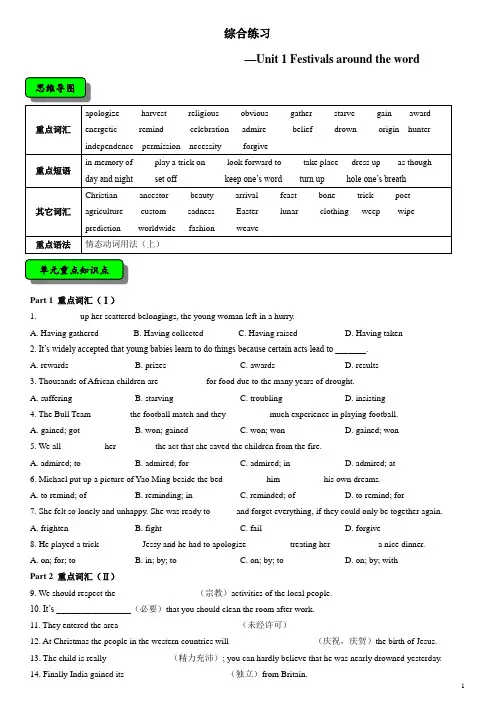
综合练习—Unit 1 Festivals around the wordPart 1 重点词汇(Ⅰ)1. _________ up her scattered belongings, the young woman left in a hurry.A. Having gatheredB. Having collectedC. Having raisedD. Having taken2. It‟s widely accepted that young babies learn to do things because certain acts lead to _______.A. rewardsB. prizesC. awardsD. results3. Thousands of African children are __________ for food due to the many years of drought.A. sufferingB. starvingC. troublingD. insisting4. The Bull Team ________ the football match and they _________ much experience in playing football.A. gained; gotB. won; gainedC. won; wonD. gained; won5. We all _________ her ________ the act that she saved the children from the fire.A. admired; toB. admired; forC. admired; inD. admired; at6. Michael put up a picture of Yao Ming beside the bed _________ him _________ his own dreams.A. to remind; ofB. reminding; inC. reminded; ofD. to remind; for7. She felt so lonely and unhappy. She was ready to _____ and forget everything, if they could only be together again.A. frightenB. fightC. failD. forgive8. He played a trick _________ Jessy and he had to apologize _________ treating her __________ a nice dinner.A. on; for; toB. in; by; toC. on; by; toD. on; by; withPart 2 重点词汇(Ⅱ)9. We should respect the __________________(宗教)activities of the local people.10. It‟s _________________(必要)that you should clean the room after work.11. They entered the area ___________________________(未经许可)12. At Christmas the people in the western countries will ___________________(庆祝,庆贺)the birth of Jesus.13. The child is really ______________(精力充沛); you can hardly believe that he was nearly drowned yesterday.14. Finally India gained its _______________________(独立)from Britain.15. Though they like jazz very much, some fans even don‟t know the _____________(起源)of jazz.Part 3 重点短语1. Great changes ____________________________(发生)in our country since the 29 Olympic Games.(1)take place (2)take the place of (3)in place of(4)take sb.‟s place (5)in place (6)out of place(7)in one‟s place (8)in the first place2. When asked about their opinions about the schoolmaster, many teachers would prefer to see him step aside _________(支持,赞同)younger men.(1)in need of (2)in search of (3)in charge of(4)in memory of (5)in praise of (6)in favor of3. I‟m ___________________(盼望)seeing you this summer vacation.(1)look at (2)look out (3)look up(4)look for (5)look into (6)look over(7)look forward to (8)look down upon4. It‟s time for the meeting, but he hasn‟t ____________________(出现,露面).(1)turn on (2)turn off (3)turn up(4)turn down (5)turn to (6)turn around / turn round(7)turn out (8)turn out to be5. What time are you planning to _________________(出发,动身,使爆炸)tomorrow?(1)set off (2)set up (3)set down(4)set out to do (5)set about doing (6)set aside6. On Halloween, children in America like to ________________(盛装,打扮)as ghosts to frighten people.7. The kids are always ____________________(恶作剧,开玩笑)their teacher.8. To be honest, he never _____________________(守信,遵守诺言).9. The audience ______________________(屏住呼吸)to see who would win the gold medal.10. It seems ___________________(仿佛,好像)there will be an election soon.Anna lived on the side of a valley. One summer, there was a very big 1 , and a lot of houses down below Anna‟s were washed away. Anna‟s house was 2 enough to escape the flood, so when the water had 3 and the other houses were 4 there with no roof and no walls and all covered with mud (泥), her house was just all right.Her house was quite small, her husband was dead, and she had four children, 5 Anna took in one of the families that had lost 6 in the flood and she 7 her home with them until it was 8 for them to rebuild their house.Anna‟s friends were 9 when they saw Anna do this. They could not understand why Anna wanted to give 10 so much more work and trouble when she already had quite a few children to 11 .“Well,” Anna 12 her fr iends, “at the end of the First World War, a woman in the town where I then lived found herself very 13 , because her husband had been killed in the 14 and she had a lot of children, 15 I have now. The day before Christmas, this woman sai d to her children, …We won‟t be able to have much for Christmas this year, so I‟m going to 16 only one present to all of us. Now I‟ll go and get it.‟ She came back with a 17who was even poorer than they, and who had no parents. “Here‟s our 18 ,” she said to her children.The children were 19 and happy to get such a present. They 20 the little girl, and she grew up as their sister. Such was that Christmas present.”1. A. earthquake B. accident C. flood D. fire2. A. below B. high C. big D. small3. A. reduced B. come C. appeared D. disappeared4. A. rising B. flowing C. falling D. standing5. A. so B. but C. for D. since6. A. nothing B. everything C. anything D. something7. A. gave B. found C. shared D. built8. A. possible B. necessary C. important D. obvious9. A. worried B. disappointed C. puzzled D. satisfied10. A. them B. herself C. him D. us11. A. support B. supply C. grow D. educate12. A. explained to B. asked for C. talked with D. turned up13. A. sad B. poor C. rich D. happy14. A. war B. storm C. rain D. flood15. A. because B. as C. which D. that16. A. get B. send C. buy D. make17. A. boy B. girl C. student D. teacher18. A. child B. daughter C. sister D. present19. A. angry B. excited C. lovely D. sorry20. A. disliked B. gained C. welcomed D. ledPart 1单词拼写(周一、周二完成)1. Christmas is an important _______________(节日,盛宴,宴会)for Christians.2. After graduation he would love to live ______________________(自主,独立).3. ___________________(农业)development simply must precede economic development.4. She was _______________(奖,奖品;授予,判定)a scholarship to study at Harvard.5. I am afraid I have _______________(获得,得到)weight.6. You can never _____________(预言,预报)what would happen next.7. It‟s cruel to ______________(淹死,淹没,溺死)the cat in the river.8. The old woman died of ______________________(饥饿).9. To know happiness one must experience _____________(悲哀,悲伤).10. Christmas and ______________(复活节)are Christian festivals.11. A crowd ____________(搜集,集合,聚集)to see what had happened.12. She spent a great deal of money to follow the _______________(样子,时尚).13. These _______________(狩猎者,猎人)succeeded in taking a fox by a trap.14. He _________________(道歉)to her for not being to her wedding.15. _____________(风俗,习俗)is sometimes considered as important as law.16. The secretary informed me of his _____________(到达,到来).17. They entered the area without any ________________(允许,许可).18. The hotel held a grand ______________________(庆祝,庆贺)for its opening.19. It‟s ______________(明显的)that she is clever.20. We ______________(羡慕,钦佩)for his righteousness when we co-worked with him.21. People who share an _____________(祖先,祖宗)are called relatives.22. The story _______________(提醒,使想起)me of my childhood.23. The ______________(宗教的)affairs have been reestablished.24. It was done under the pressure of the ___________________(必要性,需要).25. The story has attracted ______________________(世界性的,全世界的)attention.26. The peasants are _______________(收获,收割)rice in the field.27. I ______________(原谅,饶恕)his crimes at last.28. The story of his miseries is beyond my _____________(相信,信仰).29. He seems an _______________(精力充沛的)person.30. The family had its _____________(起源)in Canada.Part 2 完形填空(周三完成)Somebody might say, “I want to be a big fish, as big as Bill Gates, in a big pool, as large as Microsoft.” However,should always dream of being a big fish in a big pool!1. A. impossible B. uninteresting C. unnecessary D. uncomfortable2. A. think B. recognize C. consider D. realize3. A. what B. whether C. how D. which4. A. help B. chances C. advice D. money5. A. high B. proper C. rich D. practical6. A. jobs B. tools C. skills D. topics7. A. success B. perform C. produce D. process8. A. increase B. improve C. impress D. encourage9. A. weak B. reasonable C. strong D. amazing10. A. without B. because of C. except for D. with11. A. less B. equal C. no D. more12. A. various B. serious C. precious D. former13. A. succeed B. success C. successful D. succeeded14. A. Personally B. Certainly C. Immediately D. Generally15. A. satisfied B. proud C. relaxed D. regrettedPart 3 单项选择(周五完成)1. It ________ that I met her on my way home.A. took placeB. occurredC. happenedD. broke out2. The boy _________ the first prize, but he was so careless as to make a foolish mistake.A. must have gainedB. need have gainedC. could have gainedD. shall have gained3. He stood still in front of the shop windows as if he were ________ something in them.A. admiringB. lookingC. respectingD. liking4. Could you ________ me for my not keeping my ________?A. sorry; wordB. pardon; wordsC. forgive; promiseD. excuse; promises5. If you want to catch the first bus, you‟d better __________ for the bus station immediately.A. set upB. set aboutC. set downD. set off6. It‟s quite an informal gathering; you needn‟t __________ for it.A. be dressed inB. dress upC. be taken inD. take up7. Anyone who can help me find my lost dog can be ________ with ¥1,000.A. rewardedB. awardedC. praisedD. valued8. Those travelers _________ for lack of food before rescuers could get to them.A. starvedB. killedC. annoyedD. eager9. The teacher ________ all the students before him and told them why and how to _______ money for their sickclassmates.A. gathered; gatherB. asked; collectC. gathered; beggedD. gathered; collect10. In our childhood, we were often _________ by Grandma to pay attention to table manners.A. demandedB. remindedC. allowedD. hoped11. The villagers collected money to set up a monument __________ those who died in the great earthquake.A. in search ofB. in place ofC. in need ofD. in memory of12. I‟m sorry, but I didn‟t mean to keep you waiting here for a long time. Can you ________me?A. forgiveB. satisfyC. apologizeD. gain13. I can hardly hear the television. Would you please _________?A. turn it onB. turn it downC. turn it upD. turn it off14. She looks forward very spring to _______ the flower-lined garden.A. visitB. paying a visit toC. walkingD. walk in15. After the efforts of the doctors, the boy is now out of ________.A. breathB. controlC. sightD. fashion人教版新课标英语必修3综合练习—Unit 1 Festivals around the word(教师版)Part 1 重点词汇(Ⅰ)1. _________ up her scattered belongings, the young woman left in a hurry.A. Having gatheredB. Having collectedC. Having raisedD. Having taken答案:A2. It‟s widely accepted that young babies learn to do things because certain acts lead to _______.A. rewardsB. prizesC. awardsD. results答案:A3. Thousands of African children are __________ for food due to the many years of drought.A. sufferingB. starvingC. troublingD. insisting答案:B4. The Bull Team ________ the football match and they _________ much experience in playing football.A. gained; gotB. won; gainedC. won; wonD. gained; won答案:B5. We all _________ her ________ the act that she saved the children from the fire.A. admired; toB. admired; forC. admired; inD. admired; at答案:B6. Michael put up a picture of Yao Ming beside the bed _________ him _________ his own dreams.A. to remind; ofB. reminding; inC. reminded; ofD. to remind; for答案:A7. She felt so lonely and unhappy. She was ready to _____ and forget everything, if they could only be together again.A. frightenB. fightC. failD. forgive答案:D8. He played a trick _________ Jessy and he had to apologize _________ treating her __________ a nice dinner.A. on; for; toB. in; by; toC. on; by; toD. on; by; with答案:CPart 2 重点词汇(Ⅱ)9. We should respect the __________________(宗教)activities of the local people.答案:religious10. It‟s _________________(必要)that you should clean the room after work.答案:necessary11. They entered the area ___________________________(未经许可).答案:without permission12. At Christmas the people in the western countries will ___________________(庆祝,庆贺)the birth of Jesus.答案:celebrate13. The child is really ______________(精力充沛); you can hardly believe that he was nearly drowned yesterday.答案:energetic14. Finally India gained its _______________________(独立)from Britain.答案:independence15. Though they like jazz very much, some fans even don‟t know the _____________(起源)of jazz.答案:originPart 3 重点短语1. Great changes have taken place (发生)in our country since the 29 Olympic Games.(1)take place (2)take the place of (3)in place of(4)take sb.‟s place (5)in place (6)out of place(7)in one‟s place (8)in the first place2. When asked about their opinions about the schoolmaster, many teachers would prefer to see him step aside in favorof (支持,赞同)younger men.(1)in need of (2)in search of (3)in charge of(4)in memory of (5)in praise of (6)in favor of3. I‟m looking forward to (盼望)seeing you this summer vacation.(1)look at (2)look out (3)look up(4)look for (5)look into (6)look over(7)look forward to (8)look down upon4. It‟s time for the meeting, but he hasn‟t turned up (出现,露面).(1)turn on (2)turn off (3)turn up(4)turn down (5)turn to (6)turn around / turn round(7)turn out (8)turn out to be5. What time are you planning to set off (出发,动身,使爆炸)tomorrow?(1)set off (2)set up (3)set down(4)set out to do (5)set about doing (6)set aside6. On Halloween, children in America like to dress up (盛装,打扮)as ghosts to frighten people.7. The kids are always playing tricks on (恶作剧,开玩笑)their teacher.8. To be honest, he never keeps his promise / word (守信,遵守诺言).9. The audience hold their breath (屏住呼吸)to see who would win the gold medal.10. It seems as though / as if (仿佛,好像)there will be an election soon.Anna lived on the side of a valley. One summer, there was a very big 1C , and a lot of houses down below Anna‟s were washed away. Anna‟s house was 2B enough to escape the flood, so when the water had 3D and the other houses were 4D there with no roof and no walls and all covered with mud (泥), her house was just all right.Her house was quite small, her husband was dead, and she had four children, 5B Anna took in one of the families that had lost 6B in the flood and she 7C her home with them until it was 8A for them to rebuild their house.Anna‟s friends were 9C when they saw Anna do this. They could not understand why Anna wanted to give 10B so much more work and trouble when she already had quite a few children to 11A .“Well,” Anna 12A her friends, “at the end of the First World War, a woman in the town where I then lived found herself very 13B , because her husband had been killed in the 14A and she had a lot of children, 15B I have now. The day before Christmas, this woman said to her children, …We won‟t be able to have much for Christmas this year, so I‟m going to 16D only one present to al l of us. Now I‟ll go and get it.‟ She came back with a 17B who was even poorer than they, and who had no parents. “Here‟s our 18D ,” she said to her children.The children were 19B and happy to get such a present. They 20C the little girl, and she grew up as their sister. Such was that Christmas present.”1. A. earthquake B. accident C. flood D. fire2. A. below B. high C. big D. small3. A. reduced B. come C. appeared D. disappeared4. A. rising B. flowing C. falling D. standing5. A. so B. but C. for D. since6. A. nothing B. everything C. anything D. something7. A. gave B. found C. shared D. built8. A. possible B. necessary C. important D. obvious9. A. worried B. disappointed C. puzzled D. satisfied10. A. them B. herself C. him D. us11. A. support B. supply C. grow D. educate12. A. explained to B. asked for C. talked with D. turned up13. A. sad B. poor C. rich D. happy14. A. war B. storm C. rain D. flood15. A. because B. as C. which D. that16. A. get B. send C. buy D. make17. A. boy B. girl C. student D. teacher18. A. child B. daughter C. sister D. present19. A. angry B. excited C. lovely D. sorry20. A. disliked B. gained C. welcomed D. ledPart 1单词拼写(周一、周二完成)1. Christmas is an important feast (节日,盛宴,宴会)for Christians.2. After graduation he would love to live independently (自主,独立).3. Agricultural (农业)development simply must precede economic development.4. She was awarded (奖,奖品;授予,判定)a scholarship to study at Harvard.5. I am afraid I have gained (获得,得到)weight.6. You can never predict (预言,预报)what would happen next.7. It‟s cruel to drown (淹死,淹没,溺死)the cat in the river.8. The old woman died of starvation (饥饿).9. To know happiness one must experience sadness (悲哀,悲伤).10. Christmas and Easter (复活节)are Christian festivals.11. A crowd gathered (搜集,集合,聚集)to see what had happened.12. She spent a great deal of money to follow the fashion (样子,时尚).13. These hunters (狩猎者,猎人)succeeded in taking a fox by a trap.14. He apologized (道歉)to her for not being to her wedding.15. Custom (风俗,习俗)is sometimes considered as important as law.16. The secretary informed me of his arrival (到达,到来).17. They entered the area without any permission (允许,许可).18. The hotel held a grand celebration (庆祝,庆贺)for its opening.19. It‟s obvious (明显的)that she is clever.20. We admired (羡慕,钦佩)for his righteousness when we co-worked with him.21. People who share an ancestor (祖先,祖宗)are called relatives.22. The story reminds / reminded (提醒,使想起)me of my childhood.23. The religious (宗教的)affairs have been reestablished.24. It was done under the pressure of the necessity (必要性,需要).25. The story has attracted worldwide (世界性的,全世界的)attention.26. The peasants are harvesting (收获,收割)rice in the field.27. I forgave (原谅,饶恕)his crimes at last.28. The story of his miseries is beyond my belief (相信,信仰).29. He seems an energetic (精力充沛的)person.30. The family had its origin (起源)in Canada.Part 2 完形填空(周三完成)Somebody might say, “I want to be a big fish, as big as Bill Gates, in a big pool, as large as Microsoft.” However,You should always dream of being a big fish in a big pool!1. A. impossible B. uninteresting C. unnecessary D. uncomfortable2. A. think B. recognize C. consider D. realize3. A. what B. whether C. how D. which4. A. help B. chances C. advice D. money5. A. high B. proper C. rich D. practical6. A. jobs B. tools C. skills D. topics7. A. success B. perform C. produce D. process8. A. increase B. improve C. impress D. encourage9. A. weak B. reasonable C. strong D. amazing10. A. without B. because of C. except for D. with11. A. less B. equal C. no D. more12. A. various B. serious C. precious D. former13. A. succeed B. success C. successful D. succeeded14. A. Personally B. Certainly C. Immediately D. Generally15. A. satisfied B. proud C. relaxed D. regrettedPart 3 单项选择(周五完成)1. It ____C____ that I met her on my way home.A. took placeB. occurredC. happenedD. broke out2. The boy ____C_____ the first prize, but he was so careless as to make a foolish mistake.A. must have gainedB. need have gainedC. could have gainedD. shall have gained3. He stood still in front of the shop windows as if he were ____A____ something in them.A. admiringB. lookingC. respectingD. liking4. Could you ____C____ me for my not keeping my ________?A. sorry; wordB. pardon; wordsC. forgive; promiseD. excuse; promises5. If you want to catch the first bus, you‟d better _____D_____ for the bus station immediately.A. set upB. set aboutC. set downD. set off6. It‟s quite an informal gathering; you needn‟t _____B_____ for it.A. be dressed inB. dress upC. be taken inD. take up7. Anyone who can help me find my lost dog can be ____A____ with ¥1,000.A. rewardedB. awardedC. praisedD. valued8. Those travelers _____A____ for lack of food before rescuers could get to them.A. starvedB. killedC. annoyedD. eager9. The teacher ____D____ all the students before him and told them why and how to _______ money for their sickclassmates.A. gathered; gatherB. asked; collectC. gathered; beggedD. gathered; collect10. In our childhood, we were often ____B_____ by Grandma to pay attention to table manners.A. demandedB. remindedC. allowedD. hoped11. The villagers collected money to set up a monument _____D_____ those who died in the great earthquake.A. in search ofB. in place ofC. in need ofD. in memory of12. I‟m sorry, but I didn‟t mean to keep you waiting here for a long time. Can you ____A____me?A. forgiveB. satisfyC. apologizeD. gain13. I can hardly hear the television. Would you please _____C____?A. turn it onB. turn it downC. turn it upD. turn it off14. She looks forward very spring to ___B____ the flower-lined garden.A. visitB. paying a visit toC. walkingD. walk in15. After the efforts of the doctors, the boy is now out of ____A____.A. breathB. controlC. sightD. fashion11。