
英国国家概况-PPT课件
- 格式:ppt
- 大小:9.02 MB
- 文档页数:72

Part One: The United Kingdom of Great Britain and Northern Ireland
Chapter 1 Land and People
Chapter 2 The Origins of a Nation (500BC~AD1066)
Chapter 3 The Shape of the Nation (1066~1381)
Chapter 4 Transition to the Modern Age (1455~1688)
Chapter 5 The Rise and Fall of the British Empire (1688~1990)
Chapter 6 The Economy
Chapter 7 Government and Administration
Chapter 8 Justice the Law
Chapter 9 Social Affairs
Chapter 10 Cultural Affairs
Chapter 1 Land, People and Language
1 Different Names for Britain and its Parts
The official name of Britain is the United Kingdom of Great Britain and Northern
Ireland. The geographical names are the British Isles, Great Britain and England.
People just say Britain, the United Kingdom or simply U.K.
People
England is the largest and most populous, almost a quarter of the people lives in
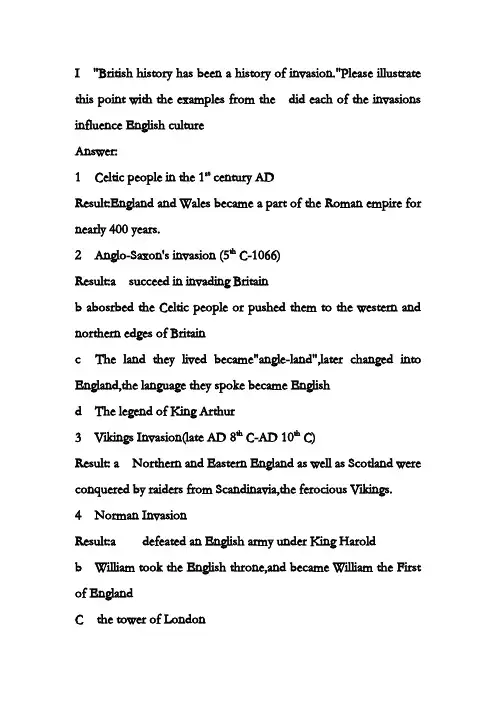
I "British history has been a history of invasion."Please illustrate
this point with the examples from the did each of the invasions
influence English culture
Answer:
1 Celtic people in the 1st century AD
Result:England and Wales became a part of the Roman empire for
nearly 400 years.
2 Anglo-Saxon's invasion (5th C-1066)
Result:a succeed in invading Britain
b abosrbed the Celtic people or pushed them to the western and
northern edges of Britain
c The land they lived became"angle-land",later changed into
England,the language they spoke became English
d The legend of King Arthur
3 Vikings Invasion(late AD 8th C-AD 10th C)
Result: a Northern and Eastern England as well as Scotland were
conquered by raiders from Scandinavia,the ferocious Vikings.
4 Norman Invasion
Result:a defeated an English army under King Harold

Chapter 2:The Origins of a Nation (5000BC-1066)
英国的起源(公元前5000年—1066年)
I. Early Settlers (5000BC-55BC)早期的居民(公元前5000年—公元前55年)
1.The first known settlers of Britain were the Iberians.
人们所知的英国最早居民是伊比利亚人。
2. At about 2000 BC the Beaker Folk arrived from the areas now know as Holland and Rhineland.
约公元前2000年,从现在的荷兰和莱茵兰地区来了宽口陶器人。
3. The Celts began to reach the Britain about 700 BC.
约公元前700年,克尔特人来到不列颠岛。
4. The Celts came to Britain in three main waves.
克尔特人来到不列颠有三次高潮。
The first waves were the Gaels-came about 600 BC.
第一次高潮是约公元前600年盖尔人的来临。
The second waves were the Brythons-came about 400 BC.
第二次高潮是约公元前400年布立吞(不列颠)人的抵达。
The third waves were the Belgae-came about 150 BC.
第三次是约公元前150年比利其人的到达。 II. Roman Britain (55BC-410AD) 罗马人统治时期的英国(公元前55年—410年)
1. British recorded history begins with the Roman invasion. In 55BC and 54BC, Julius Caesar, a Roman general, invaded Britain twice. In AD 43, the Emperor Claudius invaded Britain successfully. For nearly 400 years, Britain was under the Roman occupation, though it was never a total occupation.

第六章 英国经济
英国是世界上最老的工业国,工业革命首先发生在英国。一个世纪前英国被称为"世界工广"。英国生产出许多商品然后销往世界各地。那时的英国经济属世界强国之林,生活水平远远高于欧洲邻国。但是今非昔比。二战后不久,英国不仅失去经济霸权,而且其工业领导地位也丢失大部分。其人均国民生产总值在1900年被美国超过,1950年被法国和德国超过,1960年被意大利超过。1950年至1973年间,英国的国民生产总值平均年增产率为3.0%,低于其大多数贸易伙伴。经济发展受阻于长期收支差额赤字。一个国家的收支差额是指出口所挣的货币与进口所花货币之间的差额。当一个国家花在进口上的总货币量超过它在出口上得到的总货币量时,这个国家就遭受收支差额的赤字。几十年来英国一直存在收支差额赤字。在增长率上英国再也不能与其他工业国匹敌。现在常用"英国病"这个词来概括英国经济衰退的特征。
I.二战后英国经济的演变
二战后英国经济的发展有三个阶段:
1.15年代和60年代的稳定发展
二战蹂躏了欧洲。战争使英国经济遭受巨大损失,但它所受的直接战争损失比其他欧洲国家和日本要小。美国的援助使英国经济很快恢复。被战争抑制的消费需求很快成了促进经济发展的重要因素。到1947年底英国经济已恢复到战前水平。1950年英国的国民生产总值及外贸列世界第二位(仅次于美国),人均收入列世界第三位。
这一时期英国经济的特点是发展缓慢但很稳定,失业少,物质的极度繁荣伴随着消费水平的提高。像所有西方国家一样,英国把充分就业问题看作是战后经济的突出问题,它所奉行的经济政策以约翰·凯恩斯理论为基础。他提出,政府在利用物价和收入政策从根本上抑制通货膨胀的同时,应该利用财政和货币政策来微调社会的总需求,以达到充分就业的目的。这种以高消费和低投资为特点的政策也产生了一些问题,其中之一是劳动力费用昂贵,这反过来又导致英国在国际市场上竞争力低下。尽管50年代和60年代英国经济发展稳定, 但它仍落后于其他工业国。1953-1963年期间,英国的平均年增长为2.6%,而整个资本主义世界为5.6%,其中法国为4.6%,西德为7.1%,50年代英国工业增长率只有法国的一半。