
外研版(三起)四年级英语上册课件Module6Unit1(4)
- 格式:pptx
- 大小:2.35 MB
- 文档页数:26

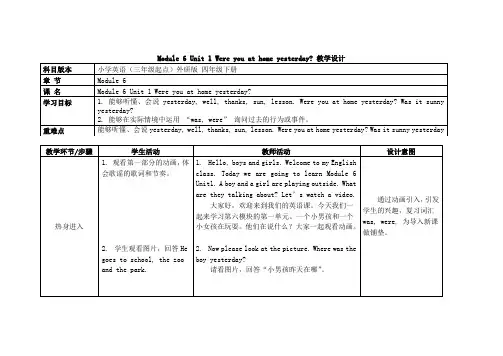
Module 6 Unit 1 Were you at home yesterday? 教学设计
教学环节/步骤 学生活动 教师活动 设计意图
热身进入 1. 观看第一部分的动画,体会歌谣的歌词和节奏。
2. 学生观看图片,回答He
goes to school, the zoo
and the park.
1. Hello, boys and girls. Welcome to my English
class. Today we are going to learn Module 6
Unit1. A boy and a girl are playing outside. What
are they talking about? Let’s watch a video.
大家好,欢迎来到我们的英语课。今天我们一起来学习第六模块的第一单元。一个小男孩和一个小女孩在玩耍。他们在说什么?大家一起观看动画。
2. Now please look at the picture. Where was the
boy yesterday?
请看图片,回答“小男孩昨天在哪”。
通过动画引入,引发学生的兴趣,复习词汇was, were, 为导入新课做铺垫。
科目版本 小学英语(三年级起点)外研版 四年级下册
章 节 Module 6
课 名 Module 6 Unit 1 Were you at home yesterday?
学习目标 1. 能够听懂、会说yesterday, well, thanks, sun, lesson. Were you at home yesterday? Was it sunny
yesterday?
2. 能够在实际情境中运用 “was, were” 询问过去的行为或事件。
重难点 能够听懂、会说yesterday, well, thanks, sun, lesson. Were you at home yesterday? Was it sunny yesterday 3. 跟随动画说唱完整的歌谣。 3. You are right! The boy was at school, at the
外研版(三起)-英语-打印版
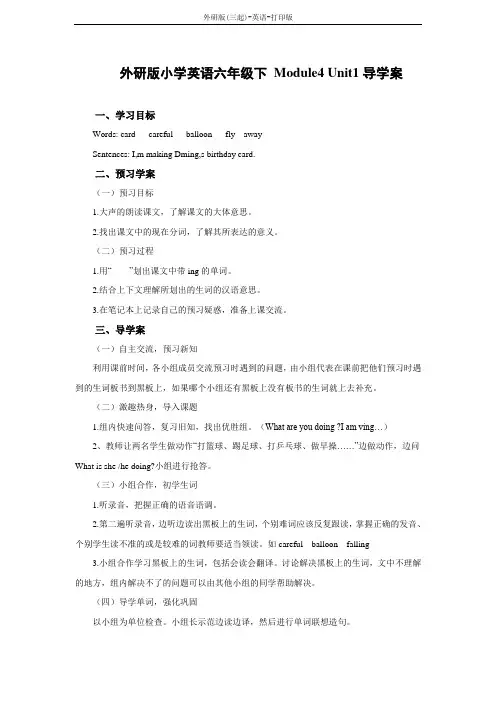
外研版小学英语六年级下 Module4 Unit1导学案
一、学习目标
Words: card careful balloon fly away
Sentences: I,m making Dming,s birthday card.
二、预习学案
(一)预习目标
1.大声的朗读课文,了解课文的大体意思。
2.找出课文中的现在分词,了解其所表达的意义。
(二)预习过程
1.用“ ”划出课文中带ing的单词。
2.结合上下文理解所划出的生词的汉语意思。
3.在笔记本上记录自己的预习疑惑,准备上课交流。
三、导学案
(一)自主交流,预习新知
利用课前时间,各小组成员交流预习时遇到的问题,由小组代表在课前把他们预习时遇到的生词板书到黑板上,如果哪个小组还有黑板上没有板书的生词就上去补充。
(二)激趣热身,导入课题
1.组内快速问答,复习旧知,找出优胜组。(What are you doing ?I am ving…)
2、教师让两名学生做动作“打篮球、踢足球、打乒乓球、做早操……”边做动作,边问What is she /he doing?小组进行抢答。
(三)小组合作,初学生词
1.听录音,把握正确的语音语调。
2.第二遍听录音,边听边读出黑板上的生词,个别难词应该反复跟读,掌握正确的发音、个别学生读不准的或是较难的词教师要适当领读。如careful balloon falling
3.小组合作学习黑板上的生词,包括会读会翻译。讨论解决黑板上的生词,文中不理解的地方,组内解决不了的问题可以由其他小组的同学帮助解决。
(四)导学单词,强化巩固
以小组为单位检查。小组长示范边读边译,然后进行单词联想造句。 外研版(三起)-英语-打印版
(五)初读课文,整体感知
1.带着问题听课文,听完课文后学生回答问题。
2.再听录音,学生跟读课文。
3.小组内互助读课文,最后尝试分角色表演课文。

小学-英语-上册-打印版
Module 6 Abilities
Unit 1 Can you run fast ?
Teaching material: Module 6, Unit 1.
Teaching aims: 1.Ask and answer about abilities using “Can you….?” “Yes, I can.
\No, I can’t .”
2.Learn the new words in this unit : can, jump ,high, run, fast, far,
ride .
Teaching important points: Can you …..? Yes, I can. \No, I can’t .
Teaching difficult points: ride , can’t ,run .
Teaching procedures:
Step 1. Warm-up
T: In 2008, the Olympic Games will be held in Beijing. So, now most of the people
like sports(运动). I like sports,too. Do you like sports.
Ss: Yes.
T holds up the card of “can” and say “I can play table tennis. And you?”
S1: I can…..
S2: I can…..
T: Sam, Amy, Daming and lingling like sports,too. What can they do ? Let’s look
at the text . Underline the new words.
小学-英语-上册-打印版
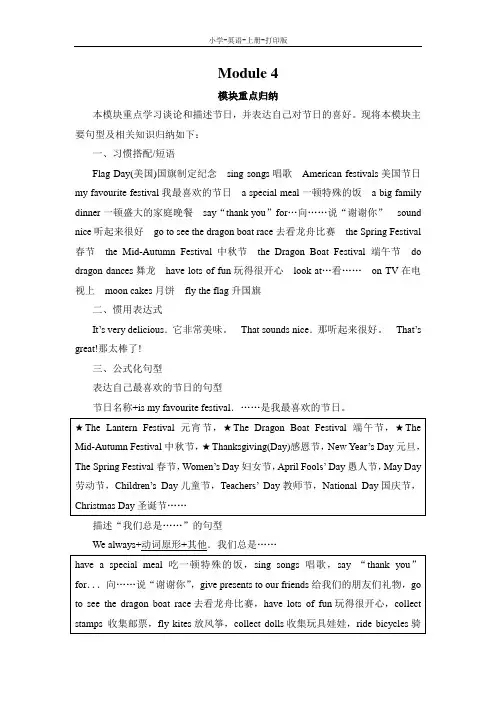
Module 4
模块重点归纳
本模块重点学习谈论和描述节日,并表达自己对节日的喜好。现将本模块主要句型及相关知识归纳如下:
一、习惯搭配/短语
Flag Day(美国)国旗制定纪念 sing songs唱歌 American festivals美国节日
my favourite festival我最喜欢的节日 a special meal一顿特殊的饭 a big family
dinner一顿盛大的家庭晚餐 say“thank you”for…向……说“谢谢你” sound
nice听起来很好 go to see the dragon boat race去看龙舟比赛 the Spring Festival春节 the Mid-Autumn Festival中秋节 the Dragon Boat Festival端午节 do
dragon dances舞龙 have lots of fun玩得很开心 look at…看…… on TV在电视上 moon cakes月饼 fly the flag升国旗
二、惯用表达式
It’s very delicious.它非常美味。 That sounds nice.那听起来很好。 That’s
great!那太棒了!
三、公式化句型
表达自己最喜欢的节日的句型
节日名称+is my favourite festival.……是我最喜欢的节日。
★The Lantern Festival元宵节,★The Dragon
Boat Festival端午节,★The
Mid-Autumn Festival中秋节,★Thanksgiving(Day)感恩节,New Year’s Day元旦,The Spring Festival春节,Women’s Day妇女节,April Fools’ Day愚人节,May Day劳动节,Children’s Day儿童节,Teachers’ Day教师节,National Day国庆节,Christmas Day圣诞节……