
外研版初中英语七年级上册 Module 4 Unit 3 Language in use (共20张PPT)
- 格式:pptx
- 大小:1.08 MB
- 文档页数:20


1 七年级上册Module 3 Unit 3
文字稿2020.9.20
P1(出镜)
Hello, everyone! I’m Helen, from Tianjin No.3 High School. Glad to meet you. Today, let’s revise some
expressions and sentence structures in Module 3. I hope you can introduce your school to others in English.
Now let’s begin!(点击)
P2(Step 1 Analysis of the material)
首先请同学们来看一下本节课我们会学习哪些内容。(点击)
P3
第三单元是本模块的复习巩固单元,其学习目的是让同学们总结和巩固“there be”句型的肯定、否定、一般疑问句和特殊疑问句形式和相应的回答,以及学会正确使用方位介词描述方位。通过本节课的学习,同学们能够用word map总结本模块所学词汇,并能借助词汇向他人介绍自己的学校。(点击)
P4(Step 2 Leading-in)
本模块儿我们主要学习的是there be句型以及there be句型的各种句式,并且我们将此句型运用于描述我们的教室和学校。同时,我们还在介绍学校内的各个建筑物时,学到了方位介词及介词短语的用法。(点击)
P5
同学们还记得这些曾经学过的句子吗?
There are thirty students in my class. (Unit 1)(点击)
Are there computers on everyone’s desk? No, there aren’t. (Unit 1)(点击)
Is there a map of the world? No, there isn’t. (Unit 1)(点击)

外研版英语七年级上册Module 3教案
Book1 Module 3 My school
一、教学内容:Unit1 There are thirty students in my class.
二、课型:Listening and speaking
三、教学目标:
1、能正确运用本单元的词汇及短语:computer, furniture, map, picture, television, wall, thirty, forty,fifty, sixty,
seventy, eighty, ninety, really, many, howmany, there, a lot of, any, world 。
2、能听懂介绍学校的简单对话。
3、能掌握“there be”句型的肯定、否定、一般疑问及特殊疑问句式和相应回答.并能运用此句型来介绍自己教室的样子。
4、能向同学们描述自己理想的教室的样子,如对自己理想教室的样子的设想等。
四、教学重难点:
掌握“there be”句型的肯定、否定、一般疑问及特殊疑问句式和相应回答.并能运用此句式来介绍自己教室的样子。
五、教学准备:
本课指导学生通过听力获取信息,培养学生听力技能。课堂上采用多媒体手段辅助教学,在轻松愉快的氛围中,在较真实的语境下,并联系学生生活实际,结合已有的知识和经验,运用所学的语言基础知识自我学习、互相学习,让学生在语言实践中相互启发、生成,体验成功。培养学生的合作精神,发展其思维和想象等能力。在教学过程中,采用多媒体手段辅助教学,利用各种图片和习题任务贯穿整个教学过程。因此,本节课需准备:PPT课件、挂图、录音机、课堂练习表格、奖品。
六、预习要求:
根据音标自学本课新单词;
七、 教学过程:
教学
步骤 教师活动 学生活动 设计意图
Step One
Warming-up (3’)
Lead in
1.Free talk:

教 学 案
课型 听说课 课题 Starter M 4 Unit 3
年级
七年级 学科 英语 设计人 审核人 授课人: 编号 日期
课题: Starter Module 4 My everyday life
Unit 3 What’s your favourite sport?
【教学目标】
1. Knowledge Aims
Key vocabulary and phrases: sport;table tennis;let;us;idea; play football;after school;go swimming;on Wednesday;play basketball
2. Ability aims
Listening: Students can understand others’ introduction and greetings by
listening.
Speaking: Students can introduce themselves and greet with others.
Reading: Students can understand the similar dialogue of self-introduction and
greetings.
Writing: Students can write their self-introduction.
3. Character building:
Self-introduction and greetings in the situation of first meeting.
【教学重点】
1. Master language of self-introduction and greetings in the situation of first
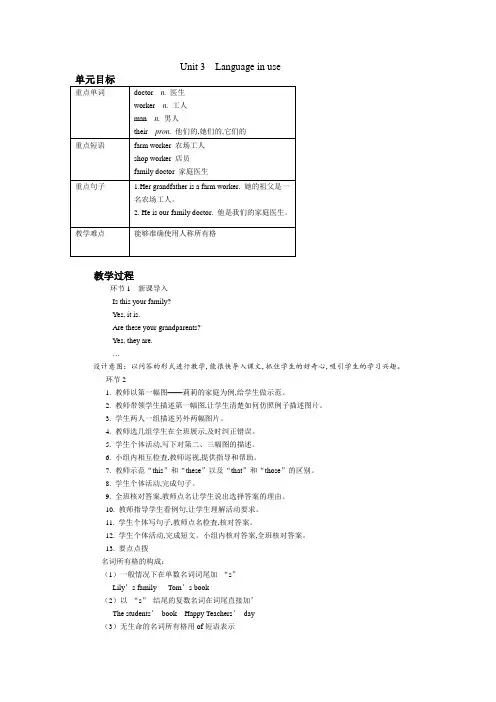
Unit 3 Language in use
单元目标
重点单词 doctor n. 医生
worker n. 工人
man n. 男人
their pron. 他们的,她们的,它们的
重点短语 farm worker 农场工人
shop worker 店员
family doctor 家庭医生
重点句子 1.Her grandfather is a farm worker. 她的祖父是一名农场工人。
2. He is our family doctor. 他是我们的家庭医生。
教学难点 能够准确使用人称所有格
教学过程
环节1 新课导入
Is this your family?
Yes, it is.
Are these your grandparents?
Yes, they are.
…
设计意图:以问答的形式进行教学,能很快导入课文,抓住学生的好奇心,吸引学生的学习兴趣。
环节2
1. 教师以第一幅图——莉莉的家庭为例,给学生做示范。
2. 教师带领学生描述第一幅图,让学生清楚如何仿照例子描述图片。
3. 学生两人一组描述另外两幅图片。
4. 教师选几组学生在全班展示,及时纠正错误。
5. 学生个体活动,写下对第二、三幅图的描述。
6. 小组内相互检査,教师巡视,提供指导和帮助。
7. 教师示范“this”和“these”以及“that”和“those”的区别。
8. 学生个体活动,完成句子。
9. 全班核对答案,教师点名让学生说出选择答案的理由。
10. 教师指导学生看例句,让学生理解活动要求。
11. 学生个体写句子,教师点名检査,核对答案。
12. 学生个体活动,完成短文。小组内核对答案,全班核对答案。
13. 要点点拨
名词所有格的构成:
(1)一般情况下在单数名词词尾加 “s”