
Sense_and_Reference
- 格式:ppt
- 大小:290.50 KB
- 文档页数:27


专八语言学考点
语言学概论
一.语言的甄别特征(Design Features):
语言的甄别特征(Design Features)包括:
1. 任意性(Arbitrariness)
2. 能产性(Productivity)
3. 双层性(Duality)
4. 移位性(Replacement)
5. 文化传承(Cultural transmission)
二.语言学的主要分支(the Main Branches of Linguistics):
1. 语音学(phonetics):用以研究语音的特点,并提供语音描写、分类和标记方法的学
科。
2. 音系学(phonology):研究语言中出现的区别语音及其模式是如何形成语音系统来表
达意义的学科。
3. 形态学(morphology):研究词的内部结构和构词规则。
4. 句法学(syntax):用以研究词是被如何组成句子,以及支配句子构成的学科。
5. 语义学(semantics):研究语言意义的学科。
6. 语用学(pragmatics):研究语言的意义在语境中如何被理解、传递和产出的学科。
7. 宏观语言学(Macrolinguistics):主要包括社会语言学(Sociolinguistics)、心理语言
学(Psycholinguistics)、人类语言学(Anthropological
Linguistics)、计算机语言学
(Computational Linguistics)。
三.语言学的流派(Different Approaches of Linguistics):
1. 结构主义语言学(Structural Lingustics): 1.1 布拉格学派(The Prague School)
1.2 哥本哈根学派(The Copenhagen School)
1.3 美国结构主义学派(American Structuralism)

1 / 16 语言学家:
1. F.de Saussure P4
Swiss linguist. He distinct the langue and parole in the early 20th
century 写了《普通语言学》
强调研究语言(what linguist should do is to abstract langue from
parole)
2. N Chomsk
American linguist distinct competence and performance in the
late 1950s
强调研究语言能力(competence) 和索绪尔的相似点
Saussure和chomsky不同之处:
索绪尔从社会学角度(sociological view)他的语言概念属于社会习俗范畴(social conventions);乔姆斯基是从心理学角度(Psychological view),认为语言能力是每个个体大脑的特征(property of mind of each individual)
3. 现代语言学基本上是描述性的(descriptive),传统语法是规定性的(prescriptive)
4. 现代语言学中共时性研究更重要(synchronic)
Phonetics(语音学) Phonology(音位学)
发音器官 2 / 16 1. pharyngeal cavity
2. oral cavity
3. nasal cavity
speech and writing are the two media or substances 言语和文字是自然语言的两种媒介和物质(言语比文字更加基础)
语音学从哪三个角度研究?
(1) 说话者角度 articulatory phonetics 发声语音学 (历史最悠久)
(2) 听话者角度 auditory phonetics 听觉语音学

sense and reference的例子(一)
sense and reference(意义和指称)是语义学中的一个重要概念,用于描述一个词语或短语的意义和所指的对象。下面是一些关于sense
and reference的例子,以帮助理解这个概念。
1. Sense and Reference:例子1
• 概念:sense是词语或短语在认知中的意义,是对概念的描述;
• 举例:词语”狗”的sense是“具有四条腿、长毛、能吠叫、是人类宠物或工作伙伴的动物”,它表示人们对狗这种动物的认知;
• 对应的reference是指,所有符合这个概念的实际对象,即现实中的狗。
2. Sense and Reference:例子2
• 概念:sense是词语或短语的指称的方式,即所选择的特定对象;
• 举例:词语”英国女王”的sense是“伊丽莎白二世,现任英国女王”,这个sense是对英国女王这一职位的特定选择;
• 对应的reference是指,伊丽莎白二世这个具体的人物,她是真正的英国女王。 3. Sense and Reference:例子3
• 概念:sense是词语的一种解释或定义,可以使用其他词语来解释一个词的含义;
• 举例:词语”爱情”的sense可以通过使用其他词来解释,比如“一种深情的、无私的、情感上的联系”;
• 对应的reference是指,人们在现实中所体验到的爱情的各种具体情境和关系。
4. Sense and Reference:例子4
• 概念:sense是词语或短语的内在意义,可以通过语境来确定;
• 举例:词语”苹果”的sense在不同的语境中可能有不同的解释,比如在水果市场上,它的sense是“一种红色或绿色的水果”;
• 对应的reference是指,这个具体的词所代表的水果。
5. Sense and Reference:例子5
• 概念:sense是词语或短语的外部语义,可以从语音、形态或上下文中推断出意义;
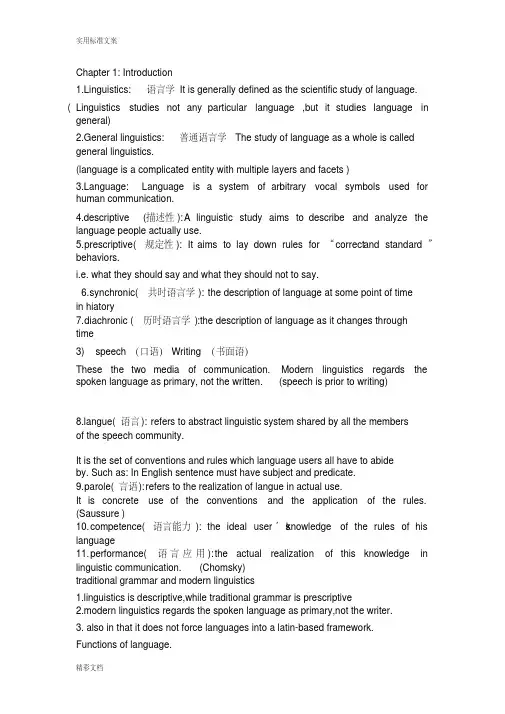
实用标准文案
精彩文档Chapter 1: Introduction 1.Linguistics:语言学It is generally defined as the scientific study of language. ( Linguistics studies not any particular language ,but it studies language in general) 2.General linguistics:普通语言学The study of language as a whole is called general linguistics. (language is a complicated entity with multiple layers and facets ) nguage:Language is a system of arbitrary vocal symbols used for human communication. 4.descriptive (描述性):A linguistic study aims to describe and analyze the language people actually use. 5.prescriptive(规定性): It aims to lay down rules for “correct and standard” behaviors. i.e. what they should say and what they should not to say. 6.synchronic(共时语言学): the description of language at some point of time in hiatory 7.diachronic (历时语言学):the description of language as it changes through time 3) speech(口语)Writing(书面语)These the two media of communication. Modern linguistics regards the spoken language as primary, not the written. (speech is prior to writing)