(完整版)小学英语语法及习题
- 格式:docx
- 大小:26.10 KB
- 文档页数:17
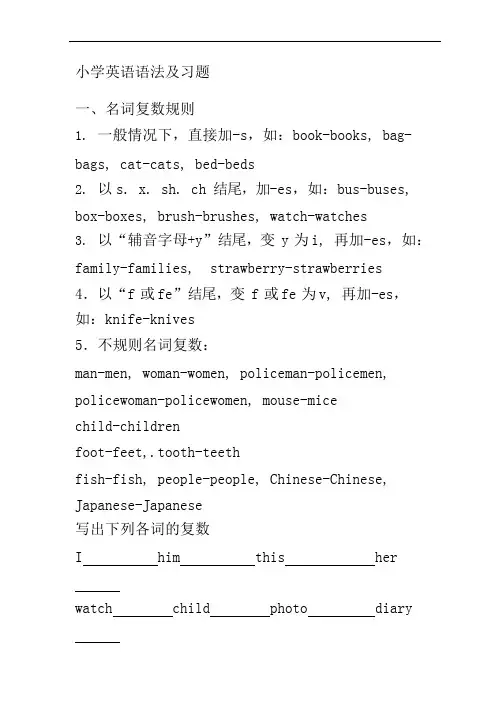
小学英语语法及习题
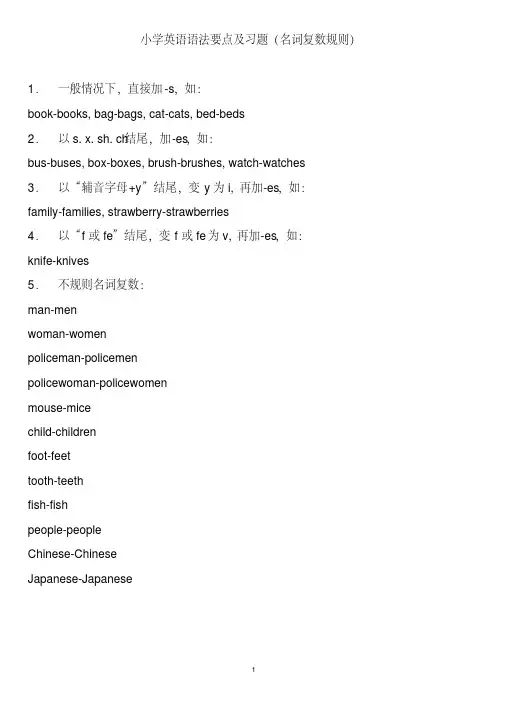
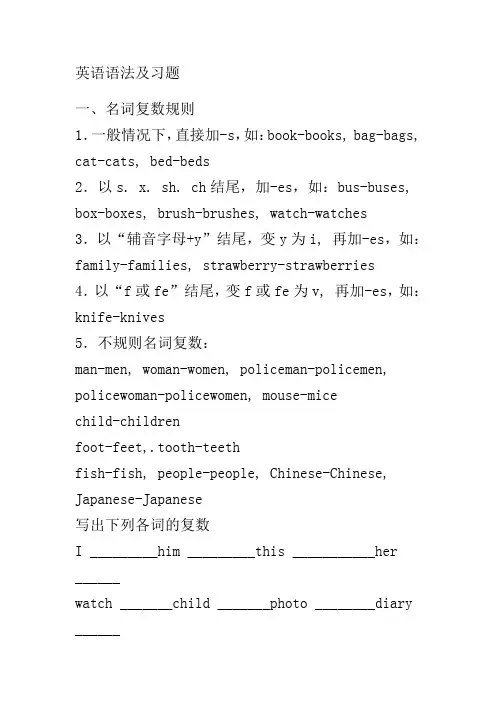
一、名词复数规则
1.一般状况下,直接加 -s ,如:book-books, bag-bags,
cat-cats, bed-beds
2.以 s. x. sh. ch 结尾,加 -es ,如: bus-buses,
box-boxes, brush-brushes, watch-watches
3.以“辅音字母 +y”结尾,变 y 为 i, 再加 -es ,如:
family-families, strawberry-strawberries
4.以“f或 fe ”结尾,变 f 或 fe 为 v, 再加 -es ,如:
knife-knives
5.不规则名词复数:
man-men, woman-women, policeman-policemen,
policewoman-policewomen, mouse-mice
child-children
foot-feet,.tooth-teeth
fish-fish, people-people, Chinese-Chinese,
Japanese-Japanese
写出以下各词的复数
I _________him _________this ___________her
______
watch _______child _______photo ________diary
______
day________ foot________ book_______ dress
________
tooth_______ sheep ______box_______ strawberry
_____
thief _______yo-yo ______ peach______ sandwich
______
man______ woman_______
paper_______ juice___________
water________ milk________ rice__________
tea__________
二、一般此刻时
一般此刻时基本用法介绍
【No. 1 】一般此刻时的功能
1. 表示事物或人物的特点、 状态。如:The sky is
blue. 天空是蓝色的。
2. 表示常常性或习惯性的动作。如: I get up at six
every day. 我每日六点起床。
3. 表示客观现实。 如:The earth goes around the
sun. 地球绕着太阳转。 一般此刻时的组成
1. be 动词:主语 +be(am,is,are)+ 其余。如:
I am a boy. 我是一个男孩。
2. 行为动词:主语 +行为动词 (+ 其余 ) 。如:
We study English.
我们学习英语。
当主语为第三人称单数
(he, she,it)
时,要在动
词后加 "-s" 或"-es" 。如: Mary likes Chinese. 玛丽
喜爱汉语。
一般此刻时的变化
1. be
动词的变化。
否认句:主语 + be + not +
如: He is not a worker.
其余。
他不是工人。
一般疑问句: Be +主语 +其余。
如: -Are you a student?
-Yes. I am. / No, I'm not.
特别疑问句:疑问词 +一般疑问句。如: Where is
my bike?
2. 行为动词的变化。
否认句:主语 + don't( doesn't ) + 动词原形 (+
其余 ) 。如:
I don't like bread.
当主语为第三人称单数时,要用 doesn't 组成否
定句。如:
He doesn't often play.
一般疑问句: Do( Does ) +主语 +动词原形 +其余。
如:
- Do you often play football?
- Yes, I do. / No, I don't.
当主语为第三人称单数时, 要用 does 组成一般疑
问句。如:
- Does she go to work by bike?
- Yes, she does. / No, she doesn't.
特别疑问句:疑问词 +一般疑问句。如: Howdoes
your father go to work?
动词 +s 的变化规则
1.一般状况下,直接加 -s ,如: cook-cooks,
milk-milks
2.以 s. x. sh. ch. o 结尾,加-es ,如:guess-guesses,
wash-washes, watch-watches, go-goes
3.以“辅音字母 +y”结尾,变 y 为 i, 再加 -es ,如:
study-studies
一般此刻时用法专练 :
一、 写出以下动词的第三人称单数
drink ________ go _______ stay ________ make
________
look _________ have_______
pass_______ carry ____
come________ watch______
plant_______ fly ________
study_______ brush________
do_________ teach_______
二、用括号内动词的合适形式填空。
1. He often ________(have) dinner at home.
2. Daniel and Tommy _______(be) in Class One.
3. We _______(not watch) TV on Monday.
4. Nick _______(not go) to the zoo on Sunday.
5. ______ they ________(like) the World Cup?
6. What _______they often _______(do)
on Saturdays? 7. _______ your parents _______(read) newspapers
every day?
8. The girl _______(teach) us English on Sundays.
9. She and I ________(take) a walk together every
evening.
10. There ________(be) some water in the bottle.
11. Mike _______(like) cooking.
12. They _______(have) the same hobby.
13. My aunt _______(look) after her baby
carefully.
14. You always _______(do) your homework well.
15. I _______(be) ill. I ’m staying in bed.
16. She _______(go) to school from Monday
to Friday. 17. Liu Tao _______(do) not like PE.
18. The child often _______(watch) TV in the
evening.
19. Su Hai and Su Yang _______(have) eight lessons
this term.
20. -What day _______(be) it today?
- It ’s Saturday. 三、依据要求改写句子
1. Daniel watches TV every evening.( 改为否认句 )
______________________________________________
_____
2. I do my homework every day.( 改为一般疑问句,
作否认回答 )
______________________________________________
__________
3. She likes milk.(改为一般疑问句,作必定回答 )
___________________________
4. Amy likes playing computer games.( 改为一般疑
问句,作否认回答 )