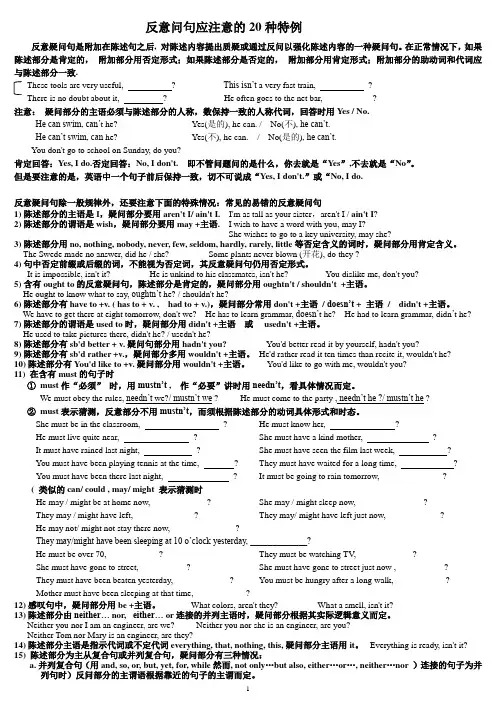
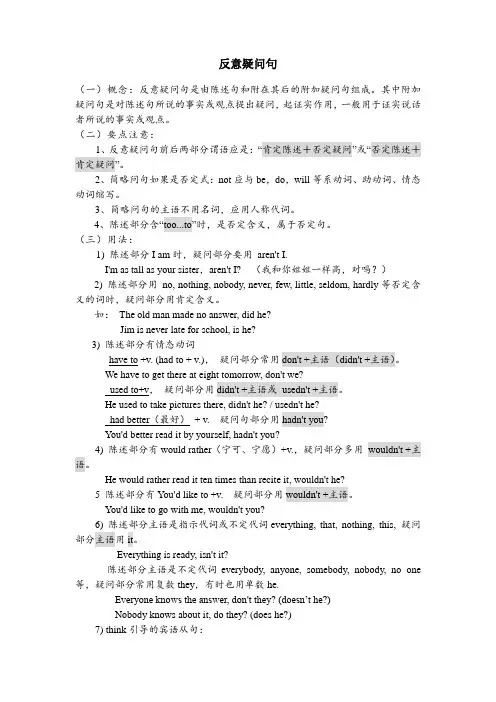
语法--反意疑问句
- 格式:doc
- 大小:29.50 KB
- 文档页数:1
语法:反意疑问句
语法:反意疑问句(前肯后否,前否后肯) 对疑问部分应注意: 1)主语只能用人称代词;2)附加疑问句的not必须与(be /助/情)缩写;3)附加疑问句的时态必须与陈述部分的时态一致。
eg.1)Tom is a work, isn’t Tom?(找错)___ 2)You can swim, can not you?(找错)______
3)He had lunch, doesn’t he?(找错)________
特别注意:1. 陈述部分含否定意味的词(few, little, never, nothing, nobody, no,
hardly, none),附加疑问句应使用肯定形式(但前缀词unhappy, unlike, disappear等列外)
eg. They are unhappy, aren’t they?
2.陈述部分的主语是everything, something, nothing, anything时,其疑问句主语应用it;陈述部分主语是everybody, somebody, nobody, everyone, no one时,其疑问句主语应用they/he。
eg.1)Everything is ready, ___________? 2)Everyone is here, ____________?
3.陈述部分是祈使句时,附加疑问句一般用:will you? 但注意:
Let’s … , shall we? Let us … , will you?
*4.陈述部分含宾语从句时,疑问部分通常与主句一致。但当主句的谓语动词是think, believe且主语是I , we时,即:I / We think (believe) + 宾从,则附加问句应与从句一致。I’m sure + 宾从也是如此。
eg. We don’t think you are right, ________?
1. Zhu Zhiwen’s never been to Hongkong, _______?
A. is he B. isn't he C. has he D. hasn't he
2. —You had nothing for breakfast this morning,______?
—No, I got up too late. A. did you B. had you C. didn't you
3. --- He didn’t come to school yesterday, didn’t he ? --- ____.He was ill in bed.
A. Yes, he did B. No, he didn’t C. Yes, what a pity D. No, I think
4. —Tom didn’t go to school this morning, did he? — .Though he had a bad cold.
A. Yes, he didn’t B. Yes, he did C. No, he didn’t D. No, he did
5. — There is something wrong with your hike, __?
— Yes. I'll have it _ tomorrow.
A. isn’t it; mend B. isn’t there: mended C. isn't it; mended D. isn't there; mend
6. They hardly watch TV on school nights, _____?
A. will they B. aren’t they C. do they
7. He has many friends at school ._____?
A. has he B. does he C. doesn’t he D. isn’t he
8. Frank is very lonely, he has few friends, ______?
A. does he B. doesn’t he C. is he
9. Don’t make so much noise. Lily, ______?
A. do you B. don’t you C. will you
10. He didn’t go there yesterday, _______he? A. did B. does C. didn’t
11. Let’s go to the cinema,______? A. will you B. shall we C. won’t you
12.—Mr. Wang's never been to Canada, has he?
—___. He went there on business last week.
A. No, he hasn't B. Yes, he has C. No, he has D. Yes, he hasn ' t