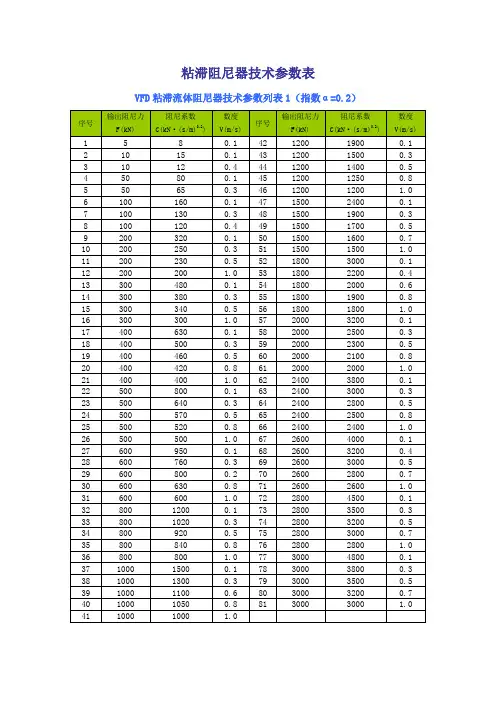
粘滞阻尼器阻尼系数
- 格式:doc
- 大小:15.85 KB
- 文档页数:3
粘滞阻尼器阻尼系数
英文回答:
Damping coefficient of a viscous damper refers to the
parameter that determines the level of resistance to motion
provided by the damper. It is a measure of how effectively
the damper dissipates energy and reduces vibrations in a
system. The damping coefficient is usually denoted by the
symbol "c" and is measured in units of force per unit
velocity (N.s/m).
The value of the damping coefficient is crucial in
determining the behavior of a system with a viscous damper.
A higher damping coefficient indicates a greater resistance
to motion and results in a faster dissipation of energy. On
the other hand, a lower damping coefficient allows for more
oscillations and slower dissipation of energy.
To better understand the concept, let's consider an
example of a car suspension system. The damping coefficient of the shock absorbers in the suspension determines the
level of comfort and stability of the ride. If the damping
coefficient is set too low, the car will bounce excessively,
causing discomfort to the passengers. On the other hand, if
the damping coefficient is set too high, the car will feel
stiff and rigid, transmitting every bump and irregularity
on the road to the passengers.
In a similar way, the damping coefficient of a viscous
damper in a building's structural system plays a crucial
role in mitigating the effects of earthquakes. A higher
damping coefficient allows the damper to dissipate more
energy during an earthquake, reducing the amplitude of
vibrations and protecting the building from structural
damage. Conversely, a lower damping coefficient would
result in higher amplitude vibrations, potentially leading
to structural failure.
中文回答:
粘滞阻尼器的阻尼系数是指决定阻尼器阻碍运动的程度的参数。它是衡量阻尼器有效地耗散能量并减少系统振动的指标。阻尼系数通常用符号"c"表示,单位为力/速度(N.s/m)。
阻尼系数的值对于确定具有粘滞阻尼器的系统的行为非常重要。较高的阻尼系数表示更大的阻力,导致能量更快地耗散。另一方面,较低的阻尼系数允许更多的振荡和能量的较慢耗散。
为了更好地理解这个概念,让我们以汽车悬挂系统为例。悬挂系统中减震器的阻尼系数决定了乘坐的舒适度和稳定性。如果阻尼系数设置得太低,汽车会过度弹跳,给乘客带来不适。另一方面,如果阻尼系数设置得太高,汽车会感觉僵硬,将道路上的每个颠簸和不平均传递给乘客。
类似地,建筑结构系统中粘滞阻尼器的阻尼系数在减轻地震影响方面起着关键作用。较高的阻尼系数使阻尼器能够在地震期间耗散更多的能量,减小振动幅度并保护建筑免受结构损坏。相反,较低的阻尼系数将导致较大振幅的振动,可能导致结构破坏。
因此,阻尼系数的选择对于系统的性能至关重要。根据具体应用的要求,需要在舒适性和稳定性之间进行权衡,并选择合适的阻尼系数来实现所需的动态响应。