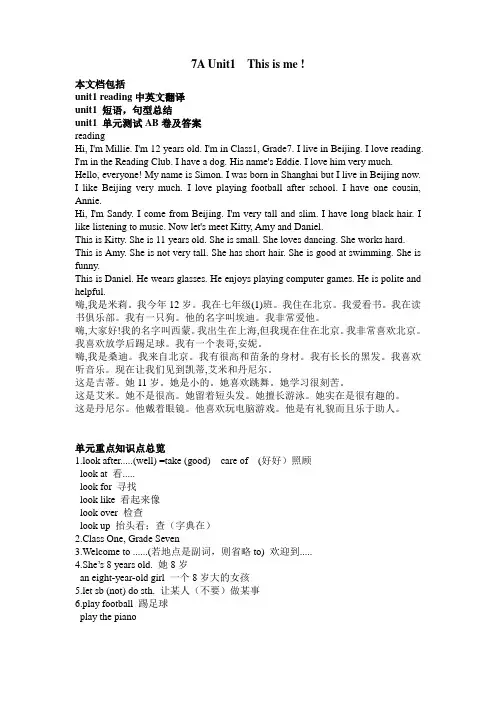
7A Unit 1 This is me
- 格式:docx
- 大小:18.44 KB
- 文档页数:5
Unit 1. This is me!The 1st period Welcome to the unitTeaching aims:1. To use appropriate greetings.2. To introduce oneself.Key points:To greet new friends properly.Difficult Points:Different ways of expressing timeProcedures:Step 1: Self-introductionThe teacher introduces himself or herself to the class, including Chinese name and English name. Then ask several students to tell them Chinese and English names.T: Do you have an English name? How old are you? Where are you from?S: My name is“”,My English name is Jack. I’m 13 years old. I’m from No. 2 middle school.Step 2: Presentation1. Ask ―What’s the time, please?‖, and encourage students to answer it.2. Present a clock, adjust it to a certain place, and ask the students to answer what the time is, and how to greet at this time.3. A Game: Divide the students into 4 groups to do the above activity. Look which team wins it. Step 3: PracticeRole play:2students a group, make a small dialogue about how to greet at a certain time.Step 4: Read and learn1. Books open to page 32. Part A, read the dialogue and let the students followed.3. Part B, let the students do B1 individually and then check together.Step 5: Presentation1. Ask the students about their hobbies (dogs).Let them talk about their dogs’appearance and names. Teach them the new word ―master2. Take out a picture of Eddie and Hobo, teach the new words ―e-dog, look after‖, and review ―look up, look like, look at‖.3. Let the students read the dialogue on page 2 after the teacher, then ask several students to read it for the class.Step 6: PracticeTeacher: Do you think it’s in the morning? Why?St: Yes, they say ―Good Morning.‖T: What will you say to your friend at this time?8:30 A.M, 2:30 P.M, 9:00 P.M ,10:00 A.M, 4:15 P.M ,11:45 A.MHomework:1. Make a dialogue in pairs with the knowledge learnt today.2. Copy the new words three times.3. Recite the dialogue on page 2.The 2nd period VocabularyTeaching aims:1. Verbs and nouns about sports.2. Describe different kinds of sports.Key points:Describe different kinds of sports.Difficult Points:1. What do they like?2. What are they like?Procedures:Step 1: Check homeworkAsk several pairs to come to act out their dialogues.Step 2: RevisionSay ―We met 6 new friends yesterday, do you remember their names?‖Let the students answer it.Step 3: Listen and answer1. Let the students listen to the tape with these questions: What are their Chinese names? What do they like?2. Let them write the answers on a piece of paper.3. Listen to the tape again to check the answers and answer:What are they like? Are they short or tall? Are they slim or fat? Aretheir hairs short or long? Do they wear glasses? Write the underlined words on the Bb and explain them.Step 4: Read and learn Open the books and turn to page 4, read after the tape, check―What are they like?‖While repeating explain the language points grammatical points.Step 5: ConsolidationDraw this table on the board. Add more columns, one column for one sport.Sport SwimmingWhere Swimming poolSpecial clothes SwimsuitEquipment GogglesTeam sport NAsk st to copy the table into their books. Think three more sports to add to the table. Homework:1. Copy new words.2. Write a profile of yourself like what we learnt today.The 3rd periodTeaching aims:1. To recognize the use of language in giving personal information.2. To use personal pronouns correctly.Key points:The use of personal pronouns.Difficult Points:The use of personal pronouns.Procedures:Step1.RevisionT: Let’s make friends. Hello! My name is …What’s your name?S1: Hello! My name is …T: How do you do!S1: How do you do!T: Hello! My name is … What’s your mane?S2: Hello! My name is …T: Nice to meet you!S2: Nice to meet you, too.(Ask some other students to do this practice.)T: Now, make friends with your classmates.Step 2.Listening and practiceT: Do you remember the six new friends in the book?S: Yes.T: What are their names? Do you remember?T & Ss: Millie, Simon, Sandy, Kitty, Amy, and Daniel.T: Yes, very good. But do you know more about them? What do they like? How old are they? What do they look like?(Students shake their heads.)T: Well, we only know their names, but we don’t know more about them. Let’s listen to the tape, and find out the answers.(Play the tape recorder once.)T: Do they tell you how old they are?Ss: Yes.T: Do they tell you what they like doing?Ss: Yes.T: And do they tell you what they look like? Are they tall? Are they slim? Do they have short hair or long hair?Ss: Yes.T: OK! Now answer my questions, please.1. How old is Millie? (She is 12 years old.)2. Where does she live now? (She lives in Beijing.)3. What does she like doing? (She likes reading books.)4. What is Simon’s Chinese name? (His Chinese name is Luo Sang.)5. What does he like? ( He likes playing football.)6. What does Sandy like? (She likes listening to music.)7. Does Kitty like swimming? (No, she doesn’t. She likes dancing.)8. Who likes swimming?(Amy does.)9. Does Daniel like playing computer games? ( Yes, he does.)T: Very good! Now, open your books, and turn to page 6.Look at Part D1. Finish this exercise quickly.T: OK, let’s check out the answers. What does Millie like?S1. She likes reading books.T: Yes, you are right. What about Simon?S2: He likes playing football.T: Then what about Kitty?…(Write the new words on the blackboard.)(New words: music)T: Well done! Read the whole passage all together. Work in groups, try to finish the table on the(Check out the answers. Write down the new words on the board: short , ponytail, glasses, wear, slim, quite, flat, hard)T: Listen Part A again. Read after the tape sentence by sentence.(Play the tape recorder again.)T: Now say ‗True or false’. Close your books, please.1. Millie is 11 years old. F2. Simon was born in Shanghai. T3. Sandy doesn’t like listening. F4. Kitty loves dancing. T5. Amy has black hair in a ponytail. F6. Daniel wears glasses. T7. Millie lives in a flat in Shanghai. F8. Andy is good at maths. T9. Simon’s cousin’s name is Annie. T10. Sandy is short. FHomeworkCopy the new words, read the textbook carefully, and write a simpleprofile of yourself.The 4th periodTeaching aims:1. To recognize the use of language in giving personal information.2. To use personal pronouns correctly.Key points:1. he use of language in giving personal information.2. The use personal pronouns.Difficult Points:1. he use of language in giving personal information.2. The use personal pronouns.Procedures:Step 1. Revision.T: First, let’s have a dictation. Open your dictation books. Write down the date, please: music, ponytail, wear, slim, quite, glasses, flat, short, hard, be born 7T: Now, listen to the tape and read after it sentence by sentence. Pay attention to the details. Then answer my questions. (Play the tape recorder.)T: Answer my questions, please.1. Who has a ponytail? (Sandy)2. Who has short hair? (Millie)3. Who has a cousin? (Millie/Simon)4. Who has a dog? What is the name of the dog? (Millie, Eddie)5. Who wears glasses? (Sandy and Daniel)6. Who likes football / basketball / dancing / swimming? (Simon/Andy/Kitty/Amy)Step 2. Doing exercises.1. Open your books and turn to page 5. Look at Part B. Help Millie to complete the note from memory. You’d better not look at Part A. I’ll give you 3 minutes. (The students complete the notes.)2. Now, compare your answers with your partner.3: Read the passage on page 4 quickly and check your answers. You should not read every word but just find out the information only. I’ll give you 2 minutes.4. Who can give us his/her answers? Please put up your hands. Good, Tom, you please.(Ask some other students to read their answers and check the answers all together.)5. This time, read the notes all together. Pay attention to the personal pronouns: she, he. (All the students read the notes.)6. We’ve read the profiles of the six new friends in this book. Can you talk about yourselves? You may use the sentence patterns in Part A. (Ask some students to give information about themselves.)7. Now , take out a piece of paper, and write a personal profile of a classmate, the class teacher, or anyone else whom we know very well.8. Who can read his/her passage? Jim, you please. (The student reads his passage.) (Ask more students to read their passages and let others guess.)Homework1. Listen to the tape for three times; complete the profile of yourselves in Part D2; tell your classmates about the six students; and do the workbook.。