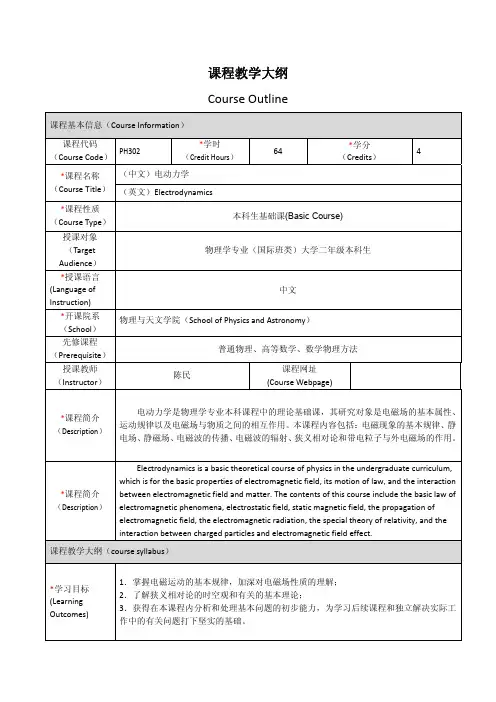
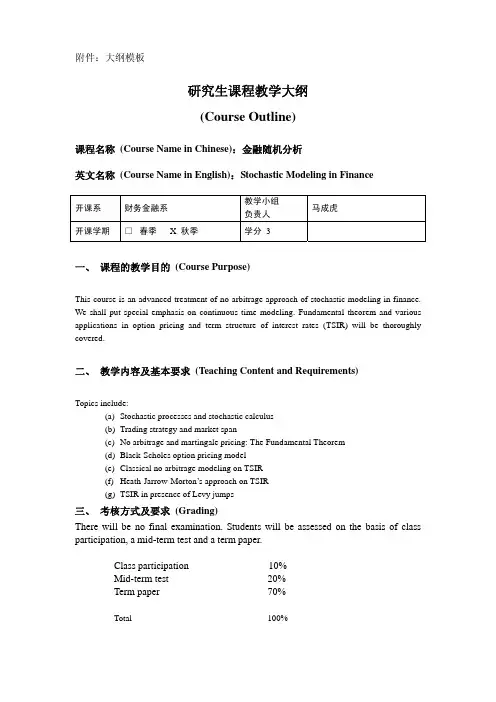
1.Course Outline
- 格式:doc
- 大小:46.50 KB
- 文档页数:4
Finance DepartmentEconomics & Management School COURSE OUTLINE Wuhan UniversityCorporate FinanceSept. 2012TEXTBOOKCorporate Finance, Ross, Westerfield, Jeffrey, Sixth Edition, McGraw-Hill Irwin , 2002.Optional: Financial Management And Policy, James C. Van Horne, Tenth Edition, Prentice Hall International, Inc. 1995.Principle of Corporate Finance, Brealey and Meyers.COURSE OBJECTIVES AND DESCRIPTIONThis course serves as a required core course for students of Finance. The objective of the course is to assist students to acquire and demonstrate an understanding of the fundamental principles and issues in corporate financial by providing a framework, concepts, and tools for analyzing financial decisions. Topics covered include discounted cash flow techniques, capital budgeting, project evaluation, risk and return tradeoffs, diversification, capital market efficiency, capital assets pricing, capital structure, financial planning, ratio analysis, mergers, convertibles, etc..Upon completing the course, students should be able to define basic terminology, to understand the theoretical relationships, and to apply the analytical techniques covered in the course to various decision-making situations. Problem-solving and decision-making skills will be practiced through examples and problem assignments.METHOD OF INSTRUCTIONLectures, problem assignments will be a principal method of instruction. Students are expected to come to class fully prepared for the discussion of assigned readings. Developing a full understanding of much of the material will be enhanced by the completion of the assigned problems.COURSE PLANDATE TOPIC READING Sept 3 Course outlineIntroduction &Time Value of Money I Chapter 1,3,4▪ A frame work of Corporate Finance▪Future value and compounding▪Present value and discounting▪Multiple cash flowsSept 10 Time Value of Money II Chapter 1,3,4 ▪Annuiyies▪Perpetuity▪Effective annual ratesSept 17 Bond Valuation I Chapter 5▪Features of bonds▪Different compounding periods▪Yield to maturity▪Bond values and yieldsSept 24 Bond Valuation II Chapter 5▪Amortizing loans▪Interest rate, default & liquidity risk▪Real & nominal interest ratesOct 8 Stock Valuation Chapter 5 ▪Value of common stock▪Zero, constant, and non-constant growth▪Dividend growth model▪Price-earnings ratio▪ExerciseOct 15 Investment Criteria Chapter 6▪Principles of investment▪Net present value▪Payback▪Internal rate of return▪Average rate of returnOct 22 Financial Statements, Cash Flow & Ratio Chapter 2,26 ▪Financial statements▪Cash flow▪Pro forma statements▪Standardized statements▪Ratio analysis▪Du Pont identity▪Financial planningOct 29 Project Evaluation Chapter 7,8 ▪Cash items vs. non-cash items▪Operation cash flow▪Tax shield▪NPV vs. other approaches▪Decision treeNov 5 Risk and Return Chapter 9,10,11,12,13 ▪Calculate return▪Standard deviation▪portfolios▪Efficiency of capital market▪Beta coefficient▪Efficient frontier▪The security market line & CAPMNov 12 Cost of Capital Chapter 17 ▪Capital structure depict▪Cost of equity and debt▪Weighted Average Cost of Capital(WACC)▪Leverage▪Cost of raising capital with retained earnings▪Other costsNov 19 Raising Capital & Leasing Chapter 19,20,21 ▪Underwriting of syndicate▪Equity issue after IPO▪Rights issue▪Financial leasing▪Comparison of borrow-and-buy with leasing▪Evaluate Leasing project▪Incentives of leasingNov 26 Capital Structure and financial Leverage Chapter 14,15, 16 ▪Leverage effect▪MM I, II without tax▪WACC with tax▪MM I, II with tax▪Trade-off theory▪Pecking orderDec 3 Dividend Policy Chapter 18 ▪Payments of dividendsCash dividend, stock dividend, stock repurchase▪Dividend decisionFraction, cash, growth rate▪Irrelevant propositionDec 10 Working Capital Management Chapter 27,28,29 ▪Operating cycle and cash cycle▪Optimal amount of current assets▪Develop a cash flow model▪Cash budgeting examples▪Short-term financial planDec 17 Mergers and Acquisitions Chapters 30 ▪Motive of mergers▪Categories and history of merger▪Calculate gains and cost of merger▪Leverage buy-out▪Battle over Δ valueDec 24 General Review I(Q & A)Dec 31 General Review II (Q & A)Jan 6 – 19 Final。