
SurveyUKUSA-historyEnglandPart2
- 格式:ppt
- 大小:302.50 KB
- 文档页数:28
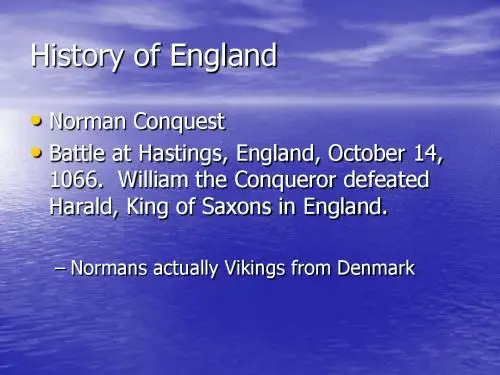

英美概况英国历史部分英美概况英国历史部分History1. Julius Caesar invaded Britain _____.A. onceB. twiceC. three times2. King Arthur was the king of _____.A. PictsB. CeltsC. ScotsD. Jutes3. The first “King of the English” was _____.A. AlfredB. EgbertC. BedeD. Ethelred4. Christianity was introduced into England in the late _____ century.A. 14thB. 8thC. 6th5. In 1653 _____ was made Lord Protector for life.A. Oliver CromwellB. Charles IC. William II6. The three great Germanic tribes: the Anglos, the _____ and the Jutes which invaded Britain form the basis of the modern British people.B. ScotsC. WelshD. Wessex7. The head of the church in Anglo-Saxon times was _____.A. the King of Denmark and NorwayB. the king of EnglandC. Julius CaesarD. the Archbishop of Canterbury8. The _____ invaded England in the earliest time.A. DanesB. IberiansC. RomansD. Celts9. The Vikings who invaded England at the turn of the 8th century came from _____.A. NorwayB. DenmarkC. FranceD. both A and B10. Edward was known as the “_____” because of his reputation for saintliness.]A. ConfessorB. ConquerorC. Protector11. Norman Conquest began in _____.A. 1016B. 1066C. 103512. In history _____ was nicknamed “King of Lackland”.B. Henry IC. Henry II13. In 1181 Henry II issued the _____ which made it compulsory for every freeman in England to be provided with arms.A. Inquest of SheriffsB. Assize of ArmsC. Doomsday Book14. Henry Plantagenet, in 1154, established the House of Angevin as _____.A. Henry IB. Henry IIC. Henry III15. Henry II appointed in 1162 _____ Archbishop of Canterbury.A. Thomas BecketB. Stephen LangtonC. Simon de Mortfort16. Charles I was beheaded in _____.A. 1649B. 1648C. 165317. It was _____ who summoned Model Parliament in 1295.A. Edward IB. Henry IVC. Simon de Montfort18. The Great Charter contained _____ sets of provisions.A. twoB. four19. The Peasants Uprising in 1381 was led by _____.A. Henry TurnerB. Watt TylerC. Richard20. The English Church was strictly _____.A. nationalB. internationalC. regional21. The Glorious Revolution in 1688 was in nature a _____.A. coup d’etatB. racial slaughterC. peasant rising22. The Industrial Revolution laid a good foundation for the _____.A. factory of the worldB. expansion of marketsC. social upheaval23. The American Revolution (the American War of Independence) broke out in _____ and ended in _____.A. 1775, 1783B. 1774, 1782C. 1786, 178424. The Battle of Hastings took place in _____.A. 1606B. 1042C. 106625. The Great Charter was signed by _____ in 1215.A. King Henry IIB. King RichardC. King John26. In the early 14th century feudalism began to _____ in England.A. growB. flourishC. declineD. end27. It was _____ who published the book “The Rights of Man”.A. Thomas MoreB. Thomas PaineC. Thomas Jefferson28. The first Prime Minister was _____.A. WilmintonB. George GrenvilleC. Robert Walpole29. The Parliame nt of 1265 which is known as the “_____” is considered the “beginning of parliament”.A. All Estates ParliamentB. Model ParliamentC. Long Parliament30. The Anglo-French hostility which began in 1337 and ended in 1453 was known as _____.A. the Wars of RosesB. the Hundred Years’ WarC. Peasant Uprising31. In the first half of 17th century _____ grow rapidly in England.A. feudalismB. capitalismC. Catholicism32. Prime Minister _____ resisted any reform that could be resisted.A. PalmerstonB. Robert PeelC. Gladstone33. By the end of the Hundred Years’ War only the port of _____ remained under English rule.A. TroyesB. GasconC. Calais34. In the 14th century took place the _____, the severest of many plagues in the middle ages.A. EarthquakeB. Black DeathC. Drought35. _____ and his followers, known as Lollards, provided ideological preparation for the labour movement of the 14th century.A. John WycliffeB. Watt TylerC. Somerset36. By the end of the Wars of the Roses the House of _____ began.A. TudorB. LancasterC. Plantagenet37. In the “_____” of 1388 five lords accused the King’s friends of treason under a very expansive definition of crime.A. All Estates parliamentB. Merciless ParliamentC. Model Parliament38. In the Wars of the Roses the Lancastrians wire badges of _____ rose.A. whiteB. redC. pinkD. yellow39. The first Civil War in Britain lasted from _____ to _____.A. 1600, 1604B. 1640, 1644C. 1642, 164640. William Shakespeare is mainly a _____.A. novelistB. dramatistC. poet41. In 1689 the “Bill of Rights” was passed. _____ began in England.A. The Constitutional MonarchyB. All Estates ParliamentC. House of Lancaster42. The _____ carried on trade relations with Russia and central Asian countries.A. Moscow CompanyB. Eastland CompanyC. East India Company43. _____ started the slave trade in the second part of the 16th century.A. John HawkinsB. Francis DrakeC. Diaz44. In 1534 Parli ament passed the “_____”, according to which Henry VIII was declared the head of the English Church.A. the Bill of RightsB. Act of SupremacyC. Act of Settlement45. Under Elizabeth I _____ was restored, and she was declared “governor” of the church.A. the Roman ChurchB. the Catholic ChurchC. the Anglican Church46. In 1337 the hostility between England and _____ resulted in the Hundred Years’ War.A. FranceB. SpainC. Russia47. The religious persecution mainly existed during the reign of _____.A. CromwellB. Charles IC. Henry VIII48. England first became a sea power in the time of _____.A. Henry VIIB. Elizabeth IC. Victoria49. The Industrial Revolution first started in _____.A. the iron industryB. the textile industryC. the coal industry50. From 1688 to 1783 English Parliament was mainlycontrolled by the party of _____.A. ToryB. WhigC. Labour51. The English Prime Minister during the Second World War was _____.A. ChurchillB. ChamberlainC. Baldwin52. At the End of _____ century, the East India Company was formed.A. 15thB. 16thC. 14th53. The Seven Years War between England and France lasted from _____ to _____.A. 1756, 1763B. 1713, 1720C. 1754, 176154. In 1689 Parliament passed “_____”, limiting the powers of the crown.A. Habeas Corpus ActB. the Bill of RightsC. Navigation Act55. _____ contrasted the first successful steam locomotive.A. George StephensonB. Samuel CromptonC. James Hargreaves56. The “Peterloo Massacre” took place in _____.A. BirminghamB. LiverpoolC. Manchester57. Between 1911 and 1914 took place the following strikes except _____.A. railway strikeB. strike of the postmenC. coal strikeD. strike of the transport58. The Victorian Age was over the _____ began.A. Edwardian AgeB. Georgian AgeC. Elizabethan Age59. The _____ government surrendered to the British invaders and was forced to sign the first unequal Treaty of Nanjing in 1842.A. IndianB. QingC. IrishD. Spanish60. The Great Charter was essentially a _____.A. Culture MovementB. colonial documentC. feudal document61. _____ broke out two years after the Hundred Years’ W ar with France.A. The Bore WarB. The Wars of the RosesC. Queen Annes’ War62. The Reformation was a product of _____.A. the RenaissanceB. the Chartist MovementC. the Hundred Years’ War63. The greatest dramatist of the English Renaissance was _____.A. ShakespeareB. MiltonC. ChaucerD. Bacon64. The English Revolution marks the beginning of the _____ period of capitalism.A. feudalB. modernC. colonialD. medieval65. By the _____ in 1783, Britain recognized the independence of the US.A. Declaratory ActB. Treaty of ParisC. Treaty of Montgomery66. The Chartist Movement began in _____ and reached its height in _____.A. 1845, 1858B. 1828, 1835C. 1839, 184867. In 1840 Britain launched an aggressive war against _____.A. FranceB. IndiaC. ChinaD. America68. _____ formed a coalition government in 1940.A. Winston ChurchillB. Lloyd GeorgeC. Neville Chamberlain69. By the _____ the British dominions became independent states in all but name.A. Statue of WestminsterB. Locarno TreatyC. Disputes Act70. The Fabians Society was founded in 1883, including intellectuals such as _____.B. Christopher Marlowe & John MiltonC. G. B. Shaw & H. G. Wells71. Before WWII _____ relied on appeasement of the European dictators to reduce tensions that might lead to war.A. Neville Chamberlain A. Stanley BaldwinC. Winston Churchill72. During WWII, Britain, America, France, Soviet Union and other antifascist countries formed a united international alliance which was called _____.A. Locarno TreatyB. Grand AllianceC. Statute of Westminster73. The first coalition government during WWI was organized when _____ was the PrimeMinister.A. Lloyd GeorgeB. Herbert AsquithC. Stanley Baldwin74. When Germany invaded _____ which was neutral, Britain declared war on Germany on 4 August, 1914.A. AustriaB. RussiaC. BelgiumD. Poland1. At about 3000 BC, some of the _____ settled in Britain.2. About 122 AD, in order to keep back the Picts and Scots, the _____ built Hadrian’s Wall.3. The real Roman conquest began in _____.4. _____ _____’s “Paradise Lost” was published in 1667.5. Beowulf, considered the greatest Old English poem, is assigned to _____ Times.6. _____ was considered the first national hero.7. On Christmas Day 1066 Duke _____ was crowned in Westminster Abbey.8. In history John was nicknamed King of _____.9. John signed the document in 1215, which in history was called the Great Charter or _____ _____.10. In 1086 William had his official to make a general survey of the land, known as _____ Book.11. The most famous scholar during Anglo-Saxon Times was _____.12. The Battle of _____ paved the way for the Norman Conquest to England.13. The Norman Conquest increased the process of _____ which had begun during the Anglo-Saxon Times.14. Duke William was known in history as William the _____.15. Along with the Normans came the _____ language.16. The English parliament originated in the _____ _____.17. The head of the _____ was Archbishop of _____.18. The _____ _____ in 1688 was in nature a coup d’etat.19. The People’s Charter included _____ points such as universal male suffrage.20. The corrupt Qing government surrendered to Britain and was forced to sign the first unequal Treaty of _____ in 1842.21. After the Crimean War _____ was forced not to fortify Sebastopol.22. The third collection of the poll tax in the early part of 1381 became the fuse of _____ _____ rising.23. The Wars of the Roses broke out between the _____ and the _____.24. The Enclosure Movement began in the _____ century.25. By the treaty of _____ in 1783, Britain recognized the independence of the US.26. In _____ Britain launched the Opium War against China.27. The East India Company formed at the end of the 16th century was one of _____ companies.28. After the Reformation the Roman Catholic Church was _____, the English Church was strictly _____.29. Mary I re-established Catholicism and burnt three hundred Protestants, for which she was called “_____” Mary.30. “Renaissance” means “_____”, i.e. Europe rediscovering its origins in the cultures of ancient Greek and Rome.31. During the Renaissance, the thinkers who worked for freedom and enlightenment were called “_____”.32. The nature of the Wars of the Roses was a _____ _____ war.33. By the beginning of the Tudor reign the manor system was replaced by the _____ system.34. In the summer of 1588 the Spanish ships, the _____ _____ was defeated by English ships.35. The greatest English humanist was Sir _____ _____ whosework _____ became a humanistic classic in the world literature.36. English Renaissance began in _____ century.37. The House of _____ was notorious for its absolutist rule.38. During the Civil Wars (1642 –1648) the supporters of Parliament were called _____ while the supporters of the King Charles I were called _____.39. In 1653 Cromwell was made _____ _____ for life and started his military dictatorship openly.40. The Seven Years War was ended by the Treaty of _____.41. The first two parties appeared in England were the _____ and the _____.42. The basic p oint of the People’s Charter is _____ _____.43. In 1764 James Hargreaves invented the _____ _____.44. From 1863 to the end of the century Britain had been carrying a foreign policy of _____ _____.45. The Parliament passed the Act of _____ in 1701, excluding James Catholic son from the succession.46. After Charles I was beheaded in 1649 England was declared a _____.47. In September 1939 Germany invaded _____, thus Britain and France declared war on Germany.48. The Industrial Revolution started during the last part of the _____ century.49. The steam engine was invented by _____ _____ in 1769.50. Samuel Crompton invented the _____ _____ in 1779.51. Edmund Cartwright invented the _____ _____ in 1785.52. Upon the completion of the _____ _____ by 1850 England became the workshop of the world.53. In 1868 the first Trade Union Congress met in _____.54. In 1534 Parliament passed the “_____ _____ _____”.55. On the eve of WWI the Triple Alliance between Germany, Austria-Hungary and _____ was formed.56. The First World War was an imperialist war as well as a _____ war because it was not confined only to Europe. It lasted _____ years.57. At the _____ _____ _____, the League of Nations was established and the Treaty of Versailles was signed.58. The _____ _____ of 1926 was Austen chamberlain’s chief claim to fame as fore ign secretary.59. On May 7, 1945, _____ surrendered unconditionally.60. It was _____ _____ who led the country during the “miracle of Dunkirk”.61. When George I began the Houses of Hanover in 1714, the _____ system was established. Explain the Following Terms1. The Norman Conquest2. The Glorious Revolution3. The Chartist Movement4. The Opium War5. The Hundred Years’ War6. Black DeathAnswer the Following Questions1. What, in your opinion, are the main causes for the slow growth of Britain’s econom y since the Second World War?2. What is the importance Simon de Mortfort hold in British history (with special reference to his role in the creation of the Parliament system)?What importance did King Alfred hold in British history?英美概况自测题(二)英国历史部分答案I. BBBCA ADBDA BABBA AACBA AAACC CBAAB BACBA ABBCB AAABC ABBBB ABABA CBABC BAABB CCAAC ABBC1. II. Iberians Romans 43 A.D John Milton Anglo-Saxon Alfred William Lackland Magna Carta Domesday Bede Hastings feudalism Conqueror French Great Council Church Glorious Revolution 6 Nanjing Russia Watt Tyler’s2. Lancasterians, Yorkists 15th Paris 1840 Chartered international, national Bloody rebirth humanists feudal civil money Invincible Armada Thomas More, Utopia 16th Stuart Roundheads, Cavaliers Lord Protector Paris Tory, Whig universal suffrage Spinning Jenny splendid isolation Settlement Commonwealth Poland 18th James Watt Spinning Mule Power Loom Industrial Revolution Manchester Act of Supremacy Italy world, 4 Paris Peace Conference Locarno Treaty Germany Winston Churchill cabinet英语考研英美概况模拟题(三)英国文化部分CultureMultiple Choice1. All children in the UK must, by law, receive a full-time education from the age of _____ to _____.A. 5, 16B. 6, 17C. 7, 182. In state schools the letters A, B and C are often used to describe “_____” or parallel classes.A. gradeB. formC. streams3. Public schools belong to the category of the _____ schools.A. stateB. independentC. local4. The pupils who had got the highest marks in the “eleven plus” examination would go to _____school.A. grammarB. technicalC. secondary modern5. Oxford and Cambridge are the oldest universities dating from _____ and _____.A. 1167, 1284B. 1234, 1325C. 1335, 14276. There are over _____ universities in Britain.A. thirtyB. fortyC. fifty7. The two features of Oxford and Cambridge are the college system and the _____.A. records of attendanceB. governing councilC. tutorial system8. The universities of St. Andrews, Glasgow, Aberdeen and Edinburgh are called the four _____ universities.A. oldB. newC. Scottish9. The _____ university offers courses through one of BBC’s television channels and by radio.A. openB. newC. middle aged10. Buckingham University is and _____ university which was established in 1973.A. independentB. openC. old11. The second centre of the British press is in _____.A. LondonB. the Fleet StreetC. Manchester12. In Britain great majority of children attend _____ schools.A. stateB. independentC. religious13. In Britain education at the age from 5 to 16 is _____.A. optionalB. compulsoryC. self-taught14. The oldest university in Britain is _____.A. CambridgeB. EdinburghC. Oxford15. British newspapers possess the following features except _____.A. freedom of speechB. fast deliveryC. monoplied by one of the five large organizationD. no difficulty for independent newspapers to survive16. The earliest newspaper in Britain is _____.A. Daily MailB. Daily TelegraphsC. The TimesD. Guardian17. _____ is the oldest Sunday newspaper in Britain.A. Sunday TimesB. The ObserverC. The peopleD. News of the World18. The most humorous magazine is _____.A. New SocietyB. Private EyeC. PunchD. Spectator19. In the UK there are about _____ dailies and over _____ weeklies.A. 130, 1000B. 200, 800C. 160, 120020. There are _____ national daily newspapers which appear every morning except on Sundays.A. nineB. sevenC. eight21. The Daily Telegraph and Sunday Telegraph support the _____.A. Liberal PartyB. Labour PartyC. Conservative Party22. The Economist, New Statesman, Spectator are _____.A. journalsB. daily newspapersC. local papers23. BBC was founded in _____ and chartered in _____ as an independent public corporation.A. 1922, 1927B. 1292, 1297C. 1822, 182724. The Exchange T elegraph Co. Ltd. is a _____ news agency.A. publicB. governmentalC. localD. private25. The BBC is mainly financed by _____.A. payment from all people who possess TV setsB. the income from advertisementsC. some large corporationsD. British government26. The most famous broadcasting company in Britain is _____.A. British Broadcasting CorporationB. Independent Broadcasting AuthorityC. Reuters27. Reuters was founded in the year of _____.A. 1518B. 1815C. 185128. The new headquarters’ building of _____ is at 85 Fleet Street, London.A. BBCB. the Press Association Ltd.C. the Exchange Telegraph Co. Ltd.29. _____ is regarded as the most English of games.A. CricketB. SoccerC. Rugger30. _____ claims the highest popular attendance in Britain.A. Rugby footballB. Association footballC. Baseball31. _____ “pools” provide amusement for millions of people who bet on the results of matches.A. Association footballB. BaseballC. Cricket32. The annual _____ championships at Wimbledon, in London, are the most famous in the world.A. hockeyB. tennisC. netball33. _____ racing is chiefly a betting sport.A. HorseB. BoatC. Dog34. Hurdle or steeplechase racing takes up the winter months, leading to its climax in the Grand National Steeplechase at _____ in March.A. LondonB. EdinburghC. Liverpool35. It was _____ who first revolutionized scientific thought in Britain.A. Francis BaconB. Thomas NewcomerC. James Watt36. _____ discovered the circulation of food.A. Francis GlissonB. William HarveyC. George Stephenson37. The Royal Society was founded in _____ in _____.A. London, 1660B. Liverpool, 1660C. London, 176038. The Royal Society reached the summit of its prestige in 1703, when _____ became its president.A. Robert BoyleB. Issae NewtonC. Francis Bacon39. James Watt was a great _____ engineer and inventor.A. IrishB. ScottishC. English40. _____ developed atomic theory in the 18th century.A. John DaltonB. Francis GlissonC. Robert Boyle41. The minor’s safety lamp was invented by _____.A. Francis BaconB. William HarveyC. Humphy Davy42. Charles Robert Darwin Developed the theory of _____.A. evolutionB. immunologyC. virology43. _____ is considered the father of English poetry.A. Geoffrey ChaucerB. John MiltonC. John Donne44. Big Ben is the nickname of _____.A. Benjamin FranklinB. Sir Benjamin HallC. the 315-foot Clock Tower45. The British Museum was founded in _____.A. 1659B. 1763C. 175346. The British Museum is financed by _____ funds and is managed by a board of 25 trustees.A. GovernmentB. individualC. local47. You could find the world-famous Speakers’ Corner in _____.A. Great RussellB. Hyde ParkC. Westminster Abbey48. _____ is the biggest and most well-known church in London.A. WhitehallB. St. Paul’s CathedralC. Westminster Abbey49. _____ is the monarch’s present London home.A. Westminster PalaceB. Buckingham PalaceC. Whitehall Palace50. Stratford-on-Avon is the place where _____ was born in 1564.A. William ShakespeareB. Charles DickensC. Samuel ButlerFill in the Blanks1. There are two systems of primary and secondary education in Britain. They are the _____ school and the _____ school.2. The independent school or “_____” school is few in number but of great influence.3. The four types of state schools in the secondary education are the _____ schools, comprehensive secondary schools, _____ schools and secondary modern schools.4. For all children in state schools, secondary education begins at the age of _____.5. There are two systems for secondary education in state schools, the _____ and the _____.6. Under the old selective system, children took an examination called the _____ _____ in their last year at a primary school. The results of this examination determined the secondary education a pupil would receive.7. The oldest schools in UK are _____ schools.8. _____ _____ schools were established before 1960, in which pupils were not separated by the criterion of academic ability.9. At _____ or _____ pupils take an examination, either at the Ordinary Level of the General Certificate of Education or the Certificate of Secondary Education.10. At 18 there is another examination for the pupils, the _____ _____ of the General Certificate of Education or the Certificate of Secondary Education.11. _____ schools are often attached to polytechnics.12. The four famous school: Eton College, Harrow School, Winchester College and Rugby School are never referred to as。

A Survey of BritishI, Filling the BlanksChapter one1, the origin of some termsBritain: The name” Britain”comes from the Brythons (Britons) who migrated from the European Continent before 300 B.C.England; The name “England”comes from the Anglo-Saxon conquerors and it means “Angla-land”, the land of the Anglo-Saxons, collectively known as Angles. the “United Kingdom of Great Britain and Northern Ireland”, once existing in the period between 1800 and the early 1920’s was the “ United Kingdom of Great Britain and Ireland”, which changed to its present form in 1927 after the 26 Irish Free States achieved their independence in the early 1920’s.2, ForefathersAnglo-Saxons (England)Celts (Welsh and Irish)3, LocationBritain is situated in Western Europe and is separated from the European continent by the North Sea, the Strait of Dover and the English Channel.4, ChristmasDecember 25th, in the memory of Jesus Christ.Chapter twoImportant banks: central bank: The Bank of England established in 1694, into public ownership in 1946Several large joint-stock banks, main ones, called “Big Four’are Lloyds, Barclays, Midland and the National-Westminster Bank groupTSB: Trust Saving BanksChapter threeMain parties: the Conservative Party developed out of the Tory Party. During the 19th century, it was the “Empire Party”. Now it has about 2miliion members.Support private enterprises, opposed to nationalization and extending social services The Labor Party was founded in1900 by a union between the Trade Union, theIndependent Labor Party and the Fabian Society.It gave independence to India in 1947.Chapter fourThe decline of feudalism (big events)The Hundred Years’ War was a feudal war as well as a trade war.From 1340 onward, Parliament was divided into two chambers: the House of Lords and the House of Commons.Significance: heavy cost increased the burden on the feudal lords and merchants vast expenditure for war put the money class, the new bourgeoisie, in a more important position.The Bourgeois RevolutionTime: 15th and 16thPeople:Charles I: “Grand Remonstrance”captured and executedOliver Cromwell: Leader of first and second civil war, cruel ruler in the period of Commonwealth. He led a army and conquered Ireland.Charles II: He succeeded the throne after Cromwell’s death.William of Orange: the “the Glorious Revolution”Chapter fiveEarly writingBeowulfThe Canterbury Tales Geoffrey ChaucerMorte D’ Authur (Death of Authur) Thomas MaloryElizabethan DramaDr Faustus MarloweHamlet, Romeo and Juliet, The merchant of Venice William ShakespeareThe Nineteenth Century NovelGreat poets: Keats, Shelley, WordsworthNovelists the Bronte sisterJane Eyer Charlotte BronteWuthering Heights Emily BronteOliver Twist, A Tale of Two Cities, David Copperfield Charles DikensTwenties century literatureMrs. Alloway Virginia Woolf1984 George OrwellChapter sixRugbyHorse RacingThe SportsCricket is regarded as the most English of all games.Golf is one of the most attractive of British sports.Chapter sevenMealMarriageChapter eightThree main stages: primary, secondary and higher education.Teachers in school choose their own books and are free to experiment in many different ways.II, Multiple ChoiceMost … rivers and lakesThe most important river:the Thames RiverRises in Cotswold Hills, though London, empties into the English ChannelThe longest river: the Severn River (354km) from the mountains of Wales to the Bristol ChannelThe most beautiful part: the Lake DistrictThe largest lake: Lake Neagh in Northern IrelandThe most famous lake: Lake Nesithe establishment of Major citiesLondon: first built by the Romans as an advance base and a trading center in the 1st centuryPolitical system (government system)Constitutional monarchy. In practice, the head of a state (king/queen), the Sovereign reigns, but not rule.General election (numbers)Every 5 years, controlled by 2 parties ( the Conservative Party & the Labor Party) The country is divided into 630 constituencies, each of which has about 60,000 voters. One qualification: over 18 years oldEarliest settlersIberians users of flint, tame dogs, goats, oxen and pigsUse of bronzeFarmEvidence of Iberians’ existence: stone monuments--- Stonehenge )3500 years ago, on Salisbury PlainCelts: 700 B.C.Hunting, weaving, bee-keeping, and the cultivation of wheat, oats(燕麦), and barley (大麦)Both of them remained tribesmen or clansmenThe ChristianizationThe Christian missionaries under Augustine were sent from Rome by the Pope from 597 A.D., by the end of 7th century all England had been Christianized, and by 737 the Church of England had been well organized.Several conquerorsBritain was invaded twice by Roman troops under Julius Caesar in 55B.C. and 54 B.C.Britain was conquered by the Roman under the Claudius in 43 A.D. and became a province of Roman until the very beginning of 5th century.In 410 A.D., all the Roman troops went back and never returned with the decline of the Roman Empire. They left only three things of value: Welsh Christianity, the Roman roads and cities, especially London.Three Teutonic(日耳曼的) groups, namely Angles, Saxons and Jutes, began to settle in Britain from the middle of the 5th century.In the late 8th century the Danes or Scandinavians began to attack the English coast. From 1017 to 1042 England was ruled by Danish kings.The federalism was established after Norman Conquest (led by William of Normandy). Britain was defeated on Oct. 14th, 1066.A parliament was called in 1265 by the lords.The Industrial Revolution (inventors)James Hargreaves invented “Spring Jenny” in 1765.Richard Arkwright invented a spinning machine run by water in 1769.Edmund Cartwright invented the power loom in 1785.The most important invention was the steam engine in 1769 and its improvement by James Watt in 1784.The steam boat was built by a young American of Irish origin.The first locomotive railway was built between Liverpool and Manchester.The fall of British EmpireAfter WWII, a wave of national liberation and independence movement swept over Asia, Africa and Latin America. The British Empire had completely disintegrated. EducationExaminations are quite important. They are required for qualification for a higher level of education.Primary school: “eleven plus” last year in the primary school, age: 11Secondary school: at least 3 main certificates1,CSE: Certificate of Secondary Education age:162,”O” Level of GCE Ordinary Level of General Certificate of Education It’s the required starting point for many types of professional training.3, “A” Level of GCE Advanced Level of General Certificate of Education It’s the standard for entrance to universities and other higher education and to many forms of professional training.Eight independent examining boards, most of them being connected with universities, are in charge of the examinations for the GCE.Similar in difficulty, differ in contents and arrangement.Administration of EducationCentral Department of Education and Science (in London) guides, advises and inspects.Local Education Authorities plans and organizes (in England and Wales).The head teacher has a great deal of authority.A striking feature for British higher education is that all British universities are private. institutions. They are all independent and self-governing.Three “Don’ts”Don’t jump the queen, ask a woman’s age and bargain.Three “INGs”betting(horse racing & Bingo) drinking(beer & tea) tippingIII, Explanations of TermsWar of the Roses (1455——1485)Barely two years after the Hundred Year’s War was concluded, England was thrown into another series of civil wars, which were fought intermittently between the Lancastrians who wore red rose and the Yorkists who wore a white rose, from 1455 to 1485, hence the name of the Wars of the Roses.During the war, the old feudal nobility was greatly weakened. When Henry Tudor, founder of a new monarchy, came to the throne in 1485, the old feudal nobility had been so weakened that it was no longer an important factor in the states.Wat Tyler’s Uprising (1381)In the summer of 1381 the peasants in Essex rebelled against the new poll of tax imposed on them during the reign of Richard II. The peasants told the king that they demanded freedom from villeinage (n. [史]隶农制, 隶农土地保有条件, 隶农身份), the reform of the church, and the establishment of a society of no class distinction and equality among people except the King. During the next talk, Wat Tyler, the leader of the peasant army, was treacherously killed by the Lord Mayor of the London. The uprising was soon suppressed by the Royal army. The uprising gave a heavy blow to the nobles with the king as their head and shook the very foundation of the feudal society in Britain.Jane EyerJane Eyer is the main work of Charlotte Bronte. It tells the story of an orphan, who has a loveless childhood at a terrible boarding school(供膳食的学校),and who goes to work for a rich man as a governess to his child. However, he has a secret in his past: a mad former wife locked at the attic of his house. The secret discovered and Jane Eyer runs away. Later she became the object of a vicar’s attention, who wishes to marry her as he feels she will make a suitable wife for a missionary. But in true Romantic fashion, this worthy bur passionless love is rejected, and Jane returns to the darker, but passionately romantic figure of her previous employer, Mr. Rochester. John BullIn speaking of John Bull, the image immediately appears in our mind. He is short and fat, with a hat on his head and a pair of boots o his feet. It is the nickname for Britain, here comes its origin: in the 18th century, a Scottish writer named John Arbuthnot (1667--1735), wrote a book called” The History of John Bull”, in which he bitterly and vividly depicted the frankness, uneasiness and funniness of a gentleman called John Bull, in order to exemplify the Englishmen in the Spanish War over the succession to the to the throne. He described him so vividly and with such remarkable truth to life that the nickname spread far and wide, and has become a synonym for Britain which everybody knows. In the 19th century, cartoonists displayed ho in caricatures so everyone now has a visual image of him.Three “Don’ts”The British have the habit of queuing. If you have watched a TV news program about Britain or have seen an English film, you probably know of the people lining up one after another, getting on the bus, getting on train or buying something, such as a newspaper. There is seldom jumping of the queue. If somebody jumps the queue, the British people will look down upon him or her and think that he or she is ill-bred and regard ignoble of such behavior.In England, you should never ask a woman for her age. Women do not like others to know their ages. They think it is very impolite of you to ask their ages.Don’t try bargain in Britain when you do the shopping. The British do not expect or welcome the bargaining. Sometimes they consider it losing face. If it is a question of a very expensive artwork or a large quantity of antique furniture or silver, you might try to work out a sensible over-all price with your salesman. The British people seldom bargain, they just buy what they want at a reasonable price, and take such a practice for granted.EasterEster is the other major Christian festival in British. It occurs in spring time and it used to be traditional for woman to wear new clothes on that occasion. While Christians attend many church services over the Easter period, for most people the main symbol of Easter is the Easter egg, originally a Christian symbol of new life. Children receive Easter egg made of chocolate.IV, Brief –Answer QuestionsWith a one sentence answerPoints:ChristmasThe Decline of Feudalism Big events: the Hundred Years’ WarBlack DeathWat Tyler’s uprisingWars of RosesThe Bourgeois Revolution(people)Charles I Oliver Cromwell Charles II William of OrangeParliamentPolice systemHolidaysNational Day is the birthday of the British Monarch, which is celebrated by “Trooping the Colour” around Buckingham Palace in London and British diplomats abroadRemembrance Day, also called Armistice Day, is an important patriotic festival on November 11th when the British remember the millions of people, both British and foreign, who died in the two World Wars.Higher educationV Q&AClimateBritain has a temperate, maritime climate, which is damp and warm all the year round and generally does not run to extremes. The annual air is about 10 degree centigrade. The climate is characterized by three features: 1) More fogs and smogs in winter, for which London is famous. 2) More rainy days and less sunny days. In some places, there are over 260 rainy days a year. 3) Instability and Changeability: no possible that the weather will be dry or wet, clear or dull, and a bad day in July can be as cold as a mild day in January.NationalityEnglish people tend to be rather conservative. The conservative attitude consists of an acceptance of things which are familiar, and an inclination to be suspicious of anything that is strange and foreign. They did not adopt rational reforms such as the metric (a decimal system of weights and measures based on the meter and on the kilogram) system until 1975, and the money system until 1971 though they had suffered the inconvenience from adhering to the old ways. The conservatism may be also illustrated by the fact that they still keep the monarchy today.General ElectionThe general election in Great Britain is held every five years and controlled by the two parties: the Conservative Party and the Labor Party.For the purpose of the election, the whole country is divided into 630 constituencies, each of which has more or less 60,000 voters and elects 1 member of the House of Commons.Any British aged over 18 may vote in the general election, with the exception of lunatics, peers who already have seats in the House of the Lords, and churchmen.As soon as the results of a general election are known, it is usually clear which party ill form the government. The Queen appoints the leader of the majority party.Customs and Habits1,talking about the weatherThe weather must be a good and usual topic in British people’s daily conversation. It’s a good choice to start and end a conversation with talking about the weather.There are two probable reasons why do Englishmen love to talk about the weather. One is the uncertainty of the weather. Since the weather is constantly changing, people show great concern about it. Another reason is that talking about weather seems a way of being friendly, without getting heated. The weather is a subject that is quite safe to talk about.2, Ladies FirstIt’s a custom, though it is less observed today than it used to be. The reason seems to be the fact that women are the equals of men in having the vote, taking paid employment and receiving higher education, but there is still the feeling that they need protection. It is still considered polite to let a woman go first, to protect her from traffic, to help her get on and off the bus and do many other things for her.3, Three “INGs’Three “INGs” refers to the drinking, betting and tipping, the ending for each of which is ING.The British people are great lovers of betting. They bet mainly on horse racing and Bingo. The former is a betting sports, the latter is a betting game. It is estimated that the total amount staked on all forms of gambling exceeds 2000£million. The number of people who take part in betting was up to 39 million.Drinking is a habit of British people. Most men have the habit of drinking beer, wine and so on. There is another type of drinking, the drinking of tea. British drinking habits are severely regulated. The drinking period is usually from 11:30 a.m. to 3 p.m. and again from 5 p.m. to 10:30 p.m., but the hours vary in different localities and many pubs now stay open all day. The British have also become accustomed to tea-drinking. Every day there are two fifteen to twenty minutes tea breaks, one in the morning the other in the afternoon, during which people stop their work and drink tea. Some factories have tea rooms for workers. It is said that the British are the biggest consumers, and use up a quarter of the total world tea production.Tipping is a custom which the British have. As elsewhere in the West, the tip depends on the type and extent of the service you have received. The tipping system in Britain or in the West, consists of small extra payment of a tenth or eighth of bill, given to certain employees, chiefly to waiters, taxi-drivers, hotel staff, hairdressers and railway porters. Apart from those special cases, gifts of money are given only cautiously.the Commonwealth GamesThe first Commonwealth Games were held in 1930 in Hamilton, Ontario, Canada and400 athletes from eleven countries took part. Since then, the Games have been held every four years except for 1942 and 1946, due to the WWII.The Games were called the British Empire Games, then the British Empire and Commonwealth Games and after that the British Commonwealth Games. From 1978 onwards they have been known as the Commonwealth Games.They are founded on history. They are the only Games where all the countries speak English. This creates a friendly atmosphere that has led to the Commonwealth Games being long known as the “Friendly Games”. The Commonwealth Games help to encourage and support health and fitness and inspire youth in the countries which complete.CricketCricket was one of the first team sports in Britain to have organized rules and to be played according to the same rules nationally. Before the Victorian era, and in modern Britain, people from all walks of life play cricket. But in 19th century, the cricket became a sport associated with the upper class. It was a game played by boys who attended public school. Cricket also became popular where the public school system was adapted, like in the colonies of Australia, New Zealand and Pakistan.It is regarded as the most English of all games, but it has been seriously and extensively adopted only in the commonwealth. So a liking for it seems to reflect a English character. Its comparative slowness and quietness is associated with its gentlemanly sportsmanship. In recent years, cricket has become less popular than it was before. If the cricket expresses and embodies the spirit of England, perhaps England is losing its spirit a little. For the great majority of British people the eight months of the football seasons are more important than the four months of the cricket season.British English is still full of reference and phrases to cricket.。
Exercises(2)英国历史Exercises1.The island of Great Britain is divided into _____ parts.A.3B. 4C.5D.22.The largest river in the United Kingdom, which runs 356 kilometers andempties into the Bristol Strait, is _____.A.the Seven RiverB.the Clyde RiverC.the Thames RiverD.the Potomac River3.Britain’s major minerals are coal, iron ore, tin ore, lead ore, oil and gas,among which ____ and ____ are the most important.A.coal…lead oreB.coal … iron oreC.iron ore…tin oreD.coal (i)4.Of the three parts of Great Britain, _____ is the smallest both in area andpopulation.A.ScotlandB.EnglandC.WalesD.Irland5.Among the four administrative units the most populousand developed is____.A.ScotlandB.EnglandC.WalesD.Northern Ireland6.Big Ben is a famous _____ in London.A.statueB.bridgeC.hotelD.clock7.The Westminster Abbey is the place where ______.A.the British royal residence in London is located.B.Almost all English kings and queens have been crownedC.The British Prime Minister livesD.The British Parliament is located8.Buckingham Palace is the London residence for ____.A.the King or QueenB.the Prime MinisterC.the Speaker of the CommonsD.the Lord Chancellor of the Upper House9.Britain once reigned supreme in the world of _____ industry.A.paperB.electronicC.mineralD.textile10.One of the main characteristics of British economy is _____.A.the purchase of raw materials and the sale of manufactured goodsabroad.B.To import oil from abroadC.To sell coal abroadD.To exchange goods with foreign nations so as to get vital foodstuffs andmanufactured goods11.The Roman occupation of Britain lasted nearly ____ years.A.300B.400C.500D.60012.The main purposes of the Great Charter was ____.A.to protect ordinary peopleB.to restrict the king’s powerC.to restrict the barons’ powerD.to establish a new government13.The most significant achievements of the Renaissance Movement were seen in_____.A.economyB.literature and artC.science/doc/877865437.html,ernment politics14.The two major political parties in Britain are the Conservative Party and the______.A.Republican PartyB.Democratic Party/doc/877865437.html,bour PartyD.Liberal Party15.Of all the English universities _____ and ____ are the mostwell-known.A.Oxford University … Eton UniversityB.Oxford University…Cambridge UniversityC.Eton College … Winchests CollegeD.Harvard…Yale16.The grammar school in modern Britain____.A.offers only grammar lessons to pupilsB.emphasizes academic studies and offers more subjects than any othersecondary schoolsC.make a point of giving practical instructions which are considered to beof help in the pupils’ future workD.only takes in the pupils who are interested in grammar17.The most widely-read novel by Jane Austen is ____.A.Mansfield ParkB.EmmaC.Sense and SensibilityD.Pride and Prejudice18.____ are the foundation-layers of the English education.A. Grammar schoolsB. Secondary modern schoolsC. Public schoolsD. Nursery schools19.Which of the following novels was NOT written by Charles Dickens?A. Wuthering HeightsB. David CopperfieldC. Oliver TwistD. Great Expectation20.____ is the nickname of Britain.A.Uncle SamB.John ArbuthnotC.Robin HoodD.John Bull21.Most British couples have their wedding ceremony ____ with the bridedressed in ____.A.at home… a long pink dressB.in a park… a short skirtC.in the church…a long white dressD.in the open…a short blue skirt22.Which of the following holidays is Not celebrated in Britain?A. EasterB. ChristmasC. Thanksgiving DayD. April Fool’s Day23.When you are invited to a dinner, you must ____.A. be punctualB. be a little lateC. be sure to attendD. be a little early24. The Union Flag of the UK is also called “___________”.A. St. Patrick’s FlagB. Union JackC. St. Andrew’s FlagD. St. David’s Flag25. Which city is the capital of Scotland?A. LondonB. CardiffC. EdingurghD. Belfest26. The National game of Wales is ___________.A. ice hockeyB. rugbyC. soccerD. golf27. ___________ Great Britain become an island.A. About 8,000 years agoB. About 15,000 years agoC. About 6,000 years agoD. About 10,000 years ago28. Which tribe invaded Britain after Roman Invasion?A. VikingsB. NormansC. SpainD. Anglo-Saxons29. Norman conquest began in __________.A. 1066B. 1348C. 1485D. 121530. _________ was the first Tudor king.A. Henry VB. Henry VIC. Henry VIID. Henry VIII31.The legislature means ___________.A. the Ministers who run the country and propose new laws.B. the elected body that passes new laws.C. the judges and the courts who ensure that everyone obeys the law.D. the Prime Mininster32. The current PM of the UK is ___________.A. Tony BlareB. Gordon BrownC. George BushD. Winston Churchill33. __________ doesn’t belong to the Commonwealth of Nations.A. CanadaB. AustraliaC. BurmaD. India34. ____________ was the leading export partner.A. GermanyB. IrelandC. BelgiumD. USA35. England’s National Day is _____________.A. St. Patrick’s DayB. St. George’s DayC. St. Andrew’s DayD. St. David’s Flag36. Which is the correct order of the title?A. Duke, Viscount, Earl, Marquis, BaronB. Duke, Marquis , Earl, Viscount, BaronC. Duke, Earl, Marquis, Viscount,BaronD. Duke, Baron , Earl, Marquis ,Viscount37. The title of the current wife of the Prince of Wales is ___________.A. The Princess of WalesB. The Princess RoyalC. The Duchess of YorkD. The Duchess of Cornwall38. _____________ will be the third successor to the UK.A. HRH The Prince of WalesB. HRH Prince Henry of WalesC. HRH Prince William of WalesD. HRH The Prince Andrew39. Beowulf was the oldest surviving ___________ in British literature.A. elegyB. sonnetC. novelletD. epic40. Which book does not belong to the tragedies written by William Shakespeare?A. HamletB. Merchants of VeniceC. MacebethD. Othello。
Understanding UK & Ireland Chapter 9 A General Survey of UKI. Decide whether the following statements are true or false. Write “T” for true and “F” for false in the space provided.___1. The official name of UK is the United Kingdom of Great Britain and Northern Ireland.___2. The longest river in Britain is River Thames.___3. On the island of Great Britain, there are four political divisions—England, Scotland, Wales and Ireland.___4. The United Kingdom consist of two main islands—Great Britain and Ireland.II. Multiple Choices5. The flag of the United Kingdom, known as the Union Jack, is made up of _____ crosses.A. oneB. twoC. threeD. four6. Which flower is symbol of England?A. ThistleB. ShamrockC. DaffodilD. Rose7. About two thirds of ____is covered by the Highlands.A. EnglandB. ScotlandC. WalesD. Northern IrelandIII. Match each of the following capitals with its island8. Scotland a) Belfast9. Wales b) Cardiff10.Northern Ireland c) EdinburghIV. Answer the Following Questions11. What are the four regions of Britain?12. What kind of geographical position does Britain have?13. Which places in Great Britain are mostly highland and lowland?14. Does Britain have a favorable climate?15. What are the factors which influence the climate in Britain? Which part of Britain has the most rainfall and which part is the driest? Chapter 10Geography & History of UKSection 1 GeographyI. Decide whether the following statements are true or false. Write “T” for true and “F” for false in the space provided._____ 1. To the west of Great Britain is the second largest island known as Scotland._____ 2. London, the capital of the UK, is situated on the Severn River near its mouth. _____ 3. There are three political divisions on the island of Great Britain. They are England,Scotland and Wales.II. Multiple Choices4. The British Isles are made up of______.A. two large islands and hundreds of small onesB. two large islands and Northern IrelandC. three large islands and hundreds of small onesD. three large islands and NorthernIreland5. The largest lake in Britain is ______.A. Loch LomondB. the Lough NeaghC. WindermereD. Ullswater6. Britai n’s climate is influenced by ______ that sweeps up from the equator and flows past the British Isles.A. the Gulf StreamB. the Brazil CurrentC. the Labrador CurrentD. the Falkland current7. The second largest city in England, _____ , is a metropolitan district and an industrial and manufacturing city.A. EdinburghB. BelfastC. GlasgowD. Birmingham8. _____ is England’s biggest naval base.A. PortsmouthB. SouthamptonC. PlymouthD. Dover9. Which is the largest city in Scotland?A. CardiffB. EdinburghC. GlasgowD. Manchester10. Britain has, for centuries, been slowly tilting with _____.A. the North-West slowly rising and the South-East slowly sinkingB. the North-East slowly rising and the South-West slowly sinkingC. the South-East slowly rising and the North-west slowly sinkingD. the South-West slowly rising and the North-East slowly sinkingSection 2 HistoryI. Decide whether the following statements are true or false. Write “T” for true and “F” for false in the space provided._____1. It was the Angles who gave their name to England and the English people._____2. The Anglo-Saxon Conquest was important in English history because it laid the foundation on which the English nationwas to be formed._____3. The Great Charter was signed in 1215 by King John._____4. Henry VII was responsible for the founding of the Church of England._____5. Britain was the first country to start the Industrial Revolution which contributed to the establishment of the British Empire.II. Multiple Choices6. Celts were different groups of ancient people who came originally from___ .A. FranceB. DenmarkC. IrelandD. Germany7. Who invaded and conquered Britain for the first time in 55 BC____?A. Emperor ClaudiusB. Julius CaesarC. King AlfredD. King Ethelred8. The Chartist Movement was officiallylaunched at a great meeting in Birmingham in__ , with the aim of pressing the Parliament to accept the People’s Charter.A. 1836B. 1838C. 1840D. 18429. The Romans led by Julius Caesar launched their first invasion on Britain in ____.A. 200B.C.B. 55 B.C.C. 55 A.D.D. 410 A.D10. When did the Hundred Years’ War start?A. 1733B. 1453C. 1337D. 1357Chapter ExercisesI. Decide whether the following statements are true or false. Write “T” for true and “F”for false in the space provided.___1.The official name of UK is the United Kingdom of Great Britain and Northern Ireland.___2.The longest river in Britain is River Thames.___3.On the island of Great Britain, there are four political divisions—England, Scotland, Wales and Ireland___4.The UK lies in the North Atlantic Ocean off the north coast of Europe.___5.British recorded history begins with the Norman invasion.II. Multiple Choices6. The highest mountain peak in Britain is called ____.A. Ben NevisB. Cross FellC. SnowdonD. Scafell7. The Lake District is famous for ___.A. its wild and beautiful sceneryB. its varied lakesC. the Lake PoetsD. all of the above8. The first known settlers of Britain were_______.A. the JutesB. the CeltsC. the SaxonsD. the Iberians9. .The objective of the Chartist Movement was democratic rights for all men, and it took its name from____.A. the Bill of RightsB. the Agreement of the PeopleC. the People’s CharterD. the Great Charter10. Who invaded and conquered Britain for the first time in 55 BC____.A. Emperor ClaudiusB. Julius CaesarC. King AlfredD. King EthelredIII. Gap-filling11. The total area of Britain is about____ square kilometers.12. Britain is separated from the European continent by ______ and_____________. 13. The capital of the Scotland is (1)________, the capital of Wales is___ and thecapital of Northern Ireland is (2) ________. 14.________ is the largest and most populous of the three political divisions on the island of Great Britain.15. The first steam engine was devised by Thomas Newcomer at the end of the 17th century, and the Scottish inventor ________ modified and improved the design in 1765. IV. Terms Explanation16. The Hundred Years' War17. The Lowland Zone18. Norman Conquest of 106619. Industrial Revolution20. The Chartist MovementChapter 11Political System & National Economy of UK Section 1 Political SystemI. Decide whether the following statements are true or false. Write “T” for true and “F” for false in the space provided.______1. The United Kingdom is a federal, not a unitary state.______2. Members of Parliament (MPs) arethose who inherit the noble titles.______3. In Britain, changes of government do not involve changes in departmental staff, who continue to carry out their duties whichever party is in power.______4. The Labor Party has always had strong links with the trade unions and received financial support from them.______5. Prime Minister is the leader of the British government.II. Multiple Choices6. The House of Commons consists of______ Members of Parliament.A 651B. 1,200C. 1,198D. 7637. The ultimate authority for law-making resides in the ______.A the House of LordsB. the House of CommonsC. the Privy CouncilD. the Shadow Cabinet8. In Britain the succession order of the Crown can be altered only by common consent of _____.A. all members of the royal familyB. the House of Lords and the House of CommonsC. cabinet and ministryD. the countries of the Commonwealth9. The United Kingdom is a constitutional monarchy. The _____ has very little power.A. queenB. monarchC. prime ministerD. kingIII. Match the following items10.1) England has existed as aunified entity since the________ century.a) King John2) The most important part ofthe English constitution is theMagna Charta, or GreatCharter, sealed by _______in 1215.b)the ConservativeParty3) In 1994 the Labor Partyelected Tony Blair, a younglawyer, as its leader.c) James IId) the Labor Partye)10thf) 11thSection 2 National EconomyI. Decide whether the following statements are true or false. Write “T” for true and “F” for false in the space provided._____ 1. Mrs. Thatcher's government took numerous measures to improve the efficiency of the economy during the past decade, using both macroeconomic and microeconomic policies._____ 2. Today, in Britain, iron and steel is called a “sick” industry._____ 3. There are steady development in the 50s and 60s, economic recession in the 70s and economic recovery in the 80s.II. Multiple Choices4. Traditional British farming involved__, which dated back to the 5th century.A. the open field systemB. the system of crop rotationC. the use of artificial fertilizerD. the use of new agricultural machinery5. In the 1970s, oil was discovered in___, but the revenue from oil did not create an economic miracle for Britain.A. the English ChannelB. the Irish SeaC. the St. George SeaD. the North Sea6. Local authorities in Great Britain raise revenue through___.A. the income taxB. the council taxC. the capital receiptsD. personal contribution7. The economic policy Britain pursued in the 1950,and 1960s was based on the theory of_______.A. Adam SmithB. John M. KeynesC. Margaret ThatcherD. Karl Marx8. Under Margaret Thatcher’s administration, Britain experienced _________.A. economic recessionB. economic expansionC. economic declineD. economic depression9. In Britain only about ____ of the population are farmers but they manage 70% of the land area.A. 2%B. 3%C. 4%D. 5%III. Match the following items10.1) The two important crops inBritain are ____.a) wheat andrice2) ____is now often referred to as the “Silicon Glen”.b) wheat andbarley3) In the early 2000s Britain’s levels of inflation and unemployment remained among the lowest in the European Union. c)the areabetweenLondon andSouth Walesd)the areabetweenGlasgow andEdinburgh inScotlande) lowestf) highestChapter ExercisesI. Gap-filling1. The British were the ______ in the world to enter the Industrial Revolution.2. The main textile producing regions of Britain are _____,____,____,and_____.3. An industrial complex in suburban Glasgow du bbed _______is the center of Scotland’s thriving technology industry.4. Historically, the financial services industry has been based in the City of______ in an area called the Square Mile.5. The Bank of England, chartered in 1694, was ______in 1946 and is the only bank that issues banknotes in England and Wales.6. The predecessor of the English parliament is________.7. There are _______ political divisions on the island of Great Britain.8. In the UK, the party which wins the second largest number of seats in the House becomes _______, with is one leader, and forms a________.9.____________were the forerunners of the Conservative Party.10. In the United Kingdom, the party which wins the ___________ number of seats in the House of Commons becomes the official Opposition.III. Terms Explanation1. Constitutional monarchy2. Primogeniture3. First past the post4. The Conservative Party and the Labor Party5. High Street BanksIV.Answer the Following Questions16. What is a general election?17. What is the supreme legislative authority in Britain? What does it consists of?18. What are the three areas in Britain which have seen some high-tech industrial growth?19. What is the British government’s role in the economy?20. How did the structure of British industry change in the last half of the 20th century?Chapter 12 Society & Culture of UK Section 1British people & their Ways of LifeI. Decide whether the following statements are true or false. Write “T” for true and “F” for false in the space provided._____1. It is customary to leave a 10% tip when eating in restaurants for good service (but not in fast food restaurants such as McDonalds.)_____2. Britain is home of the world's largest foreign exchange market and the world's richest football club—Manchester United._____3. The once typical British family headed by two parents has undergone substantial changes during the nineteenth century._____4. Marriage is legal at age 18 in Britain. II. Multiple Choices5. What is the most popular type of home in England?A.semi-detachedB.detachedC.flatD.terraced6. Which of the following is not included in the most common and typical foods eaten in Britain?A. sandwichB. fishC. chipsD. Pisa7. When does the world's most famous tennis tournament Wimbledon begin?A. on the nearest Friday to June 22B. on the nearest Monday to June 22C. on the nearest Tuesday to June 22D. on the nearest Saturday to June 22III. Match the following items8. When you are invited todinner, ten minutes _____ isexcellent.a) Football9.________is undoubtedly themost popular sport inEngland.b) Horseracing10. In England, People usually______ when first introduced.c) lated) shake handse) kiss each otherlightly on onecheekSection 2 Holidays and Special DaysI. Decide whether the following statements are true or false. Write “T” for true and “F” for false in the space provided._____1. Banks are not allowed to operate on bank holidays._____2. Each part of the United Kingdom has the same Saint's Day._____3. There are currently 8 permanent bank and public holidays in England, Wales and Scotland, and 10 in Northern Ireland. II. Multiple Choices4. In England, Wales & Ireland, both Christmas Day and _____Good Friday were traditional 'days of rest'.A. New Year's DayB. Easter MondayC. Good FridayD. May Day5. England's National Day is ____.A. St George's Day, 1 MarchB. St George's Day, 23 AprilC. New Year's Day. 1 JanD. Christmas, 25 Dec6. In England, Wales, parts of Canada, and in some other countries of the Commonwealth of Nations, ____ is a popular term applied to December 26, the day following Christmas Day.A. EasterB. LentC. Boxing DayD. Remembrance DayIII. Match each of the following parts with itsSaint’s Day.7. England a) St. David8. Scotland b) St Patrick9. Wales c) St. George10.Northern Ireland d) St. AndrewSection 3 EducationI. Decide whether the following statements are true or false. Write “T” for true and “F” for false in the space provided._____1. Education in Britain is compulsory for children aged from 5 to 16._____2. Like all British universities, Buckingham University is also partially funded by central government grants._____3.Public schools are mainly financed by fees paid by parents._____4. Boarding private schools, such as Eton College, Harrow School are open to all in Britain and a large percentage of population can attend the schools.II. Multiple Choices5. Which one is not considered as the mostfamous boarding private schools in Britain?A. Eton CollegeB. Harrow SchoolC. Woodland Junior SchoolD. Rugby School6. Normally, it will take _______ years to get an undergraduate degreeA. 3B. 4C. 5D. 27. Which of the following statements is not true about the comprehensive schools? A. They are only taken students with good academic abilities.B. They provide a large range of secondary education.C. they are founded in 1960s and 1970s.D. Most grammar schools were replaced by comprehensive schools.III. Match the following items8. Oxbridge a)Universities dedicated tothe sciences and appliedtechnology9. public schools b)Ivy League10. polytechnics d) state schoolse)private schools that chargeattendance feesf) Oxford and CambridgeSection 4 British LiteratureI. Decide whether the following statements are true or false. Write “T” for true and “F” for false in the space provided._____1. Spencer is regarded as the father of modern English poetry._____2. One of Milton’s major poetic works is Paradise Lost._____3. The majority of traditional English poems were written in iambic pentameter._____4.The Victorian Age is most famous for its essays.II. Multiple Choices5. What is the essence of the Renaissance? A.Poetry B.DramaC.Humanism D.Reason6. “If Winter comes, can Spring be far behind!”is an epigrammatic line by _____.A. J. KeatsB. W. BlakeC. W. WordsworthD. P. B. Shelley7. Among the following poets, _____ doesn’tbelong to the Victorian Poets.A. T. S. EliotB. Alfred TennysonC. Robert BrowningD. Matthew ArnoldIII. Match the following writers with their works 8.1) Virginia Woolf a) The Canterbury Tales2) Geoffrey Chaucer b) Mrs Dalloway3) Charles Dickens c) Othellod) David Copperfielde) I Wandered Lonely as aCloudIV. Gap-filling8._____________ is the most popular literary form in the medieval period.9. The Romantic Movement appeared on the literary arena of England from the publication of _____________ by Wordsworth and_____________ in 1798 to the death of_____________ in 1832. The literary form which is the most flourishing during the Romantic Period is _________.10. Samuel Richardson was the master ofwriting _____________ novels and the first novelist of ____________ tradition. His novels have a ___________, trying to inculcate virtue and good deportment._________ was his best novel.11. W. M. Thackeray was another representative of _________ in 19th England. In 1847 he published his masterpiece_________________ with a subtitle“________________________”.12. ____________________________ are considered as Shakespeare's four greatest tragedies.V. Terms Explanation1. Spenserian stanza2. Stream of Consciousness。