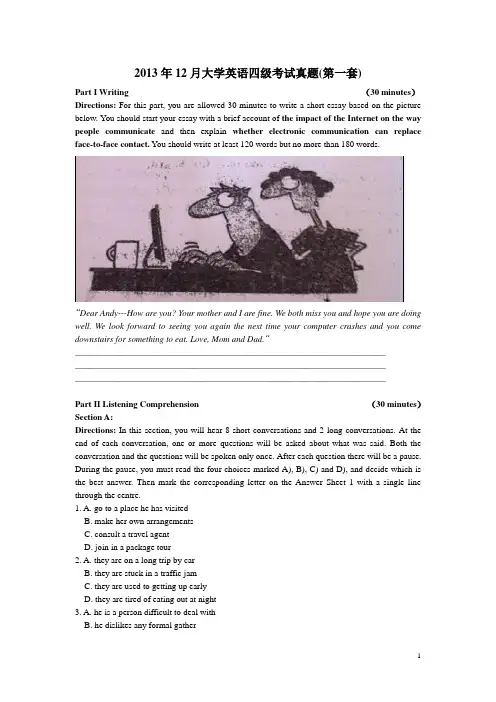
2013年12月大学英语四级考试真题(第一套)Part I Writing (30 minutes)Directions: For this part, you are allowed 30 minutes to write a short essay based on the picture below. You should start your essay with a brief account of the impact of the Internet on the way people communicate and then explain whether electronic communication can replace face-to-face contact. You should write at least 120 words but no more than 180 words.“Dear Andy---How are you? Your mother and I are fine. We both miss you and hope you are doing well. We look forward to seeing you again the next time your computer crashes and you come downstairs for something to eat. Love, Mom and Dad.”_____________________________________________________________________________________________________________________________________________________________________________________________________________________Part II Listening Comprehension (30 minutes)Section A:Directions: In this section, you will hear 8 short conversations and 2 long conversations. At the end of each conversation, one or more questions will be asked about what was said. Both the conversation and the questions will be spoken only once. After each question there will be a pause. During the pause, you must read the four choices marked A), B), C) and D), and decide which is the best answer. Then mark the corresponding letter on the Answer Sheet 1 with a single line through the centre.1. A. go to a place he has visitedB. make her own arrangementsC. consult a travel agentD. join in a package tour2. A. they are on a long trip by carB. they are stuck in a traffic jamC. they are used to getting up earlyD. they are tired of eating out at night3. A. he is a person difficult to deal withB. he dislikes any formal gatherC. he is unwilling to speak in publicD. he often keeps a distance from others4. A. work in another departmentB. pursue further educationC. recruit graduate studentsD. take an administrative job5. A. he would not be available to start the job in timeB. he is not quite qualified for the art director positionC. he would like to leave some more time for himselfD. he will get his application letter ready before May 16. A. cleaner B. mechanic C. porter D. salesman7. A. request one or two roommates to do the cleaningB. help Laura with her term paper due this weekendC. get Laura to clean the apartment herself this timeD. ask Laura to put off the cleaning until another week8. A. a problem caused by the constructionB. an accident that occurred on the bridgeC. the building project they are workingD. the public transportation conditionQuestions 9 to 11 are based on the conversation you have just heard.9. A. to look for a job as a salespersonB. to have a talk with Miss ThompsonC. to place an order for some productsD. to complain about a faulty appliance10. A. the person in charge is not in the officeB. the supplies are out of stock for the momentC. they failed to reach an agreement on the priceD. the company is re-cataloguing the items11. A. 0734,12536 extension 15B. 0734,21653 extension 51C. 0734,38750 extension 15D. 0734,62135 extension 51Questions 12 to 15 are based on the conversation you have just heard.12. A. since he found a girlfriendB. since he took to heavy smokingC. since he began to exercise regularlyD. since he started to live on his own13. A. he is getting too fatB. he smokes too muchC. he doesn’t eat vegetablesD. he doesn’t look well at all14 A. they are overweight for their ageB. they are respectful to their parentsC. they are still in their early twentiesD. they dislike doing physical exercise15 A. to quit smokingB. to reduce his weightC. to find a girlfriendD. to follow her adviceSection BDirections: In this section, you will hear 3 short passages. At the end of each passage, you will hear some questions. Both the passage and the questions will be spoken only once. After you hear questions, you must choose the best answer from the four choices marked A), B), C) and D). Then mark the corresponding letter on Answer Sheet 1 with a single line through the center.Passage OneQuestions16 to 19 are based on the passage you have just heard.16 A. they have destroyed several small townsB. they will soon spread to San FranciscoC. they have injured many residentsD. they are burning out of control17. A. they have been hospitalizedB. they have got skin problemsC. they were choked by the thick smokeD. they were poisoned by the burning chemicals18 A. it failed because of a sudden rocket explosionB. it has been re-scheduled for a midday takeoffC. it has been cancelled due to technical problemsD. it was delayed for eleven hours and thirty minutes19 A. they made frequent long-distance calls to each otherB. they illegally used government computers in New JerseyC. they were found to be smarter than computer specialistsD. they were arrested for stealing government informationPassage TwoQuestions 20 to 22 are based on the passage you have just heard.20.A. peaceful B. considerate C. generous D. cooperative21.A. someone dumped the clothes left in the washer and dryerB. someone broke the washer and dryer by overloading themC. Mindy Lance’s laundry blocked the way to the laundry roomD. Mindy Lance threatened to take revenge on her neighbors22. A. asking the neighborhood committee for helpB. limiting the amount of laundry for each washC. informing the building manager of the matterD. installing a few more washers and dryersPassage threeQuestions 23 to 25 are based on the passage you have just heard.23. A. she is both a popular and a highly respected authorB. she is the most loved African novelist of all timesC. she is the most influential author since the 1930sD. she is the first writer to focus on the fate of slaves24. A. The Book Critics Circles AwardB. the Nobel Prize for literatureC. the Pulizer Prize for fictionD. the National Book Award25. A. she is a relative of Morrison’sB. she is a slave from AfricaC. she is a skilled storytellerD. she is a black womanSection CDirections: In this section, you will hear a passage three times. When the passage is read for the first time, you should listen carefully for its general idea. When the passage is read for the second time, you are required to fill in the blanks with the exact words you have just heard. Finally, when the passage is read for the third time, you should check what you have written.Many college students today own personal computers that cost anywhere from $1,000 to perhaps $5,000 or more. 26_______, it is not uncommon for them to purchase 27_________ costing another several hundred dollars. Twenty years ago, computers were 28_________, but they were very large and extremely expensive. Few, if any, 29________ purchased computers for home use. Over they years, the price of the “guts” of a computer --- its memory --- has declined to less than a thousandth of the price per unit of memory that prevailed twenty years ago. This is the main reason why computers cost so much less today than they used to. 31_____ memory circuitry that is small enough to fit into the portable personal computers that many of us own and use. 32______, as the price of computation has declined the average consumer and business have spent more on purchasing computers.33________, improved agricultural technology, hybrid(杂交) seeds, 34________ animal breeding, and so on have vastly increased the amount of output a typical farmer can produce. The prices of goods such as meats and grains have fallen sharply relative to the prices of most other goods and services. As agricultural prices have fallen, many households have decreased their total expense on food. Even though the 35______ of a product purchased generally increases when its price falls, total expenses on it may decline.Part III Reading Comprehension (40 minutes)Section ATo get a sense of how women have progressed in science. Take a quick tour of the physics department at the University of California, Berkeley. This is a storied place, the 36_______ some of the most important discoveries in modern science---starting with Ernest Lawrence’s invention of the cyclotron(回旋加速器) in 1931. a generation ago, female faces were 37_______ and, even today, visitors walking through the first floor of LeConte Hall will see a full corridor of exhibits 38_______ the many distinguished physicists who made history here, 39_______ all of them white makes.But climb up to the third floor and you’ll see a 40______ display. There, among the photos of current faculty members and students, are portraits of the 41________head of the department, Marjorie Shapiro, and four other women whose research 42_______ everything from the mechanics of the universe to the smallest particles of matter. A sixth woman was hired just twoweeks ago. Although they’re still only about 10 percent of the physics faculty, women are clearly a presence here. And the real 43_______ may be in the smaller photos to the right: graduate and undergraduate students, about 20 percent of them female. Every year Berkeley sends its fresh female physics PhDs to the country’s top universities. That makes Shapiro optimistic, but also 44______, “I believe things are getting better,”she says, “but they’re not getting better as 45________ as I would like.”A circumstanceB confidenceC coversD currentE dealsF differentG exposing H fast I honoringJ hope K presently L rareM realistic N site O virtuallySection BDirections: In this section, you are going to read passage with ten statements attached to it. Each statement contains information given in one of the paragraphs. Identify the paragraph from which the information is derived. You may choose a paragraph more than once. Each paragraph is marked with a letter. Answer the questions by marking the corresponding letter on Answer Sheet 2.Is College a Worthy Investment?A) Why are we spending so much money on college? And why are we so unhappy about it? We allseem to agree that a college education is wonderful, and yet strangely we worry when we see families investing so much in this supposedly essential good. Maybe it’s time to ask a question that seems almost sacrilegious(大不敬的): is all this investment in college education really worth it?B) The answer, I fear, is no. for an increasing number of kids, the extra time and money spentpursuing a college diploma will leave them worse off than they were before they set foot on campus.C) For my entire adult life, a good education has been the most important thing for middle-classhouseholds. My parents spent more educating my sister and me than they spent on their house, and they’re not the only ones…and, of course, for an increasing number families, most of the cost of their house is actually the cost of living in a good school district. Questioning the value of a college education seems a bit like questioning the value of happiness, or fun.D) The average price of all goods and services has risen about 50 percent. But the price of acollege education has nearly doubled in that time. Is the education that today’s students are getting twice as good? Are new workers twice as smart? Have they become somehow massively more expensive to education?E) Perhaps a bit, Richard V edder, an Ohio University economics professor, says, “I look at thedata, and I see college costs rising faster then inflation up the mid-1980s by 1 percent a year.Now I see them rising 3 to 4 percent a year over inflation. What has happened? The federal government has started dropping money out of airplanes.” Aid has increased, subsidized(补贴的) loans have become available, and “the universities have gotten the money.”Economist Bryan Caplan, who is writing a book abut education, agrees: “It’s a giant waste of resources that will continue as long as the subsidies continue.”F) Promotional literature for colleges and student loans often speaks of debt as an “investment inyourself.” But an investment is supposed to generate income to pay off the loans. More thanhalf of all recent graduates are unemployed or in jobs that do not require a degree, and the amount of student-loan debt carried by households had increased more than five times since 1999. these graduates were told that a diploma was all they needed to succeed, but it won’t even get them out of the spare bedroom at Mom and Dad’s. for many, the most visible result of their four years is the loan payments, which now average hundreds of dollars a month on lan balances in the tens of thousands.G) It’s true about the money---sort of. College graduates now make 80 percent more than peoplewho have only a high-school diploma, and though there are no precise estimates, the wage premium(高出的部分) for an outstanding school seems to be even higher. But tha t’s not true of every student. It’s very easy to spend four years majoring in English literature and come out no more employable than you were before you went in. conversely, chemical engineers straight out of school can easily make almost four times the wages of an entry-level high-school graduate.H) James Heckman, the Nobel Prize winning economist, has examined how the returns oneducation break down for individuals with different backgrounds and levels of ability. “Even with these high prices, you’re still finding a high return for individuals who are bright and motivated,: he says. On the other hand, “if you’re not college ready, then the answer is no, it’s not worth it.” Experts tend to agree that for the average student, college is still worth it today, but they also agree that the rapid increase in price is eating up more and more of the potential return. For borderline students, tuition(学费) rise can push those returns into negative territory.I) Everyone seems to agree that the government, and parents, should be rethinking how we investin higher education---and that employers need to rethink the increasing use of college degrees as crude screening tools for jobs that don’t really require college skills. “Employers seeing a surplus of college graduates and looking to fill jobs are just adding that requirement,”says Vedder. “In fact, a college degree becomes a job requirement for becoming a bar-tender.”J) We have started to see some change on the finance side. A law passed in 2007 allows many students to cap their loan payment at 10 percent of their income and forgives any balance after25 years. But of course, that doesn’t control the cost of education; it just shifts it to taxpayers.It also encourages graduated to choose lower-paying careers, which reduces the financial return to education still further. “You’re subsidizing people to become priests and poets and so forth,” says Heckman. “You may think that’s a good thing, or you may not.” Either way it will be expensive for the government.K) What might be a lot cheaper is putting more kids to work Caplan notes that work also builds valuable skills---probably more valuable for kids who don’t naturally love sitting in a classroom. Heckman agrees wholeheartedly: “People are different, and those abilities can be shaped. Tha t’s what we’ve learned, and public policy should recognize that.”L) Heckman would like to see more apprenticeship-style(学徒式) programs, where kids can learn in the workplace---learn not just specific job skills, but the kind of “soft skills,” like getting to work on time and getting along with a team, that are crucial for career success. “It’s about having mentors(指导者) and having workplace-based education,”he says. “Time and again I’ve seen examples of this kind of program working.”M) Ah, but how do we get there from here? With better public policy, hopefully, but also by making better individual decision. “Historically markets have been able to handle these things,”says Vedder, “and I think eventually markets will handle this one. If it doesn’timprove soon, people are going to wake up and ask, ‘Why am I going to college?’”46. Caplan suggests that kids who don’t love school go to work.47. An increasing number of families spend more money on houses in a good school district.48. Subsidized loans to college students are a huge waste of money, according to one economist.49. More and more kids find they fare worse with a college diploma.50. For those who are not prepared for higher education, going to college is not worth it.51. Over the years the cost of a college education has increased almost by 100%.52. A law passed recently allows many students to pay no more than one tenth of their income fortheir college loans.53. Middle class Americans have highly valued a good education.54. More kids should be encouraged to participate in programs where they can learn not only jobskills but also social skills.55. Over fifty percent of recent college graduates remain unemployed or unable to find a suitablejob.Section CPassage OneQuestions 56 to 60 are based on the following passage.A recent global survey of 2,000 high-net-worth individuals found that 60% were not planning on a traditional retirement. Among U.S. participants, 75% expected to continue working in some capacity even after stepping away from full-time jobs. “Many of these people made their wealthy by doing something they’re passionate(有激情的) about,” says Daniel Egan, head of behavioral finance for Barclays Wealth Americas. “Given the choice, they prefer to continue working.”Barclays calls these people “nevertirees.”Unlike many Americans compelled into early retirement by company restrictions, the average nevertiree often has no one forcing his hand. If 106-year-old investor Irving Kahn, head of his won family firm, wants to keep coming to work every day, who’s going to stop him? Seventy-eight-year-old Supreme Court Justice Ruth Bader Ginsburg’s job security is guaranteed in the Constitution.It may seem that these elderly people are trying to cheat death. In fact, they are. And it’s working. Howard Friedman, a professor at UC Riverside, found in his research that those who work hardest and are successful in their careers often live the longest lives. “People are generally being given bad advice to slow down, take it easy, stop worrying, are retire to Foloida,”he described one study one study participant, still working at the age of 100, who was recently disappointed to see his son retire.“We’re beginning to see a change in how people view retirement,”says George Leeson, co-director of the Institute of Population Ageing at Oxford. Where once retirement was seen as a brief reward after a long struggle through some miserable job, it is now akin(近似) to being cast aside. What Leeson terms “the Warren Buffett effect”is becoming more broadly appealing as individuals come to “view retirement as not simply being linked to economic productivity but also about contribution.”Observers are split on whether this is a wholly good thing. On the one hand, companies and financial firms can benefit from the wisdom of a resilient(坚韧的) chief. On the other, the new generation can find it more difficult to advance---an argument that typically holds little sway to anevertiree.56. What do we learn about the so-called “nevertiree”?A. they are passionate about making a fortuneB. they have no choice but to continue workingC. they love what they do and choose not to retireD. they will not retire unless they are compelled to57. What do Irving Kahn and Ruth Bader Ginsburg have in common?A. neither of them is subject to forced retirementB. neither of them desires reward for their workC. both cling to their positions despite oppositionD. both are capable of coping with heavy workloads58. What is the finding of Howard Friedman’s research?A. the harder you work, the bigger your fortune will beB. the earlier you retire, the healthier you will beC. elderly people have to slow down to live longerD. working at an advanced age lengthens people’s life59. What is the traditional view of retirement according to the passage?A. it means a burden to the younger generationB. it is a symbol of mature and civilized societyC. it a compensation for one’s life-long hard workD. it helps increase a nation’s economics productivity60. What do critics say about “nevertirees?A. they are an obstacle to a company’s developmentB. they lack the creativity of the younger generationC. they cannot works as efficiently as they used toD. they prevent young people from getting aheadPassage TwoQuestions 61 to 65 are based on the following passage.When we talk about Americans barely into adulthood who are saddled with unbearable levels of debt. The conversation is almost always about student loan debt. but there’s a growing body of evidence suggesting that today’s young adults are also drowning in credit-care debt---and that many of them will take this debt to their graves.More than 20% overspent their income by more than $100 every single month. Since they haven’t built up their credit histories yet, it’s a safe bet that these young adults are paying relatively high interest rates on the resulting credit card debt.Although many young people blame “socializing”as a barrier to saving money, most of them aren’t knocking back $20 drinks in trendy(时尚的) lounges. They’re struggling with much more daily financial demands.To a disturbingly large extent, the young and the broke are relying on credit cards to make it until their next payday. This obviously isn’t sustainable in the long run, and it’s going to put a huge drag on their spending power even after they reach their peak earning years. Because they’ll still be paying interest on that bottle of orange juice or box of spaghetti(意式面条)they bought a decade earlier.A new study out of Ohio State University found that young adults are accumulating creditcard debt at a more rapid rate than other age groups, and that they’re slower at paying it off. “If what we found continues to hold true, we may have more elderly people with substantial financial problems in the future,” warns Lucia Dunn, professor of economics at Ohio State. “If our findings persist, we may be faced with a financial crisis among elderly people who can’t pay off their credit cards.”Dunn says a lot of these young people are never going to get out from under their credit card debt. “Many people are borrow on credit cards so heavily that payoff rates at these levels are not sufficient to recover their credit card debt by the end of their life, which could have loss implications for the credit card issuing banks.”61. What is the main idea of the first paragraph?A. many young Americans will never be able to pay off their debtsB. credit cards play an increasingly important role in college lifeC. credit cards are doing more harm than student loansD. the American credit card system is under criticism62. Why do young people have to pay a higher interest on their credit card debt?A. they tend to forget about the deadlinesB. they haven’t developed a credit historyC. they are often unable to pay back in timeD. they are inexperienced in managing money63. What is said to be the consequence of young adults relying on credit cards to make ends meet?A. it will place an unnecessary burden on societyB. it will give them no motivation to work hardC. it will exert psychological pressure on themD. it will affect their future spending power64. What will happen to young adults if their credit card debt keeps accumulating according to Lucia Dunn?A. they will have to pay an increasingly higher interest rateB. they may experience a financial crisis in their old ageC. their quality of life will be affectedD. their credit cards may be cancelled65. What does Lucia Dunn think might be a risk for the credit card issuing banks?A. they go bankrupt as a result of over-lendingB. they lose large numbers of their regular clientsC. their clients leave their debts unpaid upon deathD. their interest rates have to be reduced now and thenPart IV Translation (30 minutes)Directions: For this part, you are allowed 30 minutes to translate a passage from Chinese into English. You should write your answer on Answer Sheet 2.“你要茶还是咖啡?”是用餐人常被问到的问题。


![Costing_Theory_Part_A_[_80_Questions]](https://imgs-1438308264.cos.ap-hongkong.myqcloud.com/2ce2bcdb50e2524de5187ef8.webp)