
九年级英语上册unit4storiesandpoemslesson19astoryorapoem作业课件8
- 格式:ppt
- 大小:6.07 MB
- 文档页数:58

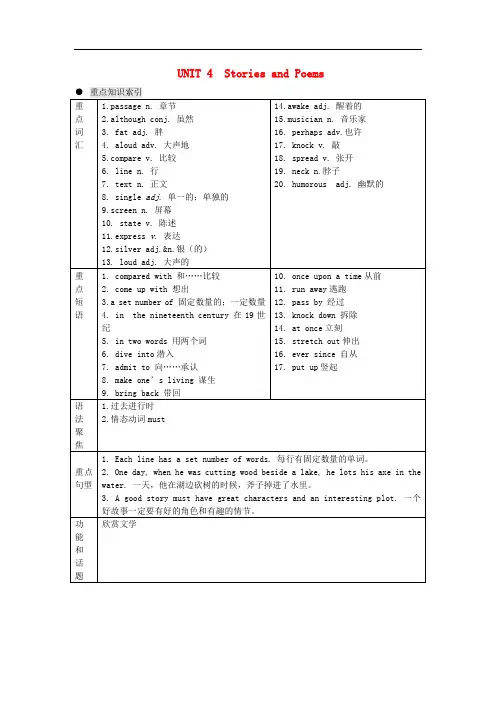

九年级英语上册Unit4 Stories and poems Lesson19 A Story or a Poem说课稿新版冀教版一. 教材分析冀教版九年级英语上册Unit4 Stories and poems Lesson19 A Story or a Poem,本节课主要让学生通过阅读一篇故事,判断其是故事还是诗歌,并在阅读过程中学习和复习过去时态的用法。
教材选取了一篇有趣的故事,让学生在轻松愉快的氛围中学习英语。
故事中出现了许多过去时态的句子,有助于学生巩固和提高过去时态的运用能力。
此外,本节课还涉及到形容词比较级和最高级的用法,为学生提供了丰富的语言材料,有助于提高他们的语言运用能力。
二. 学情分析九年级的学生已经掌握了基本的英语语法知识,过去时态的用法是他们已经学习过的内容。
但是,学生在实际运用过去时态时,仍存在一定的困难,如时态的混淆、动词的过去式形式等。
因此,在教学过程中,教师需要帮助学生巩固过去时态的用法,并提高他们在实际语境中的运用能力。
此外,学生在小学阶段已经接触过一些简单的诗歌,但对诗歌的形式和特点还不够了解。
在教学过程中,教师可以引导学生欣赏和分析故事中的诗歌,提高他们对诗歌的认识和鉴赏能力。
三. 说教学目标1.知识目标:(1)能够正确判断故事和诗歌;(2)复习并巩固过去时态的用法;(3)学习形容词比较级和最高级的用法。
2.能力目标:(1)提高学生阅读理解能力;(2)培养学生运用过去时态进行交际的能力;(3)提高学生欣赏和分析诗歌的能力。
3.情感目标:激发学生学习英语的兴趣,培养他们积极向上的学习态度。
四. 说教学重难点(1)过去时态的用法;(2)形容词比较级和最高级的用法。
(1)过去时态在实际语境中的运用;(2)诗歌的形式和特点。
五. 说教学方法与手段1.教学方法:(1)情境教学法:通过设置情境,让学生在实际语境中运用过去时态;(2)任务型教学法:引导学生完成阅读任务,提高他们的阅读理解能力;(3)欣赏教学法:引导学生欣赏和分析故事中的诗歌,提高他们对诗歌的认识和鉴赏能力。

UNIT 4 Stories and PoemsLesson 19 A Story or a Poem?习题1一、选择1. Alice is a good poet. _____, she has one shortcoming.A. althoughB. asC. howeverD. even if2. I will not give up write poems _____ I shall fail ten times.A. even ifB. asC. thoughD. until3. He had measured me _____ I could speak.A. untilB. beforeC. whileD. as4. _____, he knows more poems than you.A. Child as he isB. As he is a childC. A child as he isD. However he is a child5. Lin Tao is sure to come to help you the moment _____ his homework.A. he will finishB. he has finishedC. he finishedD. he had finished6. _____ difficult the task may be, we will try our best to finish it.A. No matterB. No wonderC. ThoughD. However7..Durning the Spring Festival , a lot of people take the bullet train home _____ it is expensive.A. soB. asC. becauseD. though8. _____ we grow older, we grow wiser.A. WithB. SinceC. WhileD. As9.Mary spends a lot of money on clothes _______ her family is not rich.A. becauseB. thoughC. ifD. so10. Although he is considered a great writer, _____.A. his works is not widely readB. but his works are not widely readC. however his works are not widely readD. yet his works are not widely read二、完型填空There have been many great inventions that change the way we live. The first great ___1___ was one that is still very important today—the wheel. This made it easy for man ___2___ heavythings and to travel long distances. For hundreds of years after that, there were ___3___ inventions that had as much effect as the wheel. Then in the early 1800’s the world started to change ___4___. There was little unknown land left in the world. People did not have to explore much anymore. In the second half of the 19th century many great inventions were made. ___5___ them were the camera, the electric light and the radio. These have all become a big part of our life today.The first part of the 20th century saw more great inventions. The helicopter in 1909. Movies ___6___ sound in 1926. The computer in 1928. And jet planes in 1930. This was also a time when a new ___7___ was first made. Nylon came out in 1935. It changed the kind of clothes people wear. Of course new inventions continued to be made. Man began looking ___8___ ways to go into space. Russia made the first step. Then the United States took another. Since then other countries,including China and Japan, ___9___ their steps into space. In 1969 man took his biggest step away from earth. ___10___ first walked on the moon. This was certainly just a beginning. New inventions will someday allow us to do things we have never yet dreamed of.1. A. scientist B. artist C. musician D. invention2. A. carry B. carrying C. to carry D. carried3. A. few B. a few C. little D. a little4. A. largely B. differently C. greatly D. freely5. A. Between B. Among C. Before D. After6. A. in B. of C. on D. with7. A. mistake B. product C. world D. material8. A. for B. out C. after D. around9. A. made B. were made C. have made D. hade made10. A. Chinese B. Japanese C. Americans D. Russians。
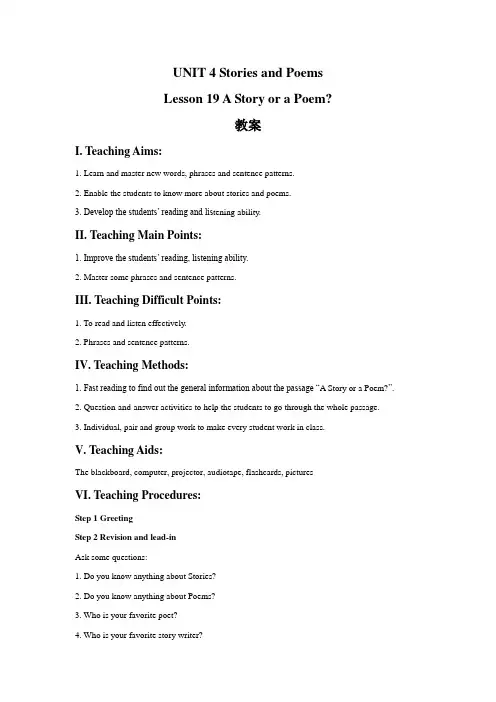
UNIT 4 Stories and PoemsLesson 19 A Story or a Poem?教案I. Teaching Aims:1. Learn and master new words, phrases and sentence patterns.2. Enable the students to know more about stories and poems.3. Develop the students’ reading and lis tening ability.II. Teaching Main Points:1. Improve the students’ reading, listening ability.2. Master some phrases and sentence patterns.III. Teaching Difficult Points:1. To read and listen effectively.2. Phrases and sentence patterns.IV. Teaching Methods:1. Fast reading to find out the general information about the passage “A Story or a Poem?”.2. Question-and-answer activities to help the students to go through the whole passage.3. Individual, pair and group work to make every student work in class.V. Teaching Aids:The blackboard, computer, projector, audiotape, flashcards, picturesVI. Teaching Procedures:Step 1 GreetingStep 2 Revision and lead-inAsk some questions:1. Do you know anything about Stories?2. Do you know anything about Poems?3. Who is your favorite poet?4. Who is your favorite story writer?Step 3 Presentation for readingAsk a question:Do you want to know some differences between a poem and a story?Step 4 Fast reading1. Give 2 minutes to read passage quickly.2. Answer questions on page 51.3. Repeat the right answer and write them on the blackboard.Step 5 Careful reading1. Explain some main phrases and sentence patterns.2. Give 4 minutes to read passage carefully and do the exercises in pairs.3. Check the answer: Ask a team of students do it one by one.Step 6 Practice1. Summarize the main ideas of the passage.2. Divide students to groups to discuss the passage.3. Make a competition: List the poets you like on the blackboard as much as you can. Step 7 Consolidation and summary1. Emphasize the phrases and sentence patterns.2. Retell some information about poems and stories.VII. Homework1. Write down the new words on your notebook.2. Use new words to make sentences.3. Preview Lesson 20.。