
反义疑问句
- 格式:ppt
- 大小:582.50 KB
- 文档页数:21

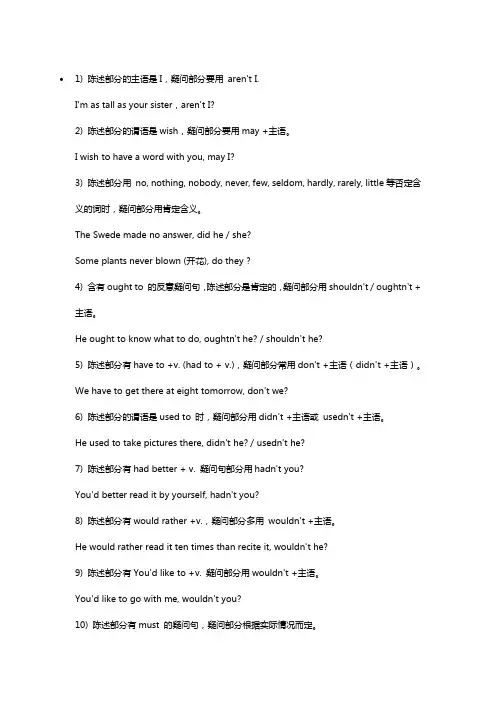
1) 陈述部分的主语是I,疑问部分要用 aren't I.
I'm as tall as your sister,aren't I?
2) 陈述部分的谓语是wish,疑问部分要用may +主语。
I wish to have a word with you, may I?
3) 陈述部分用 no, nothing, nobody, never, few, seldom, hardly, rarely, little等否定含义的词时,疑问部分用肯定含义。
The Swede made no answer, did he / she?
Some plants never blown (开花), do they ?
4) 含有ought to 的反意疑问句,陈述部分是肯定的,疑问部分用shouldn't / oughtn't +主语。
He ought to know what to do, oughtn't he? / shouldn't he?
5) 陈述部分有have to +v. (had to + v.),疑问部分常用don't +主语(didn't +主语)。
We have to get there at eight tomorrow, don't we?
6) 陈述部分的谓语是used to 时,疑问部分用didn't +主语或 usedn't +主语。
He used to take pictures there, didn't he? / usedn't he?
7) 陈述部分有had better + v. 疑问句部分用hadn't you?
You'd better read it by yourself, hadn't you?
8) 陈述部分有would rather +v.,疑问部分多用 wouldn't +主语。
He would rather read it ten times than recite it, wouldn't he?
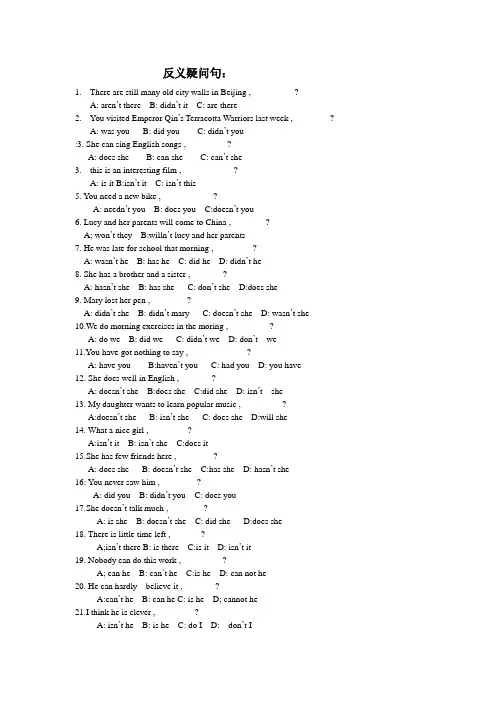
反义疑问句:
1. There are still many old city walls in Beijing , _________ ?
A: aren’t there B: didn’t it C: are there
2. You visited Emperor Qin’s Terracotta Warriors last week ,________ ?
A: was you B: did you C: didn’t you
:3. She can sing English songs ,_________ ?
A: does she B: can she C: can’t she
3. this is an interesting film , ___________ ?
A: is it B:isn’t it C: isn’t this
5. You need a new bike , ___________ ?
A: needn’t you B: does you C:doesn’t you
6. Lucy and her parents will come to China , _______ ?
A; won’t they B:willn’t lucy and her parents
7. He was late for school that morning , ________ ?
A: wasn’t he B: has he C: did he D: didn’t he
8. She has a brother and a sister ,_______ ?
A: hasn’t she B: has she C: don’t she D:does she
9. Mary lost her pen ,________ ?

反义疑问句
一、定义:
当我们陈述了一个事实,而又不是很有把握,就可以在陈述句后加一个简短问句,称为反意疑问句。
例:She is a student, isn’t she?
We speak Chinese, don’t we?
二、结构
结构一:前肯,+ 后否 例:She is a student,
isn’t she?
结构二:前否,+ 后肯 例:She
isn’t a student, is she?
三、解答步骤
1. 判定(判断该用肯定还是否定);
2. 找动(找句子的助动词:be用be,动词原形do,三单does,过去did,完成have);
3. 换代(将主语换为代词);
Jack wasn’t playing soccer, ____ _____?
Their parents have gone to London, ________ _____?
I have never been to the park, ______ ____?
四、几个类型句子
1. be动词(is, are, was, were)的句型
现在时态: 主语+is (are)„, isn’t (aren’t) + 主语?
过去时态: 主语+was (were)„, wasn’t (weren’t) + 主语?
1 He is your uncle, ____________?
2 You are not students, ____________?
3 The students are going to have a picnic, _____________?
2. 一般动词(play, study, watch 等)句型
现在时态: 主语+play/plays„, don’t (doesn’t) + 主语?
过去时态: 主语+played„, didn’t + 主语?

反义疑问句(disjunctive question) 也叫附加疑问句(tag question)
1. 句子主要部分带有从句时:
1). 如果主语是I,构成I think, I believe, I suppose等结构时,按照从句生成反义疑问句,主谓与从句一致,肯否定与主句相反。
例:I think he can swim, can’t he?
2). 如果主语不是I,而是其他正常形式的句子:
例:She said she wouldn’t call us the next day, didn’t she?
2. 句子中有I am的时候:
1). 如果句子为肯定形式:I am late, aren’t I?
2). 如果句子为否定形式;I am not a student, am I?
3. 陈述的部分主语是everybody, anyone, somebody, no one时,疑问部分通常用主语they.
4. 主语是everything, nothing, something时,疑问部分主语用it.
5. 祈使句的反义疑问句,用will you?
若祈使句以“let’s”开头,用shall we? Let us…, will you?
6. 情态动词的反义疑问句:
1). 如果情态动词不含有其他特殊的意义,就正常生成反义疑问句:
例:He can’t swim, can he?
They must clean the floor, mustn’t they? 或者 needn’t they? (must“必须”)
2). 情态动词must经常会有其他的用法和意义:
a. mustn’t 表示“不允许”或“禁止”的时候,用must/may+主语构成反义疑问句
例:Non-members mustn’t park cars here, must/may they?