反义疑问句
- 格式:docx
- 大小:27.73 KB
- 文档页数:5
conversation n.交谈;谈话
hold/have a conversation with 和……谈话
Children quickly get bored by adult conversation.
aloud adv.大声的;出生地
aloud是相对于默读而言,声音不一定很大。常与read,say等动词连用。
loudly表示有目的的提高音量以便让人听见。常指声音高且喧闹、不悦耳等
patient adj.有耐心的 n.病人
be patient with/to 对……有耐心 be patient of sth忍耐某事
Are you patient enough to teach me how to send email?
discover v.发现;发觉
dis(否定前缀)+cover(覆盖)发现
We discover this beach while we were sailing around the island.
secret n.秘密;秘诀 adj.秘密的;保密的
通常用作单数名词,其前加定冠词the。
keep a secret 保密 the secret to ……的秘诀 in secret 秘密地,暗地里
let out a secret泄露机密 tell sb a secret 告诉某人一个秘密
Your secret is safe with me.
look up(再词典、参考书中或通过电脑)查阅;抬头看
We I called him,he looked up from his paper he was writing.
I look up the word in several dictionaries.
repeat v.重复;重做
repeat本身已包含“重、又、再”的含义,故不可与“again”连用。
Please repeat what I’ve just told you.
increase v.增加;增长
increase by 增加了 increase to 增加到
Try to increase thenumber of your words.they’ve increased the price by 50﹪.
speed n.速度
at the speed of 以……的速度 with all speed 以全速
Extreme care is always needed when flying at high speed.
born v.出生adj.天生的
be born with 天生具有 be born in 出生于
Her borther was born with blind.
connect v.(使)连接;与……有联系
connect with 把……和……连接起来 connect to 把……连接到……
Connect the speakers to the CD players.
knowledge n.知识;学问
knowledge是不可数名词,但有时可加不定冠词,意为“对……有某种程度的了解”;knowledge不能做learn的宾语,只能说get some knowledge。
A little knowledge is a dangerous thing.
note n.笔记;记录 v.注意;指出短语:note down 记下take notes 记笔记 make a note of
记下,记录take note of注意到,留意
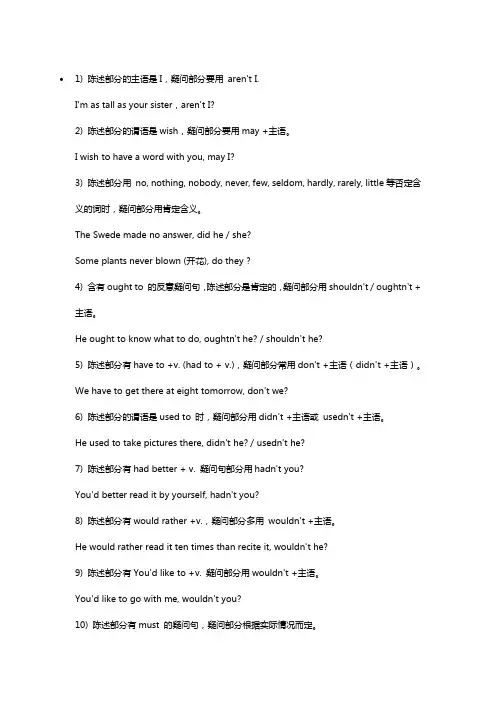
定义:附加疑问句。他表示提问人的看法,没有把握,需要对方证实。翻译疑问句由两部分组成前一部分是个陈述句,后一部分是一个简单的疑问句,两部分人称时态应保持一致。 主要形式:前肯后否;前否后肯
主语:
1.一般词语
反义疑问句中主语和主句的主语一致的主语,用主格。附加反义疑问句从句。
2.不定代词
当反义疑问句的主语为:
(1)one时,后面的疑问句可用one/he.
(2)no one时,后面的疑问句中主语使用they.
(3)everything\anything\nothing\something时,后面的疑问句主语用it不用they.
(4)this\that\those\these时,后面的疑问句主语用it或they.
(5)everyone\everybody\someone\somebody\anyone\nobody等时,后面的疑问句主语用they或he.
3.there be句型时,后面的疑问句主语用be\情态动词\助动词+there.
4.含有think,belive,suppose,imagine,expect等动词后接宾语从句构成的主从复合句在构成反义疑问句时视情况不同有两种不同的构成方式。
①当主句的人称为第一人称时,后面的简短问句应与从句相一致。
We suppose you have finshed the project,haven’t you?
②当主句的人称为第二、三人称时,后面的简短问句应与主句相一致。
Your sister supposes she needs no help,doesn’t she?
③但如果主句的时态是过去时等,疑问句要和主句的时态保持一致。
5.have
陈述部份有had better,或其中的had表示完成时态时,疑问句应该用hadn’t等开头。
You’d better get up early,havn’t you?
其他情况下有have时,疑问句应用don’t开头,如have表示“有”时,有两种形式:可用do、have来改写。
He has two sisters,doesn’t he? = He has two sisters,hasn’t he?
否定意义的词
(1)当陈述部份有never,seldom,hardly,few,little,barely,scarcely,nothing,none,nobody,rarely,no.not,no one,neither等否定意义的词汇时,反义疑问句则为肯定形式。
He can hardlyswim,can he?
(2)当陈述部份有unhappy,disike,unfriendly等否定意义的词时当作肯定句处理,反义疑问句则为否定形式。
The girl dislike history,does’t she?
(3)当陈述部份有less,fewer等词视为肯定句,反义疑问句则为肯定形式。
There will be less pollution,won’t there?
祈使句
当陈述部份是祈使句时,疑问句根据语气来表达,分三种情况:
①一般情况用will you\won’t you.
②以Let’t开头的祈使句,前肯后可肯可否,疑问句必须用Shall we;只有以Let us、Let me开头的祈使句,问句采用will you.
③当陈述句是否定的祈使句,问句可以用will you\can you.
Must有四种情况(1)表示禁止不可不必时,问句通常用Must。(2)表示有必要时,问句通常用needn’t。(3)表示推测时,问句通常根据Must后面的动词采用相应的形式。 (4)当Must have done 表示对过去情况的推测,问句要根据陈述部份谓语的情况用“did’t+主语或wasn’t/weren’t+主语”;如果强调动作的完成,问句要用“haven’t/hasn’t+主语”。
重点归纳
陈述部份的谓语 疑问部份
I/主语 aren’t I/are I
no 肯定含义
ought to(肯定的) oughtn’t+主语
have to+v(had to+v) Don’t+主语(didn’t+主语)
Used to+v didn’t+主语/usedn’t+主语
Had better +v Hadn’t+主语
Would rather +v Wouldn’t+主语
You’d like to+v Wouldn’t+主语
Must 根据实际情况而定
感叹句 Be+主语
指示代词或不定代词
(everything,that,nothing,this) 主语用it
并列复合句 谓语根据临近从句的谓语而定
Think,belive,imagine,expect,suppose等 与宾语从句相对应的从句
Everybody,anyone,somebody,nobody,no one 复数they,单数he
情态动词dare,need Need/needn’t(dare/daren’t)+主语
dare,need为实义动词 Do/don’t+主语
省去主语的祈使句 will/won’t you?
Let’s开头的祈使句 Shall we?
Let us开头的祈使句 Will you?
There be 相应的谓语动词+there
否定前缀不能视为否定词 仍使用否定形式
陈述部份谓语是Wish May+主语
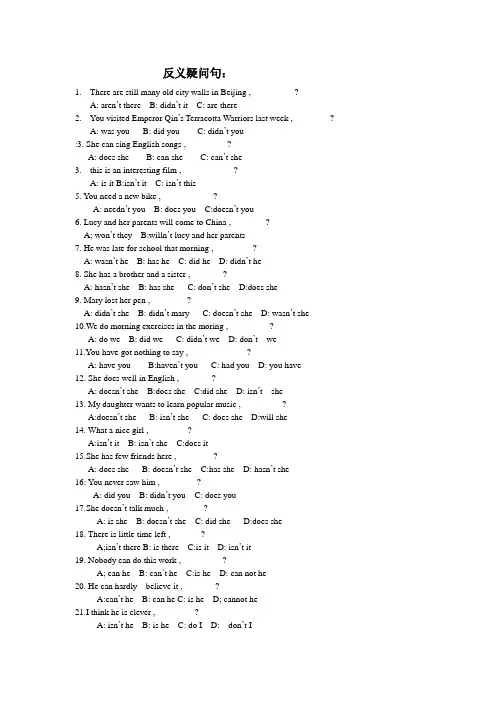
1. You’d rather watch TV this evening, ______?
a. isn’t it b. hadn’t you c. wouldn’t you d. won’t you
2. I suppose you’re not going today, ______?
a. are you b. do you c. don’t you d. aren’t you
3. I wish to shake hands with you, ______?
a. shall I b. may I c. do I d. will I
4. Three hours ought to be enough time, ______?
a. oughtn’t three hours b. didn’t they c. shouldn’t it d. shouldn’t three hours
5. They have to study a lot, ______?
a. don’t they b. haven’t they c. did they d. hadn’t they
6. When the car crashed, your brother escaped being hurt, ______ ?
a. didn’t he b. did he c. did it d. didn’t it
7. I'm sure dirty, ______?
a. am I b. isn’t I c. aren’t I d. am not I