
不同杂交稻灌浆期叶片衰老指标在常规水分管理及限水条件下的变化趋势(英文)
- 格式:pdf
- 大小:916.80 KB
- 文档页数:9


水稻各生育阶段形态特征、诊断指标和因苗管理水稻各生育阶段形态特征、诊断指标和因苗管理(一)秧苗阶段1.秧苗长相苗龄适当,叶龄整齐,苗健壮,叶挺秀,根系发达,移栽后抗植伤力强。
2.诊断指标(1)足苗:移栽时每亩秧田叶面积系数约3.0一3.5;大苗每亩总苗数为100一120 万,中苗为150一200万,小苗为250一300万,单季杂交水稻每亩总苗数为50万一75万左右;叶龄整齐一致,中苗叶龄6.1一7.0,大苗叶龄8.1一9.0,小苗叶龄4.1一5.0无土小苗叶龄3.0。
(2)发根力强,单株根系发达,白根多,栽后2一4天返青活棵,活棵标准为早晨见心叶叶尖吐水为准。
(3)抗植伤力强,中苗叶色青绿,叶弯不披垂,碳氮比10一13,称健壮秧;大苗时色淡绿,叶片硬直,碳氮比15以上,称老壮秧,小苗叶色嫩绿,叶片微弯,称嫩壮秧。
(4)秧苗基部粗壮,其粗度为0.5一0.7厘米;带蘖率大苗95%以上,中苗50%左右,小苗30%上下。
3.因苗管理图示(1)选种种子要充分成熟,纯净,粒大,饱满,发芽率高,发芽势强。
(2)浸种催芽满足种子发芽所需要的温度,水分和空气,促使种子发芽快而整齐,根与芽粗壮,以利播后迅速扎根,育成齐壮秧苗。
(3)适期播种露地育秧播种过早,易遇到低温危害,生长缓慢,发生烂秧死苗(4) 播量适宜播种过密,扎根不良,光照不足,秧苗细长黄瘦;播种适宜,秧苗健壮.(5)湿润扎根播后平沟水,保持秧板湿润,扎根快,立苗早,根芽生长健壮,成秧率高,播后深水,只长芽扎根,易引起倒芽、浮苗;如低温,还会引起烂秧、死苗。
要排水落干。
(6)早施断奶肥三叶期的秧苗,胚乳内养分已全部耗尽,它的生长靠自己的根系吸收水和养料,制造有机物质,独立生活。
追肥要早,一般在一叶一心时开始。
(7)防止死苗秧苗三叶期时,抗逆性最弱,遇5一7℃的低温,籼稻就会受到冷害,保温育秧或旱育秧,秧苗2一3叶时,由于病菌侵入,在遇低温阴雨转高温的晴天时,常出现青枯或黄枯死苗。

壤碳氮和微生物群落的影响[J].华中农业大学学报,2022,41(6):16-26.HU Q L,YANG B J,LIU N,et al.Effects of application rates of nitrogen on rice yield,carbon and nitrogen,microbial community in soil under mixed sowing of green manure[J].Journal of Huazhong Agri⁃cultural University,2022,41(6):16-26.[3]李忠义,唐红琴,何铁光,等.绿肥作物紫云英研究进展[J].热带农业科学,2016,36(11):27-32.LI Z Y,TANG H Q,HE T G,et al. Research progress of Chinese milk vetch(Astragalus sinicus)[J].Chi⁃nese Journal of Tropical Agriculture,2016,36(11):27-32. [4]林新坚,曹卫东,吴一群,等.紫云英研究进展[J].草业科学,2011, 28(1):135-140.LIN X J,CAO W D,WU Y Q,et al.Advance in As⁃tragalus sinicus research[J].Pratacultural Science,2011,28(1):135-140.[5]周兴,李再明,谢坚,等.紫云英利用后减施化肥对水稻产量和产值及土壤碳氮含量的影响[J].湖南农业大学学报(自然科学版), 2014,40(3):225-230.ZHOU X,LI Z M,XIE J,et al.Effect of re⁃ducing chemical fertilizer on rice yield,output value,content of soil carbon and nitrogen after utilizing the milk vetch[J].Journal of Hunan Agricultural University(Natural Sciences),2014,40(3):225-230. [6]张颖睿,杨滨娟,黄国勤.紫云英翻压量与不同施氮量对水稻生长和氮素吸收利用的影响[J].生态学杂志,2018,37(2):430-437. ZHANG Y R,YANG B J,HUANG G Q.Effects of Chinese milk vetch as a green manure and nitrogen fertilization on rice growth and nitrogen absorption and utilization of rice[J].Chinese Journal of Ecology,2018, 37(2):430-437.[7]王飞,林诚,林新坚,等.连续翻压紫云英对福建单季稻产量与化肥氮素吸收、分配及残留的影响[J].植物营养与肥料学报,2014,20(4):896-904.WANG F,LIN C,LIN X J,et al.Effects of continuous turnover of Astragalus sinicus on rice yield and N absorption,distribu⁃tion and residue in single-cropping rice regions of Fujian Province[J].Journal of Plant Nutrition and Fertilizer,2014,20(4):896-904. [8]ZHOU X,LU Y H,LIAO Y L,et al.Substitution of chemical fertilizer by Chinese milk vetch improves the sustainability of yield and accumu⁃lation of soil organic carbon in a double-rice cropping system[J].Jour⁃nal of Integrative Agriculture,2019,18(10):2381-2392.[9]鲁艳红,廖育林,聂军,等.紫云英与尿素或控释尿素配施对双季稻产量及氮钾利用率的影响[J].植物营养与肥料学报,2017,23(2):360-368.LU Y H,LIAO Y L,NIE J,et al.Effect of different incorpo⁃ration of Chinese milk vetch coupled with urea or controlled release urea on yield and nitrogen and potassium nutrient use efficiency in dou⁃ble-cropping rice system[J].Journal of Plant Nutrition and Fertilizers, 2017,23(2):360-368.[10]颜志雷,方宇,陈济琛,等.连年翻压紫云英对稻田土壤养分和微生物学特性的影响[J].植物营养与肥料学报,2014,20(5):1151-1160.YAN Z L,FANG Y,CHEN J C,et al.Effect of turning over Chinese milk vetch(Astragalus sinicus L.)on soil nutrients and micro⁃bial properties in paddy fields[J].Journal of Plant Nutrition and Fer⁃tilizers,2014,20(5):1151-1160.[11]刘春增,常单娜,李本银,等.种植翻压紫云英配施化肥对稻田土壤活性有机碳氮的影响[J].土壤学报,2017,54(3):657-669.LIUof Chinese milk vetch coupled with application of chemical fertilizer on active organic carbon and nitrogen in paddy soil[J].Acta Pedologi⁃ca Sinica,2017,54(3):657-669.[12]魏夏新,熊俊芬,李涛,等.有机物料还田对双季稻田土壤有机碳及其活性组分的影响[J].应用生态学报,2020,31(7):2373-2380. WEI X X,XIONG J F,LI T,et al.Effects of different organic amend⁃ments on soil organic carbon and its labile fractions in the paddy soil of a double rice cropping system[J].Chinese Journal of Applied Ecolo⁃gy,2020,31(7):2373-2380.[13]LI T,GAO J,BAI L,et al.Influence of green manure and rice straw management on soil organic carbon,enzyme activities,and rice yield in red paddy soil[J].Soil and Tillage Research,2019,195:104428.[14]常单娜,刘春增,李本银,等.翻压紫云英对稻田土壤还原物质变化特征及温室气体排放的影响[J].草业学报,2018,27(12):133-144.CHANG D N,LIU C Z,LI B Y,et al.Effects of incorporating Chinese milk vetch on redctive material characteristics and green⁃house gas emissions in paddy soil[J].Acta Prataculturae Sinica,2018, 27(12):133-144.[15]YANG W,YAO L,ZHU M,et al.Replacing urea-N with Chinese milk vetch(Astragalus sinicus L.)mitigates CH4and N2O emissions in rice paddy[J].Agriculture,Ecosystems&Environment,2022,336:108033.[16]聂江文,王幼娟,吴邦魁,等.紫云英还田对早稻直播稻田温室气体排放的影响[J].农业环境科学学报,2018,37(10):2334-2341. NIE J W,WANG Y J,WU B K,et al.Effect of Chinese milk vetch in⁃corporation on greenhouse gas emissions from early-rice direct-seed⁃ing paddy fields[J].Journal of Agro⁃Environment Science,2018,37(10):2334-2341.[17]ZHOU Q,ZHANG P,WANG Z,et al.Winter crop rotation intensifica⁃tion to increase rice yield,soil carbon,and microbial diversity[J].Heli⁃yon,2023,9(1):e12903.[18]唐海明,肖小平,李超,等.冬季覆盖作物秸秆还田对双季稻田根际土壤微生物群落功能多样性的影响[J].生态学报,2018,38(18):6559-6569.TANG H M,XIAO X P,LI C,et al.Effects of re⁃cycling straw of different winter covering crops on rhizospheric micro⁃bial community functional diversity in a double-cropped paddy field [J].Acta Ecologica Sinica,2018,38(18):6559-6569. [19]GAO S,CAO W,ZHOU G,et al.Rees bacterial communities in pad⁃dy soils changed by milk vetch as green manure:a study conducted across six provinces in south China[J].Pedosphere,2021,31(4):521-530.[20]万水霞,唐杉,蒋光月,等.紫云英与化肥配施对土壤微生物特征和作物产量的影响[J].草业学报,2016,25(6):109-117.WAN S X,TANG S,JIANG G Y,et al.Effects of Chinese milk vetch manure and fertilizer on soil microbial characteristics and yield of rice[J].Acta Prataculturae Sinica,2016,25(6):109-117.[21]万水霞,朱宏斌,唐杉,等.紫云英与化肥配施对安徽沿江双季稻区土壤生物学特性的影响[J].植物营养与肥料学报,2015,21(2):387-395.WAN S X,ZHU H B,TANG S,et al.Effects of Astragalus sinicus manure and fertilizer combined application on biological prop⁃River[J].Journal of Plant Nutrition and Fertilizers ,2015,21(2):387-395.[22]佀国涵,赵书军,王瑞,等.连年翻压绿肥对植烟土壤物理及生物性状的影响[J].植物营养与肥料学报,2014,20(4):905-912.SI G H,ZHAO S J,WANG R,et al.Effects of consecutive overturning ofgreen manure on soil physical and biological characteristics in tobac⁃co-planting fields[J].Journal of Plant Nutrition and Fertilizers ,2014,20(4):905-912.[23]王利民,黄东风,何春梅,等.紫云英还田对黄泥田土壤理化和微生物特性及水稻产量的影响[J].生态学报,2023,43(11):4782-4797.WANG L M,HUANG D F,HE C M,et al.Impacts of theChinese milk vetch (Astragalus sinicus L.)residue incorporation on soil physicalchemical,microbial properties and rice yields in yellow-mud paddy field[J].Acta Ecologica Sinica ,2023,43(11):4782-4797.[24]CHEN J R,QIN W J,CHEN X F,et al.Application of Chinese milkvetch affects rice yield and soil productivity in a subtropical double-rice cropping system[J].Journal of Integrative Agriculture ,2020,19(8):2116-2126.[25]WANG L,HE C,HUANG D et al.Co-incorporation of Chinese milkvetch (Astragalus sinicus L.)and chemical fertilizer alters microbial functional genes supporting short-time scale positive nitrogen prim⁃ing effects in paddy soils[J].Pedosphere ,2023.[26]唐海明,程凯凯,肖小平,等.不同冬季覆盖作物对双季稻田土壤有机碳的影响[J].应用生态学报,2017,28(2):465-473.TANGH M,CHENG K K,XIAO X P,et al.Effects of different winter cover crops on soil organic carbon in a double cropping rice paddy field[J].Chinese Journal of Applied Ecology ,2017,28(2):465-473.[27]周国朋,曹卫东,白金顺,等.多年紫云英-双季稻下不同施肥水平对两类水稻土有机质及可溶性有机质的影响[J].中国农业科学,2016,49(21):4096-4106.ZHOU G P,CAO W D,BAI J S,et al.Effects of different fertilization levels on soil organic matter and dis⁃solved organic matter in two paddy soils after multi-years ′rotation of Chinese milk vetch and double-cropping rice[J].Scientia Agricultura Sinica ,2016,49(21):4096-4106.[28]杨滨娟,黄国勤,王超,等.稻田冬种绿肥对水稻产量和土壤肥力的影响[J].中国生态农业学报,2013,21(10):1209-1216.YANGB J,HUANG G Q,WANG C,et al.Effects of winter green manure cul⁃tivation on rice yield and soil fertility in paddy field[J].Chinese Jour⁃nal of Eco-Agriculture ,2013,21(10):1209-1216.[29]龙莉,杨旭初,熊斌,等.冬作物秸秆还田对双季稻产量和土壤肥力的影响[J].作物研究,2019,33(2):104-109.LONG L,YANGand soil fertility in a double cropping rice paddy[J].Crop Research ,2019,33(2):104-109.[30]胡安永,孙星,刘勤,等.太湖地区不同轮作方式对稻田氨挥发和水稻产量的影响[J].水土保持学报,2013,27(6):275-279.HU AY,SUN X,LIU Q,et al.Influence of different rotations on ammonia volatilization and rice yields of paddy fields in Taihu Lake region[J].Journal of Soil and Water Conservation ,2013,27(6):275-279.[31]BOWLES T M,ACOSTA-MARTÍNEZ V,CALDERÓN F et al.Soilenzyme activities,microbial communities,and carbon and nitrogen availability in organic agroecosystems across an intensively-managed agricultural landscape[J].Soil Biology and Biochemistry ,2014,68:252-262.[32]王光华,刘俊杰,于镇华,等.土壤酸杆菌门细菌生态学研究进展[J].生物技术通报,2016,32(2):14-20.WANG G H,LIU J J,YUZ H,et al.Research progress of Acidobacteria ecology in soils[J].Bio⁃technology Bulletin ,2016,32(2):14-20.[33]CHALLACOMBE J F,HESSE C N,BRAMER L M et al.Genomesand secretomes of Ascomycota fungi reveal diverse functions in plant biomass decomposition and pathogenesis[J].BMC Genomics ,2019,20(1):976.[34]CHEN X,WANG J,YOU Y et al.When nanoparticle and microbesmeet :the effect of multi-walled carbon nanotubes on microbial com⁃munity and nutrient cycling in hyperaccumulator system[J].Journal of Hazardous Materials ,2022,423:126947.[35]杨胜香,李凤梅,彭禧柱,等.不同碳氮磷源改良剂对铅锌尾矿废弃地土壤微生物群落结构的影响[J].农业环境科学学报,2019,38(6):1256-1264.YANG S X,LI F M,PENG X Z,et al.Effects ofamendments with different C/N/P ratios on the microbial community structure in Pb-Zn mine tailings[J].Journal of Agro-Environment Sci⁃ence ,2019,38(6):1256-1264.[36]田程,邱婷,朱菲莹,等.氧化钙对西瓜枯萎病及根际细菌群落的调控[J].湖南农业大学学报(自然科学版),2018,44(6):620-624.TIAN C,QIU T,ZHU F Y,et al.Calcium oxide regulation of fusarium wilt and rhizophere bacterial community[J].Journal of Hunan Agricul⁃tural University (Natural Sciences ),2018,44(6):620-624.[37]方宇,王飞,贾宪波,等.绿肥配施减量化肥对土壤固氮菌群落的影响[J].农业环境科学学报,2018,37(9):1933-1941.FANG Y,WANG F,JIA X B,et al.Effect of green manure and reduced chemi⁃cal fertilizer load on the community of soil nitrogen-fixing bacteria[J].Journal of Agro-Environment Science ,2018,37(9):1933-1941.万欣,张怡,苏鹏程,等.农村水环境政策与污染的时空迁移特征及关系[J].农业环境科学学报,2024,43(4):886-895.WAN X,ZHANG Y,SU P C,et al.Spatiotemporal migration patterns and relationships between rural water environment policies and pollution[J].Journal of Agro-Environment Science ,2024,43(4):886-895.农村水环境政策与污染的时空迁移特征及关系万欣,张怡*,苏鹏程,骆心怡,林佳欣(河海大学商学院,南京211100)Spatiotemporal migration patterns and relationships between rural water environment policies and pollutionWAN Xin,ZHANG Yi *,SU Pengcheng,LUO Xinyi,LIN Jiaxin(School of Business,Hohai University,Nanjing 211100,China )Abstract :In order to reveal the temporal and spatial evolutional relationships between rural water pollution and the corresponding governance policies,the migration paths of gravity centers for the two indicators were plotted based on measurements of policy strength and pollution intensity.Then,various provinces were classified into different “policy-pollution ”types by using the Shapley value decomposition method,and the causal relationship between policy and pollution under each type was analyzed based on the Granger causality test method.The results showed that both the gravity centers of policy and pollution located in southeast China,but their migration paths were not aligned with each other.The former exhibited a “south-west-north-east ”directional trend,whereas the latter consistently demonstrated a propensity for migration towards the south.In terms of the link between policy and pollution,it was observedthat the reduction in pollution intensity contributed to an enhancement in policy strength in “growth-reduced ”type provinces.However,the drivers for this enhancement differ between eastern and western provinces.As for provinces classified as “reduced-reduced ”,the decrease in policy effectiveness was found to be a result of reduced pollution intensity;however,there were instances of policy deviationevident in specific dimensions of pollution.At last,the provinces falling under the "pollution growth"category did not exhibit Granger causality between policy and pollution.Therefore,it was recommended that future policy-making incorporates its association with pollution outcomes and enhances the precision,synergy,and foresight of policies,which is beneficial to the elevation of efficiency and effectiveness of policy formulation.Keywords :rural water pollution;gravity center migration;policy strength;pollution intensity;“policy-pollution ”type收稿日期:2023-04-13录用日期:2023-08-03作者简介:万欣(1985—),女,吉林通化人,博士,副教授,主要从事城乡可持续建设与治理研究。

农业领域中的专业英文词汇第一章:农作物1.主要粮食作物A.水稻(Rice)a)稻谷(Paddy)b)稻田(Paddy field)c)水稻品种(Rice varieties)d)稻田灌溉(Paddy field irrigation)e)稻田管理(Paddy field management)B.小麦(Wheat)a)小麦品种(Wheat varieties)b)春小麦(Spring wheat)c)秋小麦(Winter wheat)d)小麦收获(Wheat harvesting)e)小麦贮藏(Wheat storage)C.玉米(Maize/Corn)a)玉米品种(Maize varieties)b)玉米种植(Maize cultivation)c)玉米田(Cornfield)d)玉米收割(Maize harvesting)e)玉米加工(Corn processing)D.大米(Millet)a)小米(Foxtail millet)b)粟米(Proso millet)c)黍米(Broomcorn millet)d)燕麦(Oats)e)小米种植(Millet cultivation)E.谷子(Sorghum)a)甜高粱(Sweet sorghum)b)非洲高粱(Sudan grass)c)碱基高粱(Kafir corn)d)高粱种植(Sorghum cultivation) F.大豆(Soybean)a)大豆品种(Soybean varieties)b)大豆种植(Soybean cultivation)c)大豆收割(Soybean harvesting)d)大豆加工(Soybean processing) G.马铃薯(Potato)a)马铃薯品种(Potato varieties)b)马铃薯种植(Potato cultivation)c)马铃薯收获(Potato harvesting)d)马铃薯储藏(Potato storage) H.甘薯(Sweet Potato)a)甘薯品种(Sweet potato varieties)b)甘薯种植(Sweet potato cultivation)c)甘薯收获(Sweet potato harvesting)d)甘薯储藏(Sweet potato storage)I.大麦(Barley)a)大麦品种(Barley varieties)b)大麦种植(Barley cultivation)c)大麦收割(Barley harvesting)d)大麦加工(Barley processing)2.主要经济作物A.棉花(Cotton)a)棉花品种(Cotton varieties)b)棉花种植(Cotton cultivation)c)棉花采摘(Cotton picking)d)棉花加工(Cotton processing)e)棉花纺织(Cotton textile)B.糖蔗(Sugarcane)a)糖蔗品种(Sugarcane varieties)b)糖蔗种植(Sugarcane cultivation)c)糖蔗收割(Sugarcane harvesting)d)糖蔗加工(Sugarcane processing)e)糖蔗制糖(Sugar production)C.咖啡(Coffee)a)咖啡豆(Coffee beans)b)咖啡树(Coffee tree)c)咖啡生产(Coffee production)d)咖啡种植(Coffee cultivation)e)咖啡加工(Coffee processing)D.茶叶(Tea)a)茶叶品种(Tea varieties)b)茶园管理(Tea plantation management)c)茶叶采摘(Tea leaf picking)d)茶叶加工(Tea processing)e)茶叶质量评估(Tea quality assessment) E.可可(Cocoa)a)可可豆(Cocoa beans)b)可可树(Cocoa tree)c)可可种植(Cocoa cultivation)d)可可收割(Cocoa harvesting)e)可可加工(Cocoa processing)F.橡胶(Rubber)a)橡胶树(Rubber tree)b)橡胶种植(Rubber cultivation)c)橡胶采集(Rubber tapping)d)橡胶加工(Rubber processing)e)天然橡胶(Natural rubber)G.烟草(Tobacco)a)烟草品种(Tobacco varieties)b)烟草种植(Tobacco cultivation)c)烟叶收割(Tobacco leaf harvesting)d)烟草加工(Tobacco processing)e)烟草制品(Tobacco products)3.主要园艺作物A.蔬菜(Vegetables)a)蔬菜品种(Vegetable varieties)b)蔬菜种植(Vegetable cultivation)c)蔬菜园管理(Vegetable garden management)d)蔬菜收获(Vegetable harvesting)e)蔬菜销售(Vegetable marketing)B.水果(Fruits)a)水果品种(Fruit varieties)b)水果树(Fruit trees)c)水果种植(Fruit cultivation)d)水果收获(Fruit harvesting)e)水果贮藏(Fruit storage)C.花卉(Flowers)a)花卉品种(Flower varieties)b)花卉种植(Flower cultivation)c)花卉养护(Flower care)d)花卉市场(Flower market)e)花卉插花(Flower arrangement) D.草坪草(Turfgrass)a)草坪草品种(Turfgrass varieties)b)草坪草播种(Turfgrass seeding)c)草坪草生长(Turfgrass growth)d)草坪草修剪(Turfgrass mowing)e)草坪草管理(Turfgrass maintenance) E.香料植物(Herbs)a)香料植物品种(Herb varieties)b)香料植物种植(Herb cultivation)c)香料植物收获(Herb harvesting)d)香料植物干燥(Herb drying)e)香料植物加工(Herb processing) F.葡萄(Grapes)a)葡萄品种(Grape varieties)b)葡萄栽培(Grape cultivation)c)葡萄收获(Grape harvesting)d)葡萄酒生产(Wine production)e)葡萄园管理(Vineyard management)G.坚果(Nuts)a)坚果品种(Nut varieties)b)坚果树(Nut trees)c)坚果种植(Nut cultivation)d)坚果收获(Nut harvesting)e)坚果加工(Nut processing)第二章:土壤与土地管理4.土壤类型A.砂土(Sand)a)砂质土壤(Sandy soil)b)砂壤(Arenosol)c)砂壤土壤质地(Sandy soil texture)d)砂土排水(Sand drainage)e)砂土改良(Sand soil improvement)B.粘土(Clay)a)黏性土壤(Clayey soil)b)黏土(Clay)c)黏土土壤质地(Clayey soil texture)d)黏土结构(Clay structure)e)黏土改良(Clay soil improvement)C.壤土(Loam)a)壤土(Loam soil)b)壤土类型(Loam types)c)壤土养分(Loam soil nutrients)d)壤土pH值(Loam soil pH)e)壤土管理(Loam soil management)D.石灰土(Calcareous Soil)a)石灰土(Calcareous soil)b)石灰土性质(Calcareous soil properties)c)石灰土肥力(Calcareous soil fertility)d)石灰土酸碱性(Calcareous soil acidity)e)石灰土改良(Calcareous soil improvement)E.盐碱土(Saline-Alkaline Soil)a)盐碱土(Saline-alkaline soil)b)盐碱土特性(Saline-alkaline soil characteristics)c)盐碱土改良(Saline-alkaline soil improvement)d)盐碱土排水(Saline-alkaline soil drainage)e)盐碱土耐盐性作物(Salt-tolerant crops for saline-alkaline soil) F.沙壤土(Sandy Loam Soil)a)沙壤土(Sandy loam soil)b)沙壤土特性(Sandy loam soil characteristics)c)沙壤土管理(Sandy loam soil management)d)沙壤土改良(Sandy loam soil improvement)e)沙壤土透水性(Sandy loam soil permeability)G.腐殖土(Humus)a)腐殖土(Humus)b)腐殖质含量(Humus content)c)腐殖土形成(Humus formation)d)腐殖土功能(Humus function)e)腐殖土保肥作用(Humus role in soil fertility)5.土壤组成A.土壤结构(Soil Structure)a)土壤颗粒(Soil particles)b)土壤团聚体(Soil aggregates)c)土壤孔隙(Soil pores)d)土壤密度(Soil density)e)土壤排水性(Soil drainage)B.土壤有机质(Soil Organic Matter)a)有机质含量(Organic matter content)b)腐殖质(Humus)c)土壤有机碳(Soil organic carbon)d)有机肥料(Organic fertilizers)e)生物降解(Biodegradation)C.土壤微生物(Soil Microorganisms)a)土壤细菌(Soil bacteria)b)土壤真菌(Soil fungi)c)土壤细胞微生物(Soil microbial communities)d)土壤微生物生态系统(Soil microbial ecosystem)e)土壤微生物多样性(Soil microbial diversity) D.土壤无机成分(Soil Inorganic Components)a)矿物质(Minerals)b)矿物颗粒(Mineral particles)c)土壤矿物含量(Soil mineral content)d)土壤pH值(Soil pH)e)土壤盐分(Soil salinity)E.土壤水分(Soil Moisture)a)土壤水分含量(Soil moisture content)b)土壤水分循环(Soil moisture cycling)c)土壤水分胁迫(Soil moisture stress)d)土壤水分测量(Soil moisture measurement)e)土壤水力性质(Soil hydraulic properties)F.土壤气体(Soil Gases)a)土壤氧气(Soil oxygen)b)土壤二氧化碳(Soil carbon dioxide)c)土壤氮气(Soil nitrogen)d)土壤气体交换(Soil gas exchange)e)土壤通气性(Soil aeration)G.土壤微量元素(Soil Trace Elements)a)土壤微量元素含量(Soil trace element content)b)土壤微量元素循环(Soil trace element cycling)c)土壤微量元素生物有效性(Soil trace element bioavailability)d)土壤微量元素监测(Soil trace element monitoring)e)土壤微量元素补充(Soil trace element supplementation)6.土壤改良方法A.土壤改良剂(Soil Amendments)a)有机肥料(Organic fertilizers)b)矿物质肥料(Mineral fertilizers)c)生物固氮(Biological nitrogen fixation)d)腐植酸(Humic acid)e)石灰(Lime)B.翻耕(Tillage)a)深耕(Deep tillage)b)中耕(Medium tillage)c)浅耕(Shallow tillage)d)耕作机械(Tillage machinery)e)耕地保护(Conservation tillage)C.绿肥(Green Manure)a)绿肥作物(Green manure crops)b)绿肥覆盖(Green manure cover)c)绿肥种植(Green manure cultivation)d)绿肥种类(Types of green manure)e)绿肥割除(Green manure incorporation) D.有机物添加(Organic Matter Addition)a)堆肥(Compost)b)生物残留物(Crop residues)c)动物粪便(Manure)d)沼气废弃物(Biogas slurry)e)腐殖质(Humus)E.石灰施用(Lime Application)a)石灰施用量(Lime application rate)b)石灰种类(Types of lime)c)石灰处理(Lime treatment)d)pH调节(pH adjustment)e)酸性土壤中和(Acid soil neutralization) F.土壤覆盖(Soil Covering)a)茅草覆盖(Straw mulch)b)塑料覆盖(Plastic mulch)c)土壤覆盖作物(Cover crops)d)覆盖作物栽培(Cover cropping)e)土壤保温覆盖(Soil insulation cover) G.生物多样性增加(Increasing Biodiversity)a)种植树木(Planting trees)b)多种植物轮作(Crop rotation)c)生物多样性保护(Biodiversity conservation)d)林地复合种植(Agroforestry)e)生物多样性提升项目(Biodiversity enhancement projects)第三章:作物生长与管理7.播种A.播种(Sowing)a)播种方法(Sowing methods)b)直播(Direct seeding)c)育苗(Seedling raising)d)播种机械(Sowing machinery)e)播种时间(Sowing time)B.种子处理(Seed Treatment)a)种子消毒(Seed disinfection)b)种子浸种(Seed soaking)c)种子包衣(Seed coating)d)种子处理剂(Seed treatment agents)e)种子质量检测(Seed quality testing)C.播种密度(Seeding Density)a)单株播种量(Planting density per plant)b)每亩播种量(Seeding rate per acre)c)每公顷播种量(Seeding rate per hectare)d)播种行距(Row spacing)e)播种深度(Seeding depth)D.播种机械(Sowing Machinery)a)播种机(Seeder)b)种子播种机(Seed drill)c)压实机(Packers)d)播种组合机械(Combined seeders)e)自动播种机(Automatic seeders)E.播种管理(Sowing Management)a)播种前准备(Preparation before sowing)b)播种后管理(Post-sowing management)c)播种技术培训(Sowing technique training)d)播种记录(Sowing records)e)播种期监测(Sowing period monitoring)F.播种系统(Sowing Systems)a)滚筒播种系统(Roller seeding system)b)蓄水式播种系统(Water storage seeding system)c)直播播种系统(Direct seeding system)d)点播播种系统(Point seeding system)e)定位播种系统(Precision seeding system)G.播种时间(Sowing Time)a)春季播种(Spring sowing)b)秋季播种(Autumn sowing)c)季节性播种(Seasonal sowing)d)最佳播种时间(Optimal sowing time)e)播种日历(Sowing calendar)8.种植A.种植(Planting)a)种植技术(Planting techniques)b)种植季节(Planting season)c)种植密度(Planting density)d)种植方式(Planting method)e)种植距离(Planting distance)B.种植管理(Crop Management)a)种植计划(Crop planning)b)种植周期(Crop rotation)c)种植保护(Crop protection)d)种植监测(Crop monitoring)e)种植技术培训(Crop management training) C.作物选择(Crop Selection)a)作物品种(Crop varieties)b)作物适应性(Crop adaptability)c)作物周期(Crop cycle)d)作物耐旱性(Crop drought resistance)e)作物抗病性(Crop disease resistance) D.栽培技术(Cultivation Techniques)a)水分管理(Water management)b)施肥技术(Fertilization techniques)c)病虫害防治(Pest and disease control)d)土壤改良(Soil improvement)e)采收技术(Harvesting techniques) E.作物生长(Crop Growth)a)生长周期(Growth cycle)b)生长环境(Growth environment)c)生长调节剂(Growth regulators)d)生长监测(Growth monitoring)e)生长速率(Growth rate)F.种植机械(Planting Machinery)a)种植机(Planter)b)植保机(Sprayer)c)耕作机(Tiller)d)水肥一体机(Fertilizer applicator)e)收割机(Harvester)9.施肥A.施肥(Fertilization)a)肥料(Fertilizers)b)施肥方案(Fertilization plan)c)施肥周期(Fertilization schedule)d)施肥方法(Fertilization method)e)施肥量(Fertilizer application rate)B.肥料类型(Types of Fertilizers)a)有机肥料(Organic fertilizers)b)化学肥料(Chemical fertilizers)c)生物肥料(Biological fertilizers)d)微量元素肥料(Micronutrient fertilizers)e)缓释肥料(Slow-release fertilizers) C.主要营养元素(Major Nutrients)a)氮(Nitrogen)b)磷(Phosphorus)c)钾(Potassium)d)钙(Calcium)e)镁(Magnesium)D.微量营养元素(Micronutrients)a)锌(Zinc)b)铜(Copper)c)锰(Manganese)d)钼(Molybdenum)e)铁(Iron)E.施肥技术(Fertilization Techniques)a)叶面施肥(Foliar fertilization)b)滴灌施肥(Fertigation)c)土壤施肥(Soil fertilization)d)喷施肥料(Spray fertilization)e)肥料混施(Fertilizer blending)F.肥料管理(Fertilizer Management)a)肥料选择(Fertilizer selection)b)肥料配比(Fertilizer blending)c)施肥时间(Fertilization timing)d)施肥量调整(Fertilizer rate adjustment)e)肥料效果评估(Fertilizer effectiveness assessment) G.环境友好施肥(Environmentally Friendly Fertilization)a)精准施肥(Precision fertilization)b)节水施肥(Water-saving fertilization)c)节能施肥(Energy-saving fertilization)d)有机肥料应用(Organic fertilizer application)e)生物肥料利用(Biological fertilizer utilization)10.施药A.施药(Pesticide Application)a)农药(Pesticides)b)施药方法(Pesticide application method)d)施药时机(Pesticide application timing)e)施药装备(Pesticide application equipment) B.农药分类(Types of Pesticides)a)杀虫剂(Insecticides)b)杀菌剂(Fungicides)c)除草剂(Herbicides)d)杀线虫剂(Nematicides)e)杀鼠剂(Rodenticides)C.选择合适农药(Pesticide Selection)a)农药筛选(Pesticide screening)b)农药安全性评估(Pesticide safety assessment)c)农药效果评估(Pesticide efficacy evaluation)d)农药适应性(Pesticide suitability)e)生物农药(Biopesticides)D.施药技术(Pesticide Application Techniques)a)喷雾施药(Spray application)b)灌溉施药(Irrigation application)c)粉尘施药(Dust application)d)雾化施药(Fogging application)e)薄膜施药(Film application)E.施药管理(Pesticide Management)b)施药记录(Pesticide application records)c)施药安全措施(Pesticide safety measures)d)施药剩余物处理(Pesticide residue management)e)施药后监测(Post-application monitoring)F.环境友好施药(Environmentally Friendly Pest Control)a)集约化施药(Integrated pest management, IPM)b)生物防治(Biological control)c)天敌引入(Introduction of natural enemies)d)生态保护区施药(Pesticide application in ecological reserves)e)低毒或无毒农药(Low-toxic or non-toxic pesticides)G.抗药性管理(Resistance Management)a)抗药性监测(Resistance monitoring)b)抗药性管理策略(Resistance management strategies)c)交替使用不同农药(Rotation of different pesticides)d)混合使用不同类别农药(Mixing different classes of pesticides)e)使用低剂量农药(Using low doses of pesticides)11.灌溉A.灌溉(Irrigation)a)灌溉系统(Irrigation system)b)灌溉水源(Irrigation water source)c)灌溉设备(Irrigation equipment)d)灌溉方案(Irrigation plan)e)灌溉效率(Irrigation efficiency)B.灌溉方法(Irrigation Methods)a)地面灌溉(Surface irrigation)b)滴灌(Drip irrigation)c)喷灌(Sprinkler irrigation)d)微喷灌(Micro-irrigation)e)管道灌溉(Subsurface irrigation)C.灌溉水质(Irrigation Water Quality)a)水质检测(Water quality testing)b)水质净化(Water purification)c)盐碱化处理(Salinization treatment)d)水质监测站(Water quality monitoring station)e)水质改善技术(Water quality improvement techniques) D.灌溉管理(Irrigation Management)a)灌溉计划(Irrigation scheduling)b)灌溉监测(Irrigation monitoring)c)灌溉自动化(Irrigation automation)d)水资源管理(Water resource management)e)灌溉效率改进(Irrigation efficiency improvement)E.灌溉水量(Irrigation Water Volume)a)灌溉量(Irrigation volume)b)水量计量(Water metering)c)灌溉水需求(Irrigation water requirement)d)水资源利用率(Water use efficiency)e)水分利用效率(Water use efficiency)F.灌溉工程(Irrigation Engineering)a)灌溉渠道(Irrigation canals)b)灌溉管道(Irrigation pipelines)c)泵站(Pumping stations)d)沉淀池(Sedimentation ponds)e)水库(Reservoirs)G.节水灌溉技术(Water-saving Irrigation Techniques)a)集雨灌溉(Rainwater harvesting irrigation)b)土壤水分传感器(Soil moisture sensors)c)定量灌溉(Quantitative irrigation)d)水肥一体化(Integration of water and fertilizer)e)水资源再利用(Water reuse)12.水资源管理A.水资源管理(Water Resource Management)a)水资源规划(Water resource planning)b)水资源评估(Water resource assessment)c)水资源分配(Water resource allocation)d)水资源保护(Water resource conservation)e)水资源利用效率(Water resource utilization efficiency)B.水文学(Hydrology)a)水文监测(Hydrological monitoring)b)水文模型(Hydrological models)c)水文地质学(Hydrogeology)d)水文循环(Hydrological cycle)e)水文数据分析(Hydrological data analysis)C.水权制度(Water Rights System)a)水权分配(Water rights allocation)b)水权交易(Water rights trading)c)水权许可(Water rights permits)d)水权转让(Water rights transfer)e)水权法律(Water rights laws)D.水资源调配(Water Allocation)a)水资源分配方案(Water allocation plan)b)跨区域水资源调配(Inter-basin water transfer)c)水资源调度(Water resource scheduling)d)水资源分配机构(Water allocation agencies)e)水资源调控政策(Water resource regulation policies)E.水资源可持续利用(Sustainable Water Resource Management)a)水资源再生利用(Water recycling)b)水资源节约(Water conservation)c)水资源保护区(Water conservation zones)d)水资源治理(Water resource governance)e)水资源管理规划(Water resource management planning) F.农田水利工程(Agricultural Water Management)a)灌溉管理(Irrigation management)b)农田水利设施(Agricultural water facilities)c)农田排水系统(Agricultural drainage systems)d)土壤保水措施(Soil moisture conservation measures)e)耕地水资源管理(Arable land water resource management)第四章:病虫害防治10.常见病害A.病害管理(Disease Management)a)病害防治(Disease prevention and control)b)病害监测(Disease surveillance)c)病害防治策略(Disease management strategies)d)病害预警系统(Disease early warning systems)e)病害防治措施(Disease control measures)B.作物病害分类(Classification of Crop Diseases)a)真菌性病害(Fungal diseases)b)细菌性病害(Bacterial diseases)c)病毒性病害(Viral diseases)d)线虫性病害(Nematode diseases)e)真菌性腐烂病(Fungal rot diseases)C.常见病害名称(Common Disease Names)a)枯萎病(Wilting disease)b)白粉病(Powdery mildew)c)锈病(Rust)d)炭疽病(Anthracnose)e)灰霉病(Gray mold)f)褐斑病(Brown spot disease)g)叶斑病(Leaf spot disease)h)病毒花叶病(Virus mosaic disease)D.病害传播途径(Transmission of Diseases)a)空气传播(Airborne transmission)b)接触传播(Contact transmission)c)土传播(Soilborne transmission)d)种子传播(Seedborne transmission)e)昆虫传播(Insect vector transmission) E.病害防治方法(Methods of Disease Control)a)化学防治(Chemical control)b)生物防治(Biological control)c)遗传抗性(Genetic resistance)d)文化防治(Cultural control)e)物理防治(Physical control)F.病害诊断与监测(Disease Diagnosis and Monitoring)a)病害诊断技术(Disease diagnosis techniques)b)病害监测系统(Disease monitoring systems)c)病害病原检测(Disease pathogen detection)d)病害症状识别(Disease symptom recognition)e)病害防治效果评估(Assessment of disease control efficacy)G.病害抗性育种(Disease Resistance Breeding)a)抗病性遗传育种(Genetic breeding for disease resistance)b)分子标记辅助选育(Marker-assisted selection for disease resistance)c)杂交育种(Hybrid breeding for disease resistance)d)基因编辑技术(Gene editing techniques for disease resistance)11.常见虫害A.虫害管理(Pest Management)a)虫害监测(Pest surveillance)b)虫害防治(Pest control)c)虫害防治策略(Pest management strategies)d)虫害防治措施(Pest control measures)e)虫害防治技术(Pest control techniques)B.害虫分类(Classification of Pests)a)害虫种类(Types of pests)b)昆虫害虫(Insect pests)c)线虫害虫(Nematode pests)d)啮齿类害虫(Rodent pests)e)螨虫害虫(Mite pests)C.常见害虫名称(Common Pest Names)a)蚜虫(Aphids)b)白粉虫(Whiteflies)c)菜青虫(Cabbage loopers)d)蜗牛(Snails)e)甲虫(Beetles)f)蝗虫(Locusts)g)蜘蛛螨(Spider mites)h)叶蝉(Leafhoppers)D.害虫生物学与生态学(Pest Biology and Ecology)a)害虫生活史(Pest life cycle)b)害虫天敌(Natural enemies of pests)c)害虫趋光性(Phototaxis of pests)d)害虫繁殖率(Reproduction rate of pests)e)害虫食性(Feeding habits of pests)E.害虫传播途径(Transmission of Pests)a)空气传播(Airborne transmission)b)直接接触传播(Direct contact transmission)c)间接接触传播(Indirect contact transmission)d)矢量传播(Vector-borne transmission)e)土壤传播(Soilborne transmission)F.害虫防治方法(Methods of Pest Control)a)生物防治(Biological control)b)化学防治(Chemical control)c)物理防治(Physical control)d)遗传防治(Genetic control)G.害虫诊断与监测(Pest Diagnosis and Monitoring)a)害虫识别技术(Pest identification techniques)b)害虫监测系统(Pest monitoring systems)c)害虫防治效果评估(Assessment of pest control efficacy)d)害虫防治方案调整(Adjustment of pest control strategies)12.农药A.杀虫剂(Insecticides)a)有机磷杀虫剂(Organophosphate insecticides)b)拟除虫菊酯(Pyrethroids)c)新一代杀虫剂(Neonicotinoids)d)氯氟氰菊酯(Chlorpyrifos)e)吡虫啉(Imidacloprid)f)灭螨剂(Acaricides)B.杀菌剂(Fungicides)a)三唑酮类杀菌剂(Triazole fungicides)b)多菌灵(Mancozeb)c)氧化锌(Zinc oxide)d)丙环唑(Propiconazole)e)苯醚甲环唑(Methyl benzimidazole carbamate) C.除草剂(Herbicides)a)非选择性除草剂(Non-selective herbicides)b)除草剂混剂(Herbicide mixtures)c)除草剂抗性(Herbicide resistance)d)草甘膦(Glyphosate)e)氯吡氯(Atrazine)f)苯醚乙草胺(2,4-Dichlorophenoxyacetic acid) D.杀线虫剂(Nematicides)a)卡布杀线虫(Carbamate nematicides)b)磺胺类杀线虫剂(Sulfonylurea nematicides)c)噻嗪类杀线虫剂(Thiazole nematicides)d)多菌灵(Mancozeb)e)拜尔(Bayer)f)噻虫嗪(Thiacloprid)E.杀鼠剂(Rodenticides)a)抗凝血剂(Anticoagulant rodenticides)b)磷化合物(Phosphorus compounds)c)铝磷(Aluminum phosphide)d)防除鼠药(Rat poison)e)鼠药毒性(Toxicity of rodenticides)F.生物农药(Biopesticides)a)细菌制剂(Bacterial formulations)b)真菌制剂(Fungal formulations)c)植物提取物(Plant extracts)d)昆虫性激素(Insect growth regulators)e)酶制剂(Enzyme formulations)G.农药应用技术(Pesticide Application Techniques)a)农药喷雾器(Pesticide sprayers)b)农药施洒系统(Pesticide application systems)c)农药喷雾技术(Pesticide spraying techniques)d)农药喷洒量(Pesticide spraying volume)e)农药安全使用指南(Guidelines for safe pesticide use)13.生物防治A.生物防治(Biological Control)a)天敌释放(Natural enemy release)b)生物防治剂(Biological control agents)c)生物入侵防治(Biological invasion control)d)生物控制方案(Biological control programs)e)生物防治技术(Biological control techniques)B.天敌(Natural Enemies)a)捕食性昆虫(Predatory insects)b)寄生性昆虫(Parasitic insects)c)天敌昆虫(Entomophagous insects)d)天敌微生物(Entomopathogenic microorganisms)e)天敌植物(Entomophagous plants)C.拮抗生物(Antagonistic Organisms)a)拮抗真菌(Antagonistic fungi)b)拮抗细菌(Antagonistic bacteria)c)拮抗线虫(Antagonistic nematodes)d)拮抗植物(Antagonistic plants)e)拮抗性病毒(Antagonistic viruses)D.天敌培育与释放(Rearing and Release of Natural Enemies)a)天敌培育技术(Natural enemy rearing techniques)b)天敌大规模培育(Mass rearing of natural enemies)c)天敌释放策略(Strategies for natural enemy release)d)天敌释放效果评估(Assessment of natural enemy release efficacy)e)天敌库建设(Establishment of natural enemy reservoirs)E.引种与引进(Introduction of Natural Enemies)a)外来天敌引进(Introduction of exotic natural enemies)b)天敌适应性评估(Assessment of natural enemy adaptability)c)天敌引种效果监测(Monitoring of natural enemy introduction effects)d)天敌引种审批与管理(Approval and management of natural enemyintroductions)e)天敌引种风险评估(Risk assessment of natural enemy introductions) F.生物防治在综合防治中的应用(Integration of Biological Control)a)生物防治与化学防治的综合应用(Integration of biological andchemical control)b)生物防治与生物灭菌的综合应用(Integration of biological control andbio fumigation)c)生物防治与物理防治的综合应用(Integration of biological andphysical control)d)生物防治与遗传抗性育种的综合应用(Integration of biological controland genetic resistance breeding)e)生物防治与文化防治的综合应用(Integration of biological control andcultural control)第五章:收获与储存14.收割A.收割机械(Harvesting Machinery)a)收割机(Harvester)b)脱粒机(Thresher)c)打捆机(Baler)d)切茎机(Stalk chopper)e)摘菜机(Vegetable harvester)f)摘果机(Fruit harvester)B.收割作业(Harvesting Operations)a)收割期(Harvesting season)b)收割计划(Harvesting schedule)c)收割技术(Harvesting techniques)d)收割速度(Harvesting speed)e)收割效率(Harvesting efficiency) C.收割产品(Harvested Products)a)庄稼(Crop)b)作物(Crop)c)农产品(Agricultural produce)d)果实(Fruit)e)蔬菜(Vegetable)f)谷物(Grain)g)饲料(Fodder)D.收割后处理(Post-harvest Handling)a)储藏(Storage)b)保鲜(Preservation)c)加工(Processing)d)运输(Transportation)e)包装(Packaging)f)分级(Grading)E.收割管理(Harvest Management)a)收割时间(Harvesting time)b)收割条件(Harvesting conditions)c)收割质量(Harvesting quality)d)收割损失(Harvesting losses)e)收割成本(Harvesting costs)f)收割后土壤管理(Post-harvest soil management) F.收割技术(Harvesting Techniques)a)手工收割(Manual harvesting)b)机械收割(Mechanical harvesting)c)自动化收割(Automated harvesting)d)GPS导航收割(GPS-guided harvesting)e)智能收割系统(Smart harvesting systems)f)水稻插秧机(Rice transplanter)G.收割安全(Harvesting Safety)a)安全操作规程(Safety procedures)b)作业安全设备(Safety equipment)c)危险警示(Hazard warnings)d)事故预防(Accident prevention)e)应急处理(Emergency procedures)f)培训和教育(Training and education)15.采摘A.采摘工具(Harvesting Tools)a)采摘篮(Picking basket)b)采摘器(Picker)c)采摘剪(Pruning shears)d)采摘袋(Picking bag)e)采摘器械(Harvesting equipment) B.采摘作业(Picking Operations)a)采摘时间(Picking time)b)采摘季节(Picking season)c)采摘技术(Picking techniques)d)采摘速度(Picking speed)e)采摘员(Picker)C.采摘产品(Harvested Products)a)水果(Fruit)b)蔬菜(Vegetable)c)茶叶(Tea leaves)d)坚果(Nuts)e)花卉(Flowers)f)果实(Produce)D.采摘后处理(Post-picking Handling)a)分类(Sorting)b)清洗(Washing)c)包装(Packaging)d)贮存(Storage)e)运输(Transportation)f)销售(Marketing)E.采摘管理(Picking Management)a)采摘计划(Picking schedule)b)采摘质量(Picking quality)c)采摘成本(Picking costs)d)采摘效率(Picking efficiency)e)采摘损失(Picking losses)F.采摘技术(Picking Techniques)a)手工采摘(Hand picking)b)机械采摘(Mechanical picking)c)自动化采摘(Automated picking)d)选择性采摘(Selective picking)e)连续采摘(Continuous picking)G.采摘安全(Picking Safety)a)安全装备(Safety gear)b)安全操作规程(Safety procedures)c)危险警示(Hazard warnings)d)事故预防(Accident prevention)e)应急处理(Emergency procedures)f)培训和教育(Training and education)16.农产品储存A.储存设施(Storage Facilities)a)仓库(Warehouse)b)储藏室(Storage room)c)冷库(Cold storage)d)空调库(Air-conditioned storage)e)粮仓(Granary)f)储存罐(Storage tank)B.储存技术(Storage Techniques)a)空气调节(Air ventilation)b)低温储存(Low-temperature storage)c)干燥储存(Dry storage)d)控温储存(Temperature-controlled storage)e)控湿储存(Humidity-controlled storage)f)气调储存(Modified atmosphere storage) C.储存条件(Storage Conditions)a)温度(Temperature)b)湿度(Humidity)c)光照(Lighting)d)通风(Ventilation)e)气体组成(Gas composition)f)空气质量(Air quality)D.储存器具(Storage Containers)a)箱子(Box)b)袋子(Bag)c)桶(Bucket)d)罐子(Can)e)管道(Pipeline)f)网袋(Net bag)E.储存管理(Storage Management)a)储存计划(Storage plan)b)储存检查(Storage inspection)c)储存标记(Storage labeling)d)储存记录(Storage records)e)储存库存(Storage inventory)f)储存安全(Storage security)F.储存损耗(Storage Losses)a)质量损失(Quality loss)b)量损失(Quantity loss)c)损耗预防(Loss prevention)d)损耗控制(Loss control)e)损耗评估(Loss assessment)f)损耗减少策略(Loss reduction strategies) G.储存保鲜剂(Storage Preservatives)a)防腐剂(Preservatives)b)抗氧化剂(Antioxidants)c)抑菌剂(Antimicrobials)d)除湿剂(Desiccants)e)包装材料(Packaging materials)f)灭菌剂(Sterilants)17.农产品加工A.加工设备(Processing Equipment)a)磨粉机(Milling machine)b)榨油机(Oil press)c)搅拌机(Mixer)d)烘干设备(Drying equipment)e)破碎机(Crusher)f)分选机(Sorter)B.加工工艺(Processing Techniques)a)热处理(Heat treatment)b)冷冻(Freezing)c)脱水(Dehydration)d)腌制(Pickling)e)发酵(Fermentation)f)烟熏(Smoking)C.加工产品(Processed Products)a)食品(Food products)b)饲料(Feed)c)油脂(Oils and fats)d)饮料(Beverages)e)粉末(Powders)f)谷物制品(Cereal products)D.加工工厂(Processing Plants)a)食品加工厂(Food processing plant)b)油压厂(Oil mill)c)粉磨厂(Flour mill)d)糖厂(Sugar mill)e)酿酒厂(Brewery)f)乳品加工厂(Dairy processing plant) E.加工流程(Processing Processes)a)清洗(Washing)b)切割(Cutting)c)研磨(Grinding)d)榨取(Extraction)e)烘焙(Baking)f)包装(Packaging)F.加工质量控制(Processing Quality Control)a)原料检验(Raw material inspection)b)加工过程监控(Processing process monitoring)c)成品检验(Finished product inspection)d)质量管理体系(Quality management system)e)卫生标准(Hygiene standards)f)安全标准(Safety standards)G.加工创新技术(Advanced Processing Technologies)a)超临界流体提取(Supercritical fluid extraction)b)微波加热(Microwave heating)c)超声波处理(Ultrasonic processing)d)真空冷冻干燥(Vacuum freeze-drying)e)纳米技术应用(Nanotechnology applications)f)3D打印食品(3D printed food)第六章:畜牧业与养殖业18.主要家畜品种A.牛类(Cattle)a)奶牛(Dairy cattle)b)肉牛(Beef cattle)c)犊牛(Calves)d)母牛(Heifers)e)公牛(Bulls)f)阉牛(Steers)B.羊类(Sheep)a)绵羊(Merino sheep)b)肉羊(Meat sheep)c)母羊(Ewes)d)公羊(Rams)e)羔羊(Lambs)C.猪类(Pigs)a)种猪(Breeding pigs)b)肉猪(Meat pigs)c)母猪(Sows)d)公猪(Boars)e)仔猪(Piglets)D.家禽(Poultry)a)鸡(Chickens)b)鸭(Ducks)c)鹅(Geese)d)鸽子(Pigeons)E.马类(Horses)a)马(Horses)b)马匹(Equines)c)马驹(Foals)d)母马(Mares)e)公马(Stallions)19.主要家禽品种A.鸡(Chickens)a)肉鸡(Broilers)b)蛋鸡(Layers)c)母鸡(Hens)d)公鸡(Roosters)e)鸡雏(Chicks)B.鸭(Ducks)a)肉鸭(Meat ducks)b)家鸭(Domestic ducks)c)鸭雏(Ducklings)d)鸭母(Ducks)C.鹅(Geese)a)家鹅(Domestic geese)b)野鹅(Wild geese)c)鹅雏(Goslings)d)公鹅(Ganders)e)母鹅(Geese)20.畜禽养殖管理A.畜禽养殖管理(Livestock and Poultry Farm Management)a)养殖计划(Farming plan)b)畜禽场(Livestock farm)c)禽舍(Poultry house)d)养殖场地规划(Farm layout planning)e)养殖管理系统(Farming management system)f)养殖技术培训(Farming technology training)B.畜禽饲养管理(Livestock and Poultry Feeding Management)a)饲料配制(Feed formulation)b)饲料供应(Feed supply)c)饲料管理(Feed management)d)饲料成本分析(Feed cost analysis)e)饲料搭配(Feed rationing)f)自动喂食系统(Automatic feeding system)C.畜禽健康管理(Livestock and Poultry Health Management)a)疫病预防(Disease prevention)b)免疫接种(Vaccination)c)畜禽健康监测(Livestock and poultry health monitoring)d)疾病控制(Disease control)e)兽医服务(Veterinary services)f)健康记录管理(Health record management)D.畜禽繁殖管理(Livestock and Poultry Reproduction Management)a)繁殖计划(Breeding plan)b)繁殖选择(Breeding selection)c)繁殖管理(Breeding management)d)繁殖技术(Breeding techniques)e)生殖健康(Reproductive health)f)繁殖效率评估(Reproductive efficiency assessment)E.畜禽舍环境管理(Livestock and Poultry Housing EnvironmentManagement)a)温湿度控制(Temperature and humidity control)b)空气质量管理(Air quality management)c)照明管理(Lighting management)d)床料管理(Bedding management)e)水源管理(Water source management)f)粪便处理(Waste management)F.畜禽品质管理(Livestock and Poultry Quality Management)a)产品质量控制(Product quality control)b)安全生产管理(Safe production management)c)产品认证标准(Product certification standards)d)品种改良计划(Breeding improvement plan)e)养殖环境优化(Farming environment optimization)f)食品安全管理(Food safety management)第七章:农业经济与市场21.农产品市场。
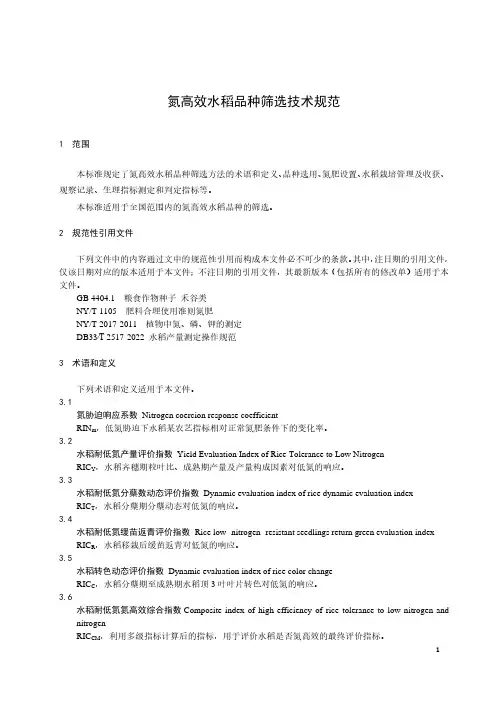
氮高效水稻品种筛选技术规范1 范围本标准规定了氮高效水稻品种筛选方法的术语和定义、品种选用、氮肥设置、水稻栽培管理及收获、观察记录、生理指标测定和判定指标等。
本标准适用于全国范围内的氮高效水稻品种的筛选。
2 规范性引用文件下列文件中的内容通过文中的规范性引用而构成本文件必不可少的条款。
其中,注日期的引用文件,仅该日期对应的版本适用于本文件;不注日期的引用文件,其最新版本(包括所有的修改单)适用于本文件。
GB 4404.1 粮食作物种子禾谷类NY/T 1105 肥料合理使用准则氮肥NY/T 2017-2011 植物中氮、磷、钾的测定DB33∕T 2517-2022 水稻产量测定操作规范3 术语和定义下列术语和定义适用于本文件。
3.1氮胁迫响应系数Nitrogen coercion response coefficientRIN m,低氮胁迫下水稻某农艺指标相对正常氮肥条件下的变化率。
3.2水稻耐低氮产量评价指数Yield Evaluation Index of Rice Tolerance to Low NitrogenRIC Y,水稻齐穗期粒叶比、成熟期产量及产量构成因素对低氮的响应。
3.3水稻耐低氮分蘖数动态评价指数Dynamic evaluation index of rice dynamic evaluation indexRIC T,水稻分蘖期分蘖动态对低氮的响应。
3.4水稻耐低氮缓苗返青评价指数Rice low -nitrogen -resistant seedlings return green evaluation index RIC R,水稻移栽后缓苗返青对低氮的响应。
3.5水稻转色动态评价指数Dynamic evaluation index of rice color changeRIC C,水稻分蘖期至成熟期水稻顶3叶叶片转色对低氮的响应。
3.6水稻耐低氮氮高效综合指数Composite index of high efficiency of rice tolerance to low nitrogen and nitrogenRIC CM,利用多级指标计算后的指标,用于评价水稻是否氮高效的最终评价指标。