
case brief
- 格式:ppt
- 大小:211.00 KB
- 文档页数:21


Lonergan v. Scolnick – Case Brief SummarySummary of Lonergan v. Scolnick, 129 Cal. App. 2d 179, 276 P.2d 8 (Cal. Ct. App. 1954).FactsScolnick (D) sought to sell certain real property and placed the following ad in a Los Angeles paper: ‘Joshua Tree vic. 40 acres, . . . need cash, will sacrifice.’ Lonergan (P) answered the ad and Scolnick wrote to him describing the property and providing directions, and stated that his rock-bottom price was $2,500 cash.Lonergan wrote to Scolnick to ask for details regarding the precise location of the real estate and to recommend an escrow agent “should I desire to purchase the land.” Scolnick replied the next day and told him to decide quickly because he expected to have a buyer within a week. Scolnick sold the property four days later. Two days later the plaintiff received Scolnick’s letter and replied the next day that he accepted the offer.Lonergan brought this lawsuit alleging that the defendant had breached a contract to sell the land. The plaintiff claimed that the land was worth $6,081 and sought the difference between that and the asking price of $2,500. Defendant denied that a contract had formed. The trial court favor of Scolnick and Lonergan appealed.Issue∙Must there be a manifestation of contractual intent in order to create an enforceable contract?Holding and Rule∙Yes. There must be a manifestation of contractual intent and it must be unequivocal and show that the parties intended to create a binding agreement.There can be no contract unless there has been a meeting of the minds and the parties have mutually agreed upon some specific thing. This is usually evidenced by one party making an offer which is accepted by the other party. Section 25 of the Restatement of the Law on Contracts reads: ‘If from a promise, or manifestation of intention, or from the circumstances existing at the time, the person to whom the promise or manifestation is addressed knows or has reason to know that the person making it does not intend it as an expression of his fixed purpose until he has given a further expression of assent, he has not made an offer.’The court held that the language used by the defendant in his letters indicated that they were not intended as an expression of fixed purpose to make a definite offer. The advertisement in the paper was a mere request for an offer. The letter of March 26 contained no definite offer because it merely gave further particulars and told the plaintiff how to locate the property if interested. The letter of April 8 answered some questions asked by the plaintiff, and stated that if he were really interested he would have to act soon. That the defendant expected a buyer in a short time indicated that he intended to sell to the first-comer. Lonergan was not being given a right to act within a reasonable time after receiving the letter.DispositionJudgment for Scolnick affirmed.NotesManifestation of contractual intent is determined by the objective person standard of a reasonable person standing in the shoes of the offeree.Lonergan v. ScolnickFacts:∙ D posted an ad in a newspaper about some land he needed to sell urgently. P saw the ad and inquired about it.∙ D sent P information about the property, along with directions to get to it. D stated that the rock-bottom price was $2500; D also made sure that the letter purported itself to be a "form letter".∙P wrote to D asking for more info on the land and suggesting an escrow service "should [he] desire to purchase the land".∙ D wrote back giving the legal description of the land and saying that if P was really interested, he should decide quickly since D expected to have a buyer in a week or so.∙ D sold the property to a third party.∙Three days later, P opened an escrow account and sent D a letter telling him that he was purchasing the land.∙Upon finding out that the land had already been sold, P sued D for breach of contract.Procedural History:∙Lower court found for D, said that the D made an offer which was qualified and conditioned upon prompt acceptance by P. Since P delayed, contract was not entered upon.∙CA COA affirmed, found for D, no contract, but for totally different reasons than the lower court.Issues:∙Where is the line between contract negotiation and contract formation?∙Does an advertisement qualify as an offer?Holding/Rule:∙ A contract is officially formed when one party makes an offer and the other party assents to the offer.∙"If…the person to whom the promise is addressed knows or has reason to know that the person making it does not intend it as an expression of his fixed purpose until he has given a further expression of assent, he has not made an offer."∙An advertisement is a mere request for an offer.Reasoning:∙The can be no contract unless the minds of the parties have met and mutually agreed upon some specific thing.∙The correspondence indicated an intention on the part of the D to find out whether the P was interested, not an intention to make a definite offer to the P.∙The statement that D expected to have a buyer in the next week or so indicated that D intended to sell to the first-comer and was reserving the right to do so.o P should have known that he was not being given time to accept an offer, but that some further assent on the part of the D would be required.Dissent: None.Notes:"Manifestation of contractual intent" is required to form a binding contract and is judged using the "reasonable person" standard.Davis v. Jacoby – Case Brief SummarySummary of Davis v. Jacoby, 34 P.2d 1026 (1934).FactsBlanche Whitehead and her husband Rupert enjoyed a close relationship with their niece Caro Davis (P). The Whitehead’s suffered health and financial difficulties and Rupert asked Davis to come to California to help take care of Blanche and assist Rupert with his business affairs. She was promised an inheritance in return for her assistance.One week after Davis agreed Rupert committed suicide. Davis mo ved to California to care for Blanche. Upon Blanche’s death Davis learned that Rupert had left his entire estate to two nephews.Davis sued Rupert’s estate (Jacoby, D), asserting that her agreement with Rupert had created a contractual obligation for him to make a will and bequest his estate to her and that she was entitled to quasi-specific performance. Davis appealed the trial court’s ruling in favor of the estate that no contract had been formed because Rupert had made a unilateral offer that could only have been accepted via performance.IssueWhat type of offer is presumed to have been made where the offer is ambiguous as to whether it is unilateral or bilateral? RuleAn offer is presumed to be bilateral if it is ambiguous with regard to whether it is unilateral or bilateral.The court pointed to Rupert’s statement “Will you let me hear from you as soon as possible…” as a request for an immediate reply so that he could make arrangements and rely on Davis’s promise to come to California. Furthermore, sinc e Rupert asked her to take care of them until both of them had died, it was apparent that he had to rely on Davis’s promise to continue to care for Blanche if she survived him.DispositionJudgment for the estate reversed.Akers v. J.B. Sedberry, Inc. – Case BriefFacts:Sedberry (D), through majority shareholder Mrs. Sedberry, entered into a contract with Akers (P) whereby Akers would serve as Chief Engineer for five years. Sedberry entered into a similar five year employment contract with Whitsitt (P). Akers and Whitsitt were to perform their duties at the Jay Bee Manufacturing Company in Tyler, Texas.Mrs. Sedberry later purchased stock in Jay Bee owned by Jay Bee’s general manager, who was then replaced by Sorenson. Ps had difficulty working with Sorenson and Jay Bee owed large amounts of money to a bank whose officials were concerned the company would fail under Sorenson. The bank addressed its concerns to Ps, who then met with Sedberry without Sorenson’s knowledge to discuss possibilities for the ref inancing of Jay Bee. As a show of good faith, Ps offered their resignations on ninety days notice; Sedberry refused. Ps returned to Jay Bee with instructions; however, the next day Mrs. Sedberry informed Ps that their resignations were accepted effective immediately.Ps sued D for breach of their employment contracts and contended that Mrs. Sedberry had refused their resignations and that no offer remained open. The trial court awarded damages to Ps and D appealed.IssueIf two parties are in each other’s presence and one party extends an offer without indicating any time period for acceptance, for how long will the offer remain open?Holding and RuleIf two parties are in each other’s presence and one makes an offer without indicating any time for accep tance, an inference will be drawn that that offer will not extend beyond the time of the conversation unless special words or circumstances indicate a contrary intention on the part of the offeror.An employee’s tender of resignation is not binding until i t has been accepted by the employer. Such an offer must be accepted according to its terms and within the time fixed. An offer may be terminated by: 1) rejection, or 2) failure to accept within the time fixed, or 3) failure to accept within a reasonable time if no time is fixed.A determination of what constitutes a “reasonable time” is a question of fact depending on the nature of the contract proposed, usages of business, and other factual circumstances. An offer made by one to another face to face is deemed to continue only to the close of their conversation and cannot be accepted thereafter (Restatement (2d) of Contracts 40).The court held that in this case Ps’ face to face offer was terminated when Mrs. Sedberry rejected it. The attempt by D to terminate the contract the following day was a breach and Ps were entitled to the recovery granted by the trial court.NotesThis is known as the in praesenti rule and it applies to telephone conversations as well as face to face meetings.Sedberry, Inc. by written contract, employed Akers as Chief Engineer for five year term. Mrs. M.B. Sedberry guaranteed the employer’s performance of thi s contract. Sedberry Inc. employed Whitsitt as Assistant Chief Engineer for five years. He guaranteed employer’s performance again.Difficulty arose, financial and person at the site in TX and the two returned to Franklin to discuss the company with Mrs. Franklin. At the very beginning to show their good faith, Akers told Mrs. Sedberry they would offer their resignation on a ninety day notice, provided they were paid according to the contract for that period. She would not accept them. She held that no mention was made of the ninety day notice.She later sent them telegrams: “resignation offer accepted, effective immediately.”Akers then wrote that there was no pending offer to resign. The offer he expressed earlier was rejected. His letter further stated that Akers was expecting to be paid according to the terms of his contract until he could find other employment that would pay him as much income as that provided in his contract, and that if he accepted a job with less income, he expected the difference.ISSUEDoes ignoring an offer constitute nonacceptance?HOLDING:Yes.An offer is rejected when the offeror is justified in inferring from the words or conduct of the offeree that the offeree intends not to accept the offer or to take it under further advisement.Ordinarily, an offer made by one to another in a face to face conversation is deemed to continue only to the close of their conversation, and cannot be accepted thereafter. If the offeree turns away in silence, the proper inference is that the offer is no longer open to acceptance. There is nothing in the evidence to show that they intended the offer to continue beyond that conversation.Petterson v. PattbergFacts∙P owned real estate and took out a mortgage from D against the property. The mortgage had 5 years remaining before it came due.∙ D wrote P and said that he would knock $780 off the mortgage if the mortgage is paid on or before May 31 and the regular quarterly payment due in April is made on time.∙P made the April payment on time.∙P went to D's house in late May to pay off the remainder of the mortgage. D refused to accept payment from P and told P he had sold the mortgage to a third party. Thus, P lost the $780 discount he would have gotten.∙P sued D for this amount.Procedural History∙Lower court found for P, contract was binding.∙NY Appellate Court affirmed, found for P.∙NY COA reversed, found for D, contract was not formed.Issues∙Can an offeror in a unilateral contract revoke the offer at any time before performance?Holding/Rule:(DEPRECATED)∙ An offeror in a unilateral contract may revoke the offer at any time before performance.Reasoning∙The act requested to be done by the offeror was payment in full of the reduced principal prior to the due date. The offeree was not able to do this, so no contract was formed. (It was the offeree that prevented this though!) ∙It is elementary that any offer to enter into a unilateral contract may be withdrawn before the act requested to be done has been performed.∙If the offeror can say "I revoke" before the offeree accepts, however brief the interval of time between the two acts, there is no escape from the conclusion that the offer is terminated.∙An offer to sell property may be withdrawn before acceptance without any formal notice to the person to whom the offer is made.∙We think that in this particular instance the offer of the D was withdrawn before it became a binding promise, and no contract was ever made for the breach that the P claims.Dissent∙It is a principle of fundamental justice that if a promisor is himself the cause of the failure of performance wither of an obligation due him or of a condition upon which his own liability depends, he cannot take advantage of the failure.∙If the D intended to induce payment and yet reserve the right to refuse payment when offered, he should have useda phrase better calculated to express his meaning than the words "I agree to accept".Notes∙This rule is deprecated; this case would be decided differently today.∙From the First Restatement...∙§ 45. Revocation of Offer for Unilateral Contract; Effect of Part Performance or Tender. "If an offer for a unilateral contract is made, and part of the consideration requested in the offer is given or tendered by the offeree in response thereto, the offeror is bound by a contract, the duty of immediate performance of which is conditional on the full consideration being given or tendered within the time stated in the offer, or, if no time is stated, within a reasonable time."∙o July 28, 1955 (P) was preparing bid for a schoolo Customary in that area to receive bids by telephone- received 50-75 sub- bids that dayo Estimator for (D), called in a bid for 7,131 for pavement work.♣(D) bid was lowest, and so was the (P’s) bid…he was awarded the job and relied on (D) for pavement.o Stopped by, next day, on which (D) rejected the deal.♣ (D) refused to do work for less than $15,000.o 1st promise was for subcontract saying if you choose me I will do work at this price and 2nd promise is for subcontractor to keep it open and not change it until he hears about bid.- Defendant’s argumento No enforceable offer between parties on the ground that it was a revocable offer, and he revoked it before (P) communicated acceptance…(Option contract)♣ Court ruled – no option supported by consideration, nor bilateral contract binding both parties.♣ No consideration upon the deal• However, it doesn’t need consideration to make a promise binding under unilateral contract.o Mistake of bid price.♣ Court ruled –If mistake alters it, the (P) must know that there was a mistake (school v. Kastroff)….in thi s case, (P) had no reason to believe that there was a mistake…only $3,000 less.♣ Additional reason for enforcing it actually, mislead the (P)o No consideration with allegiance to Restatement 90.♣ Court Ruled – that 90, actually shows that performance is not necessary if a person reasonably relies on the promise.o Plaintiff failed to mitigate the damages or that they could not have been mitigated.♣ Evidence showed that he spent several months trying to get sub-contractors –Defendant’s argument wasmeritless.- Plaintiff’s argument∙-Superior court entered judgment for “Drennan”o Entered judgment for $3,817 in favor of (P)♣ Definite offer to do paving, (P) relied on this offer, on computing his own bid…difference between plaintiffs bid and bid used (10,948.60).∙-Did (P)’s reliance make defendant’s offer irrevocable?∙- YES.- The absence of consideration is not fatal to enforcing a contact….performance is not always necessary.- Promise is binding if it has to be binding to prevent injustices from occurring.∙- Restatement 90- a promise that should reasonably expect to induce action or forebearance of a definite and substantial character….such action or forebearance is binding if injustice can be avoided only by enforcement of the promise.∙- Defendant-o Court ruled♣Had reason to expect that if its bid had proved to be the lowest it would be used by plaintiff…”induced action ofa definite and substantial character on the part of the promise.♣Defendant did not state that bid could be “revocable” at any time prior to acceptance…kept silent…court must decide what was implied by this silence?♣ Part-performance or tender may furnish in place of consideration for the subsidiary promise.♣Didn’t bargain for the use of its bid….however, reasonable to suppose that defendant submitted its bid to obtain the contract.o Actually his own interest that bid get accepted. Reason to expect reliance.o Could foresee harm- Plaintiffo Promptly informed (D) that he was being rewarded the job.∙- Affirmed∙School district v. Kastroff…in this case, it was $11,000 off, and the school district knew that it was off.∙S. Dakota example- does not believe that it will abolish performance on unilateral promise contract—look at context of the case at hand.∙• No evidence defendant offered to make bid irrevocable in exchange for plaintiffs use of figures in computing bid (option contract) and no evidence plaintiff would use defendants bid as acceptance binding plaintiff that he would award subcontract to defendant if he won (bilateral contact).Drennan v. Star Paving Co. – Case Brief SummarySummary of Drennan v. Star Paving Co., 51 Cal.2d 409, 333 P.2d 757 (Cal. 1958).FactsStar Paving (D) submitted a subcontractor bid to Drennan (P), a general contractor, for a public school construction project. Drennan used Star Paving’s bid of $7,100.00 to prepare his final bid and was awarded t he contract. The next day Star Paving informed Drennan that it had underestimated the cost of the project and refused to do the work for less than $15,000. Drennan hired another subcontractor to do the work for $11,000 and sued Star Paving for the difference between $11,000 and $7,100. The trial court entered judgment for Drennan, holding that Star Paving had made an offer and that Drennan had relied upon that offer when listing Star Paving as the subcontractor. Star Paving appealed.Issues1.Can reasonable, justifiable, and foreseeable reliance render an offer binding?2.What is the test for applying promissory estoppel?Holding and Rule (Traynor)1.Yes. An offer that the promissor should reasonably expect to induce action or forbearance of a definite and substantialcharacter by the promisee, and which does induce such action or forbearance, is binding if injustice can be avoided only by enforcing the promise. See Restatement (2d) of Contracts 90.2.In order for promissory estoppel to apply there must be: 1) a clear and definite offer; 2) a reasonable expectation thatthe offer will induce reliance in the other party; 3) actual and reasonable reliance by the offeree; and 4) a detriment which only can be avoided by enforcement of the offer.Star Paving’s subcontractor bid constituted a promise to perform under conditions both express and implied, according to the circumstances. It was silent on revocation and therefore the court determined whether there were conditions imposed by law or reasonably inferred. The court turned to Restatement (2d) of Contracts 45; merely acting in justifiable reliance on a unilateral offer is sufficient to make that offer irrevocable for a reasonable period of time to complete performance.Public PolicyWhether implied in law or fact, enforcement of Star Paving’s promise precluded the injustice that would result if the offer could be revoked after the offeree acted in detrimental reliance upon it. Reasonable reliance resulting in a foreseeable and prejudicial change in the promisee’s position affords the compelling basis for implying a subsidiary promise not to revoke a unilateral offer. Star Paving had a stake in Drennan’s reliance on the bid in making Drennan’s bid on the general contract. The court held that it was only reasonable that Drennan have the opportunity to accept Star Paving’s bid after Drennan was awarded the general contract if Drennan justifiably and reasonably relied on Star Pa ving’s offer.As for Star Paving’s mistake defense, Drennan could not have justifiably relied on Star Paving’s bid if Drennan had reason to believe that Star Paving’s bid was in error. The mistake that Star Paving made in its bid was not one of which Drennan knew or should have known and Drennan’s reliance was justified.DispositionJudgment for Drennan affirmed.NotesPromissory estoppel must only be used if there is no consideration. Drennan effectively overruled James Baird Co. v. Gimbel Bros. Inc. and is the seminal case for the modern approach to applying promissory estoppel in the context of subcontractor bidding disputes based on mistake.See Adarand Constructors, Inc. v. Peña for another case involving general contractor and subcontractor bids. Lewis v. Browning – Case BriefLewis v. Browning, 130 Mass. 173 (1881).FactsLewis (P) wrote to Browning (D) asking him to send him a telegraph by a certain date if he wished to agree to the terms of a lease. Lewis claimed that no contract had formed because he did not receive Browning’s acceptance by the deadline. The trial court entered judgment in favor of P and D appealed.IssueMay an offeror demand that acceptance be made by actual communication of that acceptance to him?Holding and RuleYes. An offeror may demand that acceptance be made by actual communication of that acceptance to him.Parties may contract around the mailbox rule by stating the terms for acceptance in the contract. The court held that under these facts it was necessary for P to receive D’s acceptance in order to render the contract valid and enforceable. D’s acceptance never reached P and therefore P prevailed.DispositionAffirmed.Buyer made a bid of $250,000 on real property owned by seller. Buyer notified Ardente that the offer was accepted and forwarded a formal written agreement. Buyer signed the agreement and returned it together with a $20,000 check and a request for confirmation that certain items of furniture would be included in the transaction. Seller refused to sell those items or the property and did not sign the purchase and sales agreement.Buyer sued for specific performance and seller moved for summary judgment on the grounds that no contract had formed.The court held that the P’s request for confirmation regarding the additional items was a conditional acceptance and therefore a counteroffer. The court granted D’s motion for summary judgment and P appealed.Must the buyer’s acceptance be “definite and unequivocal” to be effective?Affirm.Where there is an offer to form a bilateral contract, the offeree must communicate his acceptance to the offeror before any contractual obligation can come into being. The acceptance must be transmitted to the offeror in some over manner. The acceptance may not impose additional conditions on the offer, nor add limitations. There can be additions, only if it is made unequivocally clear that the offer would be accepted regardless of additions.The only expression of acceptance which was communicated to seller was the delivery of the executed purchase and sale agreement accompanied by the letter. Whatever buyer’s unexpressed intention was in sending the documents is irrelevant. The b uyer’s acceptance was not absolute and was accompanied by a request for a gratuitous benefit.** Plaintiffs did not bring up verbal acceptance issue at trial, therefore it is unmentionable.Rhode Island Case Rule: It is not equivocation, howeve r, “if the offeree merely puts into words that which was already reasonably implied in the terms of the offer.”“And acceptance must receive a reasonably construction and the mere addition of a collateral or immaterial matter will not prevent the formatio n of a contract.”To show that the acceptance is different “it must be shown that the acceptance differs in some material respect from the offer.”“When the offeree, in its acceptance of an offer, absolves the offeror of a material obligation, the “rules of contract construction and the “rules of common sense” preclude construing that the absolution as an additional term that invalidates the acceptance.Ardente v. HoranArdente v. Horan, 117 R.I. 254, 366 A.2d 162 (R.I. 1976).FactsArdente (P) made a bid of $250,000 on real property owned by Horan (D). Horan notified Ardente that the offer was accepted and forwarded a formal written agreement. P signed the agreement and returned it together with a $20,000 check and a request for confirmation that certain items of furniture would be included in the transaction. D refused to sell those items or the property and did not sign the purchase and sales agreement.P sued for specific performance and D moved for summary judgment on the grounds that no contract had formed. The court held that the P’s request for confirmation regarding the additional items was a conditional acceptance and therefore a counteroffer. The court granted D’s motion for summary judgment and P appealed.IssueMust an acceptance be definite and unequivocal to be effective?Holding and RuleYes. An acceptance must be definite and unequivocal to be effective. In this case the mere execution of the agreement alone would have operated as acceptance. However, the terms of the letter conditioned that acceptance upon the inclusion of the furniture. An acceptance may not impose additional conditions on the offer, nor may it add limitations. An acceptance, which is equivocal or upon condition or with a limitation, is a counteroffer and requires acceptance by the original offeror before a contractual relationship exists. However, an acceptance may be valid despite conditional language if the acceptance is clearly independent of the condition.The court held that the letter of acceptance by P was not consistent with an absolute acceptance accompanied by a request for a gratuitous benefit and therefore was a conditional acceptance or counteroffer.DispositionAffirmed.Poel v. Brunswick-Balke-Collender Co.Facts:∙ D called P to place a phone order for rubber. P sent D a letter to confirm the transaction. P then sent D a contract stating the terms of the order.∙ D sent P a letter asking P to deliver the goods at once. The letter said that the acceptance of the order had to be promptly acknowledged.∙Later, D sent a letter to P saying that they did not want the rubber. P sued D.Procedural History:∙Lower court found for P, contract valid.∙NY COA reversed, found for D, no contract formed.Issues:∙Is a contract formed if the terms of acceptance do not directly mirror the terms of the offer?Holding/Rule:∙ A contract is not formed if the terms of acceptance do not directly mirror the terms of the offer.Reasoning:∙When an acceptance sets out different terms than those stated in the offer, the acceptance becomes a counter-offer.∙P did not acknowledge the receipt of the order, so the proposal remained unaccepted.∙Only two courses were open to the D; it could accept or it could reject.o A proposal to accept the offer it modified or an acceptance subject to other terms and conditions was equivalent to an absolute rejection of the offer made by P.Dissent:∙None given.Notes:∙There is much more flexibility in these cases now; see the UCC.∙This was not necessarily a good result; the mirror image rule has inherent problems.- 3 years, 55 transactions….Carpet Mart is bringing suit for fraud and misrepresentation on the quality of their rugs.- Upon “Collins” receiving a telephone order – typed information regarding the deal.- Becomes a contact when:1. Signed and delivered by buyer to seller and accepted by seller2. When buyer has received and retained this order for ten days w/o rejection3. When buyer has accepted deliver on any part of merchandise• or when buyer has indicated acceptance of terms thereof*** Acceptance or “order” subject to all of the terms and conditions on the face and reverse side hereof***。
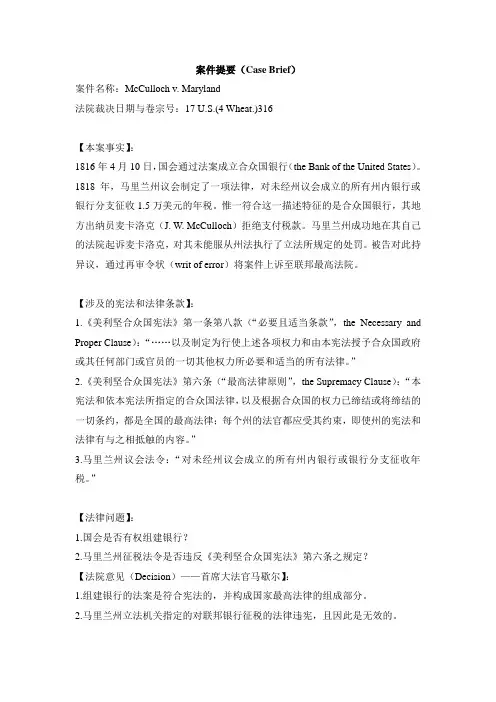
案件提要(Case Brief)案件名称:McCulloch v. Maryland法院裁决日期与卷宗号:17 U.S.(4 Wheat.)316【本案事实】:1816年4月10日,国会通过法案成立合众国银行(the Bank of the United States)。
1818年,马里兰州议会制定了一项法律,对未经州议会成立的所有州内银行或银行分支征收1.5万美元的年税。
惟一符合这一描述特征的是合众国银行,其地方出纳员麦卡洛克(J. W. McCulloch)拒绝支付税款。
马里兰州成功地在其自己的法院起诉麦卡洛克,对其未能服从州法执行了立法所规定的处罚。
被告对此持异议,通过再审令状(writ of error)将案件上诉至联邦最高法院。
【涉及的宪法和法律条款】:1.《美利坚合众国宪法》第一条第八款(“必要且适当条款”,the Necessary and Proper Clause):“……以及制定为行使上述各项权力和由本宪法授予合众国政府或其任何部门或官员的一切其他权力所必要和适当的所有法律。
”2.《美利坚合众国宪法》第六条(“最高法律原则”,the Supremacy Clause):“本宪法和依本宪法所指定的合众国法律,以及根据合众国的权力已缔结或将缔结的一切条约,都是全国的最高法律;每个州的法官都应受其约束,即使州的宪法和法律有与之相抵触的内容。
”3.马里兰州议会法令:“对未经州议会成立的所有州内银行或银行分支征收年税。
”【法律问题】:1.国会是否有权组建银行?2.马里兰州征税法令是否违反《美利坚合众国宪法》第六条之规定?【法院意见(Decision)——首席大法官马歇尔】:1.组建银行的法案是符合宪法的,并构成国家最高法律的组成部分。
2.马里兰州立法机关指定的对联邦银行征税的法律违宪,且因此是无效的。
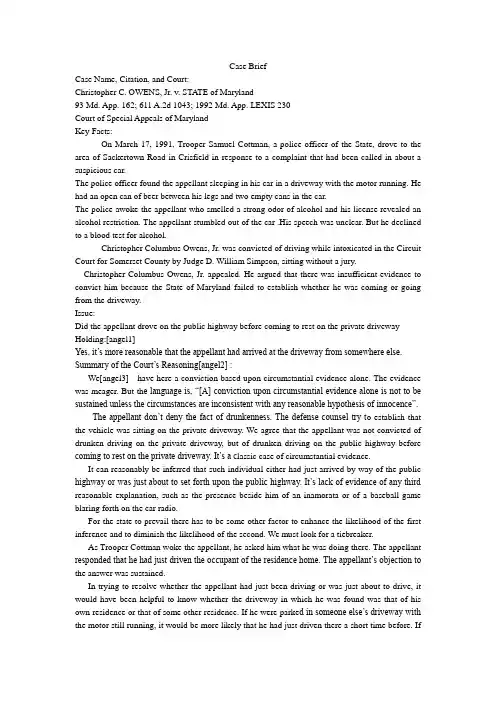
Case BriefCase Name, Citation, and Court:Christopher C. OWENS, Jr. v. STATE of Maryland93 Md. App. 162; 611 A.2d 1043; 1992 Md. App. LEXIS 230Court of Special Appeals of MarylandKey Facts:On March 17, 1991, Trooper Samuel Cottman, a police officer of the State, drove to the area of Sackertown Road in Crisfield in response to a complaint that had been called in about a suspicious car.The police officer found the appellant sleeping in his car in a driveway with the motor running. He had an open can of beer between his legs and two empty cans in the car.The police awoke the appellant who smelled a strong odor of alcohol and his license revealed an alcohol restriction. The appellant stumbled out of the car .His speech was unclear. But he declined to a blood test for alcohol.Christopher Columbus Owens, Jr. was convicted of driving while intoxicated in the Circuit Court for Somerset County by Judge D. William Simpson, sitting without a jury.Christopher Columbus Owens, Jr. appealed. He argued that there was insufficient evidence to convict him because the State of Maryland failed to establish whether he was coming or going from the driveway.Issue:Did the appellant drove on the public highway before coming to rest on the private driveway Holding:[angel1]Yes, it’s more reasonable that the appellant had arrived at the driveway from somewhere else. Summary of the Court’s Reasoning[angel2] :We[angel3] have here a conviction based upon circumstantial evidence alone. The evidence was meager. But th e language is, “[A] conviction upon circumstantial evidence alone is not to be sustained unless the circumstances are inconsistent with any reasonable hypothesis of innocence”.The appellant don’t deny the fact of drunkenness. The defense counsel try t o establish that the vehicle was sitting on the private driveway. We agree that the appellant was not convicted of drunken driving on the private driveway, but of drunken driving on the public highway before coming to rest on the private driveway. It’s a c lassic case of circumstantial evidence.It can reasonably be inferred that such individual either had just arrived by way of the public highway or was just about to set forth upon the public highway. It’s lack of evidence of any third reasonable explanation, such as the presence beside him of an inamorata or of a baseball game blaring forth on the car radio.For the state to prevail there has to be some other factor to enhance the likelihood of the first inference and to diminish the likelihood of the second. We must look for a tiebreaker.As Trooper Cottman woke the appellant, he asked him what he was doing there. The appellant responded that he had just driven the occupant of the residence home. The appellant’s objection to the answer was sustained.In trying to resolve whether the appellant had just been driving or was just about to drive, it would have been helpful to know whether the driveway in which he was found was that of his own residence or that of some other residence. If he were parke d in someone else’s driveway with the motor still running, it would be more likely that he had just driven there a short time before. Ifparked in his driveway at home, the relative strength of the inbound inference over the outbound would diminish.The driveway where the arrest took place was on Sackertown Road. The charging document listed the appellant’s address as 112 Cove Second Street. Since one of the charges against the appellant was that of driving in violation of an alcohol restriction on his license, it would have been routine procedure to have offered the license, showing the restriction. Because of the summary nature of the trail, the license was never offered in evidence.l Three beer cans were in evidence. The circumstance would give rise to a reasonable inference that the appellant’s drinking spree was on the downslope rather than at an early stage. One doesn’t drink in the house and then carry the empties out to the car, turn on the lights and motor. Some significant drinking had taken pl ace while the appellant was in the car. The appellant’s unconsciousness state enforces that inference. One passes out on the steering wheel after one has been drinking for some time, not as one only begins to drink.The vehicle had been observed driving in some sort of erratic fashion. Had the appellant simply been sitting, with his motor idling, on the driveway of his own residence, it’s not likely that someone from the immediate vicinity would have found suspicious the presence of a familiar neighbor in a familiar car sitting in his own driveway.It does not prove guilt in and of itself. It simply makes one of two alternative inferences more reasonable. The totality of the circumstances are, in the last analysis, inconsistent with a reasonable hypothesis of innocence. It makes the drawing of the inference of guilty more than a mere flip of a coin between guilt and innocence. It makes it rational and therefore within the proper purview of the fact-finder.Judgment:Appellant’s conviction was affirmed by the court.Personal Impressions:First of all, I think the judge who wrote the opinion have clearness logic. According to the circumstances, he reasoned out the consequence of the case step by step. Although the evidence is insufficiency, the judge found that circumstances were inconsistent with any reasonable hypothesis of innocence. It’s rational to infer that the appellant had just arrived by way of the public highway. Christopher Columbus Owens, Jr. should be convicted of driving while intoxicated. I hold the same viewpoint with the judges.[angel1]本案有holding吗?[angel2]推理这部分小结太过详细,比如被告没回答警官的提问“你在干吗?”以及他的住址不在证据之中,这些都不需要详细叙述,只需一两句带过即可。