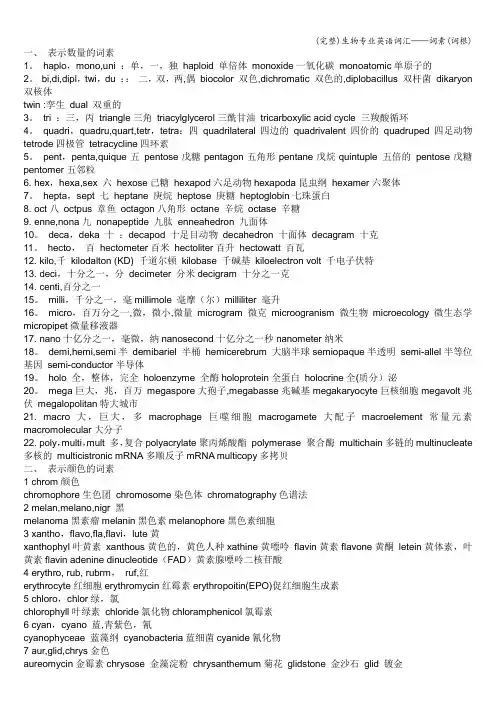
生物学英语词汇大全生物学专业英语词汇
- 格式:docx
- 大小:37.54 KB
- 文档页数:3
生物学英语词汇大全生物学专业英语词汇
请注意,以下是根据给定的题目“生物学英语词汇大全生物学专业英语词汇”的格式撰写的一份文章。
生物学英语词汇大全生物学专业英语词汇
Introduction:
In the field of biology, a strong grasp of English vocabulary is essential
for effective communication and understanding of scientific concepts. This
article aims to provide a comprehensive list of biology-related terms in
English, specifically catering to those studying biology as a discipline. The
following sections will cover a wide range of topics, including genetics, cell
biology, ecology, and more.
Genetics:
1. Nucleotide: The basic building block of DNA and RNA, consisting of
a sugar, a phosphate group, and a nitrogenous base.
2. Chromosome: A thread-like structure made up of DNA and proteins,
carrying genetic information in the form of genes.
3. Allele: One of the alternative forms of a gene occupying a specific
position on a chromosome.
4. Genotype: The genetic makeup of an organism, representing the
combination of alleles present in its cells.
5. Phenotype: The observable characteristics of an organism that result
from its genotype and environmental factors. Cell Biology:
1. Cell Membrane: A semipermeable membrane surrounding the
cytoplasm of a cell, regulating the passage of substances in and out of the
cell.
2. Organelle: A specialized structure within a cell that performs a
specific function, such as the mitochondria or Golgi apparatus.
3. Ribosome: A cellular structure responsible for protein synthesis,
translating the genetic code from mRNA into a functional protein.
4. Endoplasmic Reticulum: A network of membranes within the cell
involved in the synthesis of proteins and lipids.
5. Mitochondria: Organelles responsible for generating energy in the
form of ATP through cellular respiration.
Ecology:
1. Ecosystem: A community of organisms and their physical
environment, functioning as a unit within a biome.
2. Food Chain: A linear sequence of organisms in which each organism
serves as a source of food for the next.
3. Biodiversity: The variety of life forms present in a given area or
ecosystem.
4. Sustainability: The ability to maintain ecological balance and meet the
needs of present and future generations. 5. Carbon Footprint: The total amount of greenhouse gases emitted
directly or indirectly by an individual, organization, or product.
Evolution:
1. Natural Selection: The process by which advantageous traits are more
likely to be passed on to future generations.
2. Adaptation: The process by which organisms change or develop traits
to better fit their environment.
3. Speciation: The formation of new and distinct species through
reproductive isolation and genetic divergence.
4. Fossil Record: The accumulated evidence of past life, preserved in
rocks and sediment, providing insights into evolutionary history.
5. Mutation: A permanent change in the DNA sequence of a gene,
leading to variations within a population.
Conclusion:
This article has provided a comprehensive list of biology-related English
vocabulary for those studying biology as a discipline. From genetics to
ecology and evolution, these terms cover a wide range of topics within the
field. By familiarizing themselves with these terms, students will enhance
their understanding and fluency in the English language in the context of
biology.