
财务管理课件chap012
- 格式:ppt
- 大小:1.19 MB
- 文档页数:35


IM-1 CHAPTER 20 INTERNATIONAL TRADE FINANCE
SUGGESTED ANSWERS AND SOLUTIONS TO END-OF-CHAPTER
QUESTIONS AND PROBLEMS
QUESTIONS
1. Discuss some of the reasons why international trade is more difficult and risky from the exporter’s
perspective than is domestic trade.
Answer: International trade is more difficult and risky for a firm than is domestic trade. In foreign trade,
the exporter may not be familiar with the buyer, and thus not know if the importer is creditworthy. If
merchandise is exported abroad and the buyer does not pay, it may prove difficult, if not impossible, for
the exporter to have any legal recourse. Additionally, political instability makes it risky to ship
merchandise abroad to certain parts of the world.
2. What three basic documents are necessary to conduct a typical foreign commerce trade? Briefly
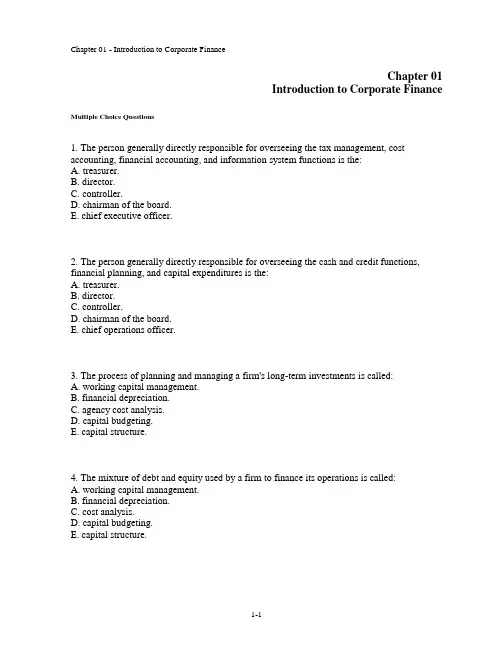
Chapter 01 - Introduction to Corporate Finance
1-1 Chapter 01
Introduction to Corporate Finance
Multiple Choice Questions
1. The person generally directly responsible for overseeing the tax management, cost
accounting, financial accounting, and information system functions is the:
A. treasurer.
B. director.
C. controller.
D. chairman of the board.
E. chief executive officer.
2. The person generally directly responsible for overseeing the cash and credit functions,
financial planning, and capital expenditures is the:
A. treasurer.
B. director.
C. controller.
D. chairman of the board.
E. chief operations officer.
3. The process of planning and managing a firm's long-term investments is called:
A. working capital management.
B. financial depreciation.
C. agency cost analysis.
D. capital budgeting.
E. capital structure.
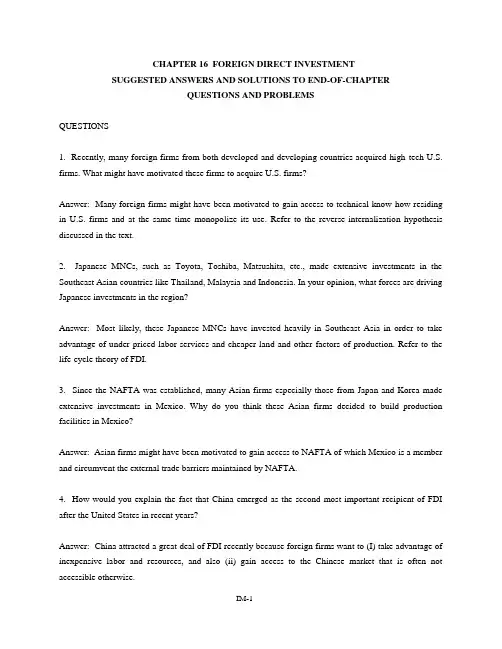
IM-1 CHAPTER 16 FOREIGN DIRECT INVESTMENT
SUGGESTED ANSWERS AND SOLUTIONS TO END-OF-CHAPTER
QUESTIONS AND PROBLEMS
QUESTIONS
1. Recently, many foreign firms from both developed and developing countries acquired high-tech U.S.
firms. What might have motivated these firms to acquire U.S. firms?
Answer: Many foreign firms might have been motivated to gain access to technical know-how residing
in U.S. firms and at the same time monopolize its use. Refer to the reverse-internalization hypothesis
discussed in the text.
2. Japanese MNCs, such as Toyota, Toshiba, Matsushita, etc., made extensive investments in the
Southeast Asian countries like Thailand, Malaysia and Indonesia. In your opinion, what forces are driving
Japanese investments in the region?
Answer: Most likely, these Japanese MNCs have invested heavily in Southeast Asia in order to take

_
CHAPTER 18 INTERNATIONAL CAPITAL BUDGETING
SUGGESTED ANSWERS AND SOLUTIONS TO END-OF-CHAPTER
QUESTIONS AND PROBLEMS
QUESTIONS
1. Why is capital budgeting analysis so important to the firm?
Answer: The fundamental goal of the financial manager is to maximize shareholder
wealth. Capital investments with positive NPV or APV contribute to shareholder wealth.
Additionally, capital investments generally represent large expenditures relative to the
value of the entire firm. These investments determine how efficiently and expensively
the firm will produce its product. Consequently, capital expenditures determine the
long-run competitive position of the firm in the product marketplace.
2. What is the intuition behind the NPV capital budgeting framework?
Answer: The NPV framework is a discounted cash flow technique. The methodology