
人教版英语七年级下册 Unit 12 Section A (2d-3c)课件
- 格式:ppt
- 大小:1.02 MB
- 文档页数:21

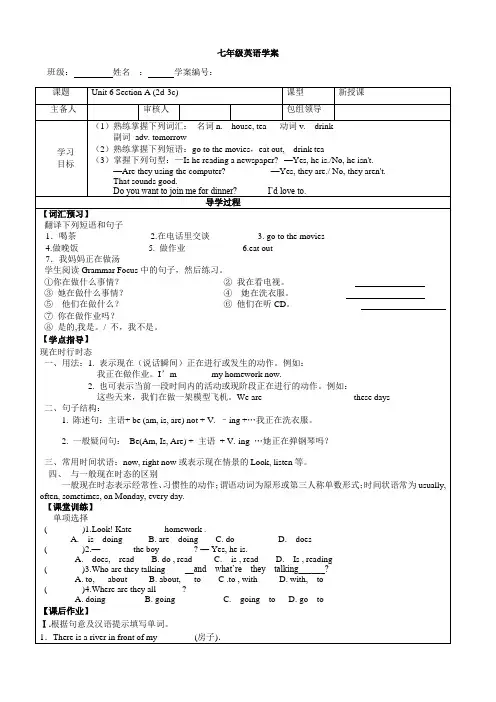
七年级英语学案
班级: 姓名 : 学案编号:
课题 Unit 6 Section A (2d-3c) 课型 新授课
主备人 审核人 包组领导
学习
目标 (1)熟练掌握下列词汇: 名词n. house, tea 动词v. drink
副词 adv. tomorrow
(2)熟练掌握下列短语:go to the movies,eat out, drink tea
(3)掌握下列句型:—Is he reading a newspaper? —Yes, he is./No, he isn't.
—Are they using the computer? —Yes, they are./ No, they aren't.
That sounds good.
Do you want to join me for dinner? I’d love to.
导学过程
【词汇预习】
翻译下列短语和句子
1.喝茶_________ 2.在电话里交谈___________3. go to the movies__________
4.做晚饭______________ 5. 做作业_____________6.eat out____________
7.我妈妈正在做汤___________________
学生阅读Grammar Focus中的句子,然后练习。
①你在做什么事情?_____________________ ② 我在看电视。 _____________
③ 她在做什么事情?___________________ ④ 她在洗衣服。 ___________
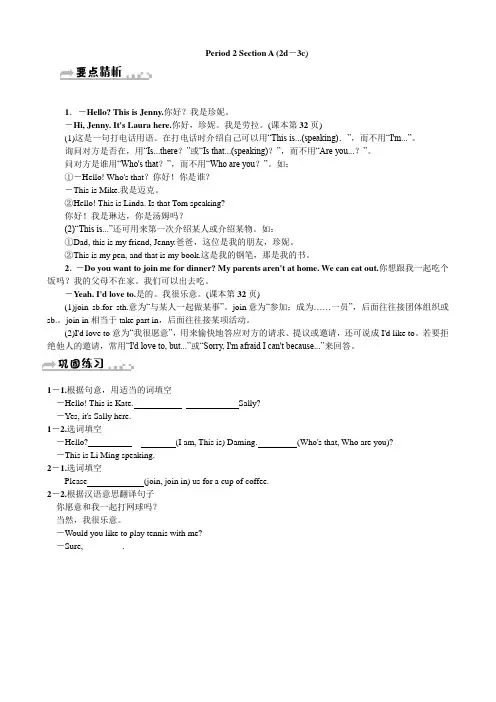
Period 2 Section A (2d-3c)
1.-Hello? This is Jenny.你好?我是珍妮。
-Hi, Jenny. It's Laura here.你好,珍妮。我是劳拉。(课本第32页)
(1)这是一句打电话用语。在打电话时介绍自己可以用“This is...(speaking).”,而不用“I'm...”。
询问对方是否在,用“Is...there?”或“Is that...(speaking)?”,而不用“Are you...?”。
问对方是谁用“Who's that?”,而不用“Who are you?”。如:
①-Hello! Who's that?你好!你是谁?
-This is Mike.我是迈克。
②Hello! This is Linda. Is that Tom speaking?
你好!我是琳达,你是汤姆吗?
(2)“This is...”还可用来第一次介绍某人或介绍某物。如:
①Dad, this is my friend, Jenny.爸爸,这位是我的朋友,珍妮。
②This is my pen, and that is my book.这是我的钢笔,那是我的书。
2.-Do you want to join me for dinner? My parents aren't at home. We can eat out.你想跟我一起吃个饭吗?我的父母不在家。我们可以出去吃。
-Yeah. I'd love to.是的。我很乐意。(课本第32页)
(1)join sb.for sth.意为“与某人一起做某事”。join意为“参加;成为……一员”,后面往往接团体组织或sb.。join in相当于take part in,后面往往接某项活动。
(2)I'd love to意为“我很愿意”,用来愉快地答应对方的请求、提议或邀请,还可说成I'd like to。若要拒绝他人的邀请,常用“I'd love to, but...”或“Sorry, I'm afraid I can't because...”来回答。
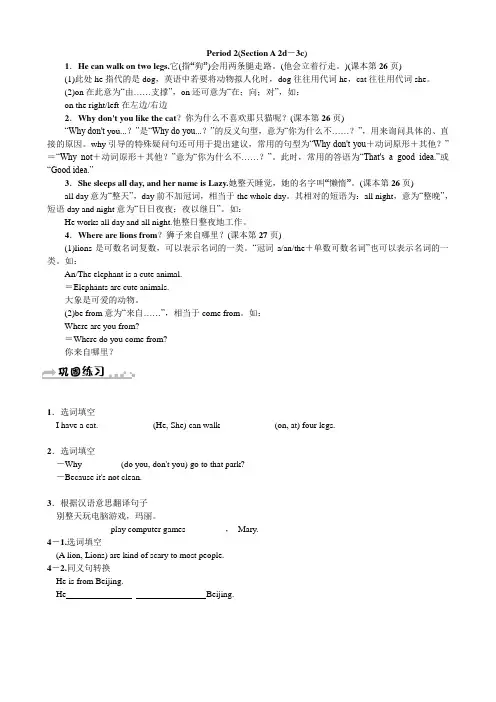
Period 2(Section A 2d-3c)
1.He can walk on two legs.它(指“狗”)会用两条腿走路。(他会立着行走。)(课本第26页)
(1)此处he指代的是dog,英语中若要将动物拟人化时,dog往往用代词he,cat往往用代词she。
(2)on在此意为“由……支撑”,on还可意为“在;向;对”,如:
on the right/left在左边/右边
2.Why don't you like the cat?你为什么不喜欢那只猫呢?(课本第26页)
“Why don't you...?”是“Why do you...?”的反义句型,意为“你为什么不……?”,用来询问具体的、直接的原因。why引导的特殊疑问句还可用于提出建议,常用的句型为“Why don't you+动词原形+其他?”=“Why not+动词原形+其他?”意为“你为什么不……?”。此时,常用的答语为“That's a good idea.”或“Good idea.”
3.She sleeps all day, and her name is Lazy.她整天睡觉,她的名字叫“懒惰”。(课本第26页)
all day意为“整天”,day前不加冠词,相当于the whole day。其相对的短语为:all night,意为“整晚”,短语day and night意为“日日夜夜;夜以继日”。如:
He works all day and all night.他整日整夜地工作。
4.Where are lions from?狮子来自哪里?(课本第27页)
(1)lions是可数名词复数,可以表示名词的一类。“冠词a/an/the+单数可数名词”也可以表示名词的一类。如:
An/The elephant is a cute animal.
=Elephants are cute animals.
大象是可爱的动物。
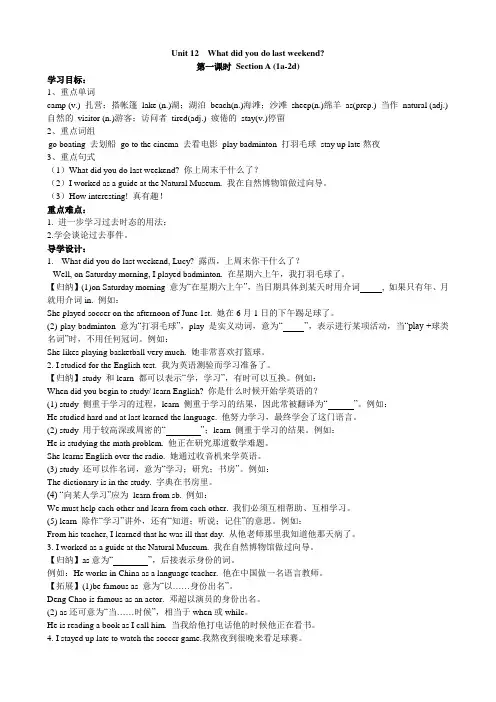
Unit 12 What did you do last weekend?
第一课时 Section A (1a-2d)
学习目标:
1、重点单词
camp (v.) 扎营;搭帐篷 lake (n.)湖;湖泊 beach(n.)海滩;沙滩 sheep(n.)绵羊 as(prep.) 当作 natural (adj.)自然的 visitor (n.)游客;访问者 tired(adj.) 疲倦的 stay(v.)停留
2、重点词组
go boating 去划船 go to the cinema 去看电影 play badminton 打羽毛球 stay up late熬夜
3、重点句式
(1)What did you do last weekend? 你上周末干什么了?
(2)I worked as a guide at the Natural Museum. 我在自然博物馆做过向导。
(3)How interesting! 真有趣!
重点难点:
1. 进一步学习过去时态的用法;
2.学会谈论过去事件。
导学设计:
1. --What did you do last weekend, Lucy? 露西,上周末你干什么了?
--Well, on Saturday morning, I played badminton. 在星期六上午,我打羽毛球了。
【归纳】(1)on Saturday morning 意为“在星期六上午”,当日期具体到某天时用介词 , 如果只有年、月就用介词in. 例如:
She played soccer on the afternoon of June 1st. 她在6月1日的下午踢足球了。
(2) play badminton 意为“打羽毛球”,play 是实义动词,意为“ ”,表示进行某项活动,当“play +球类名词”时,不用任何冠词。例如:
She likes playing basketball very much. 她非常喜欢打篮球。