
伟大的盖茨比The Great Gatsby
- 格式:ppt
- 大小:3.74 MB
- 文档页数:17


Ironic Art Analysis in The Great Gatsby《伟大的盖茨比》中的反讽艺术探析
Abstract: In The Great Gatsby, Fitzgerald mainly constructs the ironic effect
by using verbal irony, situational irony and structural irony. Through the
employment of irony, Fitzgerald gives a clear presentation of the characters’
duplicity and the plots’ incongruity, which helps to highlight the theme and
reinforce the novel’s aesthetic tension.
Key Words: New Criticism; verbal irony; situational irony;structural irony; The
Great Gatsby
1、Introduction
New Criticism is a formalist movement in literary theory that dominated
American literary criticism in the middle decades of the 20th century. The New
Critics argue that the meaning of a text is intrinsic and should not be confused with
the author’s intentions nor the reader’s responses. According to the theory of irony in

Chapter 3
THERE was music from my neighbor's
house through the summer nights. In his blue
gardens men and girls came and went like
moths among the whisperings and the
champagne and the stars. At high tide in the
afternoon I watched his guests diving from the
tower of his raft, or taking the sun on the hot
sand of his beach while his two motor−boats
slit the waters of the Sound, drawing
aquaplanes over cataracts of foam. On
week−ends his Rolls−Royce became an
omnibus, bearing parties to and from the city
between nine in the morning and long past
midnight, while his station wagon scampered
like a brisk yellow bug to meet all trains. And
on Mondays eight servants, including an extra
gardener, toiled all day with mops and
scrubbing−brushes and hammers and
garden−shears, repairing the ravages of the
night before.

On The Great Gatsby
The film described for the 20's through the perfect artistic form to sell "the
American dream" which liquor nouveau riche Gates compared pursues vanishing, has
promulgated the American society's tragedy. Feeling sympathetic with Gatsby who
spent almost his whole life pursuing Daisy unworthy when I watched the film.
. In the third person Nike’s view, which first half is comedy and second half is
tragedy, who learns that his next-door neighbor, who throws lavish parties hosting
hundreds of people, is the wealthy, mysterious Jay Gatsby. And the key character,
Gatsby, had fallen in love with Daisy in 1917 as an Army Lieutenant stationed near
Daisy's hometown, Louisville. After the war, Gatsby came east and bought his
mansion near Daisy and Tom, where he hosts parties hoping she will visit. Before
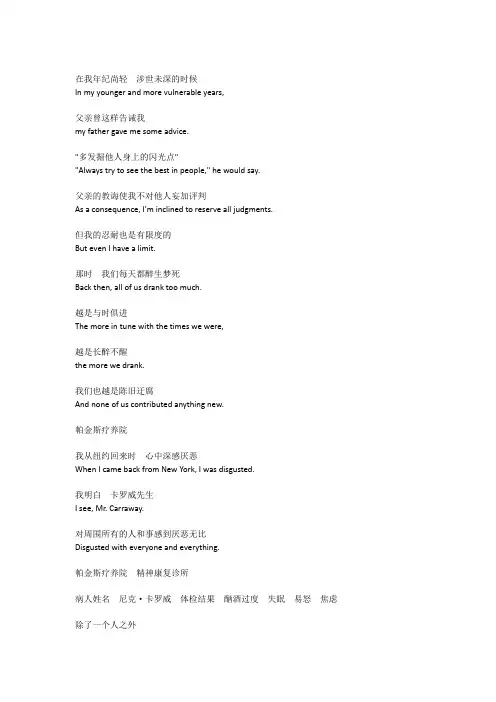
在我年纪尚轻 涉世未深的时候
In my younger and more vulnerable years,
父亲曾这样告诫我
my father gave me some advice.
"多发掘他人身上的闪光点"
"Always try to see the best in people," he would say.
父亲的教诲使我不对他人妄加评判
As a consequence, I'm inclined to reserve all judgments.
但我的忍耐也是有限度的
But even I have a limit.
那时 我们每天都醉生梦死
Back then, all of us drank too much.
越是与时俱进
The more in tune with the times we were,
越是长醉不醒
the more we drank.
我们也越是陈旧迂腐
And none of us contributed anything new.
帕金斯疗养院
我从纽约回来时 心中深感厌恶
When I came back from New York, I was disgusted.
我明白 卡罗威先生
I see, Mr. Carraway.
对周围所有的人和事感到厌恶无比
Disgusted with everyone and everything.
帕金斯疗养院 精神康复诊所
病人姓名 尼克·卡罗威 体检结果 酗酒过度 失眠 易怒 焦虑
除了一个人之外 Only one man was exempt from my disgust.
一个人
One man?
卡罗威先生
Mr. Carraway?
盖茨比
Gatsby.
医嘱 年月日 初次问诊 盖茨比
他是你的朋友吗
Was he a friend of yours?
他是我见过的最乐观的人