The Great Gatsby
- 格式:docx
- 大小:14.21 KB
- 文档页数:2
The Great Gatsby: A Tragedy of Affection
The Great Gatsby (Penguin Global; Stg edition,1925) was written by American
author F. Scott Fitzgerald. The story primarily concerns the young and mysterious
millionaire Jay Gatsby and his quixotic passion and obsession for the beautiful
former debutante Daisy Buchanan. Considered to be Fitzgerald's magnum opus,
The Great Gatsby explores themes of decadence, idealism, resistance to change,
social upheaval, and excess, creating a portrait of the Jazz Age or the Roaring
Twenties that has been described as a cautionary tale regarding the “American
Dream”.
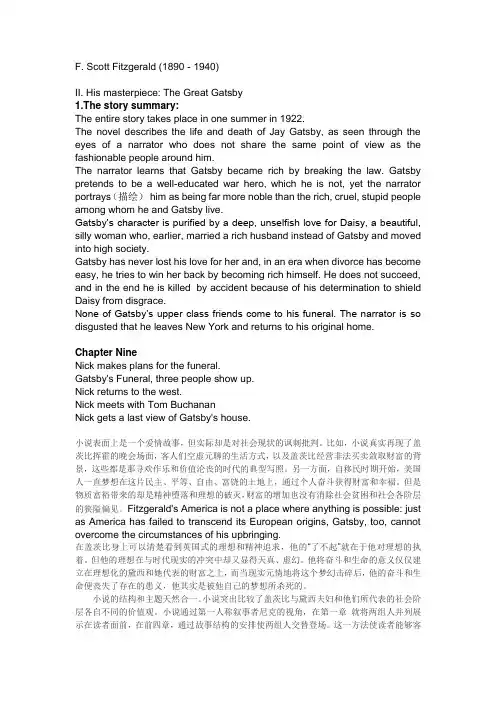
The Great Gatsby, in the form of the recollection of a bystander, Nick, tells
the story of Gatsby, a young man from the bottom of society, tried to become a
celebrity in order to pursue his beloved girl Daisy. But he was not accepted by the
upper society and his dream was finally shattered. While serving as a lieutenant in
an army training camp, he fell in love with Daisy, a southern heiress. However,
when he returned from overseas after the war with a military medal, Daisy had
married Tom Buchanan, a strong, rich but rude young man from Chicago. Gatsby,
who was obsessed with love and dreams, worked hard and became a millionaire
from a poor officer. He bought a luxury villa on the west end of Long Island, across
the bay from the Buchanan’s. His house was brightly lit every night, and throngs
of guests reveled in wine. His only wish is to see his lover Daisy. But Daisy had
already changed. Daisy driving run over dead husband's mistress, Tom impute Gatsby, Gatsby finally killed. She didn't even go to his funeral. Nick, the narrator,
sees through the cruelty and malice of the rich in the upper class and leaves New
York to return to his hometown in the Midwest.
Maybe for some readers, Gatsby is silly and unwise. He kept chasing after
money, just to win the heart of Daisy, an elegant and attractive but mammonish
and selfish lady. He sacrifices for her blindly, even by playing with his life. Sadly,
all he gains is just Daisy’s indifference. She is not touched by his death, but leave
the place with her husband as if nothing has happened. However, from my
perspective, just as the novel’s title says, Gatsby is truly great. He sees the essence
of Daisy worship money but still loves her, he is willing to take the blame for her,
sacrifices everything for her. His pure heart is more precious than money. He is a
firm belief in the dream pursuer, a dream pursuer who dares to pay. In that era
full of impetuous and money worship atmosphere, he is so different.
To conclude, the book can serve as a reminder for us to live a meaningful life,
open up a path to the dream with wisdom and faith in spite of the flashy secular.
Just as it says at the end of the story,” So we beat on, boats against the current,
borne back ceaselessly into the past” (185).