
会计学原理-约翰·J·怀尔德版-上海交通大学-03
- 格式:ppt
- 大小:1.64 MB
- 文档页数:44

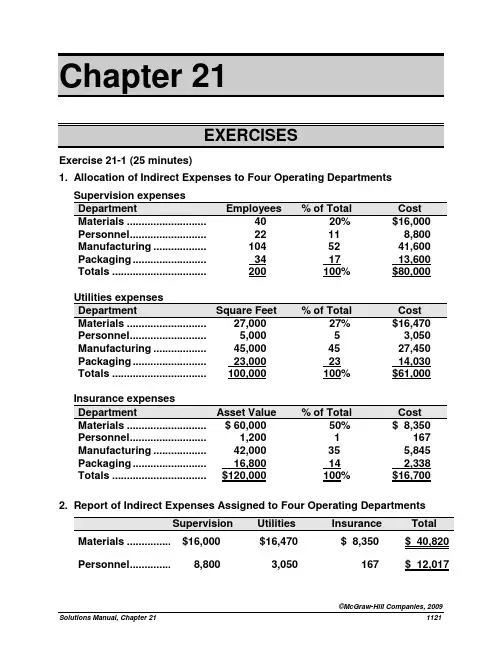
Chapter 21Exercise 21-1 (25 minutes)1. Allocation of Indirect Expenses to Four Operating DepartmentsPersonnel ..............................22 11 8,800 Manufacturing ......................104 52 41,600 Packaging ............................. 34 17 13,600 Totals ....................................200 100% $80,000Personnel ..............................5,000 5 3,050 Manufacturing ......................45,000 45 27,450 Packaging ............................. 23,000 23 14,030 Totals ....................................100,000 100% $61,000Personnel ..............................1,200 1 167 Manufacturing ......................42,000 35 5,845 Packaging ............................. 16,800 14 2,338 Totals ....................................$120,000 100% $16,700 2. Report of Indirect Expenses Assigned to Four Operating DepartmentsMaterials ...................$16,000 $16,470 $ 8,350 $ 40,820 Personnel ..................8,800 3,050 167 $ 12,017Manufacturing ..........41,600 27,450 5,845 $ 74,895 Packaging ................. 13,600 14,030 2,338 $ 29,968 Totals ........................$80,000 $61,000 $16,700 $157,700Exercise 21-2 (30 minutes)........................Depreciation ......................56,600 2,000 MH $28.30 per machine hour Line preparation ...............46,000250 setups $184.00 per setup1. Assignment of overhead costs to the two products using ABCMachinery depreciation ......... 500 hours $ 28.30 14,150 Line preparation ..................... 40 setups $184.00 7,360 Total overhead assigned ....... $23,340Machinery depreciation ......... 1,500 hours $ 28.3042,450 Line preparation ..................... 210 setups $184.00 38,640 Total overhead assigned ....... $84,660Direct labor .................................. 12,200 23,800 Overhead (using ABC) ................ 23,340 84,660 Total cost ..................................... $54,540 $151,660 Quantity produced ...................... 10,500 ft. 14,100 ft. Average cost per foot (ABC) ....... $5.19 $10.763. The average cost of rounded edge shelves declines and the average cost of squared edge shelves increases. Under the current allocation method, the rounded edge shelving was allocated 34% of all of the overhead cost ($12,200 direct labor/$36,000 total direct labor). However, it does not use 34% of all of the overhead resources. Specifically, it uses only 25% of machine hours (500 MH/2,000 MH), and 16% of the setups (40/250). Activity based costing allocated the individual overhead components in proportion to the resources used.Exercise 21-7 (15 minutes)(1) Items included in performance reportThe following items definitely should be included in the performance report for the auto service department manager because they are controlled or strongly influ enced by the manager’s decisions and activities:•Sales of parts•Sales of services•Cost of parts sold•Supplies•Wages (hourly)(2) Items excluded from performance reportThe following items definitely should be excluded from the performance report because the department manager cannot control or strongly influence them:•Building depreciation•Income taxes allocated to the department•Interest on long-term debt•Manager’s salary(3) Items that may or may not be included in performance reportThe following items cannot be definitely included or definitely excluded from the performance report because they may or may not be completely under the manager’s control or strong influence:•Payroll taxes Some portion of this expense relates to themanager’s salary and i s not controllable by themanager. The portion that relates to hourly wagesshould be treated as a controllable expense.•Utilities Whether this expense is controllable depends on thedesign of the auto dealership. If the auto servicedepartment is in a separate building or has separateutility meters, these expenses are subject to themanager’s control. Otherwise, the expense probablyis not controllable by the manager of the auto servicedepartment.Exercise 21-9 (20 minutes)(1)Electronics ...................$750,000 $3,750,000 20% Sporting Goods ...........800,000 5,000,000 16% Comment: Its Electronics division is the superior investment center on the basis of the investment center return on assets.Exercise 21-9 (continued)(2)Net income ...................$750,000 $800,000 Target net income$3,750,000 x 12% ...... 5,000,000 x 12% .......(450,000)(600,000)Residual income……. $300,000 $200,000Comment: Its Electronics division is the superior investment center on the basis of investment center residual income.(3) The Electronics division should accept the new opportunity, since it will generate residual income of 3% (15% - 12%) of the i nvestment’s invested assets.Exercise 21-10 (15 minutes)Electronics ...................$750,000 $10,000,000 7.50% Sporting Goods ...........800,000 8,000,000 10.0%Electronics ...................$10,000,000 $3,750,000 2.67 Sporting Goods ...........8,000,000 5,000,000 1.6 Comments: Its Sporting goods division generates the most net income per dollar of sales, as shown by its higher profit margin. The Electronics division however is more efficient at generating sales from invested assets, based on its higher investment turnover.Problem 21-1A (60 minutes)Part 1Average occupancy cost = $111,800 / 10,000 sq. ft. = $11.18 per sq. ft. Occupancy costs are assigned to the two departments as followsLanya’s Dept................. 1,000 $11.18 $11,180 Jimez’s Dept................. 1,700 $11.18 $19,006**A total of $30,186 ($11,180 + $19,006) in occupancy costs is charged to these departments. The company would follow a similar approach in allocating the remaining occupancy costs ($81,614, computed as $111,800 - $30,186) to its other departments (not shown in this problem).Part 2Market rates are used to allocate occupancy costs for depreciation, interest, and taxes. Heating, lighting, and maintenance costs are allocated to the departments on both floors at the average rate per square foot. These costs are separately assigned to each class as follows:Depreciation—Building .................$ 31,500 $31,500 Interest—Building mortgage .........47,000 47,000Taxes—Building and land .............14,000 14,000Gas (heating) expense ...................4,425 $ 4,425 Lighting expense ...........................5,250 5,250 Maintenance expense .................... 9,625 ______ 9,625 Total ................................................$111,800 $92,500 $19,300Value-based costs are allocated to departments in two stepsSecond floor ...................5,000 10 50,000Total market value .........$250,000Second floor ................... 50,000 20 18,500 3.70Totals ..............................$250,000 100% $92,500Usage-based costs allocation rate = $19,300 / 10,000 sq. ft.= $1.93 per sq. ft.We can then compute total allocation rates for the floors$16.73 Second floor ........................... 3.70 1.93 $ 5.63 These rates are applied to allocate occupancy costs to departmentsLanya’s Department......................... 1,000 $16.73 $16,730 Jimez’s Department......................... 1,700 5.63 $ 9,571Part 3A second-floor manager would prefer allocation based on market value. This is a reasonable and logical approach to allocation of occupancy costs. The current method assumes all square footage has equal value. This is not logical for this type of occupancy. It also means the second-floor space would be allocated a larger portion of costs under the current method, but less using an allocation based on market value.Part 1Professional salaries ..................$1,600,000 10,000 hours $160 per hour Patient services & supplies .......$ 27,000 600 patients $45 per patient Building cost ...............................$ 150,000 1,500 sq. ft. $100 per sq. ft. Total costs ...................................$1,777,000Part 2Allocation of cost to the surgical departments using ABCProfessional salaries ............. 2,500 hours $160 per hr. $400,000 Patient services & supplies ...... 400 patients $45 per patient 18,000 Building cost .......................... 600 sq. ft. $100 per sq. ft. 60,000 Total ...............................................................................................$478,000 Average cost per patient ...............................................................$ 1,195Professional salaries ............. 7,500 hours $160 per hr. $1,200,000 Patient services & supplies ...... 200 patients $45 per patient 9,000 Building cost .......................... 900 sq. ft. $100 per sq. ft 90,000 Total ................................................................................................$1,299,000 Average cost per patient ...............................................................$ 6,495[Note that the sum of the amounts allocated to General Surgery and Orthopedic Surgery ($478,000 + $1,299,000) equals the total amount of indirect costs ($1,777,000).] Part 3If all center costs were allocated on the number of patients, the average cost of general surgery would increase. Since general surgery sees 2/3 of all patients (400/600), it would get allocated 2/3 of all center costs. Orthopedic surgery is currently consuming more professional salaries and building space than general surgery, but has fewer patients.Problem 21-3A (70 minutes)Cost of goods sold ........................ 89,964 63,612 27,500 181,076 (2) Gross profit .................................... 93,636 38,988 22,500 155,124 Direct expensesSales salaries ............................... 21,000 7,100 8,500 36,600Advertising ................................... 2,100 700 1,100 3,900Store supplies used .................... 594 378 400 1,372 (3) Depreciation of equipment ......... 2,300 900 1,000 4,200Total direct expenses .................. 25,994 9,078 11,000 46,072 Allocated expensesRent expense ............................... 5,632 2,835 2,353 10,820 (4) Utilities expense .......................... 2,292 1,153 955 4,400 (4) Share of office dept. expenses ... 15,288 8,540 4,172 28,000 (5) Total allocated expenses ............ 23,212 12,528 7,480 43,220 Total expenses ............................... 49,206 21,606 18,480 89,292Net income ..................................... $ 44,430 $17,382 $ 4,020 $ 65,832 Supporting Computations—coded (1) through (5) in statement aboveGrowth rate (8% increase) ............... x 108% x 108%2010 sales ......................................... $183,600 $102,600 $ 50,000Growth rate (8% increase) ............... x 108% x 108% x 55%* 2010 cost of goods sold .................. $ 89,964 $ 63,612 $ 27,500 A LTERNATIVELY2009 cost of goods sold .................. $ 83,300 $ 58,9002009 sales ......................................... $170,000 $ 95,0002009 cost as % of sales ................... 49% 62%2010 sales ........................................ $183,600 $102,600 $ 50,000 2010 cost as % of sales .................. x 49% x 62% x 55%* 2010 cost of goods sold .................. $ 89,964 $ 63,612 $ 27,500 * T he 55% cost of goods sold percent is computed as 100% minus the predicted 45% gross profit margin.Growth rate (8% increase) ................x 108% x 108%2010 store supplies ..........................$ 594 $ 378 $ 400One-fifth from clock to paintings (1,408) $ 1,408 One-fourth from mirror topaintings ______ (945) 945 2010 allocation of $10,820 rent .........$ 5,632 $ 2,835 $ 2,353 Percent of total * ...............................2010 allocation of $4,400total utilities ....................................$ 2,292 $ 1,153 $ 955Percent of total sales * ......................54.6% 30.5% 14.9% 2010 allocation of $28,000total office departmentexpenses ($20,000 in 2009plus $8,000 increase) ......................$ 15,288 $ 8,540 $ 4,172 * Instructor note: If students round to something other than one-tenth of a percent, theirnumbers will slightly vary.Part 1a.Responsibility Accounting Performance ReportManager, Camper DepartmentFor the YearBudgeted Actual Over (Under)Amount Amount Budget Controllable CostsRaw materials .................................$195,900 $194,800 $ (1,100) Employee wages ............................104,200 107,200 3,000 Supplies used .................................34,000 32,900 (1,100) Depreciation—Equipment ............. 63,000 63,000 0 Totals ..............................................$397,100 $397,900 $ 800b.Responsibility Accounting Performance ReportManager, Trailer DepartmentFor the YearBudgeted Actual Over (Under)Amount Amount Budget Controllable CostsRaw materials .................................$276,200 $273,600 $ (2,600) Employee wages ............................205,200 208,000 2,800 Supplies used .................................92,200 91,300 (900) Depreciation—Equipment ............. 127,000 127,000 0 Totals ..............................................$700,600 $699,900 $ (700)c.Responsibility Accounting Performance ReportManager, Ohio PlantFor the YearBudgeted Actual Over (Under)Amount Amount Budget Controllable CostsDept. manager salaries ................. $ 97,000 $ 98,700 $ 1,700 Utilities ........................................... 8,800 9,200 400 Building rent .................................. 15,700 15,500 (200) Other office salaries ..................... 46,500 30,100 (16,400) Other office costs ......................... 22,000 21,000 (1,000) Camper department ...................... 397,100 397,900 800 Trailer department ........................ 700,600 699,900 (700) Total ............................................... $1,287,700 $1,272,300 $(15,400)Part 2The plant manager did a good job of controlling costs and meeting the budget. He came in under budget for the plant even though he paid the department managers more than budgeted and had to absorb the amounts over budget in their departments. This is because he spent less than the budget amount on building rent, other office salaries, and other office costs. The Trailer Department manager also came in under budget. The Camper Department manager came in over budget, and thus performed the worse of the three managers.Problem 21-1B (60 minutes)Part 1Average occupancy cost = $372,000 / 20,000 sq. ft. = $18.60 per sq. ft.Occu pancy costs are assigned to Miller’s department as followsMiller’s Dept.................. 2,000 $18.60 $37,200Part 2Market rates are used to allocate occupancy costs for the building rent. Lighting and cleaning costs are allocated to the departments on all three floors at the average rate per square foot. Costs assigned to each class are:Lighting expense ................... 20,000 $20,000 Cleaning expense .................. 32,000 _______ 32,000 Totals ...................................... $372,000 $320,000 $52,000Value-based costs are allocated in two steps(i) Compute market value of each floorSecond floor ...................7,500 24 180,000Basement floor ...............5,000 12 60,000Total market value .........$600,000Problem 21-1B (Continued)(ii) Allocate the $320,000 to each floor based on its percent of market valueSecond floor ...................180,000 30 96,000 12.80 Basement floor ............... 60,000 10 32,000 6.40$600,000 100% $320,000Usage-based costs allocation rate = $52,000 / 20,000 sq. ft.= $2.60 per sq. ft.Total allocation rates for the departments on all three floors areSecond floor .................12.80 2.60 15.40Basement floor ............. 6.40 2.60 9.00These rates are applied to alloc ate occupancy costs to Miller’s departmentMiller’s Department ................................2,000 $9.00 $18,000Part 3A basement manager would prefer the allocation based on market value. This is a reasonable and logical approach to allocation of occupancy costs. With a flat rate method, all square footage has equal value. This is not logical for this type of occupancy. Less cost would be allocated to the basement departments if the market value method were used.。

会计学原理Financial-Accounting-by-Rob ert-Libby第八版-第三章-答案Chapter 3Operating Decisions andthe Accounting SystemANSWERS TO QUESTIONS1. A typical business operating cycle for a manufacturer would be as follows:inventory is purchased, cash is paid to suppliers, the product is manufactured and sold on credit, and the cash is collected from the customer.2. The time period assumption means that the financial condition andperformance of a business can be reported periodically, usually every month, quarter, or year, even though the life of the business is much longer.3. Net Income = Revenues + Gains - Expenses - Losses.Each element is defined as follows:Revenues -- increases in assets or settlements of liabilities from ongoing operations.Gains -- increases in assets or settlements of liabilities from peripheral transactions.Expenses -- decreases in assets or increases in liabilities from ongoingoperations.Losses -- decreases in assets or increases in liabilities from peripheraltransactions.4. Both revenues and gains are inflows of net assets. However, revenuesoccur in the normal course of operations, whereas gains occur from transactions peripheral to the central activities of the company. An example is selling land at a price above cost (at a gain) for companies not in the business of selling land.Both expenses and losses are outflows of net assets. However, expenses occur in the normal course of operations, whereas losses occur from transactions peripheral to the central activities of the company. An example is a loss suffered from fire damage.5. Accrual accounting requires recording revenues when earned andrecording expenses when incurred, regardless of the timing of cash receipts or payments. Cash basis accounting is recording revenues when cash is received and expenses when cash is paid.Financial Accounting, 8/e 3-2 © 2014 by McGraw-Hill Global Education Holdings, LLC. This is proprietary material solely for authorized instructor use. Not authorized for sale or distribution in any manner. This document may not be copied, scanned, duplicated, forwarded, distributed, or posted on a website, in whole or part.Financial Accounting, 8/e3-3© 2014 by McGraw-Hill Global Education Holdings, LLC. This is proprietary material solely for authorized instructor use. Not authorized for sale or distribution in any manner. This document may not be copied, scanned, duplicated, forwarded, distributed, or posted on a website, in whole or part.6. The four criteria that must be met for revenue to be recognized under theaccrual basis of accounting are (1) delivery has occurred or services have been rendered, (2) there is persuasive evidence of an arrangement for customer payment, (3) the price is fixed or determinable, and (4) collection is reasonably assured.7. The expense matching principle requires that expenses be recorded whenincurred in earning revenue. For example, the cost of inventory sold during a period is recorded in the same period as the sale, not when the goods are produced and held for sale.8. Net income equals revenues minus expenses. Thus revenues increase netincome and expenses decrease net income. Because net income increases stockholders’ equity, revenues increase stockholders’ equity and expenses decrease it.9. Reve nues increase stockholders’ equity and expenses decreasestockholders’ equity. To increase stockholders’ equity, an account must be credited; to decrease stockholders’ equity, an account must be debited. Thus revenues are recorded as credits and expenses as debits. 10.11.12.13. Total net profit margin ratio is calculated as Net Income Net Sales (orOperating Revenues). The net profit margin ratio measures how much of every sales dollar is profit. An increasing ratio suggests that the company is managing its sales and expenses effectively.ANSWERS TO MULTIPLE CHOICE1. c2. a3. b4. b5. c6. c7. d8. b9. a10. bFinancial Accounting, 8/e 3-4 © 2014 by McGraw-Hill Global Education Holdings, LLC. This is proprietary material solely for authorized instructor use. Not authorized for sale or distribution in any manner. This document may not be copied, scanned, duplicated, forwarded, distributed, or posted on a website, in whole or part.Authors' Recommended Solution Time(Time in minutes)* Due to the nature of this project, it is very difficult to estimate the amount of time students will need to complete the assignment. As with any open-ended project, it is possible for students to devote a large amount of time to these assignments. While students often benefit from the extra effort, we find that some become frustrated by the perceived difficulty of the task. You can reduce student frustration and anxiety by making your expectations clear. For example, when our goal is to sharpen research skills, we devote class time discussing research strategies. When we want the students to focus on a real accounting issue, we offer suggestions about possible companies or industries.Financial Accounting, 8/e 3-5 © 2014 by McGraw-Hill Global Education Holdings, LLC. This is proprietary material solely for authorized instructor use. Not authorized for sale or distribution in any manner. This document may not be copied, scanned, duplicated, forwarded, distributed, or posted on a website, in whole or part.Financial Accounting, 8/e 3-6© 2014 by McGraw-Hill Global Education Holdings, LLC. This is proprietary material solely for authorized instructor use. Not authorized for sale or distribution in any manner. This document may not be copied, scanned, duplicated, forwarded, distributed, or posted on a website, in whole or part.MINI-EXERCISESM3–1.TERMG (1) LossesC (2) Expense matching principle F (3) RevenuesE (4) Time period assumption B(5) Operating cycleM3–2.Cash Basis Income StatementAccrual Basis Income StatementRevenues: Cash sales Customer deposits$8,000 5,000 Revenues: Sales to customers$18,000 Expenses:Inventory purchases Wages paid 1,000 900 Expenses: Cost of sales Wages expense Utilities expense 9,000 900 300Net Income$11,100Net Income $7,800Revenue Account Affected Amount of Revenue Earned in JulyM3–4.Expense Account Affected Amount of Expense Incurred in JulyFinancial Accounting, 8/e 3-7 © 2014 by McGraw-Hill Global Education Holdings, LLC. This is proprietary material solely for authorized instructor use. Not authorized for sale or distribution in any manner. This document may not be copied, scanned, duplicated, forwarded, distributed, or posted on a website, in whole or part.a. Cash (+A) ............................................................................ 15,000Games Revenue (+R, +SE) .......................................... 15,000 b. Cash (+A) ............................................................................ 3,000Accounts Receivable (+A) ................................................ 5,000 Sales Revenue (+R, +SE) ............................................. 8,000 c. Cash (+A) ............................................................................ 4,000Accounts Receivable (-A) ........................................... 4,000 d. Cash (+A) ............................................................................ 2,500Unearned Revenue (+L) ............................................... 2,500 M3–6.e. Cost of Goods Sold (+E, -SE)........................................... 6,800Inventory (-A) ............................................................... 6,800 f. Accounts Payable (–L) (800)Cash (-A) (800)g. Wages Expense (+E, -SE) ................................................. 3,500Cash (-A) ...................................................................... 3,500 h. Insurance Expense (+E, -SE) . (500)Prepaid Expenses (+A) ...................................................... 1,00 Cash (-A) ...................................................................... 1,500 i. Repairs Expense (+E, -SE) .. (700)Cash (-A) (700)j. Utilities Expense (+E, -SE) (900)Accounts Payable (+L) (900)Financial Accounting, 8/e 3-8 © 2014 by McGraw-Hill Global Education Holdings, LLC. This is proprietary material solely for authorized instructor use. Not authorized for sale or distribution in any manner. This document may not be copied, scanned, duplicated, forwarded, distributed, or posted on a website, in whole or part.Transaction (c) results in an increase in an asset (cash) and a decrease in an asset (accounts receivable). Therefore, there is no net effect on assets.M3–8.Transaction (h) results in an increase in an asset (prepaid expenses) and a decrease in an asset (cash). Therefore, the net effect on assets is 500.Financial Accounting, 8/e 3-9 © 2014 by McGraw-Hill Global Education Holdings, LLC. This is proprietary material solely for authorized instructor use. Not authorized for sale or distribution in any manner. This document may not be copied, scanned, duplicated, forwarded, distributed, or posted on a website, in whole or part.Craig’s Bowling, Inc.Income StatementFor the Month of July 2014Revenues:Games revenue $15,000Sales revenue 8,000Total revenues 23,000Expenses:Cost of goods sold 6,800Utilities expense 900Wages expense 3,500Insurance expense 500Repairs expense 700Total expenses 12,400Net income $ 10,600M3–10.Financial Accounting, 8/e 3-10 © 2014 by McGraw-Hill Global Education Holdings, LLC. This is proprietary material solely for authorized instructor use. Not authorized for sale or distribution in any manner. This document may not be copied, scanned, duplicated, forwarded, distributed, or posted on a website, in whole or part.M3–11.These results suggest that Jen’s Jewelry Company earned approximately $0.31 for every dollar of revenue in 2015, and over time, the ratio has improved. Jen’s has become more effective at managing sales and expenses.As additional analysis:Between 2013 to 2014 and 2014 to 2015, sales have increased at a lower percentage than net income. This suggests that the company has been more effective at controlling expenses than generating revenues.EXERCISESE3–1.TERMK (1) ExpensesE (2) GainsG (3) Revenue realization principleI (4) Cash basis accountingM (5) Unearned revenueC (6) Operating cycleD (7) Accrual basis accountingF (8) Prepaid expensesJ (9) Revenues - Expenses = Net IncomeL (10) Ending Retained Earnings =Beginning Retained Earnings + Net Income - Dividends DeclaredE3–2.Req. 1Cash Basis Income StatementAccrual Basis Income StatementRevenues:Cash sales Customer deposits $500,00070,000Revenues:Sales tocustomers$750,000Expenses:Inventory purchases Wages paidUtilities paid90,000180,30017,200Expenses:Cost of salesWages expenseUtilities expense485,000184,00019,130Net Income $282,500 Net Income $61,870Req. 2Accrual basis financial statements provide more useful information to external users. Financial statements created under cash basis accounting normally postpone (e.g., $250,000 credit sales) or accelerate (e.g., $70,000 customer deposits) recognition of revenues and expenses long before or after goods andservices are produced and delivered (until cash is received or paid). They also do not necessarily reflect all assets or liabilities of a company on a particular date.Activity Revenue AccountAmount of RevenueActivity Expense AccountAmount of ExpenseE3–5.Transaction (k) results in an increase in an asset (cash) and a decrease in an asset (accounts receivable). Therefore, there is no net effect on assets.* A loss affects net income negatively, as do expenses.E3–6.Transaction (f) results in an increase in an asset (property, plant, and equipment) and a decrease in an asset (cash). Therefore, there is no net effect on assets.E3–7.(in thousands)a. Plant and equipment (+A) (636)Cash ( A) (636)Debits equal credits. Assets increase and decrease by the same amount.b. Cash (+A) (181)Short-term notes payable (+L) (181)Debits equal credits. Assets and liabilities increase by the same amount.c. Cash (+A) ..........................................................................Accounts receivable (+A) ................................................ 10,765 28,558Service revenue (+R, +SE) ........................................ 39,323 Debits equal credits. Revenue increases retained earnings (part of stockholders' equity). Stockholders' equity and assets increase by the same amount.E3–7. (continued)d. Accounts payable (-L) ..................................................... 32,074Cash (-A) ................................................................... 32,074 Debits equal credits. Assets and liabilities decrease by the same amount.e. Inventory (+A) ................................................................... 32,305Accounts payable (+L) .............................................. 32,305 Debits equal credits. Assets and liabilities increase by the same amount.f. Wages expense (+E, -SE) ............................................... 3,500Cash (-A) ................................................................... 3,500 Debits equal credits. Expenses decrease retained earnings (part ofstockholders' equity). Stockholders' equity and assets decrease by thesame amount.g. Cash (+A) .......................................................................... 39,043Accounts receivable (-A) ....................................... 39,043 Debits equal credits. Assets increase and decrease by the same amount.h. Fuel expense (+E, -SE) (750)Cash (-A) (750)Debits equal credits. Expenses decrease retained earnings (part ofstockholders' equity). Stockholders' equity and assets decrease by thesame amount.i. Retained earnings (-SE) (597)Cash (-A) (597)Debits equal credits. Assets and stock holders’ equity decrease by thesame amount.j. Utilities expense (+E, -SE) (68)Cash (-A) ................................................................... Accounts payable (+L) .............................................. 55 13Debits equal credits. Expenses decrease retained earnings (part of stockholders' equity). Together, stockholders' equity and liabilities decrease by the same amount as assets.E3–8.Req. 1a.Cash (+A) ................................................................... 2,300,000Short-term note payable (+L) ........................ 2,300,000 Debits equal credits. Assets and liabilities increase by the same amount.b.Equipment (+A) ......................................................... 98,000Cash (-A) ........................................................ 98,000 Debits equal credits. Assets increase and decrease by the same amount.c.Merchandise inventory (+A) .................................... 35,000Accounts payable (+L) .................................. 35,000 Debits equal credits. Assets and liabilities increase by the same amount.d.Repairs (or maintenance) expense (+E, -SE) ......... 62,000Cash (-A) ........................................................ 62,000 Debits equal credits. Expenses decrease retained earnings (part ofstockholders' equity). Stockholders' equity and assets decrease by thesame amount.e.Cash (+A) ................................................................... 390,000Unearned pass revenue (+L) ......................... 390,000 Debits equal credits. Since the season passes are sold before Vail Resorts provides service, revenue is deferred until it is earned. Assets andliabilities increase by the same amount.f.Two transactions occur:(1) Accounts receivable (+A) (800)Ski shop sales revenue (+R, +SE) (800)Debits equal credits. Revenue increases retained earnings (a part ofstockholders' equity). Stockholders' equity and assets increase by thesame amount.(2) Cost of goods sold (+E, -SE) (500)Merchandise inventory (-A) (500)Debits equal credits. Expenses decrease retained earnings (a part ofstockholders' equity). Stockholders' equity and assets decrease by thesame amount.E3–8. (continued)g.Cash (+A) ................................................................... 320,000Lift revenue (+R, +SE) .................................... 320,000 Debits equal credits. Revenue increases retained earnings (a part ofstockholders' equity). Stockholders' equity and assets increase by thesame amount.h.Cash (+A) ................................................................... 3,500Unearned rent revenue (+L) .......................... 3,500 Debits equal credits. Since the rent is received before the townhouse isused, revenue is deferred until it is earned. Assets and liabilities increase by the same amount.i. Accounts payable (-L) ............................................. 17,500Cash (-A) ........................................................ 17,500 Debits equal credits. Assets and liabilities decrease by the same amount. j.Cash (+A) . (400)Accounts receivable (-A) (400)Debits equal credits. Assets increase and decrease by the same amount. k.Wages expense (+E, -SE) ........................................ 245,000Cash (-A) ........................................................ 245,000 Debits equal credits. Expenses decrease retained earnings (a part ofstockholders' equity). Stockholders' equity and assets decrease by thesame amount.Req. 22/1 Rent expense (+E, -SE) (275)Cash (-A) (275)2/2 Fuel expense (+E, -SE) (490)Accounts payable (+L) (490)2/4 Cash (+A) (820)Unearned revenue (+L) (820)2/7 Cash (+A) (910)Transport revenue (+R, +SE) (910)2/10 Advertising expense (+E, -SE) (175)Cash (-A) (175)2/14 Wages payable (-L) ......................................................... 2,300Cash (-A) ......................................................... 2,3002/18 Cash (+A) ..........................................................................Accounts receivable (+A) ................................................ 1,600 2,200Transport revenue (+R, +SE) ......................... 3,800 2/25 Parts supplies (+A) .......................................................... 2,550Accounts payable (+L) ................................... 2,550 2/27 Retained earnings (-SE) .. (200)Dividends payable (+L) (200)Req. 1 and 2Accounts Unearned Fee NoteAdditional Paid-inRebuilding Fees RentItem (f) is not a transaction; there has been no exchange.E3–10. (continued)Req. 3Net income using the accrual basis of accounting:Revenues $19,850 ($19,000 + $850)– Expenses 16,900 ($16,500 + $400)Net Income $ 2,950Assets = Liabilities + Stockholders’ Equity$12,090 $ 7,700 $ 1,70024,800 4,440 7,8202,460 48,500 9,36010,420 2,950 netincome7,40025,300$82,470 $60,640 $21,830Req. 4Net income using the cash basis of accounting:Cash receipts $27,650 (transactions a through d)–Cash disbursements 19,760 (transactions g, i, and k)Net Income $ 7,890Cash basis net income ($7,890) is higher than accrual basis net income ($2,950) because of the differences in the timing of recording revenues versus receipts and expenses versus disbursements between the two methods. The $7,800 higher amount in cash receipts over revenues includes cash received prior to being earned (from (b), $600) and cash received after being earned (in (d), $7,200). The $2,860 higher amount in cash disbursements over expenses includes cash paid after being incurred in the prior period (in (g), $2,300), plus cash paid for supplies to be used and expensed in the future (in (k), $960), less an expense incurred in January to be paid in February (in (e), $400).STACEY’S PIANO REBUILDING COMPANYIncome Statement (unadjusted)For the Month Ended January 31, 2014 Operating Revenues:Rebuilding fees revenue $ 19,000 Total operating revenues 19,000 Operating Expenses:Wages expense 16,500 Utilities expense 400 Total operating expenses 16,900 Operating Income 2,100 Other Item:Rent revenue 850 Net Income $ 2,950Req. 1 and 2Common Additional RetainedFood Sales Revenue Catering Sales RevenueE3–14.Req. 1TRAVELING GOURMET, INC.Income Statement (unadjusted)For the Month Ended March 31, 2014 Revenues:Food sales revenueCatering sales revenueTotal revenues Expenses:Supplies expenseUtilities expenseWages expenseFuel expenseTotal costs and expenses $ 11,9004,20016,10010,8304206,28036317,893Net Loss $ (1,793) Req. 2Transaction O, I, or F Activity (or No Effect) on Statement ofDirection and AmountReq. 3The company generated a small loss of 1,793 during its first month of operations, before making any adjusting entries. The adjusting entries for use of the building and equipment and interest expense on the borrowing will increase the loss. Cash flows from operating activities were also negative at $2,973 (= + 11,900 + 2,600 –10,830 –363 –6,280) . So far the company does not appear to be successful, but it is only in its first month of operating a retail store. If sales can be increased without inflating fixed costs (particularly salaries expense), the company may soon turn a profit. It is not unusual for small businesses to report a loss or have negative cash flows from operations as they start up operations.E3–15.Req. 1Transaction Brief Explanationa Issued 10,000 shares of common stock to shareholders for $82,000cash.b Purchased store fixtures for $15,400 cash.c Purchased $24,800 of inventory, paying $6,200 cash and thebalance on account.d Sold $14,000 of goods or services to customers, receiving $9,820cash and the balance on account. The cost of the goods sold was$7,000.e Used $1,480 of utilities during the month, not yet paid.f Paid $1,300 in wages to employees.g Paid $2,480 in cash for rent, $620 related to the current month and$1,860 related to future months.h Received $3,960 cash from customers, $1,450 related to currentsales and $2,510 related to goods or services to be provided in thefuture.Req. 2Kate’s Kite CompanyIncome StatementFor the Month Ended April 30, 2014Sales Revenue Expenses:Cost of salesWages expenseRent expenseUtilities expenseTotal expenses $ 15,4507,0001,3006201,48010,400Net Income $ 5,050Kate’s Kite CompanyBalance SheetAt April 30, 2014Assets Liabilities and Shareholders’ Equity Current Assets: Current Liabilities:Cash $70,400 Accounts payable $20,080 Accounts receivable 4,180 Unearned revenue 2,510 Inventory 17,800 Total current liabilities 22,590 Prepaid expenses 1,860 Shareholders’ Equity:Total current assets 94,240 Common stock 10,000 Store fixtures 15,400 Additional paid-in capital 72,000Retained earnings 5,050Total shareholders’equity87,050Total Assets $109,640 Total Liabilities &Shareholders’ Equity$109,640E3–16.Req. 1Assets = Liabilities + Stockholders’ Equity $ 3,200 $ 2,400 $ 800 8,000 5,600 4,0006,400 1,600 3,200 $17,600 $9,600 $ 8,000Req. 2Accounts Long-TermAccounts Unearned Long-TermAdditionalConsulting Fee InvestmentRent ExpenseE3–16. (continued)Req. 3Revenues $58,400 ($58,000 from sales + $400 on investments)– Expenses 56,400 ($36,000 + $12,000 + $800 + $7,600)Net Income $ 2,000Assets = Liabilities + Stockholders’ Equity$ 1,120 $ 1,600 $ 80012,400 7,200 4,0006,400 1,600 2,7202,000 net income $19,920 $10,400 $ 9,520 Req. 4Net Profit Margin = Net Income = $2,000 = 0.0345Ratio Sales (Operating) Revenues $58,000* or 3.45% * The $400 of investment income is not an operating revenue and is not included in the computation.The increasing trend in the net profit margin ratio (from 2.5% in 2013 to 2.9% in 2014 and then to 3.45% in 2015) suggests that the company is managing its sales and expenses more effectively over time.E3–17.Req. 1Accounts receivable increases with customer sales on account and decreases with cash payments received from customers.Prepaid expenses increase with cash payments of expenses related to future periods and decrease as these expenses are incurred over time.Unearned subscriptions increase with cash payments received from customers for goods or services to be provided in the future and decreases when those goods or services are provided.Req. 2Trade Accounts ReceivablePrepaidExpensesUnearnedSubscriptionsComputations:Beginning + “+”-“-”= EndingTrade accounts receivable 717 + 5,240 -??==6935,264Prepaid expenses 95 + 203 -??==107191Unearned subscriptions 224 + 2,690 -??==2312,683E3–18.ITEM LOCATION1. Description of a company’sprimary business(es). Letter to shareholders;Management’s Discussion and Analysis; Summary of significant accounting policies note2. Income taxes paid. Notes; Statement of cash flows3. Accounts receivable. Balance sheet4. Cash flow from operatingactivities.Statement of cash flows5. Description of a company’srevenue recognition policy. Summary of significant accounting policies note6. The inventory sold during theyear.Income statement (Cost of Goods Sold)7. The data needed to compute thenet profit margin ratio.Income statementPROBLEMSP3-1.Transactions Debit Credita. Example: Purchased equipment for use in the business;5 1, 8paid one-third cash and signed a note payable for thebalance.b. Paid cash for salaries and wages earned by employees thisperiod.15 1 c. Paid cash on accounts payable for expensesincurred last period.7 1d. Purchased supplies to be used later; paid cash. 3 1e. Performed services this period on credit. 2 14f. Collected cash on accounts receivable for servicesperformed last period. 1 2g. Issued stock to new investors. 1 11, 12h. Paid operating expenses incurred this period.15 1i. Incurred operating expenses this period to be paidnext period.15 7 j. Purchased a patent (an intangible asset); paid cash. 6 1 k. Collected cash for services performed this period. 1 14 l. Used some of the supplies on hand for operations.15 3 m. Paid three-fourths of the income tax expense for the year;the balance will be paid next year.16 1, 10 n. Made a payment on the equipment note in (a); the paymentwas part principal and part interest expense.8, 17 1 o. On the last day of the current period, paid cash for aninsurance policy covering the next two years. 4 1a. Cash (+A) ........................................................................... 40,000Common stock (+SE) (20)Additional paid-in capital (+SE) ................................ 39,980 b. Cash (+A) ........................................................................... 60,000Note payable (long-term) (+L) ..................................... 60,000 c. Rent expense (+E, -SE) .................................................... 1,500Prepaid rent (+A) ............................................................... 1,500 Cash (-A) ...................................................................... 3,000 d. Prepaid insurance (+A) ..................................................... 2,400Cash (-A) ..................................................................... 2,400 e. Furniture and fixtures (or Equipment) (+A) ..................... 15,000Accounts payable (+L) ............................................... 12,000Cash (-A) ..................................................................... 3,000 f. Inventory (+A) .................................................................... 2,800Cash (-A) ..................................................................... 2,800 g. Advertising expense (+E, -SE) .. (350)Cash (-A) (350)h. Cash (+A) (850)Accounts receivable (+A) (850)Sales revenue (+R, +SE) ............................................ 1,700 Cost of goods sold (+E, -SE) . (900)Inventory (-A) (900)i. Accounts payable (-L) ...................................................... 12,000Cash (-A) ..................................................................... 12,000 j. Cash (+A) (210)Accounts receivable (-A) (210)。

约翰怀尔德会计学原理全文共四篇示例,供读者参考第一篇示例:约翰怀尔德(John Wild)是一位著名的会计学家,他对会计学原理的研究和贡献被广泛认可。
他在他的著作中系统地探讨了会计学的基本原理和理论,帮助人们更好地理解和应用会计学知识。
会计学原理是会计学的基础,是会计科学的根本。
约翰怀尔德在他的著作中详细阐述了会计学原理的重要性,并提出了许多深刻的见解。
他指出,会计学原理是指导会计学实践的准则和规则,其作用是维护会计学的准确性、可靠性和公正性。
在他的著作中,约翰怀尔德强调了会计学原理在企业经营管理中的重要性。
他认为,只有建立在正确的会计学原理基础之上的会计信息才能为企业决策提供准确的参考。
他还指出,遵循正确的会计学原理可以帮助企业提高内部管理效率,加强企业的风险控制能力,提高企业的经营绩效。
约翰怀尔德的著作对会计学原理的研究和理解做出了重要贡献。
他的思想为会计学界和企业管理者提供了宝贵的启示,对促进会计学的发展和提升会计学的实践水平具有重要意义。
希望更多的人可以关注会计学原理的研究,深入理解和应用约翰怀尔德等会计学家的研究成果,为企业的可持续发展和社会的进步做出更大的贡献。
第二篇示例:约翰·怀尔德是一位著名的会计学家,他对会计学原理的研究和贡献被誉为经济学领域的里程碑之一。
怀尔德的研究不仅深刻地影响了当代会计学的发展,也为未来的学者们提供了重要的启示。
本文将对怀尔德的会计学原理进行介绍和分析。
怀尔德认为,会计学原理是会计学的基础,是会计学家应该遵循的核心准则。
在怀尔德看来,会计学原理主要包括:货币计量、持续经营、历史成本、收入确认、费用匹配等几个方面。
这些原则不仅是会计师在日常工作中的行为准则,也是保障会计信息质量和经济运作有序的重要基础。
货币计量原则是指所有的财务信息应该用货币单位进行衡量和记录。
怀尔德认为,货币单位是衡量财务状况和经营业绩的唯一标准,只有将所有的资产、负债、收入和支出都转化为货币单位,才能使这些信息具有可比性和可信度。