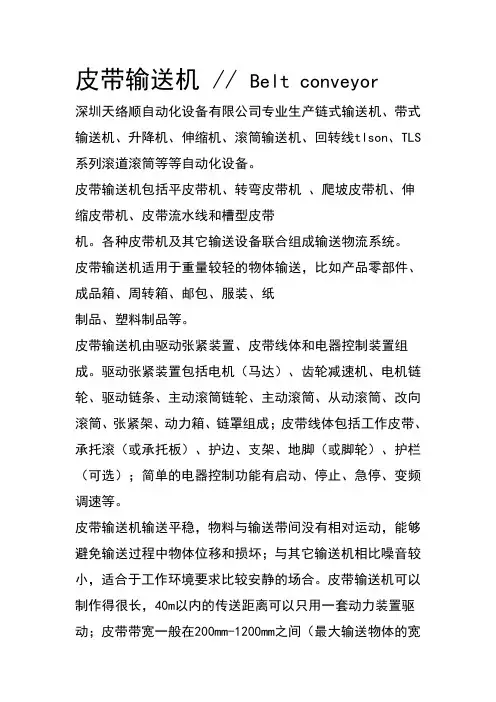
conveyor belt
- 格式:pdf
- 大小:503.83 KB
- 文档页数:4
Conveyor beltPoint of contact between a power transmission belt and its pulley. A conveyor belt uses a wide belt and pulleys and is supported by rollers or aflat pan along its path.These conveyor structures contain belts for moving bulk sulfur from railcars to storage pilesand from the piles to ships.A conveyor belt (or belt conveyor ) consists of two or more pulleys,with a continuous loop of material - the conveyor belt - that rotatesabout them. One or both of the pulleys are powered, moving the beltand the material on the belt forward. The powered pulley is called thedrive pulley while the unpowered pulley is called the idler. There aretwo main industrial classes of belt conveyors; Those in generalmaterial handling such as those moving boxes along inside a factoryand bulk material handling such as those used to transport industrialand agricultural materials, such as grain, coal, ores, etc. generally inoutdoor locations. Generally companies providing general materialhandling type belt conveyors do not provide the conveyors for bulkmaterial handling. In addition there are a number of commercialapplications of belt conveyors such as those in grocery stores.The belt consists of one or more layers of material they can be madeout of rubber. Many belts in general material handling have two layers.An under layer of material to provide linear strength and shape called acarcass and an over layer called the cover. The carcass is often a cottonor plastic web or mesh. The cover is often various rubber or plasticcompounds specified by use of the belt. Covers can be made frommore exotic materials for unusual applications such as silicone for heator gum rubber when traction is essential.Material flowing over the belt may be weighed in transit using abeltweigher. Belts with regularly spaced partitions, known as elevatorbelts , are used for transporting loose materials up steep inclines. Belt Conveyors are used in self-unloading bulk freighters and in live bottom trucks. Conveyor technology is also used in conveyor transport such as moving sidewalks or escalators, as well as on many manufacturing assembly lines. Stores often have conveyor belts at the check-out counter to move shopping items. Ski areas also use conveyor belts to transport skiers up the hill.A wide variety of related conveying machines are available, different as regards principle of operation, means and direction of conveyance, including screw conveyors, vibrating conveyors, pneumatic conveyors, the moving floor system, which uses reciprocating slats to move cargo, and roller conveyor system, which uses a series of powered rollers to convey boxes or pallets.Belt conveyor systemsConveyors are used as components in automated distribution and warehousing. In combination with computer controlled pallet handling equipment this allows for more efficient retail, wholesale, and manufacturing distribution.It is considered a labor saving system that allows large volumes to move rapidly through a process, allowing companies to ship or receive higher volumes with smaller storage space and with less labor expense.Rubber conveyor belts are commonly used to convey items with irregular bottom surfaces, small items that would fall in between rollers (e.g. a sushi conveyor bar), or bags of product that would sag between rollers. Belt conveyors are generally fairly similar in construction consisting of a metal frame with rollers at either end of a flat metal bed. The belt is looped around each of the rollers and when one of the rollers is powered (by an electrical motor) the belting slides across the solid metal frame bed, moving the product. In heavy use applications the beds which thebelting is pulled over are replaced with rollers. The rollers allow weight to be conveyed as they reduce the amount of friction generated from the heavier loading on the belting. Belt conveyors can now be manufactured with curved sections which use tapered rollers and curved belting to convey products around a corner. These conveyor systems are commonly used in postal sorting offices and airport baggage handling systems.Belt conveyors are the most commonly used powered conveyors because they are the most versatile and the least expensive. Product is conveyed directly on the belt so both regular and irregular shaped objects, large or small, light and heavy, can be transported successfully. These conveyors should use only the highest quality premium belting products, which reduces belt stretch and results in less maintenance for tension adjustments. Belt conveyors can be used to transport product in a straight line or through changes in elevation or direction. In certain applications they can also be used for static accumulation or cartons.Belt Conveyor systems at a Packing Depot Baggage Handling Belt Conveyor systemsSnake sandwich belt conveyorA sandwich belt conveyor uses two conveyor belts, face-to-face, to gently but firmly contain the product being carried, hence making steep incline and even vertical-lift runs easily achievable. The Snake Sandwich Belt Conveyor was created in 1979. The study was conceived by Joseph A. Dos Santos, P.E., President of Dos Santos International, with the help of a grant from the U.S. Bureau of Mines. The study was to develop a means of moving and elevating large quantities of bulk materials, including coarse products such as rocks, aggregate, coal, etc. at the steepest possible inclines. The intent was to use only existing and generally available hardware in order to achieve the most economically feasible and easily maintained steep-angle conveyor design. Snake Conveyors are available in widely ranging profiles of C and S Shape. In any case, a long bottom belt approach is possible to the sandwich entrance, and discharge may be on the high incline or may be after the extension of the carrying belt beyond the mouth of the sandwich.Snake Sandwich conveyors offer several advantages. First unlimited conveying capacity, a system suitable for the most rugged mine applications and gentle on sensitive and friable materials, high availability and low operating and maintenance costs, smooth surfaced belts allowing continuous belt cleaning by scrapers and plows. This also facilitates intermediate material discharge by belt plows, as appropriate, before and/or beyond the sandwiched part of the Snake profile. All conventional conveyor hardware ensures economy and fast delivery of replacement parts.Long belt conveyorsThe longest belt conveyor system in the world is in Western Sahara. It is 100 km long, from the phosphate mines of Bu Craa to the coast south of El-Aaiun.The longest conveyor system in an Airport is the Dubai International Airport baggage handling system at 92km. It was installed by Siemens and commissioned in 2008, and has a combination of traditional belt conveyors and tray conveyors.The longest single belt conveyor runs from Meghalaya in India to Sylhet in Bangladesh. It is about 17 km long and conveys limestone and shale at 960 tons/hr, from the quarry in India to a cement factory in Bangladesh (7 km long in India and 10 km long in Bangladesh). The conveyor was engineered by AUMUND France and Larsen & Toubro. The conveyor is actuated by 3 synchronized drive units for a total power of about 1.8 MW (2 drives at the head end in Bangladesh and 1 drive at the tail end in India). The conveyor belt was manufactured in 300-meter lengths on the Indian side and 500-meter lengths on the Bangladesh side, and was installed onsite by NILOS India. The idlers, or rollers, of the system are unique in that they are designed to accommodate both horizontal and vertical curves along the terrain. Dedicated vehicles were designed for the maintenance of the conveyor, which is always at a minimum height of 5 meters above the ground to avoid being flooded during monsoon periods.HistoryPrimitive conveyor belts were used since 19th century. In 1901, Sandvik invented and started the production of the Steel Conveyor belts. In 1905 Richard Sutcliffe invented the first conveyor belts for use in coal mines which revolutionized the mining industry. In 1913, Henry Ford introduced conveyor-belt assembly lines at Ford Motor Company's Rouge factory, in Dearborn Michigan. In 1972, the French society REI created in New Caledonia the then longest straight-belt conveyor in the world, at a length of 13.8 km. Hyacynthe Marcel Bocchetti was the concept designer.Popular cultureMany video games feature conveyor belts, such as Donkey Kong (1981) and Half-Life (1998).The Gladiators 1990s TV series featured The Travelator, a moving walkway (a type of conveyor belt) in its obstacle course. A 2008 MythBusters episode "Airplane on a Conveyor Belt" featured a conveyor belt regarding the myth that a plane cannot take off while sitting on a conveyor belt moving in the opposite direction.See also•Chain conveyor•Checkweigher•Conveyor systems•Lineshaft roller conveyor•Moving walkway•Thermohaline circulation•TreadmillArticle Sources and Contributors4Article Sources and ContributorsConveyor belt Source: /w/index.php?oldid=369691835 Contributors: -Majestic-, 119, 1redrun, 4bcomponents, Akaykr01, Alansohn, Alexius08, Amatulic,AndrewDressel, Andy Johnston, Anthonyverre, ArmadilloFromHell, Arre, Aslonline, Autoload, Bensin, Beuren, Black Kite, BlueFlex, Bongwarrior, Borgx, Brian0918, C.lettinga, CONFIQ,Cacycle, CanadianGuy, Catsbarracuda, Chairman S., ChemGardener, Chris moden, Crohnie, Dailone, Dantadd, DavidLevinson, Dbenbenn, Discospinster, DonSiano, Doodle77, Dughoo,Dwayne, EEPROM Eagle, Eekerz, Eequor, Elemesh, Eric outdoors, Erik9, Flexlink-marketing, FreplySpang, Fuzheado, Gaius Cornelius, Gareth Owen, Gogo Dodo, Gum, Haon 2.0, Harlem675, Harryboyles, Heron, Hmilgram, Hooperbloob, ImkeElisa, Intgr, Inwind, Iridescent, , JHunterJ, Japanese Searobin, JzG, Karlseidel, Kolossos, Krgiri, Lchrzan, Leonard G., Levkovd,Lloydd, Lord RTL, Loxinabox, Lucacasa2005, Mac, MatthewBurton, Mav, Mengfeish, Miwanya, Mmxx, Mtelewicz, Mulherndesign, Mydogategodshat, Natl1, Nick4gwen, NigelR, NipponBill, Nvrajesh, OptimusPrimal, Osarius, Otto Normalverbraucher, Ouro, Patrick, Phoenix2, Prabhaswin, Przepla, RG2, Rackdesign, Reedy, Reggio71, Requestion, Rmhermen, Ronz, Rossami,Roux-HG, Santanew, Saotres, ScottCEI, Silvonen, SiobhanHansa, Smithfarm, Squink, Srihariprasad, Srpsunil, Sterner2, T1980, TGWmechanics, Tabletop, Tangotango, Tassedethe, Thrill Fodea, Tinton5, Tommy2010, Toohool, Triplesdynamics, Veinor, Vivekbjmc, Vsmith, Webxsposure, Weregerbil, WikiMHEDA, Wittkowsky, Wknight94, Zetawoof, Zs, 173 anonymous editsImage Sources, Licenses and ContributorsImage:power transmission belt.gif Source: /w/index.php?title=File:Power_transmission_belt.gif License: Public Domain Contributors: User Brian0918 on en.wikipedia Image:AlbertaSulfurAtVancouverBC.jpg Source: /w/index.php?title=File:AlbertaSulfurAtVancouverBC.jpg License: unknown Contributors: Leonard G.Image:Belt-conveyor-handling.jpg Source: /w/index.php?title=File:Belt-conveyor-handling.jpg License: Public Domain Contributors: Chris modenImage:Belt-conveyor-handling2.jpg Source: /w/index.php?title=File:Belt-conveyor-handling2.jpg License: Public Domain Contributors: Chris modenLicenseCreative Commons Attribution-Share Alike 3.0 Unported/licenses/by-sa/3.0/。