Incoterms-2010-国际贸易术语中英文对照解释(全)
- 格式:doc
- 大小:550.51 KB
- 文档页数:88
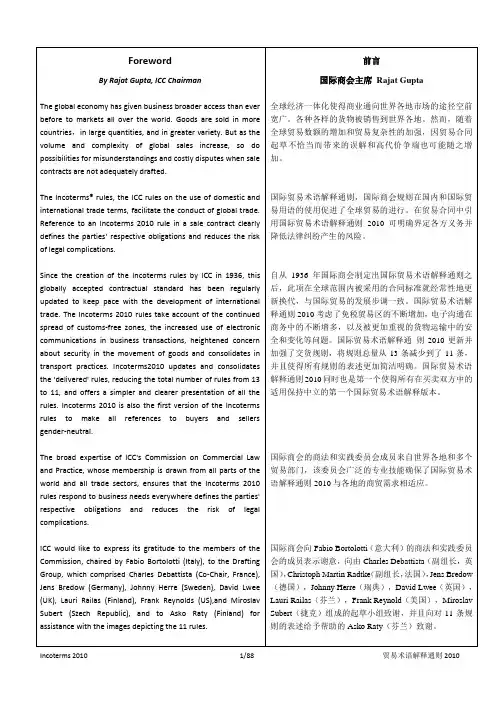
Incoterms 2010 1/88 贸易术语解释通则2010 Foreword
By Rajat Gupta, ICC Chairman
The global economy has given business broader access than ever
before to markets all over the world. Goods are sold in more
countries,in large quantities, and in greater variety. But as the
volume and complexity of global sales increase, so do
possibilities for misunderstandings and costly disputes when sale
contracts are not adequately drafted.
The Incoterms® rules, the ICC rules on the use of domestic and
international trade terms, facilitate the conduct of global trade.
Reference to an Incoterms 2010 rule in a sale contract clearly
defines the parties' respective obligations and reduces the risk
of legal complications.
Since the creation of the Incoterms rules by ICC in 1936, this
globally accepted contractual standard has been regularly
updated to keep pace with the development of international
trade. The Incoterms 2010 rules take account of the continued
spread of customs-free zones, the increased use of electronic
communications in business transactions, heightened concern
about security in the movement of goods and consolidates in
transport practices. Incoterms2010 updates and consolidates
the 'delivered' rules, reducing the total number of rules from 13
to 11, and offers a simpler and clearer presentation of all the
rules. Incoterms 2010 is also the first version of the Incoterms
rules to make all references to buyers and sellers
gender-neutral.
The broad expertise of ICC's Commission on Commercial Law
and Practice, whose membership is drawn from all parts of the
world and all trade sectors, ensures that the Incoterms 2010
rules respond to business needs everywhere defines the parties'
respective obligations and reduces the risk of legal
complications.
ICC would like to express its gratitude to the members of the
Commission, chaired by Fabio Bortolotti (Italy), to the Drafting
Group, which comprised Charles Debattista (Co-Chair, France),
Jens Bredow (Germany), Johnny Herre (Sweden), David Lwee
(UK), Lauri Railas (Finland), Frank Reynolds (US),and Miroslav
Subert (Szech Republic), and to Asko Raty (Finland) for
assistance with the images depicting the 11 rules. 前言
国际商会主席 Rajat Gupta
全球经济一体化使得商业通向世界各地市场的途径空前宽广。各种各样的货物被销售到世界各地。然而,随着全球贸易数额的增加和贸易复杂性的加强,因贸易合同起草不恰当而带来的误解和高代价争端也可能随之增加。
国际贸易术语解释通则,国际商会规则在国内和国际贸易用语的使用促进了全球贸易的进行。在贸易合同中引用国际贸易术语解释通则 2010 可明确界定各方义务并降低法律纠纷产生的风险。
自从1936年国际商会制定出国际贸易术语解释通则之后,此项在全球范围内被采用的合同标准就经常性地更新换代,与国际贸易的发展步调一致。国际贸易术语解释通则2010考虑了免税贸易区的不断增加,电子沟通在商务中的不断增多,以及被更加重视的货物运输中的安全和变化等问题。国际贸易术语解释通 则2010更新并加强了交货规则,将规则总量从13条减少到了11条,并且使得所有规则的表述更加简洁明确。国际贸易术语解释通则2010同时也是第一个使得所有在买卖双方中的适用保持中立的第一个国际贸易术语解释版本。
国际商会的商法和实践委员会成员来自世界各地和多个贸易部门,该委员会广泛的专业技能确保了国际贸易术语解释通则2010与各地的商贸需求相适应。
国际商会向Fabio Bortolotti(意大利)的商法和实践委员会的成员表示谢意,向由Charles Debattista(副组长,英国),Christoph Martin Radtke(副组长,法国),Jens Bredow
(德国),Johnny Herre(瑞典),David Lwee(英国),Lauri Railas(芬兰),Frank Reynold(美国),Miroslav
Subert(捷克)组成的起草小组致谢,并且向对11条规则的表述给予帮助的Asko Raty(芬兰)致谢。
Incoterms 2010 2/88 贸易术语解释通则2010
INTRODUCTION
The Incoterms® rules explain a set of three-letter trade terms
reflecting business-to-business practice in contracts for the sale
of goods. The Incoterms® rules describe mainly the tasks, costs
and risks involved in the delivery of goods from sellers to buyers.
How to use the Incoterms® 2010 rules
1. Incorporate the Incoterms® 2010 rules into your contract of
sale
If you want the Incoterms® 2010 rules to apply to your contract,
you should make this clear in the contract, through such words
as, “[the chosen Incoterms rule including the named place,
followed by] Incoterms® 2010”.
2. Choose the appropriate Incoterms rule
The chosen Incoterms rule needs to be appropriate to the
goods, to the means of their transport, and above all to whether
the parties intend to put additional obligations, for example
such as the obligation to organize carriage or insurance, on the
seller or on the buyer. The Guidance Note to each Incoterms
rule contains information that is particularly helpful when
making this choice. Whichever Incoterms rule is chosen, the
parties should be aware the interpretation of their contract may
well be influenced by customs particular to the port or place
being used.
3. Specify your place or port as precisely as possible
The chosen Incoterms rule can work only if the parties name a
place or port, and will work best if the parties specify the place
or port as precisely as possible.
A good example of such precision would be::
“FCA 38 Cours Albert 1er, Paris, France Incoterms 2010”.
Under the Incoterms rule
Ex Works(EXW),
Free Carrier(FCA),
Delivered at Terminal(DAT),
Delivered at Place(DAP),
Delivered Duty Paid(DDP),
Free Alongside Ship(FAS),
and Free on Board(FOB),
the named place is the place where delivery takes place and
where risk passes from the seller to the buyer.